







.webp)

















Marketing and GTM teams have spent the last two years experimenting with AI. Most of them have nothing to show for it. A few ChatGPT prompts saved to a shared doc, a Zapier workflow that broke after two weeks, maybe a pilot project that never left someone's laptop. The tools exist. The problem is implementation.
That's exactly where an AI implementation agency for marketing earns its value. Not by recommending tools or building strategy decks, but by deploying production-grade AI systems inside your go-to-market operations — content engines, lead pipelines, competitive intelligence agents, RevOps automation — and getting them running in weeks instead of quarters.
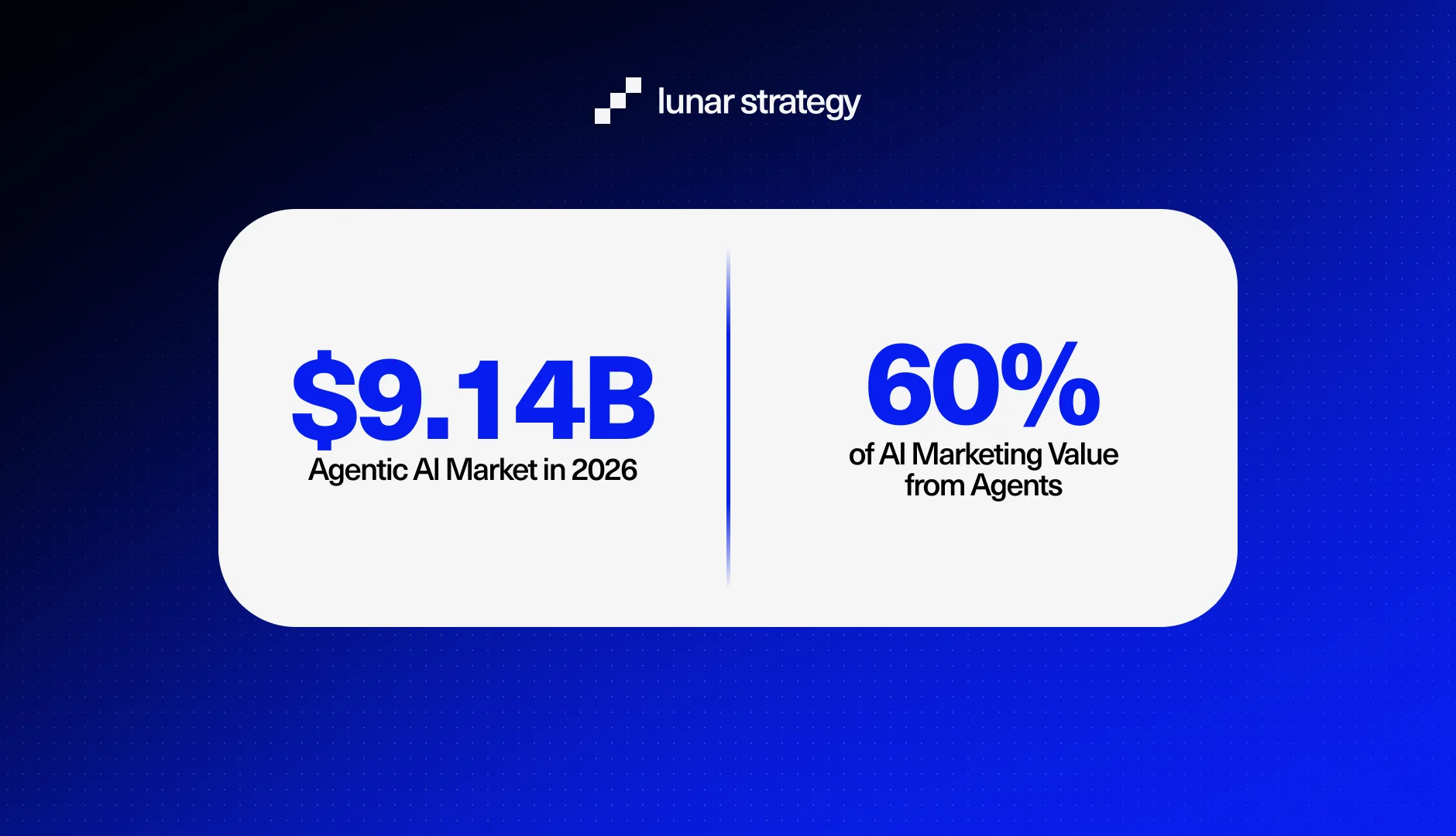
The agentic AI market is projected to reach $9.14 billion in 2026, and a disproportionate share of that growth is flowing into marketing and sales use cases. McKinsey estimates that agentic AI will drive more than 60 percent of the increased value AI generates from marketing and sales deployments. The agencies that matter in this space aren't selling AI as a feature — they're building AI as infrastructure for how GTM teams operate.
This guide ranks the seven best AI implementation agencies for marketing and GTM teams in 2026. The ranking criteria: depth of marketing-native AI implementation, speed from kickoff to production systems, and documented client outcomes. Whether you're running a SaaS growth team, a marketing department that needs to scale without headcount, or a revenue org looking to wire AI into every stage of your funnel — this list is built for practitioners, not browsers.
Table of Contents
- Quick Comparison Table
- Espressio AI
- GetDevDone™
- Workflows.io
- Axe Automation
- GrowthSpree
- Growthcurve
- Waking Digital
- What to Look for When Choosing an AI Implementation Agency
- How AI Implementation Is Changing Marketing Operations in 2026
- Frequently Asked Questions
Quick Comparison Table
1. Espressio AI
Best for: Growth, marketing, and BD teams that need AI infrastructure — not tools, not advice, but production systems running inside their operations within weeks.
Headquarters: Global (remote-first)
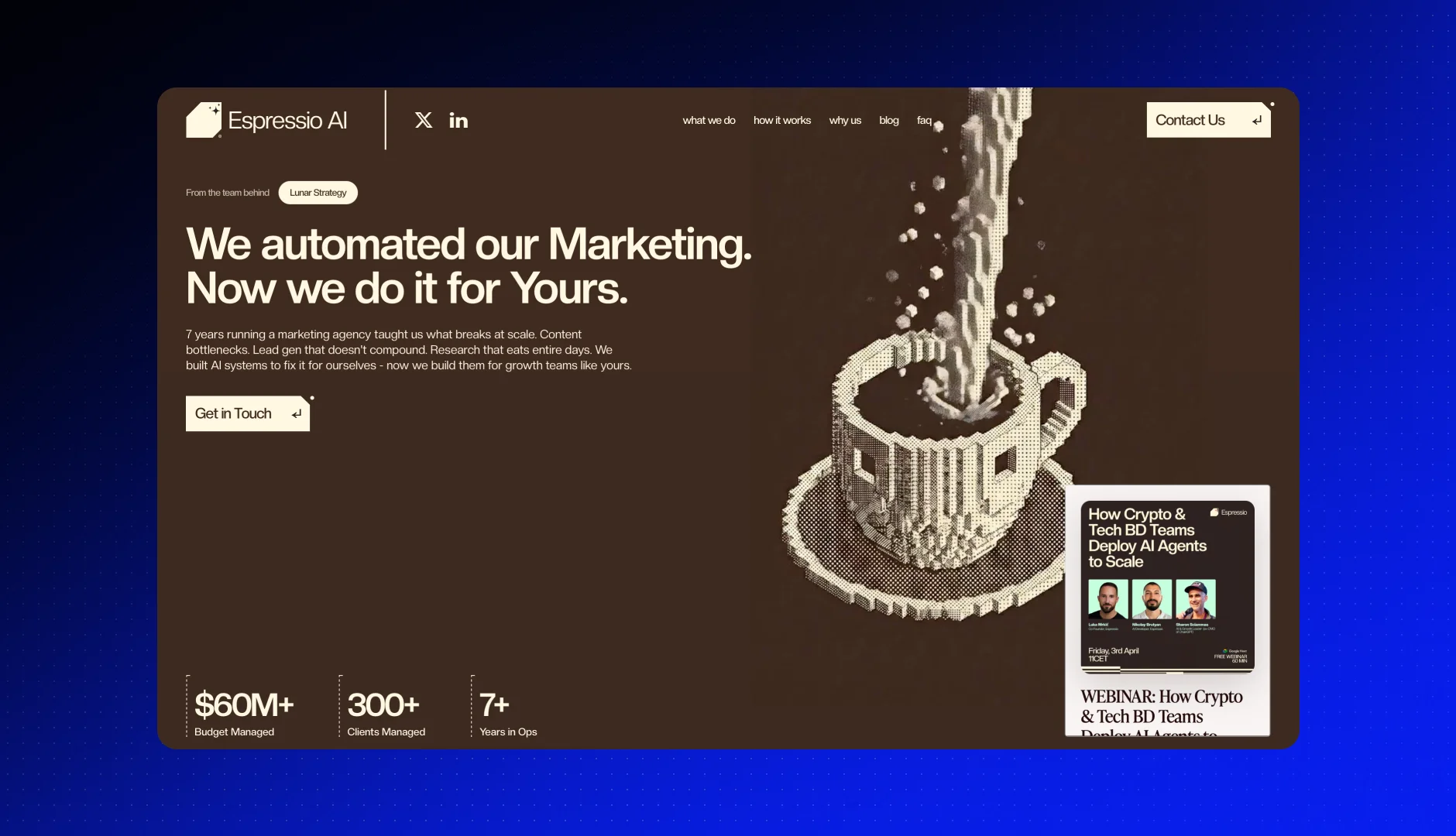
Founded from: Lunar Strategy (7+ years, 300+ clients, $60M+ managed budget)
Core systems: Content OS, Lead Gen Pipeline, Competitive Intelligence Agent, Revenue OS
Team: Tim Haldorsson (Founder), Shann Holmberg (Head of Product), Luka Mrkic (Head of Growth), Kimmo Hakonen (CIO)
Why They're #1
Espressio AI is an AI infrastructure partner built for growth, marketing, and BD teams — and their origin story is what separates them from every other AI implementation agency on this list. They didn't start as a technology consultancy that learned marketing vocabulary. They came out of seven years inside marketing operations at Lunar Strategy, running campaigns for over 300 clients across SaaS, fintech, and Web3 with more than $60 million in managed budget. They built AI systems to solve their own operational bottlenecks before ever offering them to clients.
hat practitioner-first credibility is rare — and it shows up in how fast their systems move from workshop to production.
Their message captures it well: the AI race is already happening — they build the systems that keep you in front.
Core Systems
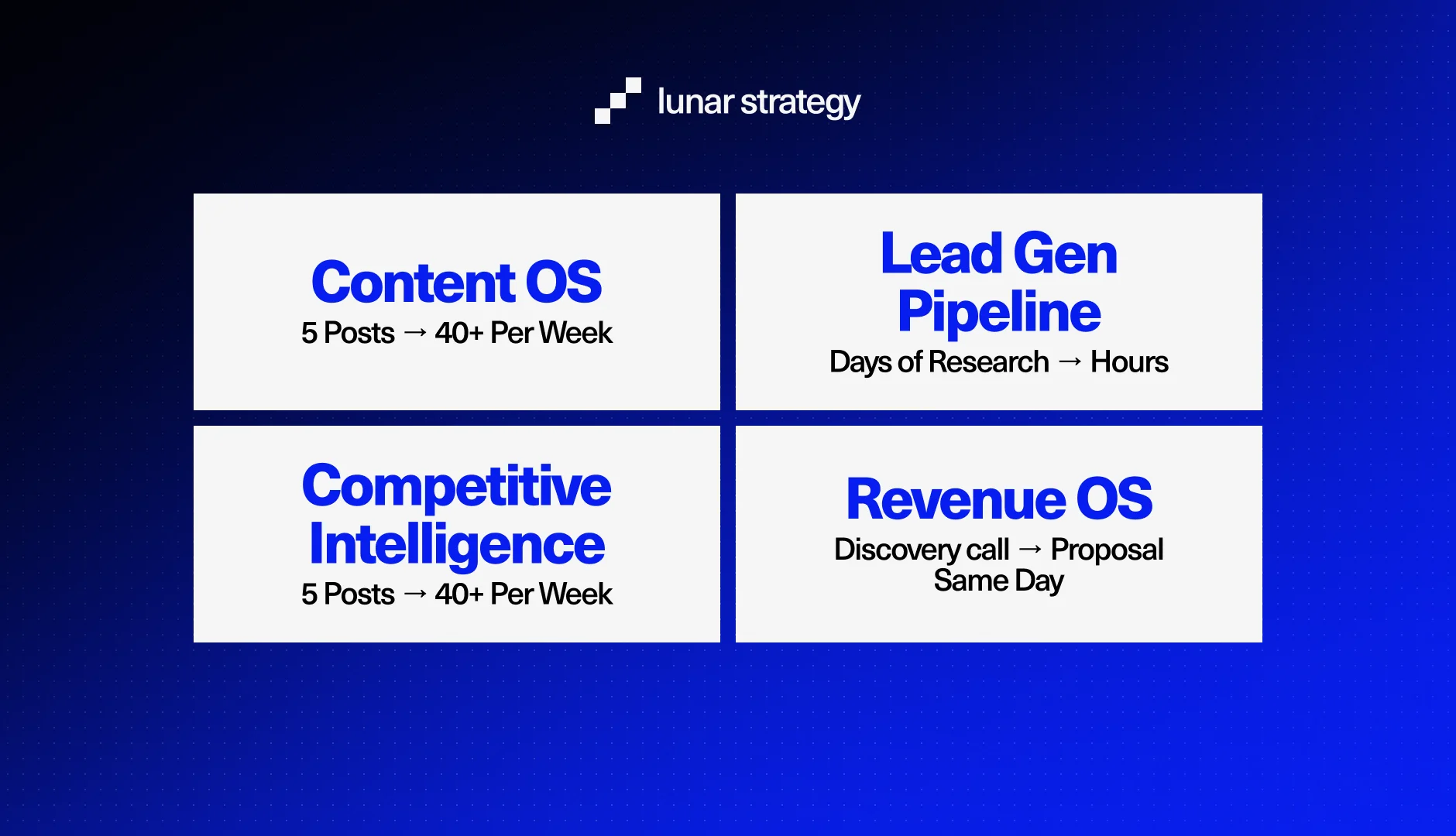
- Content OS: A production-grade content engine that takes a four-person marketing team from five posts per week to forty-plus — without hiring. The system handles ideation, drafting, optimization, and scheduling with human review built into every stage. This isn't ChatGPT wrapped in a dashboard. It's a full content operating system with brand governance, multi-channel distribution, and quality controls that maintain editorial standards at scale.
- Lead Gen Pipeline: Automates prospect research, scoring, enrichment, and list building in hours instead of days. The pipeline plugs into existing CRMs and outbound tools — no rip-and-replace required. For GTM teams still building lead lists manually or relying on stale database exports, this system compresses days of SDR work into automated workflows.
- Competitive Intelligence Agent: Always-on monitoring across competitor content output, pricing changes, product launches, and market positioning. Replaces the quarterly competitive review that most teams either skip entirely or execute inconsistently. Marketing and BD teams running this agent operate with a fundamentally different information advantage.
- Revenue OS: Collapses the sales cycle from first call to delivered proposal within the same day. For BD teams where speed-to-proposal directly impacts close rates, this system eliminates the dead time between discovery and delivery.
How They Work
Every engagement starts with a two-hour deep-dive workshop that maps your current GTM workflows, surfaces automatable processes, and produces a concrete implementation roadmap. That workshop has standalone value — teams walk away with a clear picture of where AI fits regardless of whether they engage further. From roadmap to deployed systems, the timeline is measured in weeks, not quarters.
Every system ships with defined KPIs — content output multiplied, hours saved, leads generated, pipeline velocity increased — because vague promises of "efficiency gains" don't survive a board meeting.
Ideal client: SaaS companies, marketing agencies, and fintech firms with lean teams that need to operate at the output level of organizations three to four times their size.
Pricing: Workshop + implementation engagement (custom scoped).
Growth and marketing teams ready to see what AI infrastructure looks like in practice can book a strategy session at espressio.ai (https://espressio.ai).
2. GetDevDone™
Best for: Digital agencies and growing brands that need a scalable, white-label engineering arm to implement and rescue AI builds.
Headquarters: US-based (San Francisco, CA)
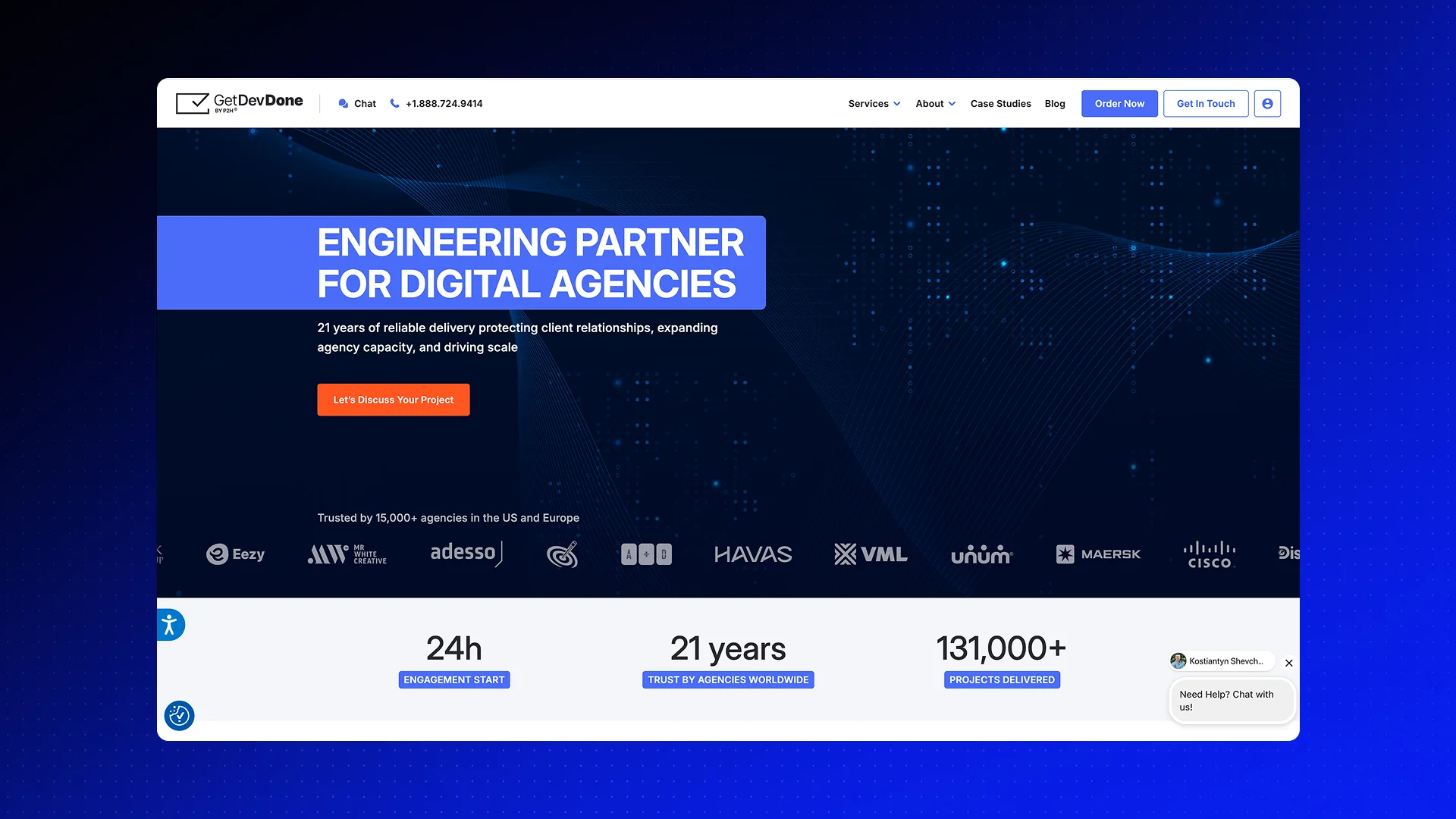
Key differentiator: Over 21 years of execution maturity with 131,000+ projects delivered for 15,150+ agencies worldwide.
Notable: Dedicated AI build rescue and rebuild services alongside production-grade frontend and eCommerce web engineering.
What They Do
GetDevDone™ is the engineering partner for digital agencies.
Since 2005, GetDevDone has delivered projects for 15,150+ agencies worldwide across website development, front-end development, eCommerce development, digital design, and AI engineering.
For marketing agencies managing the modern wave of AI implementations, GetDevDone provides specialized AI engineering support to smoothly embed smart website features and professional AI code cleanup to rebuild fragmented or inconsistent functionality. Their strength lies in combining historic process maturity with cutting-edge tech capabilities, safeguarding agency profit margins while preventing conversion or SEO losses during major site upgrades or migrations.
Ideal client: Busy digital agencies and mid-market teams that already have strategic direction and need a reliable, long-term development partner to build, deploy, or rescue AI-powered features behind the scenes.
Pricing: $25–$49/hr
3. Workflows.io
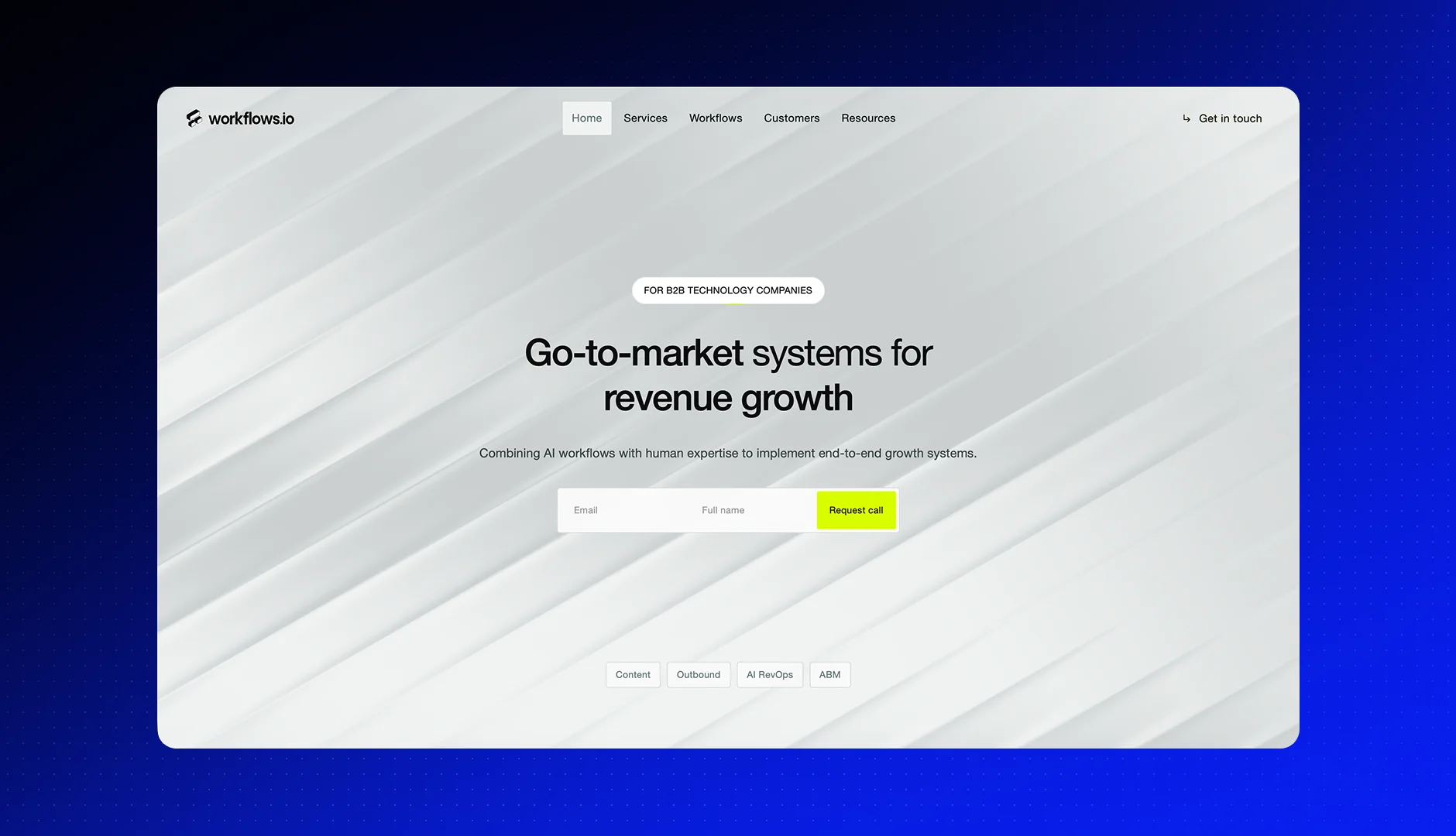
Best for: Series A+ startups that need AI-first GTM infrastructure across content, outbound, and RevOps.
Headquarters: US-based
Key differentiator: AI-first GTM growth studio backed by YC network; documented $1.3M pipeline generation case study
Notable: Deep integration of content production, outbound automation, and revenue operations into a unified GTM system
What They Do
Workflows.io operates as an AI-first GTM growth studio — a model that blends content, outbound, and RevOps into a single AI-powered system rather than treating them as separate workstreams. Their positioning within the YC network gives them credibility with venture-backed startups that expect speed and technical sophistication. The documented case study showing $1.3 million in pipeline generated for a single client is a concrete proof point.
Their strength is connecting the dots between content, outbound sequences, and revenue attribution in a way that most agencies treat as separate engagements. For Series A+ teams where every marketing dollar needs to trace back to pipeline, that integration matters.
Ideal client: Venture-backed startups (Series A and above) with technical founders who want a GTM partner that thinks in systems, not campaigns.
Pricing: Project and retainer engagements (quote-based).
4. Axe Automation
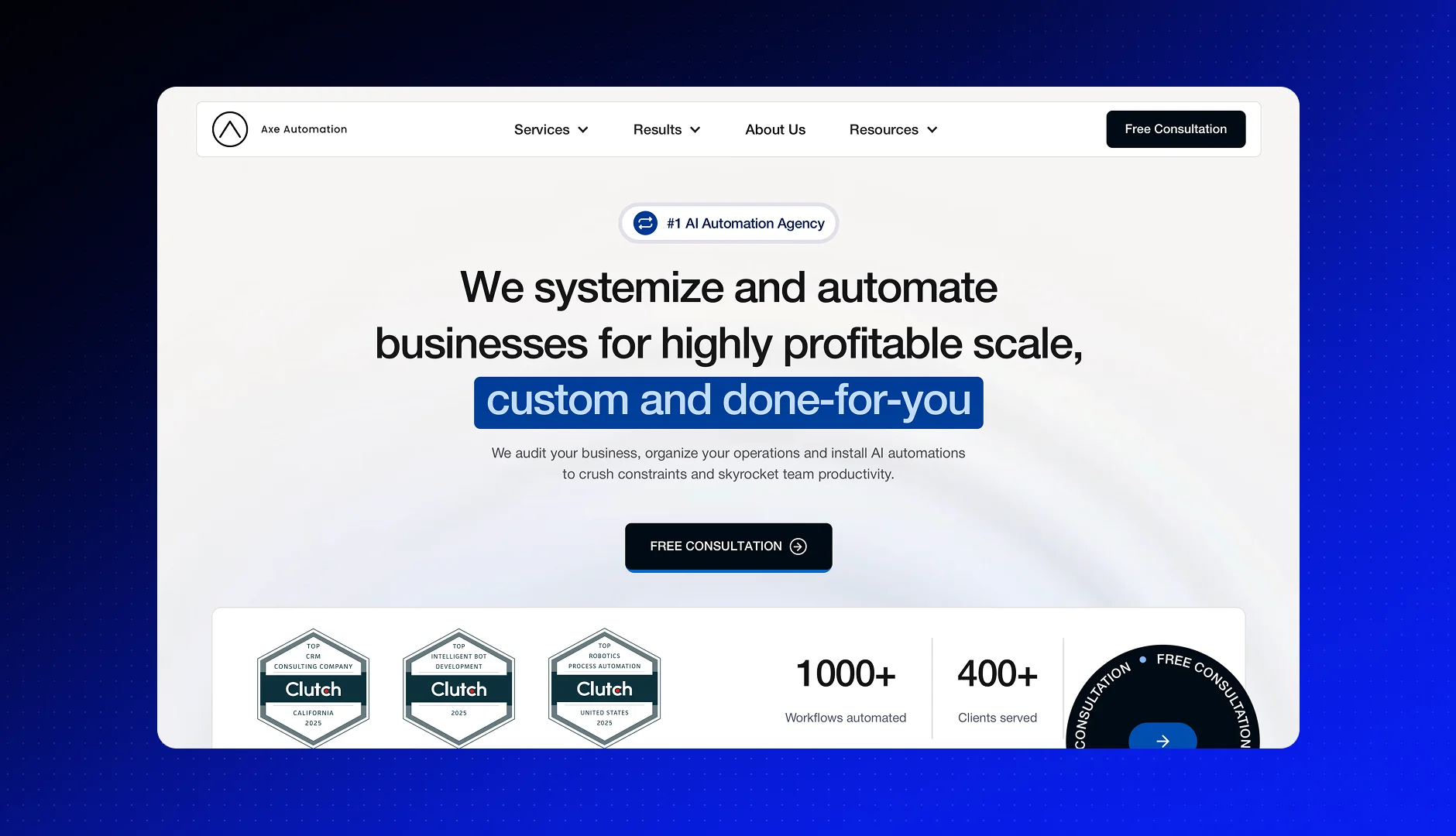
Best for: Small and mid-market businesses that need done-for-you AI workflow automation without hiring a technical team.
Headquarters: US-based
Key differentiator: Over 150 clients served with fixed-scope AI automation builds in the $5K-$15K range
Notable: Deep expertise in Zapier, Make, CRM integrations, and operational workflow automation
What They Do
Axe Automation fills a specific gap in the AI implementation agency landscape: practical, done-for-you workflow automation for businesses that don't have engineering resources. Their model centers on fixed-scope builds — typically $5,000 to $15,000 per project — that automate CRM workflows, lead routing, data enrichment, and operational processes using platforms like Zapier and Make.
With over 150 clients, they've built a repeatable delivery process that gets automations live in two to four weeks. For marketing teams that need their existing tools wired together intelligently rather than a full AI infrastructure overhaul, Axe Automation delivers practical results at an accessible price point.
Ideal client: SMBs and mid-market companies that need operational workflow automation built and maintained without in-house technical staff.
Pricing: Fixed project builds ($5K-$15K per automation).
5. GrowthSpree
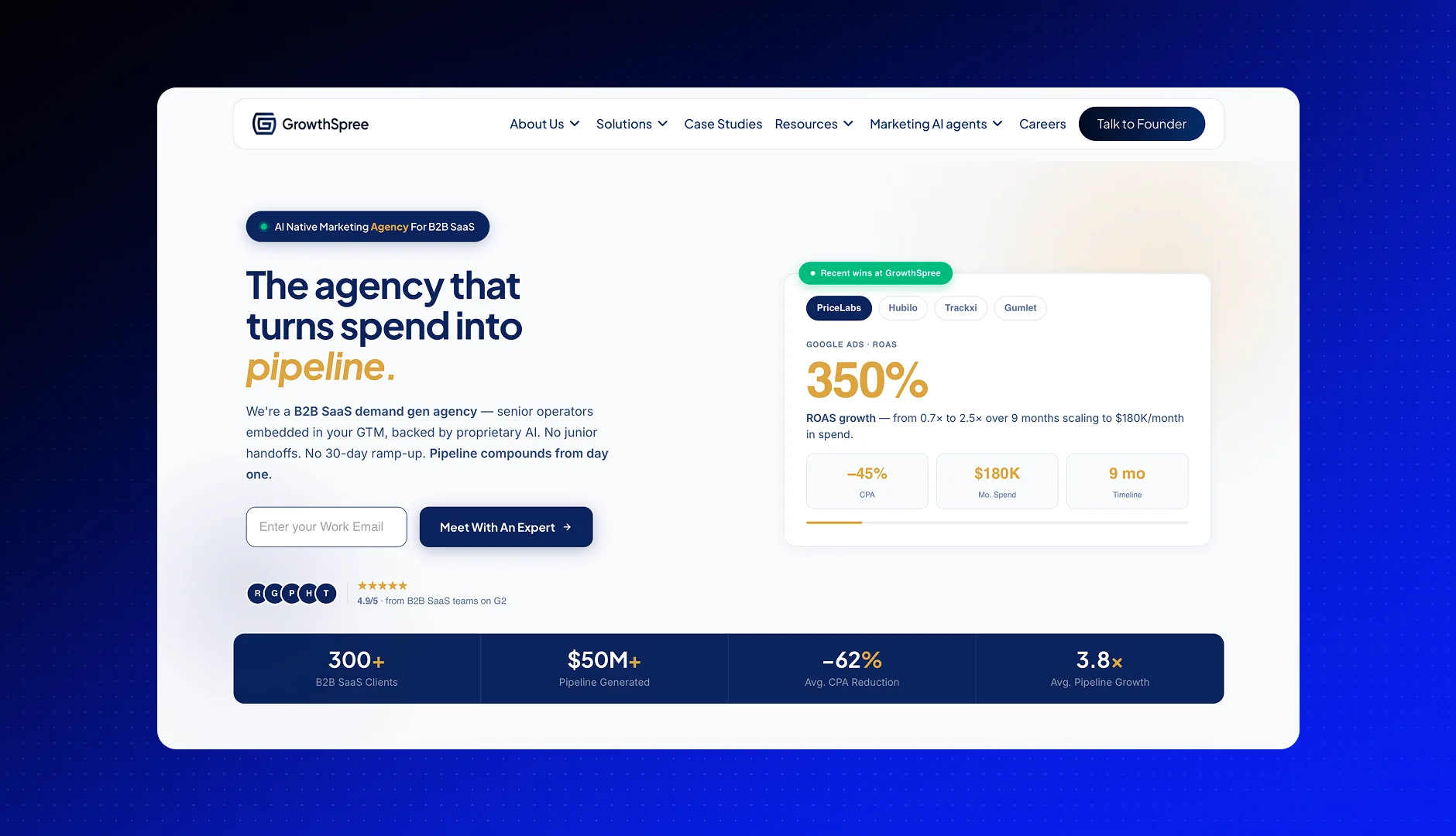
Best for: B2B SaaS marketing teams that want AI-native marketing with revenue operations baked into the foundation.
Headquarters: US-based
Key differentiator: MCP-powered AI agents integrated into a RevOps-first marketing model
Notable: One of the few AI GTM agencies building with Model Context Protocol architecture from the ground up
What They Do
GrowthSpree takes a RevOps-first approach to AI marketing implementation — meaning every system they build is wired to revenue attribution from day one. Their use of MCP-powered AI agents is technically interesting: Model Context Protocol allows their agents to maintain context across tools and workflows, producing more coherent and accurate outputs than standard API-chained automations.
For B2B SaaS teams where marketing's value is measured entirely by pipeline contribution, GrowthSpree's insistence on connecting every AI system back to revenue metrics provides built-in accountability. As an AI GTM agency, their monthly retainer model ($3,000 to $10,000) gives teams ongoing access to agents for GTM teams rather than one-time project delivery.
Ideal client: B2B SaaS companies with $2M-$20M ARR that need AI-native marketing tightly integrated with revenue operations and pipeline reporting.
Pricing: Monthly retainer ($3K-$10K/month).
6 Growthcurve
Best for: High-growth consumer and tech brands that need AI-optimized paid media and creative at scale.
Headquarters: London / Global
Key differentiator: AI-driven growth methodology tested at brands including Uber, Coinbase, and other high-scale consumer platforms
Notable: Combines AI creative generation with performance media buying for compounding optimization loops
What They Do
Growthcurve is an AI growth agency with roots in scaling some of the most recognizable consumer brands in tech. Their model combines AI-powered creative production with performance media optimization — a feedback loop where creative performance data informs the next round of AI-generated variants, compressing the test-learn-iterate cycle that traditionally takes weeks into days.
For marketing teams spending significant budget on paid channels, Growthcurve's approach to AI-augmented media buying and creative iteration addresses the two biggest bottlenecks in performance marketing: creative fatigue and manual optimization cycles. Their track record with high-growth brands provides credibility that's hard to replicate.
Ideal client: Consumer tech, fintech, and marketplace brands with significant paid media budgets that need AI to improve creative velocity and media efficiency simultaneously.
Pricing: Custom retainer (quote-based).
7. Waking Digital
Best for: Ecommerce and DTC brands that need AI automation across content, email, and social channels.
Headquarters: US-based
Key differentiator: Ecommerce-native AI marketing implementation across content generation, email flows, and social media automation
Notable: Focused specifically on the ecommerce marketing stack — Shopify, Klaviyo, social platforms — rather than trying to serve every vertical
What They Do
Waking Digital brings AI marketing implementation to ecommerce and DTC brands through a channel-specific approach. Rather than building generic AI systems and adapting them, they've built automation workflows native to the ecommerce marketing stack — product description generation, email flow optimization, social content scheduling, and campaign automation across the platforms ecommerce teams actually use.
For ecommerce marketing teams drowning in the volume demands of product content, email sequences, and daily social posting, Waking Digital's focused approach means faster time to value. Their systems are built around the specific tools and workflows that ecommerce marketers already operate, reducing the integration friction that derails broader AI implementation projects.
Ideal client: Ecommerce and DTC brands running on Shopify or similar platforms that need AI automation across content, email marketing, and social — without overhauling their existing tech stack.
Pricing: Custom retainer (quote-based).
What to Look for When Choosing an AI Implementation Agency
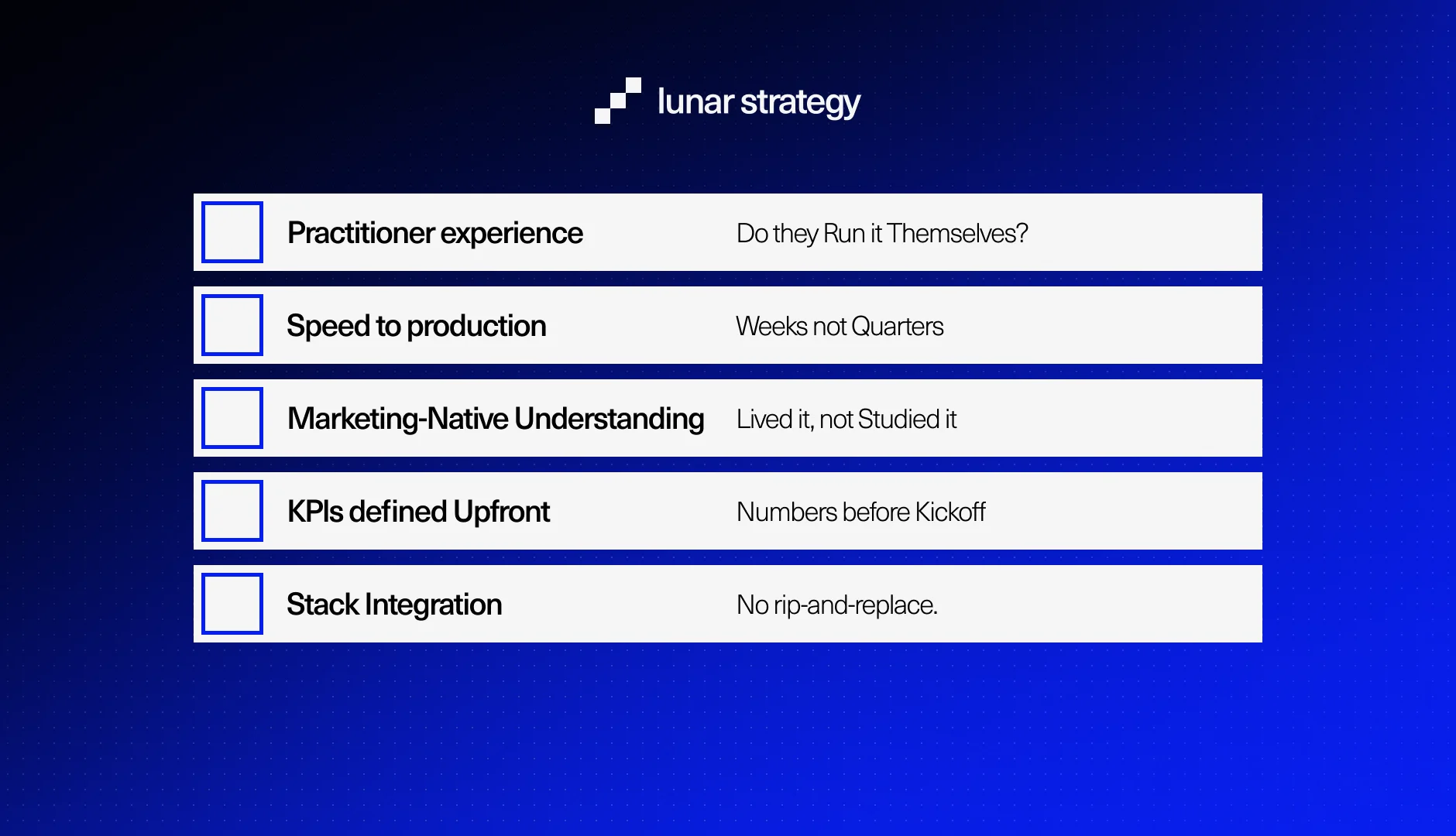
Not every AI implementation agency delivers the same thing. Some build strategy decks. Others build production systems. Before evaluating vendors, get clear on the five criteria that separate agencies producing real GTM outcomes from those repackaging old services under an AI label.
1. Practitioner Experience vs. Consulting Experience
The single most important signal is whether the agency has built and operated AI systems for their own GTM operations — not just for clients. Agencies that run their own content engines, lead pipelines, and competitive intelligence agents daily understand operational friction, edge cases, and failure modes in ways that pure consultancies never will. Ask whether the team uses the same systems they're proposing to build for you. If the answer is no, you're hiring theorists.
2. Speed to Production
Ask how fast you'll have a working system — not a strategy document, not an implementation roadmap, but something running in your operations producing output you can measure. The best AI implementation agencies ship production systems in weeks. If someone is quoting three to six months of discovery before anything goes live, they're optimizing for their billing cycle, not your GTM velocity.
3. Marketing-Native Understanding
There's a meaningful gap between AI agencies that started in technology and learned marketing, versus those that lived inside marketing operations and built AI to solve problems they experienced firsthand. The difference surfaces in scoping conversations: marketing-native agencies understand your content calendar, CRM workflows, attribution models, and reporting cadence without needing a week of discovery to learn your world.
4. Measurable KPIs Before Deployment
Every system should ship with defined success metrics — content output multiplied, hours saved per week, leads generated, pipeline influenced, cost per acquisition reduced. If an agency can't tell you exactly what you'll be measuring four weeks after kickoff, they're selling a promise, not a system. The best marketing AI implementation partners tie their deliverables to numbers that matter in your next board meeting.
5. Integration with Your Existing Stack
The strongest AI implementation agencies build systems that plug into your existing CRM, content management platform, analytics tools, and outbound infrastructure. If an agency requires you to adopt an entirely new tech stack, the total cost of implementation — including team retraining, data migration, and workflow disruption — may outweigh the benefits. Ask for a stack compatibility assessment before signing anything.
How AI Implementation Is Changing Marketing Operations in 2026
The conversation about AI in marketing has shifted decisively. It's no longer about whether to adopt AI — it's about how fast you can move from experimentation to production systems. Here's what's driving the shift.
From Tools to Agents
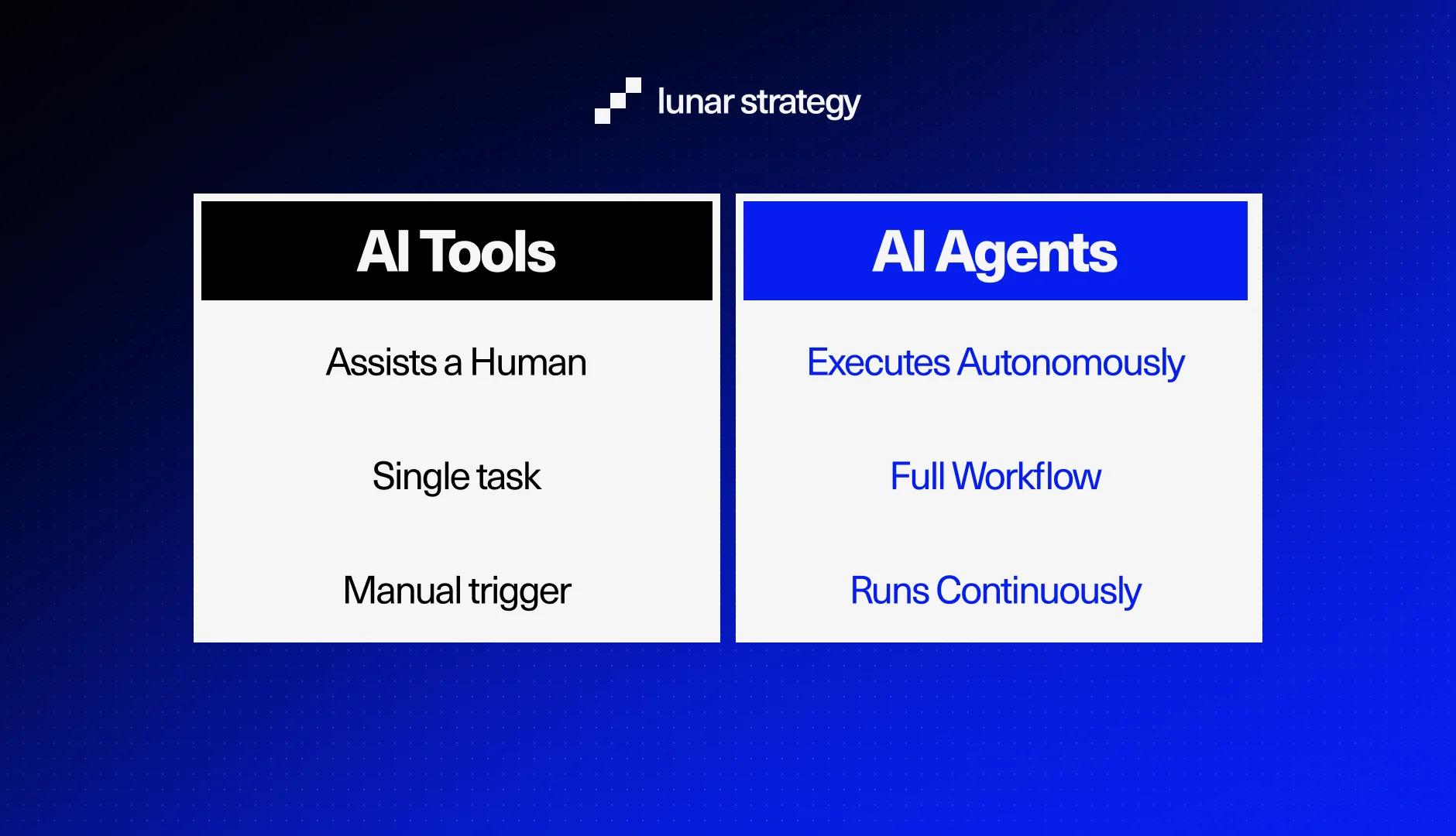
The defining transition in marketing operations right now is the move from AI tools to AI agents. Tools assist — they help a human do a task faster. Agents execute — they take an objective, decompose it into steps, make decisions, and produce output with minimal oversight. The agentic AI market's projected $9.14 billion valuation in 2026 reflects this shift. Marketing teams deploying AI agents for GTM workflows — content production, lead generation, competitive monitoring, proposal delivery — are operating at a structurally different level than teams still prompting ChatGPT for blog outlines.
Implementation Is the Bottleneck
Eighty-eight percent of marketers report using AI daily. But the gap between "using AI" and "running AI systems in production" is enormous. Most marketing teams have experimented. Very few have implemented. The bottleneck isn't awareness or willingness — it's the technical and operational complexity of moving from a prototype to a system that runs reliably inside existing workflows. That's the gap an AI implementation agency for marketing exists to close.
The Compounding Advantage
AI implementation in marketing creates compounding returns. A content engine doesn't just produce more content — it generates data on what performs, which feeds back into the system, improving output quality over time. A lead gen pipeline doesn't just build lists faster — it learns which prospect signals correlate with closed deals, making each subsequent list more accurate. Teams that deploy AI systems early build a data and operational advantage that widens every month they operate. The longer you wait to implement, the harder it becomes to close the gap.

Why GTM Teams Are Leading Adoption
Go-to-market teams — marketing, sales, BD, revenue operations — have the highest density of workflows that are simultaneously high-volume, repetitive, and high-value. Content production, prospecting, competitive analysis, reporting, proposal generation — these are exactly the workflows where AI agents deliver the most measurable impact. It's not an accident that GTM is where AI implementation spend is concentrating.
Frequently Asked Questions
What is an AI implementation agency?
An AI implementation agency is a firm that builds and deploys artificial intelligence systems — including AI agents, content engines, lead generation pipelines, and competitive intelligence tools — inside client operations. Unlike AI consultancies that deliver strategy recommendations, or SaaS platforms that offer self-serve tools, an AI implementation agency handles the end-to-end work of scoping, building, integrating, and operationalizing AI systems within your existing workflows. The focus is on production systems that run reliably and produce measurable output, not prototypes or proofs of concept.
How much do AI implementation agencies cost?
Pricing varies significantly based on scope and agency model. Done-for-you workflow automation builds typically range from $5,000 to $15,000 per project. Monthly retainer engagements with AI-native marketing agencies fall between $3,000 and $10,000 per month. Full-service AI implementation partners — agencies deploying multiple systems across content, lead gen, and competitive intelligence — typically scope custom engagements. Workshop-style entry points, like Espressio AI's two-hour deep-dive workshop, offer a lower-risk starting point before committing to a full implementation engagement. Enterprise-scale deployments at Fortune 500 organizations carry custom contract pricing.
How fast can an AI implementation agency deploy?
The best AI implementation agencies deploy production systems in weeks, not months. Agencies that require six months of discovery and strategy before any system goes live are typically optimizing for their own revenue cycle, not your operational needs. Look for agencies that offer a structured workshop or audit as a first step — a path from kickoff to a working system inside your operations within two to four weeks is achievable with the right partner. Enterprise deployments with governance and security requirements may follow phased timelines, but the first production system should still be live within the first month.
What's the difference between an AI tool and an AI implementation agency?
An AI tool is a product you adopt — a software platform with features your team uses. An AI implementation agency builds systems tailored to your specific workflows, data, and operational context. The difference is analogous to buying project management software versus hiring a firm to redesign your operations. Tools offer general capability. An AI implementation agency delivers specific, integrated systems that run inside your GTM operations and produce outcomes tied to your KPIs — content output, leads generated, pipeline influenced, hours saved.
Do AI implementation agencies replace marketing teams?
No. AI implementation agencies build systems that multiply your existing team's capacity. The operating model is "same team, dramatically more output, zero new hires." A four-person marketing team running AI content engines and lead gen pipelines can produce the output of a team three to four times its size. The human team focuses on strategy, quality review, relationship management, and creative direction while AI systems handle production-scale execution. The goal is leverage, not replacement.
What results should I expect from an AI implementation agency?
Specific outcomes vary by system deployed, but benchmarks from leading agencies include: five to ten times increases in content production output, lead generation timelines compressed from days to hours, fifteen-plus hours per week saved on reporting and manual processes, same-day proposal delivery from first sales call, and measurable reductions in cost per acquisition. The key is insisting on defined KPIs before any engagement begins. Agencies that can't specify measurable outcomes before deployment are selling services, not systems — and that distinction matters when you're reporting results to leadership.
This guide was last updated in April 2026. Agency capabilities, pricing, and client rosters change frequently. We recommend contacting agencies directly for the most current information.