



























Introduction
Crypto moves faster than most teams plan for: what worked last cycle stops working this one, channels shift, audiences fragment, and competitive dynamics change overnight.
Most teams can't keep pace. Projects with strong products fail because their marketing couldn't adapt fast enough. They operate on outdated playbooks, chase metrics that stopped mattering months ago, and react to shifts after momentum is already gone.
At Lunar Strategy, we've seen this firsthand. Working on over 250 web3 projects across every market phase over the last six years has shown us where marketing actually breaks down and where it holds up.
This guide maps where crypto marketing is heading in 2026 based on signals already taking shape across sectors, stages, and market cycles.
By the end, you'll know which channels will matter, where attention is moving, and how to structure your marketing for what's coming.
Your preparation for 2026 starts here.
Let's get started.
Table of Contents
Introduction
1: Why 2026 Demands Different MarketingChapter
2: Audience Segmentation in the New EraChapter
3: Value Metrics Replace Vanity MetricsChapter
4: Moving Beyond One-Channel MarketingChapter
5: Web3 Retail ExpandsChapter
6: AI-Native Marketing WorkflowsChapter
7: Trust and ComplianceChapter
8: Sector-Specific Strategy PlaybooksChapter
9: Rewards ≠ RetentionClosing
Chapter 1: Why 2026 Demands Different Marketing
By 2025, the industry had entered a different phase. Growth slowed, speculation cooled, and attention shifted toward products that actually worked. Many projects disappeared. The ones that survived focused on solving real problems.
As the noise faded, expectations rose. Users became more selective. Partners became more cautious. Capital flowed toward teams that could demonstrate traction, reliability, and long-term potential.
That shift will carry directly into 2026.
From Hype to Usefulness
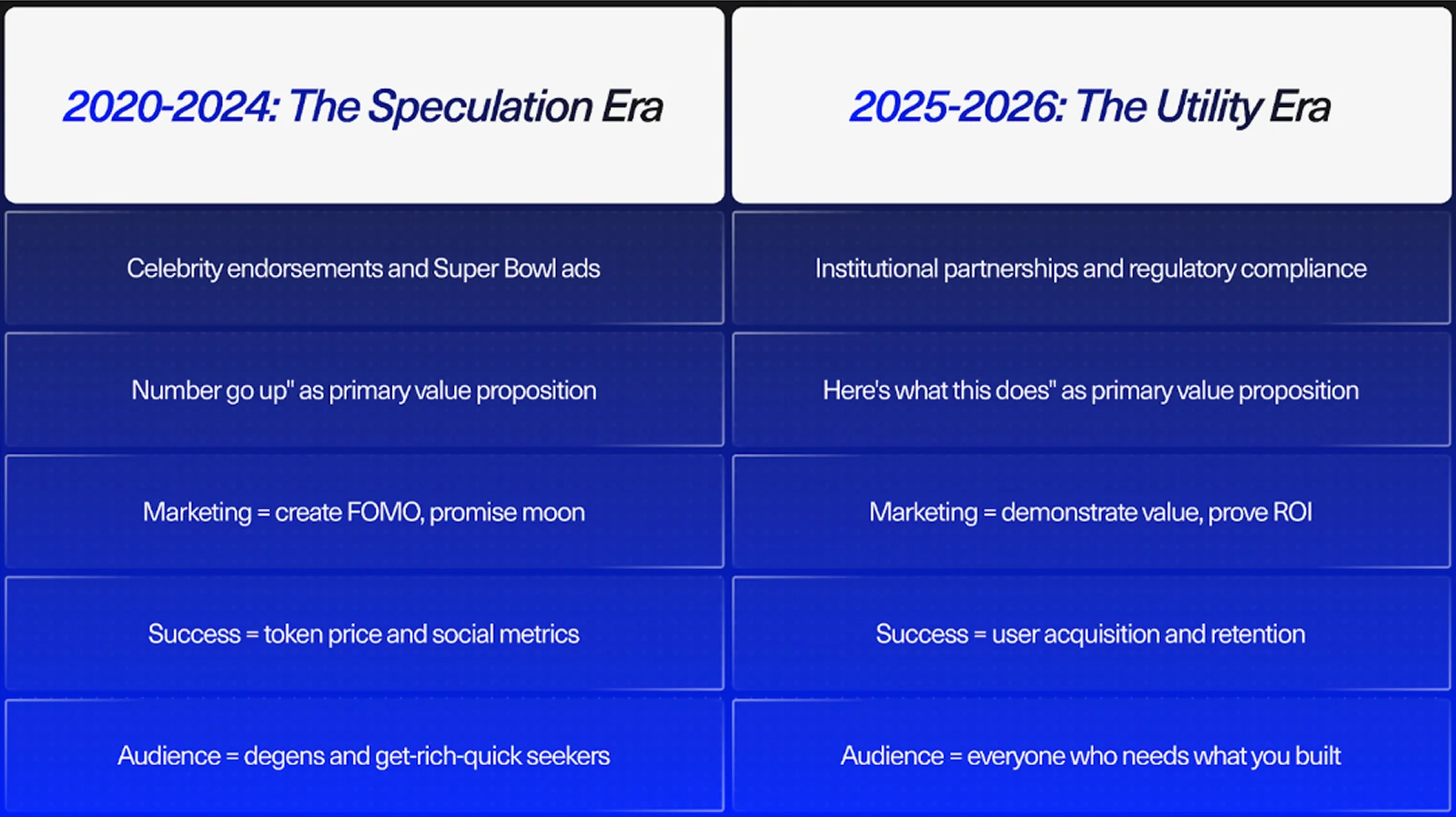
Earlier cycles rewarded visibility. Marketing centered on momentum, social buzz, and price action. Success meant charts going up, followers growing, and engagement spiking.
That approach no longer defines the market.
As products matured, messaging shifted. Teams focused on outcomes instead of promises. Adoption instead of attention. Retention began to matter more than reach.
Projects with solid fundamentals and quieter marketing outlasted launches built purely on hype. Social buzz became less reliable as a signal of future growth.
The market moved on.
What Drove the Shift
The shift didn’t come from a single change. Several forces moved at the same time, each reinforcing the others. Together, they reshaped how crypto products are evaluated and how they need to be marketed.
Clearer rules changed who could participate.
In the U.S., ETFs and clearer regulatory oversight gave institutions an entry point. In Europe, MiCA created a unified framework across markets. Large financial firms that had waited on the sidelines began launching products and infrastructure. As participation widened, expectations rose with it.
User expectations evolved.
Earlier cycles attracted users focused on price movement. Newer audiences cared more about reliability, usefulness, and trust. Questions shifted toward value, safety, and integration with familiar systems. This change reflected crypto’s expanding reach beyond early adopters into everyday use cases.
Crypto faded into the background.
Payment networks, neobanks, and traditional banks integrated blockchain into existing products. Crypto became less visible to end users. People used the benefits without engaging with the technology directly. That invisibility raised the bar - products now compete with established fintech and consumer platforms, not just other crypto projects.
Each force reinforced the others, pushing the industry into a new phase where marketing depends less on narrative and more on clarity, credibility, and usefulness.
What This Means for Marketing
The audience expanded. Competition intensified.
Crypto products now sit alongside established Web2 platforms. As users naturally compare the two, expectations rise. Clear value matters more. Language needs to stay simple. Reliability has to come before trust.
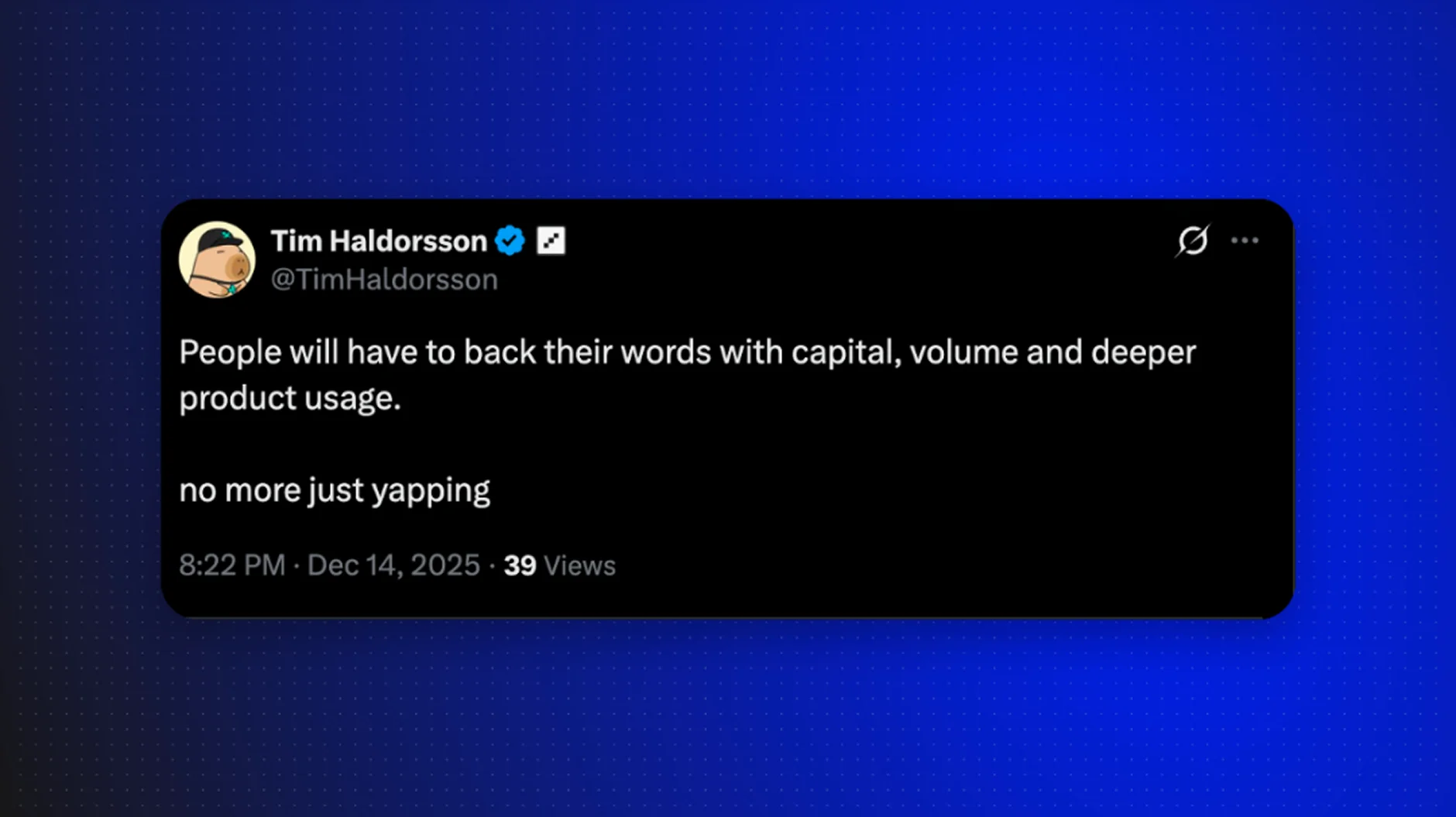
Marketing is moving in that direction. Toward usefulness over narrative. Toward specific problems rather than broad enthusiasm. Toward signals that reflect real adoption instead of surface-level attention. Trust and compliance shift from supporting roles to core positioning elements.
Crypto entered a new phase. Marketing must evolve with it.
Chapter 2: Audience Segmentation in the New Era
Crypto marketing didn't change overnight. It shifted gradually, driven by how people began using products rather than how they talked about them. As crypto expanded into payments, savings, gaming, and infrastructure, the audience stopped behaving like a single group with shared motivations.
That change shows up everywhere: in the questions users ask, the signals they respond to, and the standards they apply before committing time or capital.
Two shifts defined this:
We’re moving past “get rich” messaging
For years, growth followed excitement. Narratives and upside potential carried products far - often faster than their underlying utility justified.
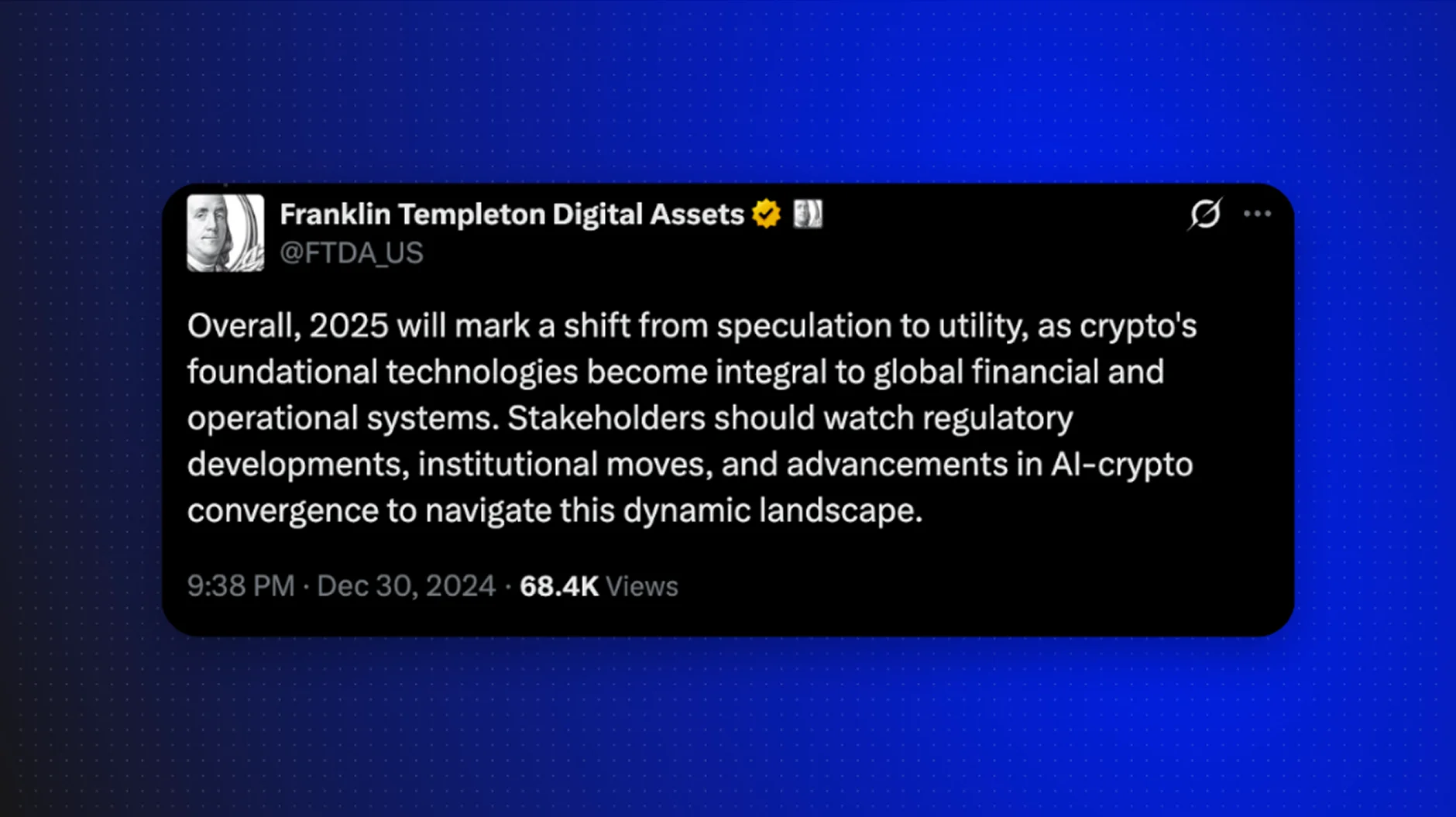
That dynamic weakened as the audience widened. Utility has become the main driver of crypto adoption: people use crypto when it solves real, everyday problems.
By 2024, nearly two-thirds of newly launched tokens came with a clear use case - a 40% increase from 2022. The global crypto user base continued to grow, with adoption accelerating most in regions where crypto solves everyday needs like payments and savings. Today's audience focuses on tangible value rather than hype.
Speculation hasn’t disappeared. It simply stopped being the foundation for durable growth.
Users now ask: “What does this actually do?
As crypto reached a broader audience, the way people evaluate products shifted.
The first questions from users are now about purpose:
➤ What does this enable?
➤ How does it fit into something I already do?
➤ Why is it better than the alternative?
The technology fades into the background. Outcomes move to the foreground.
What does the New Audience Mean for Marketing?
Once “what does this actually do?” becomes the default filter, marketing decisions change at every level:
- Positioning shifts toward outcomes: Value propositions work best when they start with the benefit the user cares about. Technical architecture, decentralization, and token mechanics still matter, but they don’t lead the story.
- Channels follow intent: Utility-driven users discover products where problems are actively being solved. Crypto-native channels remain important for certain segments, but they no longer represent the full growth path.
Success metrics move closer to real usage: Attention alone becomes a weaker signal. What matters more is activation, repeat use, and retention.
This is the core segmentation shift of the new era. Marketing now has to meet people where they are, answer the questions they’re actually asking, and measure success by adoption.
Chapter 3: Value Metrics Replace Vanity Metrics
By 2025, the cracks in common crypto marketing metrics had become obvious.
Follower counts, short-term TVL spikes, and large community numbers still fill reports and pitch decks, but fewer teams treat them as reliable signs of growth. The shift away from vanity metrics started after 2023 and accelerated as budgets tightened and expectations rose.
Teams narrowed their focus to a smaller set of numbers that consistently explained performance. Heading into 2026, marketing decisions increasingly depend on whether users stay active and contribute value after their first interaction.
Why Vanity Metrics Are Losing Ground
Earlier growth strategies centered on visibility. Token price movement, liquidity incentives, rapid community growth, and social reach drove dashboards and budget decisions.
When incentives slowed, the weaknesses showed up.
Customer acquisition costs climbed into the hundreds per user. Retention dropped sharply within months. Communities that looked massive on paper showed little ongoing activity. Liquidity declined as yields normalized. Engagement disappeared once rewards ended.
The core issue was measurement.
By 2024 and 2025, investors and boards started evaluating growth differently. As platforms like Dune made usage data more accessible, surface-level metrics became less meaningful. Retention curves and cohort behavior became standard in reporting.
Heavy reliance on vanity metrics now only signals misalignment.
The Metrics Shaping Marketing as 2026 Approaches
Five metrics continue to correlate with lasting growth across categories and market cycles:
Revenue
Revenue shows whether a product creates ongoing economic value.
While TVL shows how much capital is present, it doesn’t indicate how often users engage or whether the product is actually used. Capital can move quickly when incentives change.
More teams now prioritize revenue and fee generation as signals of real adoption. They use these metrics to evaluate product strength and marketing quality.
Benchmarks increasingly favor consistent revenue streams over temporary TVL spikes.
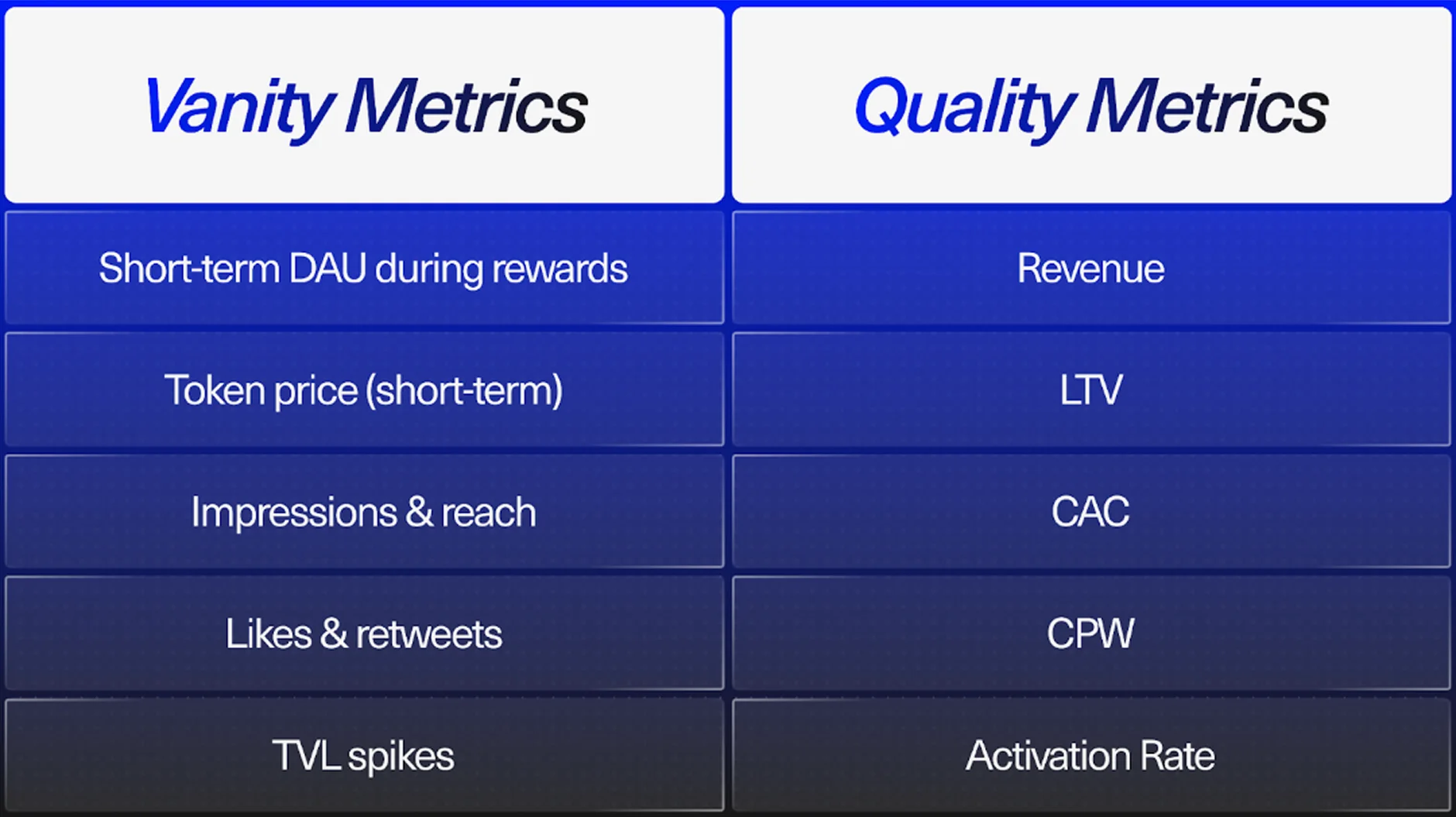
Customer Acquisition Cost (CAC) / Cost per Wallet (CPW)
Acquisition cost becomes useful when it reflects real usage.
What matters is an active wallet that completes a meaningful on-chain action. That cost includes everything needed to reach the user: paid media, content, partnerships, KOL activity, and token incentives. Token distributions count as acquisition costs alongside cash spend.
New tracking methods measure cost per engaged wallet instead of surface-level conversions. The goal is to understand what it actually takes to acquire users who use the product.
Campaigns using intent-based targeting and wallet-level filtering increasingly operate at lower acquisition costs. Broader campaigns with weak retention face more scrutiny.
Lifetime Value (LTV)
Lifetime value shows the total contribution a user makes over time.
In Web3, that contribution goes beyond direct fees. It includes indirect value from liquidity provision, governance participation, referrals, ecosystem growth, or content creation.
Users who stay active longer contribute more consistently. Retention determines how usage turns into value.
More teams now focus on usage-based LTV, tracking value created through sustained activity instead of one-time volume or short-lived spikes.
Activation Rate
Activation shows whether users reach the point where the product’s value becomes clear.
That moment varies by product:
→ a first swap or deposit
→ a first purchase
→ a funded transaction
→ completing onboarding followed by an initial action
Many users drop off before reaching activation. Wallet setup, fees, and unclear flows interrupt momentum early.
Activation receives more attention heading into 2026. When only a small share of signups activate, true acquisition costs rise quickly. Cost per activation provides a clearer picture of campaign quality.
Most activation gains come from improving onboarding instead of increasing spend.
Why This Matters Now
Crypto marketing continues moving toward a more disciplined model as the industry approaches 2026.
Surface metrics remain visible, while usage, retention, and value carry more influence. Teams that align around CAC, LTV, activation, revenue, and retention are better positioned for the next phase of growth.
The transition is still underway. By 2026, measuring what matters will be standard practice.
Chapter 4: Moving Beyond One-Channel Marketing
For much of the last cycle, crypto marketing revolved around a single assumption: if you dominated Crypto Twitter, you were winning.
Budgets flowed into threads, KOL campaigns, Spaces, and timeline visibility. Community strategy often meant growing a CT presence. Distribution plans centered on staying visible in one feed.
That approach carried projects far in 2021. By 2025, its limits are clear.
Teams seeing sustained traction today run campaigns across multiple channels simultaneously. СT still plays a major role as one part of a broader system.
Why One Platform No Longer Carries Growth
CT continues to serve an important purpose. It remains effective for reaching community members who already understand the space. The broader audience spends time elsewhere.
Younger users consume information through short-form videos. Professionals exploring real-world use cases engage on LinkedIn. Developers spend time in repositories, forums, and technical communities. Many people begin research by asking AI tools instead of scrolling social feeds.
At the same time, competition for attention on Twitter intensified. Most projects speak to the same audience, in the same format, within a crowded feed. Distribution efficiency declined as more teams competed for the same slice of attention.
Platform risk also became harder to ignore. Algorithm changes, moderation shifts, verification policies, and API restrictions repeatedly altered reach and engagement. Heavy reliance on a single centralized platform meant exposure to factors outside a team's control.
Where Crypto Marketing Is Expanding
Distribution spreads across a wider set of channels, each serving a distinct role. Marketing now works as a coordinated system where different platforms support different stages of discovery, evaluation, and adoption.
The channels that matter most tend to fall into a few clear categories:
- Short-form video platforms (TikTok, Instagram Reels): These platforms play a growing role in early discovery. Short, visual explanations lower the barrier to understanding complex ideas. Founders, educators, and teams use the format to explain products, share progress, and tell stories in a way that feels accessible.
- YouTube: Longer-form content supports deeper learning. Tutorials, protocol breakdowns, and interviews help users compare options and build confidence before committing capital or time. Content continues to compound value over time as people search for answers.
- LinkedIn: It has become increasingly relevant for projects focused on infrastructure, enterprise use cases, institutional adoption, and professional audiences. Consistent posting around building progress, industry insight, and practical applications often reaches an engaged audience with less noise than crypto-native feeds.
- Reddit: It supports detailed discussion and long-form questions. Crypto-focused subreddits remain active spaces for learning, debate, and evaluation. Teams that participate transparently and answer questions directly often build credibility and organic word-of-mouth.
- Decentralized social platforms (Farcaster, Lens): Web3-native social platforms continue to attract builders and early adopters. Ownership of social graphs and content portability appeal to users sensitive to platform risk. Presence here helps teams stay aligned with where crypto-native communities are gradually moving.
AI chat platforms: More people now ask AI tools questions about crypto products, comparisons, and concepts. Projects with clear documentation, accessible explanations, and consistent public content are more likely to surface in these answers.
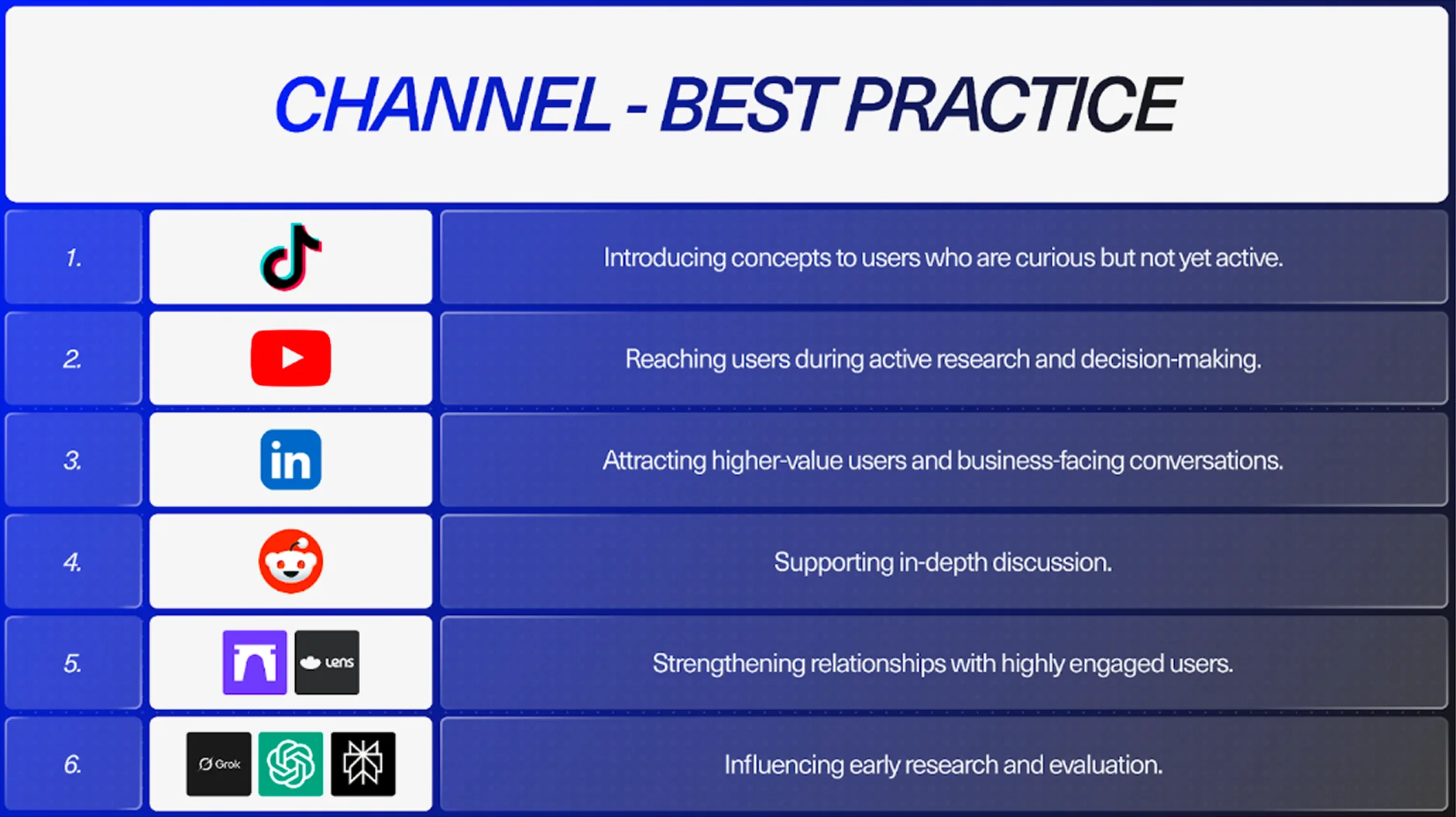
Multiple channels now support the full journey. Effective distribution in 2026 comes from understanding the role each platform plays and designing content to match it.
Why Multi-Channel Distribution Works
Different channels support different stages of the user journey.
One platform introduces a concept. Another explains it in depth. Another supports ongoing engagement. Another builds professional trust. Another answers detailed questions. Another reinforces ownership and participation.
Users move across these environments naturally. Being present across several of them increases the chance of showing up at the right moment.
Reaching someone once creates awareness. Reaching them consistently across contexts builds familiarity and trust.
Content designed for one platform rarely transfers cleanly to another. Teams that adapt format and tone see stronger results across the board.
Chapter 5: Web3 Retail Expands
By 2025, the tone around crypto adoption had changed visibly. The strongest mainstream narratives shifted toward outcomes people already understand: faster settlement, cheaper cross-border transfers, simpler access to assets, and better ways to move value globally.
That shift matters because it changes where demand comes from. Crypto products increasingly appear through payment networks, fintech apps, and familiar financial interfaces. As those surfaces expand, Web3 retail starts to look like standard retail.
Stablecoins Enter Everyday Payment Systems
One of the clearest signals came from established players.
In April 2025, Mastercard introduced new capabilities to support stablecoin payments from wallets to checkout, signaling its intent to scale them across its global network.
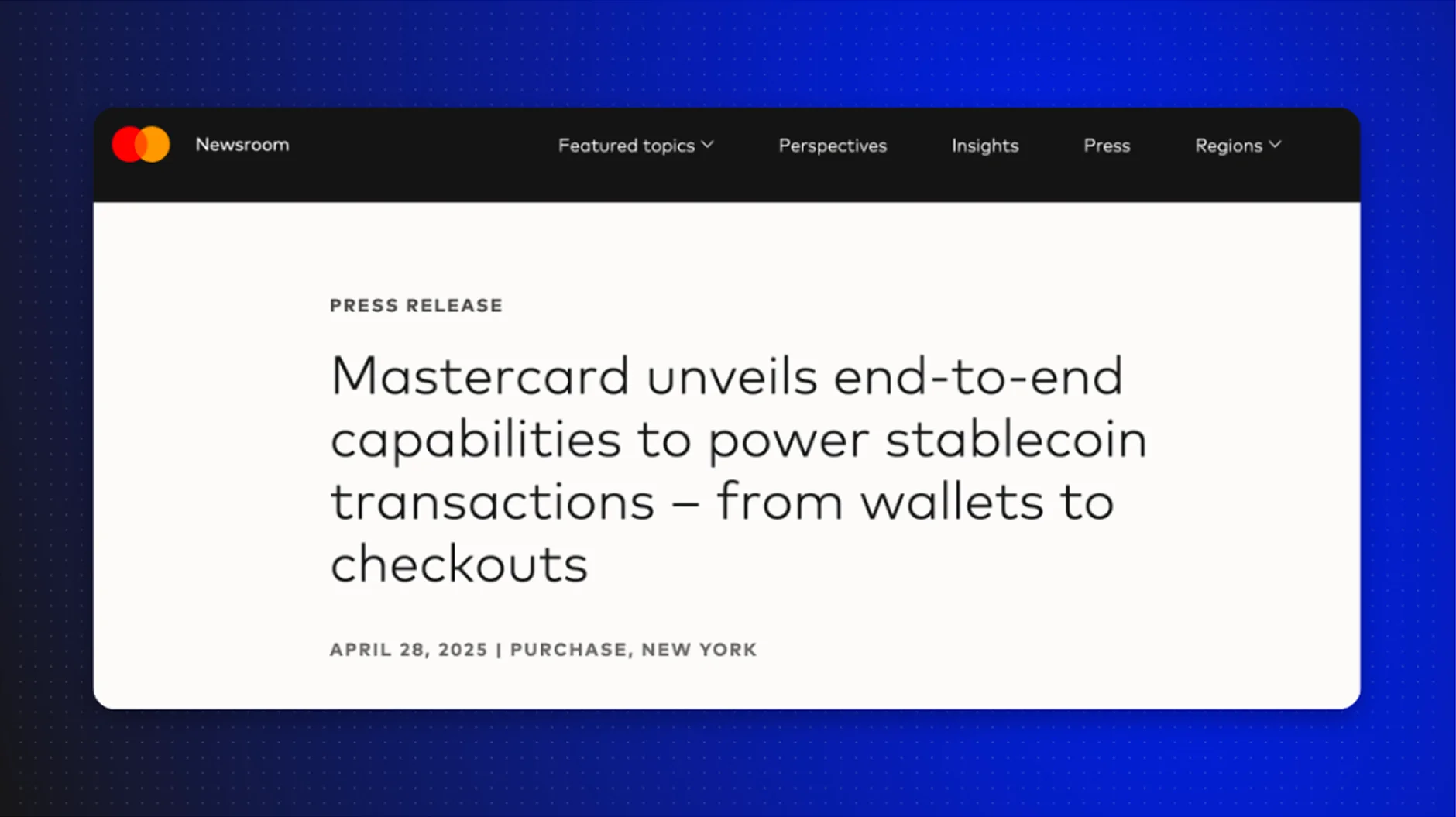
The message was clear: stablecoins were becoming a payment infrastructure meant to work inside systems that merchants and consumers already use.
That announcement fit a broader pattern:
Blockchain-based settlement is moving closer to everyday finance.
Stablecoins illustrate the shift most clearly.
According to a16z’s State of Crypto 2025, stablecoins powered roughly $46 trillion in annual transaction volume. Even after adjusting for non-organic activity, the report estimates about $9 trillion in organic volume moving through stablecoin rails.
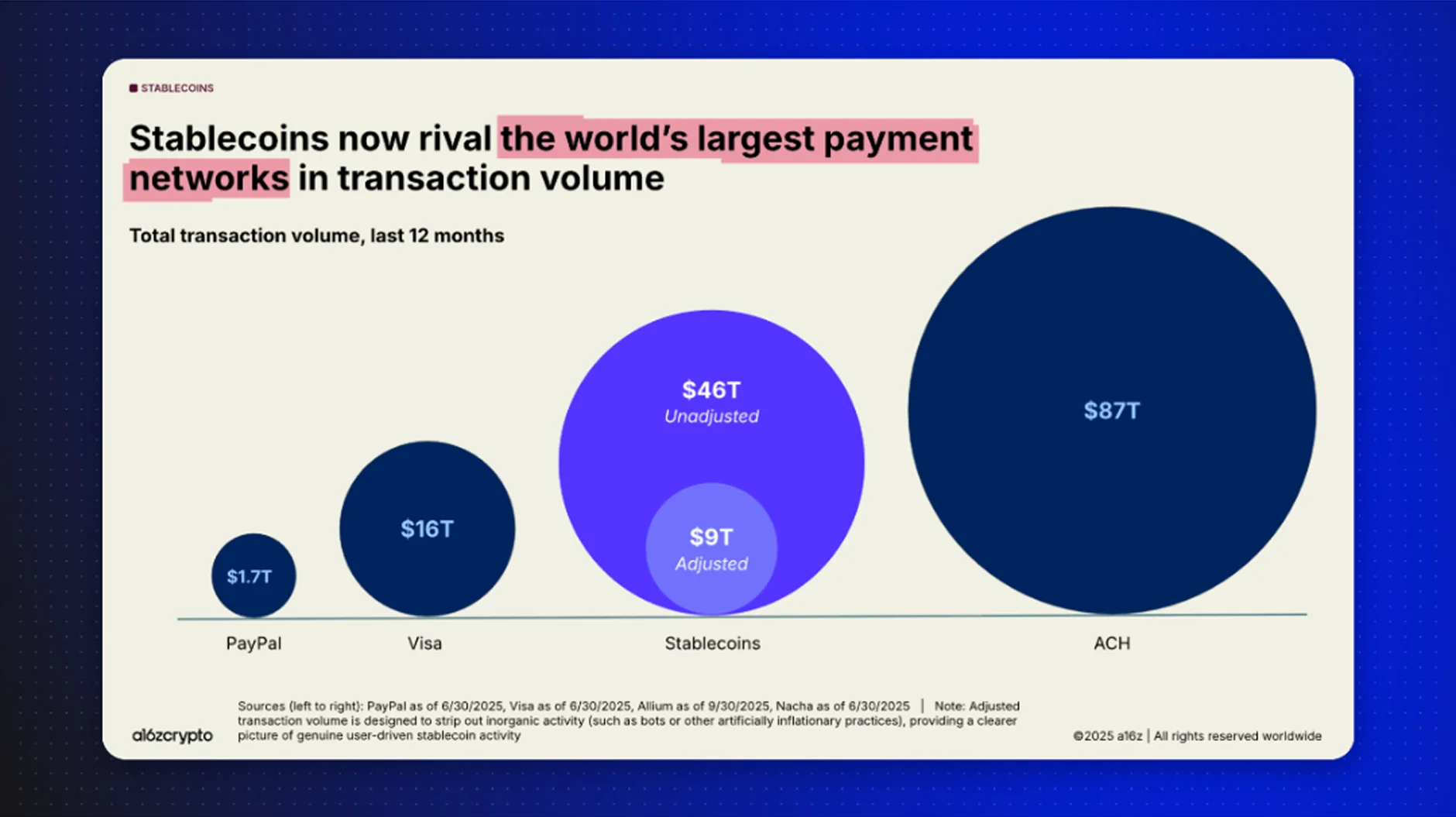
Those figures place stablecoins alongside major payment networks in terms of throughput. They show how stablecoins are used: as predictable, fast-moving money for efficient transfers.
Many users now encounter stablecoins as a way to move money efficiently - often inside products that feel like standard fintech.
Tokenized real-world assets moved closer to execution
Alongside payments, tokenized real-world assets gained momentum.
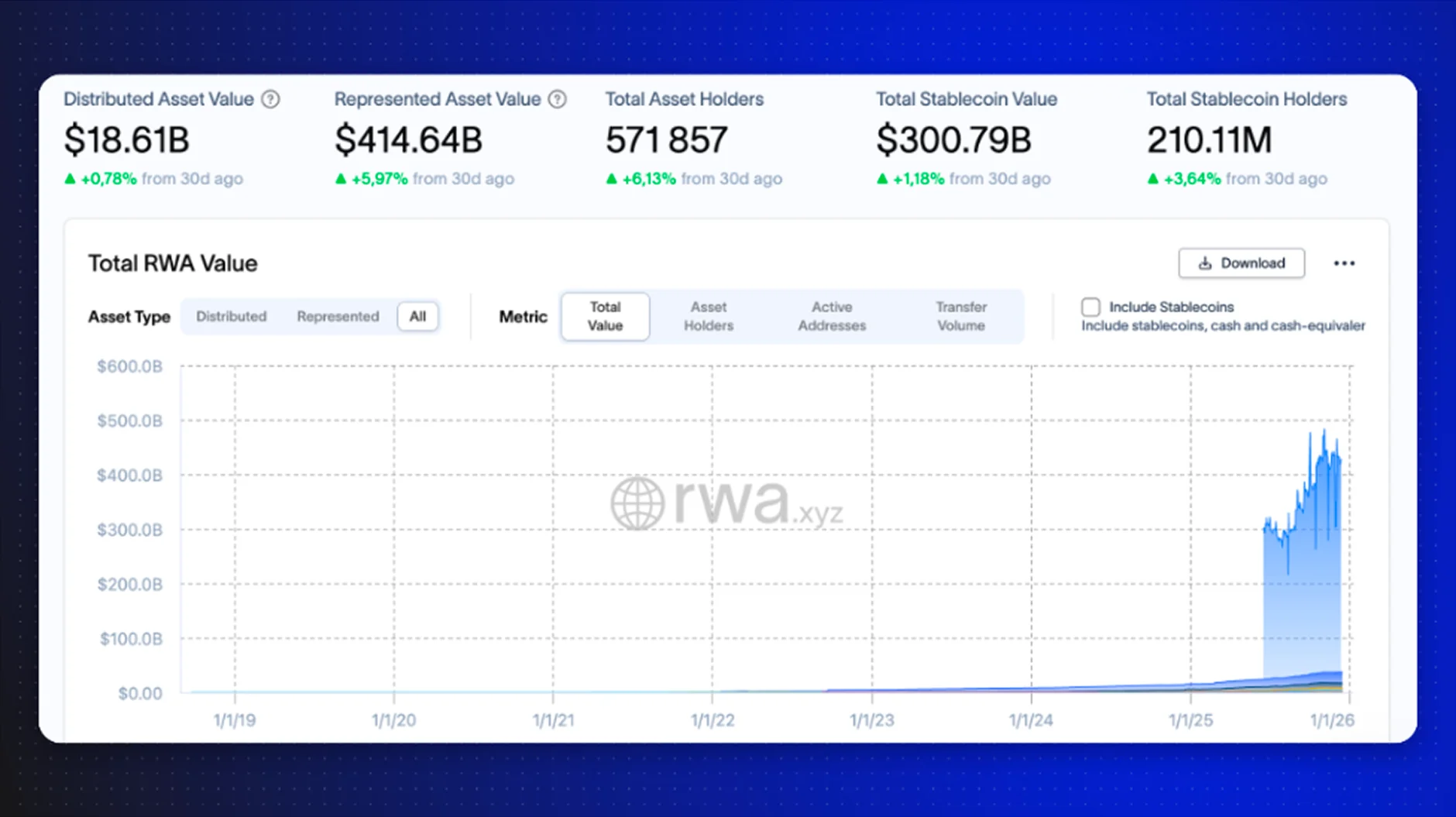
Standard Chartered projected that the tokenized RWA market (excluding stablecoins) could reach $2 trillion by 2028, up from roughly $35 billion today.
Retail users gain fractional access to assets that were previously difficult to reach. Ownership becomes more flexible, while infrastructure becomes simpler.
This narrative reshapes how crypto is evaluated. Blockchain becomes understood as a settlement and access layer for existing markets.
The boundary keeps fading.
Distribution surfaces are becoming more familiar:
- Fintech apps make crypto exposure feel like a feature rather than a separate identity.
- Payment processors make acceptance easier for merchants who want settlement and conversion handled cleanly.
- Banks expand access through interfaces consumers already trust.
As these channels grow, the audience expands with them. Many of these users evaluate products the same way they evaluate any other financial tool.
What This Means for Marketing in 2026
As crypto products move through mainstream financial rails, the marketing job shifts with them. Crypto products now get evaluated alongside fintech apps, payment tools, and financial services people already understand. That changes how products are positioned, what signals matter most, and where teams focus effort.
It shows up in three practical ways.
- The user outcome leads the message: Messaging that works with retail audiences starts with the benefit they can feel: faster settlement, lower fees, easier access, and predictable transfers. Technical details have their place - they come after the core benefit is clear.
- Trust becomes part of the product story: Retail markets demand proof. Partnerships, compliance posture, security practices, support, and reliability all show up earlier in the decision process. As mainstream surfaces pull users in, expectations rise with them.
- Retail UX standards become the baseline: The experience has to match what users already tolerate in banking, commerce, and consumer fintech. Simple flows, readable language, fewer steps, clear error states, and support that feels reachable - these stop being “nice to have.”
Marketing that adapts to these changes will speak to a much wider audience and convert more consistently. It matches the way retail users think, evaluate, and choose products.
Chapter 6: AI-Native Marketing Workflows
AI changed how crypto marketing operates throughout 2025. Tasks that once required constant manual effort became systemized. Community support runs continuously. Content moves from draft to distribution in minutes. Campaign execution no longer depends on daily coordination.
As teams prepare for 2026, this infrastructure is becoming standard. Automation increases reach, consistency, and speed. At the same time, it changes how attention forms and how credibility is established. Marketing now operates in an environment where activity is abundant, and evaluation takes more time.
How AI Agents Change Content Distribution
AI agents now handle much of the repetitive work that once limited scale.
In community channels, automated systems answer common questions, guide onboarding, and provide basic support across time zones. They track recurring issues, surface high-intent conversations, and maintain coverage while keeping moderator teams lean.
Content distribution follows a similar pattern. AI-assisted tools generate updates, educational posts, summaries, and newsletters quickly. Platforms streamline aggregation and formatting, allowing teams to maintain cadence efficiently. Human input shifts toward editing, framing, and accuracy.
Social presence becomes more consistent. Automated profiles manage posting schedules and engagement across platforms on clear systems.
Campaign execution scales as well. AI-driven platforms assist with creator discovery, outreach tracking, performance monitoring, and budget optimization. Smaller teams manage programs that previously required dedicated departments.
The result is a broader reach and more predictable execution.
Personalization at Scale Without Losing Authenticity
Generic messaging no longer lands the way it once did. Research from McKinsey shows that 71% of consumers expect personalized interactions, and 76% feel frustrated when brands miss the mark.
As AI handles more of the execution layer, personalization becomes less about tooling and more about discipline. The advantage comes from how clearly automation is directed, constrained, and reviewed.
Getting personalization right comes down to a few core principles:
- Human direction stays central. AI surfaces insights. Humans decide how to communicate them. Brand voice, tone, and narrative still require judgment. Teams that separate insight generation from message ownership maintain coherence.
- Consistency matters. Automated outputs should sound like the project. Tone guidelines, templates, and editorial review help maintain continuity across channels.
- Space for real interaction. Automation handles routine communication. Direct engagement remains important for moments that require context, trust, or nuance.
- Relevance over volume. Personalization is about showing up at the right moment with relevant information. Well-aligned interactions perform better when they match user needs.
AI marketing systems function best as infrastructure. They create leverage, coordination, and scale. Authenticity comes from how teams use that leverage: through clarity, consistency, and intentional human involvement.
The Rise of AI-Generated Shilling
As AI tools spread across crypto marketing workflows, the volume of automated content increased just as quickly. By 2025, bots were producing human-sounding posts at scale across X, Telegram, and Discord. Reply sections filled with repetitive hype, recycled takes, and low-effort engagement designed to farm visibility.
The InfoFi wave made the scale visible. Platforms that rewarded users for posting crypto commentary unintentionally encouraged mass production of AI content.
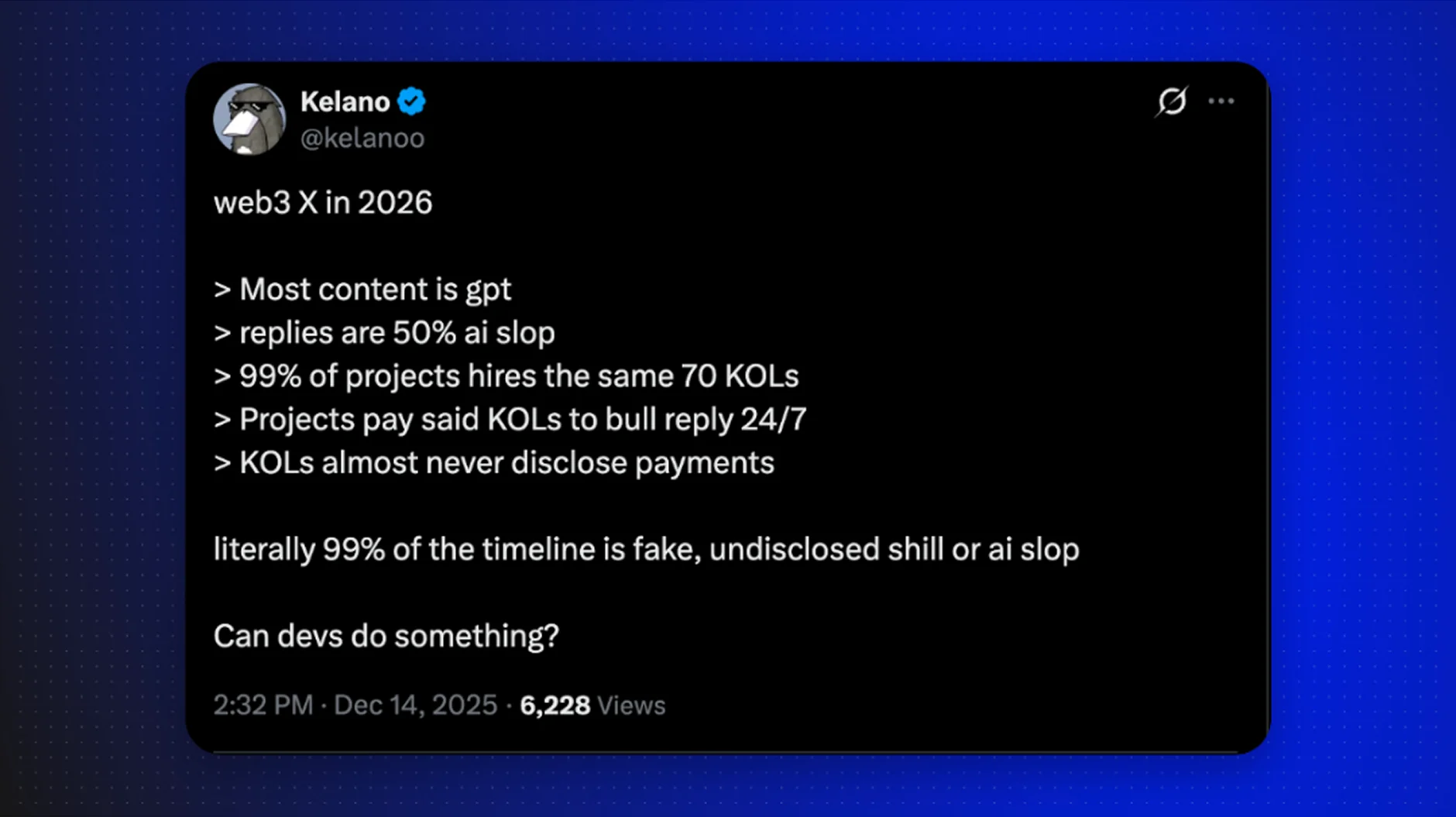
Surface-level engagement lost credibility. Activity rarely reflected real interest or sustained participation. Users and platforms started looking for stronger signals.
How Projects Stand Out in a Saturated Environment
Projects planning for 2026 should focus on signals that are hard to fake. In an environment where activity is cheap to generate, credibility comes from choices in how marketing is designed and executed.
That difference becomes visible in a few repeatable behaviors:
- Prioritize visible builders and real voices. Make founders and core contributors consistently present. AMAs, live discussions, and direct updates help anchor the project in real people and real decision-making. Regular visibility creates continuity and makes progress easier to trust.
- Shift from broadcasting to participation. Highlight real usage, user feedback, and community contributions. User stories, organic discussion, and shared milestones carry more weight than polished marketing messages.
- Design engagement for longevity. Move away from short-term engagement mechanics. Systems that reward ongoing involvement, such as quest-based programs, progression paths, and contribution-based incentives, encourage learning, experimentation, and continued use. These approaches generate activity grounded in real behavior.
- Tie access to meaningful activity. Consider reserving research, dashboards, early features, or insights for users who demonstrate genuine participation. Gating access through verifiable actions helps filter audiences naturally and improves engagement quality.
- Maintain clear editorial standards. Use AI to support scale. Review, shape, and contextualize automated outputs to protect tone, clarity, and trust. Consistent editorial oversight ensures that automation remains aligned with the project’s voice and values.
Content generation is now easy. Credibility requires real work. The projects that stand out in 2026 build marketing systems around participation, visibility, and proof of real use. In crowded feeds, those signals travel further and last longer.
Chapter 7: Trust and Compliance
By 2025, a clear pattern had emerged: projects that treated transparency as optional struggled to grow. Regulatory pressure increased, users became more cautious, and reputational damage proved hard to reverse.
As the industry matured, trust became a defining growth factor. Projects that invested in compliance, clear communication, and verifiable behavior found it easier to attract users, partners, and capital. Trust started influencing measurable outcomes.
This shift showed up in the data. After new EU regulations came into effect, fully compliant exchanges saw a noticeable increase in retail sign-ups, outperforming peers that operated with less regulatory clarity. Compliance became a competitive advantage.
Regulatory-First Marketing
By the time teams started planning for 2026, the regulatory environment had become more structured. Europe's MiCA framework created a shared baseline, while other regions introduced clearer guidance. This gave many teams enough certainty to build compliance into their core strategy.
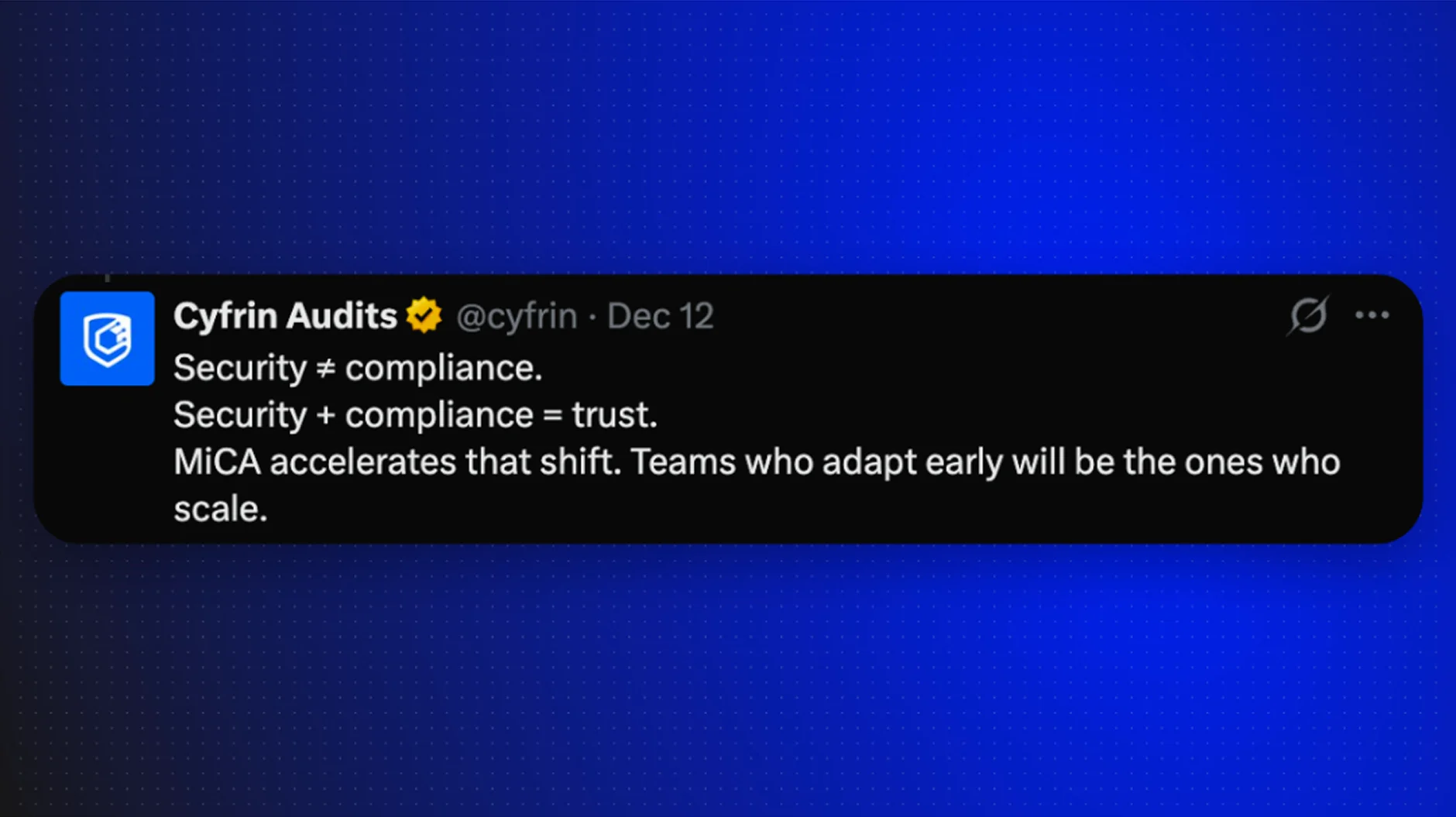
Marketing approaches adjusted accordingly. Instead of keeping regulatory details buried in legal sections, teams began presenting them more openly.
Common elements now featured in marketing materials:
- Licensing status and jurisdictional approvals
- Independent security audits
- Clear team identities and professional backgrounds
- Explicit risk disclosures
- Transparent token distribution and treasury structure
These signals address how users evaluate credibility. They also align with expectations from institutional partners and traditional financial platforms.
Retail users entering crypto through fintech apps look for familiar markers of legitimacy. Institutions require regulatory clarity before allocating capital. Payment providers and financial partners prefer working with projects that operate within defined frameworks. Clear compliance messaging supports all three.
Marketing teams increasingly work closely with legal advisors to ensure accuracy across communications. Claims are reviewed, terminology is precise, and metrics are verifiable. While this can slow execution, it reduces downstream risk and builds credibility over time.
Transparency as a Growth Input
Transparency increasingly срфтпуі how projects earn confidence as they move toward broader audiences. As expectations rise, trust develops through what teams show, explain, and document. In practice, this shows up across a few consistent areas:
- Security visibility. Audit reports are published and accessible. Architecture is explained in plain language. Historical issues are acknowledged along with remediation steps. Bug bounty programs and disclosure processes are easy to find.
- Risk communication. Projects explain potential downsides. Smart contract risk, market volatility, regulatory exposure, and technical constraints are addressed directly.
- Team visibility. Teams with public identities and verifiable experience tend to face fewer trust barriers. Backgrounds, prior work, and open-source contributions help users and partners assess credibility quickly.
- Tokenomics clarity. Distribution schedules, vesting timelines, emissions plans, and treasury management are outlined clearly. Transparent allocations and predictable unlocks build confidence.
These elements form the baseline for 2026. Transparency marks maturity in a market where trust develops through what teams consistently show and explain.
What This Means for Execution
As expectations rise, marketing execution becomes more intentional. Day-to-day decisions reflect the same discipline applied to product and operations. This shows up most clearly in how teams plan, communicate, and evaluate risk:
- More deliberate content. Claims are supported. Statistics are contextualized. Language avoids exaggeration. Output may be lower in volume, but clarity and confidence increase.
- Stricter partnership criteria. Influencers, integrations, and collaborators are evaluated more carefully. Reputation risk is considered part of the decision.
- Compliance as positioning. Regulatory alignment is communicated alongside product capabilities. Labels like “MiCA-compliant” or “audited” appear as trust signals.
- Crisis communication standards. When issues arise, prompt disclosure and clear updates play a major role in preserving confidence. Projects that communicate consistently tend to recover more effectively.
As teams look toward 2026, marketing decisions increasingly revolve around a simple question:
Does this strengthen long-term trust?
The projects that scale steadily are the ones users, partners, and regulators feel comfortable engaging with over time.
Chapter 8: Sector-Specific Strategy Playbooks
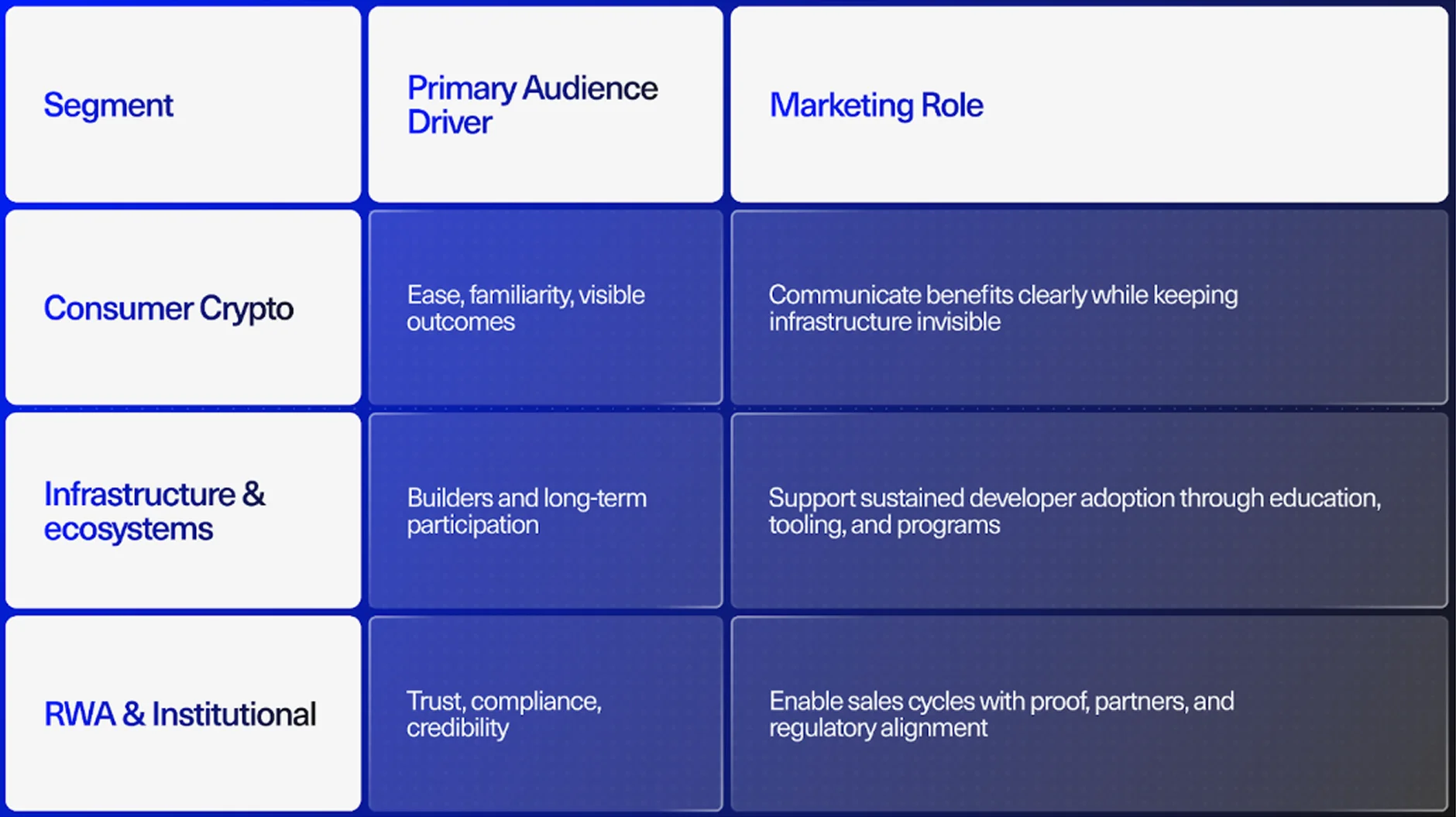
Crypto growth follows different paths across different sectors. As the market expands, each vertical moves forward for distinct reasons. Marketing works best when it reflects the specific dynamics of each sector. Strategy means matching how value is discovered, evaluated, and sustained in each context.
Consumer Crypto
Adoption increases when products feel familiar and easy to use.
Teams that reduce visible complexity tend to attract broader audiences. Products that lead with benefits such as access, speed, or entertainment reach users more effectively than those centered on technical explanations. Consumer-facing crypto products perform best when messaging stays outcome-driven. Successful positioning emphasizes what users gain.
Examples from 2024–2025 reinforce this approach:
- MoonPay framed its product around fast card-based access
- Immutable emphasized gas-free gameplay
- Lens Protocol described user ownership and portability
As crypto products reach broader audiences, familiarity becomes a practical advantage. Teams that make value easy to understand reduce friction early and expand who can engage with the product. In consumer crypto, clear outcomes and simple experiences set the foundation for adoption.
Infrastructure and Ecosystem Growth
For L1s, L2s, and tooling platforms, developer adoption shapes long-term outcomes. Builder activity translates into applications, users, and transaction volume over time.
Leading ecosystems invest heavily in developer growth. Annual allocations range from tens of millions to several hundred million dollars, structured through milestone-based grants, hackathons, and ongoing support.
Arbitrum, Optimism, Solana, and Polkadot each developed distinct funding models, combining grants, retroactive rewards, and educational pipelines. Hackathons functioned as entry points, while bootcamps and documentation supported retention.
Documentation plays a direct marketing role in this segment. Clear onboarding, examples, and tutorials reduce friction. Platforms like Base turned education into engagement by linking learning paths to on-chain activity and recognition.
As L2 competition intensified, differentiation shifted toward developer experience, tooling compatibility, and economic support rather than narrative positioning alone.
RWA and Institutional Markets
Tokenized real-world assets expanded rapidly through 2024 and 2025. Market size estimates rose sharply as traditional asset managers entered the space. Growth came primarily from institutional participation rather than retail speculation.
BlackRock's BUIDL fund demonstrated how institutional positioning works in practice. Messaging focused on operational efficiency and client outcomes. Partnerships with custodians, transfer agents, and infrastructure providers reinforced credibility. Expansion across multiple chains followed demand.
Securitize and Ondo Finance showed similar patterns. Regulatory status, team backgrounds, and partner networks featured prominently in their positioning. Compliance functioned as an asset.
Sales cycles in this segment stretched across multiple quarters. Progress depended on education, proof of concept, risk review, and procurement alignment. Relationships extended beyond single champions to include legal, compliance, and executive stakeholders.
Messaging followed institutional norms. Content leaned toward research, documentation, and factual performance. Claims stayed within regulatory requirements. Trust signals served as primary persuasion tools.
The Core Principle
Across all three segments, the underlying lesson remains consistent. Growth reflects alignment with audience expectations, distribution surfaces, and decision processes.
Recognize which environment you operate in and shape marketing systems accordingly.
Chapter 9: Rewards ≠ Retention
Between 2023 and 2025, points systems and airdrops became one of the most widely used growth tools in crypto. What started as an effective way to attract early users scaled quickly into a standard acquisition mechanic.
By early 2024, more than 115 billion points had been distributed across protocols. By year-end, roughly 88% of crypto projects had launched some form of airdrop, drawing close to 200 million participants. Participation increased sharply while outcomes became more predictable.
As rewards scaled, farming professionalized.
Entire ecosystems emerged around extracting value from incentive programs. Educational content on airdrop optimization became mainstream. Tooling advanced. Multi-wallet management, cloud phone infrastructure, and opportunity aggregators turned farming into a repeatable process.
Industrial-scale operations followed. Reporting documented setups running tens of thousands of devices in parallel, coordinated through master systems designed to evade Sybil detection. At this scale, incentive programs became distribution events captured by specialists.
The data confirms the impact.
During Arbitrum's airdrop, nearly half of all tokens went to addresses controlled by users managing multiple wallets. LayerZero identified hundreds of thousands of Sybil addresses, representing a meaningful share of eligible participants. Some projects saw a small number of entities claim disproportionate portions of supply.
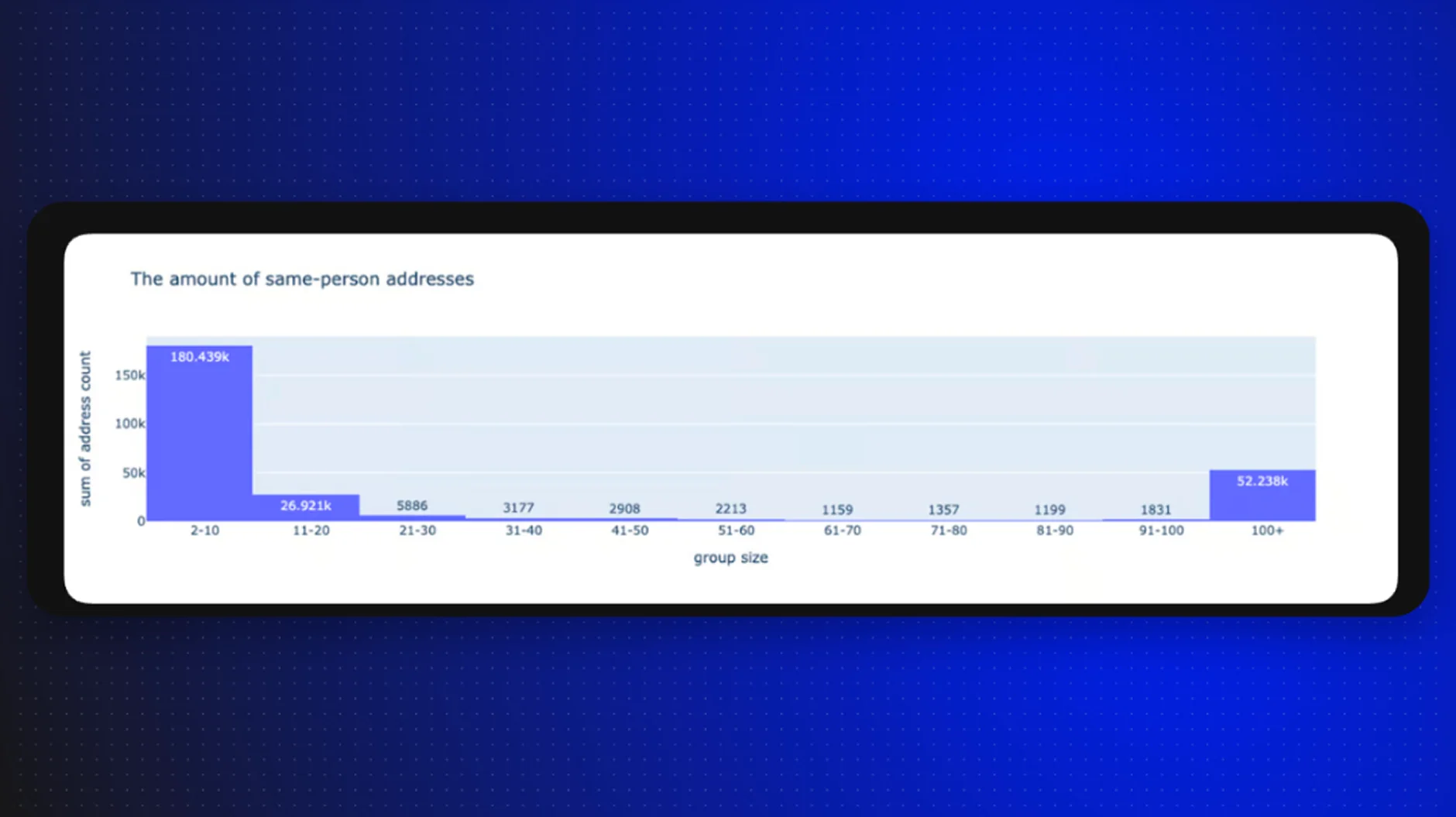
Teams invested heavily in filtering and enforcement. These efforts increased operational complexity, community friction, and moderation overhead. Even aggressive anti-Sybil campaigns resulted in large-scale self-reporting, appeals, and engagement drops immediately after announcements.
Incentives attracted attention at scale. Usage after distribution told a different story.
Retention Patterns After Incentives End
Post-airdrop behavior follows a consistent curve across most protocols.
Analyses of dozens of airdrops show that the majority of distributed tokens lose value within weeks. Withdrawals following incentive events regularly reduce retained TVL by up to 40%. Activity typically settles slightly above pre-airdrop baselines before flattening.
Wallet-level data reinforces this pattern. A large share of users transact once and disappear. Few convert into repeat users within the first month. Products that reach strong retention benchmarks do so through completion of a core value action.
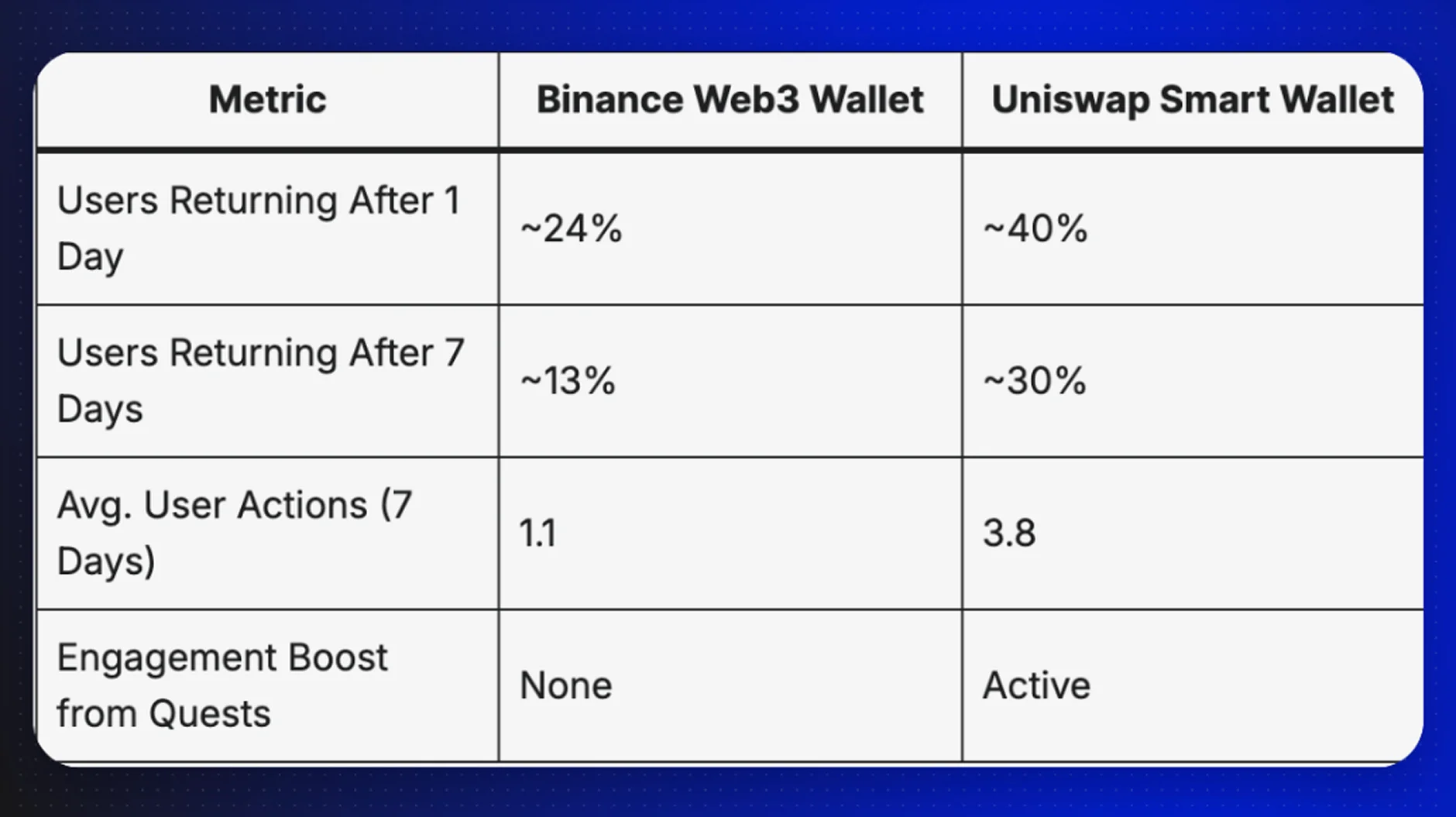
The cost implications compound quickly.
Web3 companies routinely spend a significantly higher share of enterprise value on acquisition than their Web2 peers. When incentives represent a meaningful percentage of fully diluted valuation, the effective cost per retained user escalates sharply once churn is accounted for.
Airdrops distribute supply efficiently. Commitment develops through different means.
Product-Market Fit Comes First
Sustainable growth in crypto consistently starts with product-market fit. When users return because the product delivers clear value, incentives can support growth. The projects that internalized this sequence built real usage first and introduced tokens only after behavior was already established.
- Uniswap, dYdX, Compound, and Arbitrum built working products, found active users, and established clear use cases before introducing tokens. Incentives arrived after behavior stabilized rather than before.
- Polymarket demonstrated product-market fit during the 2024 U.S. election cycle. Activity increased rapidly as the platform provided timely, accurate market signals. Growth was driven by usage rather than speculation. Stablecoin settlement kept attention on outcomes rather than token price.
In each case, incentives reinforced existing behavior.
How to Assess Product-Market Fit in Web3
Traditional metrics can be influenced by incentives or automation in crypto environments. Wallet counts, transaction volume, and community size require careful interpretation.
More durable signals:
→ Organic retention without rewards
→ Depth and frequency of usage
→ User-driven referrals
→ Revenue or value generated through real activity
→ Community quality
Feedback matters. Asking users how they would feel if a product disappeared still provides insight, though responses require interpretation when financial incentives are present.
Timing matters as well. Teams that focus early cycles on product iteration, direct user feedback, and economic clarity tend to introduce growth mechanics more successfully later.
Closing
Crypto marketing in 2026 will look different.
The shift is already underway. Users are asking different questions. Attention is spreading across platforms. Retention is becoming harder to fake. Incentives are losing efficiency. Compliance is moving from optional to expected. Products that work are starting to outlast those built on momentum alone.
By the time most teams adjust, the market will have already moved.
The window to prepare is narrow. Projects that move now will enter 2026 with established systems, proven channels, and clear positioning. Those that wait will spend the year catching up while competitors capture mindshare, users, and market position. The cost of waiting compounds quickly in crypto.
Preparation makes the difference.