


























Two platforms most people barely heard of in 2022 settled more notional trading volume last year than the GDP of New Zealand.
Kalshi and Polymarket combined: $44B in 2025. Kalshi raised $1B at a $22B valuation in May 2026. NYSE's parent company, ICE, committed $2B to Polymarket at a $9B valuation. AI agents are executing 30%+ of onchain trades. And a clutch of new teams is building vertical-specific platforms on Base, Solana, Hyperliquid, and Arweave - each betting the duopoly can't own every category.
This is the most complete overview of who's building in prediction markets right now.
The numbers that changed the story
2024 was the proof point. The U.S. presidential election sent $3.3B through Polymarket's election market alone. Every major financial news desk covered prediction market odds during the campaign. Bloomberg, Politico, and FiveThirtyEight cited them in their analyses.
What happened after November 5 surprised everyone. Volume didn't collapse back to baseline. Sports markets absorbed the slack.
By the end of 2025, sports accounted for 85% of Kalshi's trading volume and 39% of Polymarket's. Tech and Science markets grew 1,637% year-over-year. Economics markets grew 905%. Politics - the vertical everyone assumed drove everything - grew only 43%.
Prediction markets found their durable engine, and it wasn't elections.
The duopoly
Polymarket runs on Polygon, settles in USDC, and has deliberately avoided charging fees on most markets to build volume dominance first. ICE made a $2B strategic investment at roughly a $9B post-money valuation in October 2025. X named Polymarket its official prediction market partner in June 2025. Substack integrated live Polymarket odds natively in February 2026 - within weeks, one in five of Substack's top 250 highest-revenue publications was using the data. The platform's CMO confirmed a POLY token and airdrop are coming. Estimated fee run-rate: $200M+ annually once full rollout ships.
Kalshi secured CFTC designation as a designated contract market - the first of its kind for event contracts - and used it as a distribution moat. That credential got it into Robinhood, which facilitated 4B+ event contracts in 2025 alone. Kalshi launched Super Bowl markets in January 2025. Sports went from ~10% of volume to 85%+ in under 12 months. In May 2026 it raised $1B at a $22B valuation led by Coatue, with Sequoia, a16z, Paradigm, Morgan Stanley, and ARK. At that close: ~2M monthly users, ~$178B annualized trading volume, ~$1.5B annualized revenue.
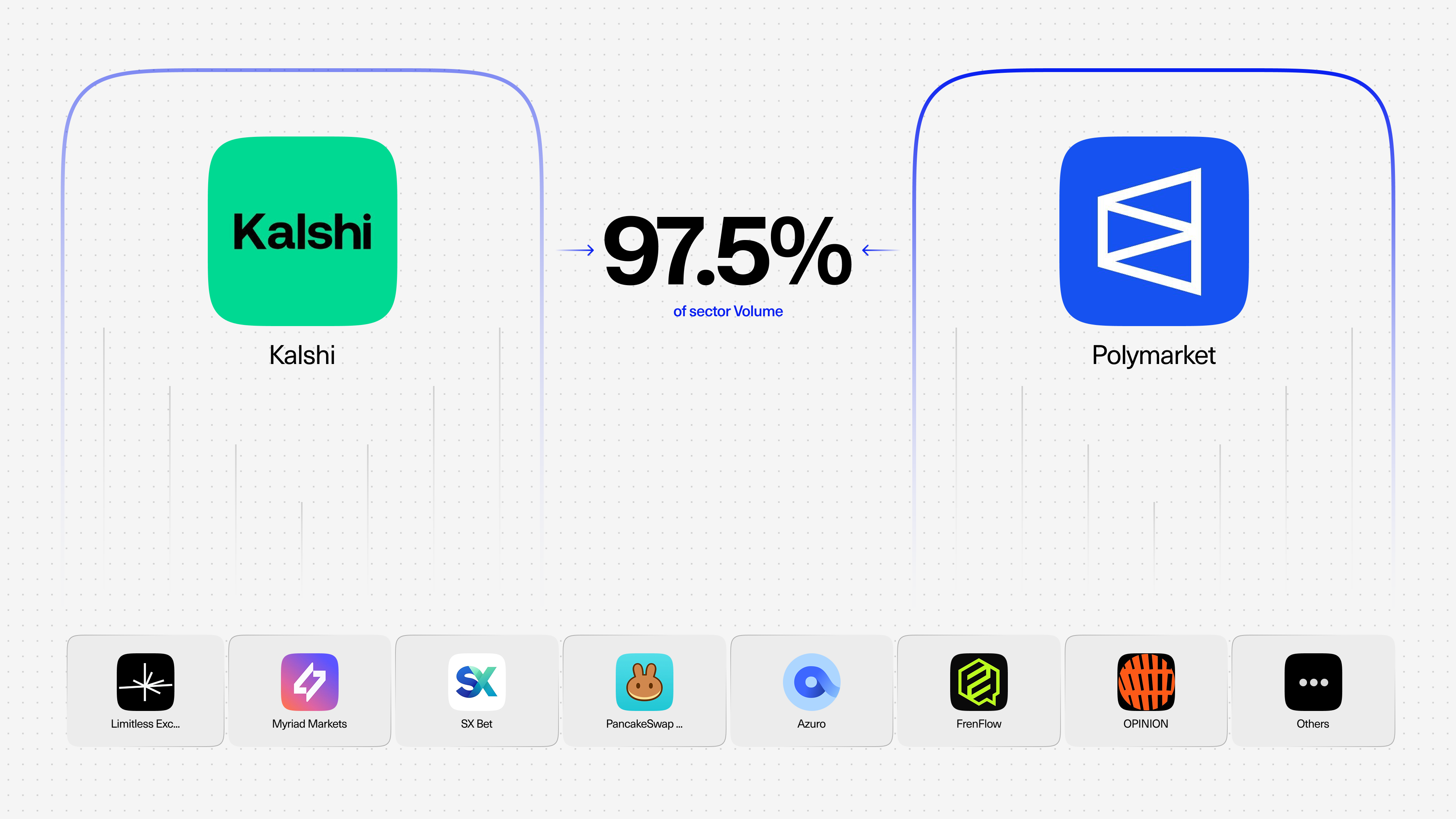
Together they controlled roughly 97.5% of the sector's trading volume in 2025.
The ecosystem map
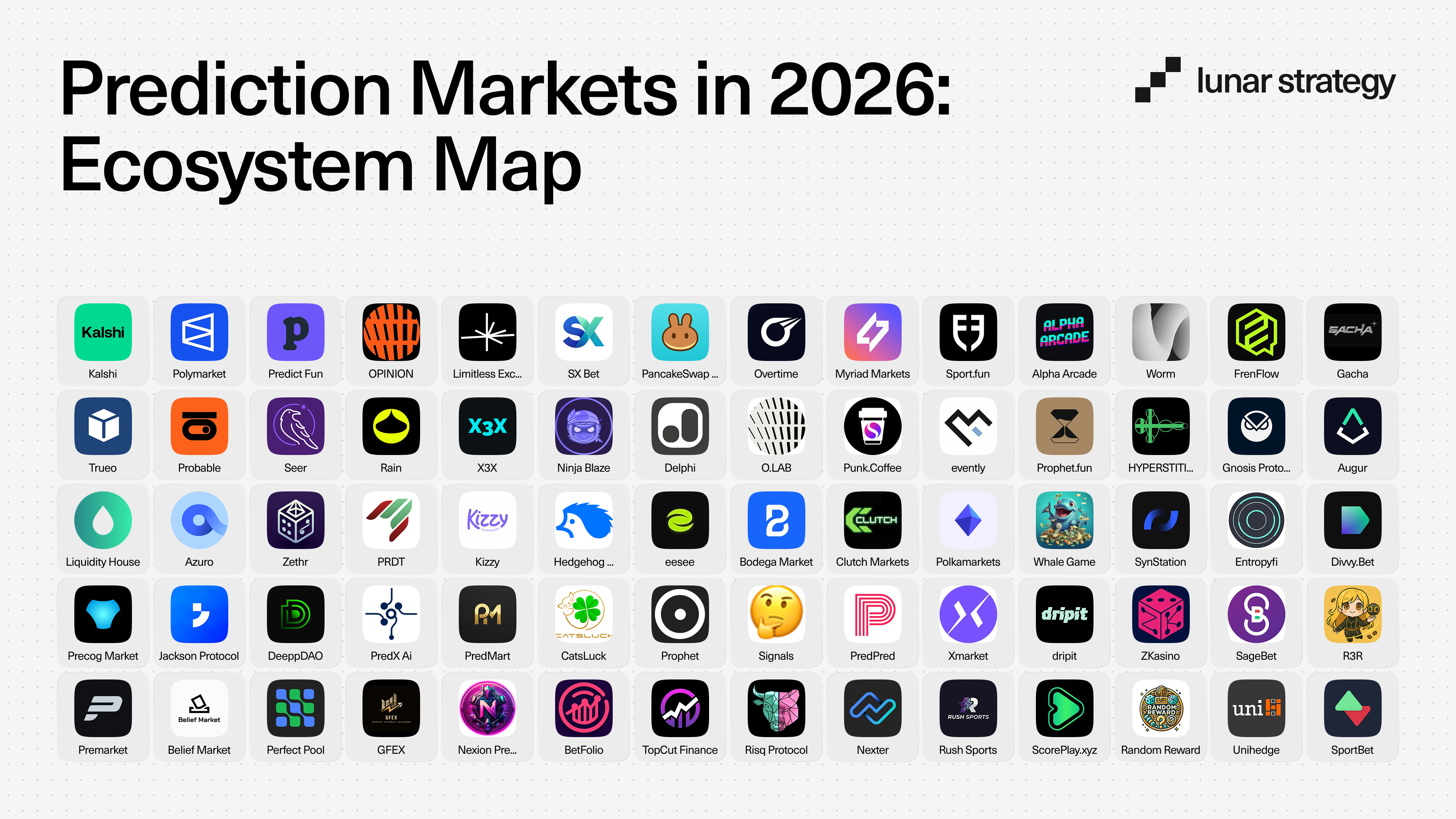
The challengers
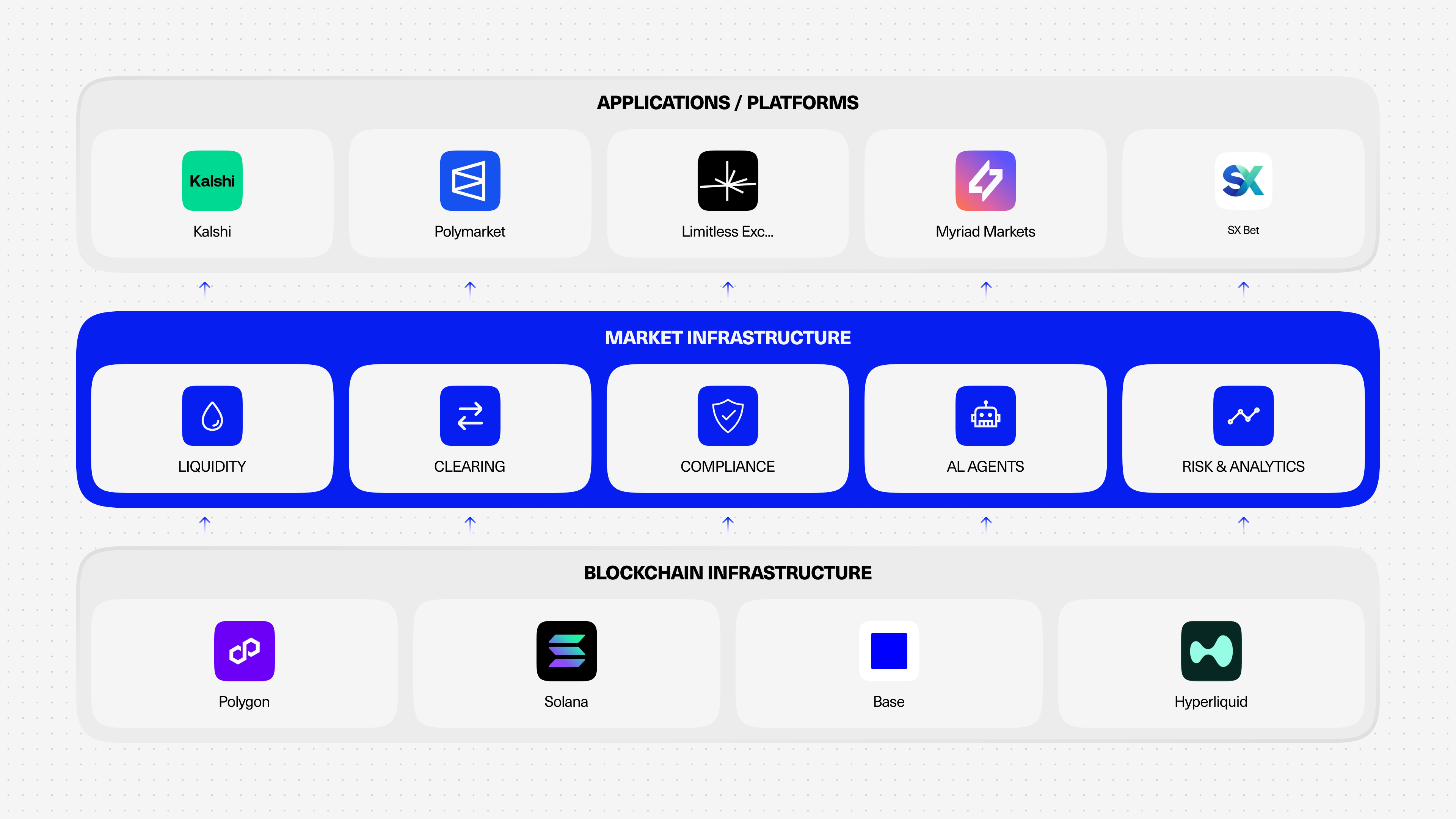
A dozen teams are building outside the duopoly. Each targeting a specific gap.
Limitless is on Base. Short-duration markets - 15-minute, hourly, daily - built for crypto and stock traders who want fast resolution. Raised $10M from 1confirmation, Coinbase Ventures, F-Prime, DCG, and Arrington. Hit $1.1B monthly volume in Q1 2026. The $LMTS token launched with an $800M FDV at ATH.
Myriad runs on Abstract chain with integrations into Linea, Celo, and BNB. The bet: media-native prediction markets. First distribution deal was embedding predictions into Trust Wallet in December 2025. 430k+ users, 1.7M+ predictions placed. Founded by the team behind Decrypt and Rug Radio.
KASH embeds into X via @kash_bot, letting users create and trade predictions inside quote-posts. Raised $2M in February 2026 from Big Brain Holdings, Spartan, Coinbase Ventures, Animoca, and Sui Foundation. The thesis: the prediction market with the shortest path to where users already spend time wins.
Drift Protocol is built on Drift Protocol's $500M Solana liquidity pool. 30+ collateral tokens accepted, cross-collateral positions, FUEL rewards.
Hedgehog Market targets onchain-native metrics - base fees, funding rates, validator performance - plus general binary options on Solana and Eclipse. Permissionless market creation. Around $20M TVL at peak.
Hyperliquid HIP-4 launched May 2, 2026, co-authored with Kalshi's head of crypto John Wang. Fully USDH-collateralized, CLOB-based, zero open fees. The first market, a BTC outcome deployed by Hyperliquid themselves, did $6M in volume on day one. Outcome is currently the leading front-end for HIP-4, driving 10x more volume than any other interface.
Azuro protocol is infrastructure rather than a consumer frontend. A sports prediction layer for other teams to build on, using a Liquidity Tree pool design. $11M raised from Delphi Digital, Gnosis, and Arrington Capital.
Overtime runs on Optimism, Arbitrum, and Base. All protocol revenue flows to $OVER token buybacks.
Robinhood - powered by Kalshi's backend - facilitated 2B+ event contracts in Q3 2025 alone.
On the infrastructure side: the clearing company raised a $15M seed from Union Square Ventures, Haun Ventures, Coinbase Ventures, and Variant in August 2025. Founded by former Polymarket and Kalshi executives. Capital flowing to the clearinghouse layer is a classic asset-class maturation signal.
What's driving 2026
Regulated venues want onchain rails. Kalshi tokenizing markets on Solana, Polymarket's acquisition of QCEX for U.S. CFTC compliance, and Hyperliquid's HIP-4 co-authored with Kalshi all point the same direction: one global liquidity layer with regional regulatory wrappers above it.
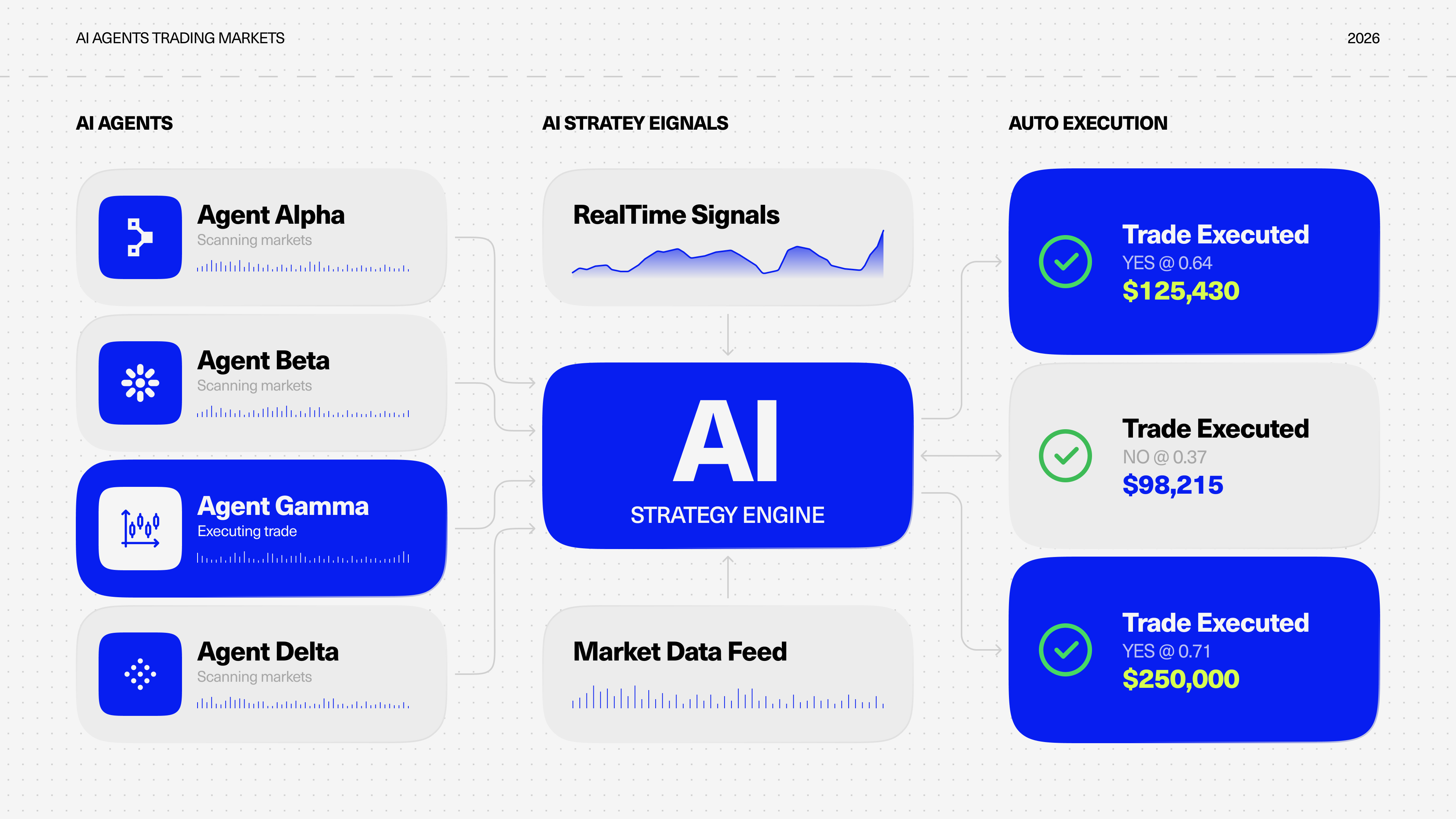
AI agents are already a material share of activity. More than 30% of wallets on Polymarket are running AI agents, according to analytics platform LayerHub. Olas's Polystrat agent executed 4,200+ trades in its first month with returns up to 376% on individual positions. Elastics raised $2M for a natural-language trading interface. Prediction markets are becoming algo-trading venues whether or not teams design for it.
Media platforms treat prediction odds as sticky content. X's official partner deal, Substack's native integration, and Google Finance displaying live odds all serve the same function: turning financial questions into shared media moments that drive organic acquisition.
Sports is the durable vertical. The 2024 election built the audience. Sports retained it. Any new platform raising capital in 2026 without a sports strategy is either building deep infrastructure or making a concentrated bet on a niche.
The real challenges
Three risks are worth naming directly.
Volume metrics are contested. Paradigm published analysis in December 2025 showing that Polymarket's NegRisk architecture causes double-counting in most third-party trackers. CertiK estimated wash-trading peaked near 60% of some 2024 Polymarket volumes. The $44B figure is a directional benchmark, not a clean audit.
State-level legal friction is real. 19+ federal lawsuits as of January 2026. Ohio ruled in March 2026 that Kalshi's sports products are gambling. Wisconsin and Arizona AGs have filed actions against both platforms. Federal tailwinds from the CFTC coexist with serious state-level headwinds - and that tension won't resolve quickly.
Token speculation is inflating activity. A meaningful share of 2025 and early 2026 volume tracks POLY airdrop anticipation. Any platform publishing headline volume numbers without noting this is doing its readers a disservice.
The bottom line
Prediction markets crossed from "interesting DeFi experiment" to a financial asset class in 2024. In 2025, they built institutional plumbing - exchange parent strategic investments, CFTC settlements, Robinhood integrations, and clearinghouse seed rounds. In 2026, the field is figuring out who else can win besides Kalshi and Polymarket.
The answer, so far: vertically specialized teams with a clear distribution advantage and a defined path to either regulatory cover or onchain liquidity density.
The generalist clone play is dead. Every other approach is still open.
If you're building in this space and want to figure out the right growth architecture for your vertical, let's talk.