



























TLDR:
- A yield vault sells trust that a yield source keeps paying, to capital that can leave any block. Attention is cheap. Trust is the wall.
- Whales and dolphins hold 70–99% of vault AUM. So attracting deposits is closer to enterprise BD than retail growth.
- Move capital through five stages: attention, trust, deposit, retain, refer. The trust stage is where most capital leaks.
- The biggest TVL comes from distribution (a CEX, wallet, or curator picking you up), not retail posts.
- Judge health by retention and net flows, not the headline TVL number.
Capital got skeptical this year, and the charts show it. DeFi's total value locked sits at $71.77B, down about 37% year-to-date, and it fell every single month of 2026 (Yahoo Finance). Behind every allocator's caution sits the Stream Finance collapse of November 2025, a roughly $93M loss that analysts mapped to about $285M of potential contagion across DeFi (The Block). Money that used to move on a headline yield now checks the audit before it commits.
That changes what vault marketing is. A yield vault sells one thing: trust that a yield source will keep paying, to capital that can leave any block. Not a token, not an APY number, but trust. Deposits are a vote of trust, and they're liquid, so the entire job is manufacturing and compounding trust while making it easy for the right capital to find you and hard for it to leave.
Vaults don't grow on APY. They grow on trust, distribution, and a credible incentive engine.
— Shann Holmberg, Lunar Strategy
Most vaults that stall have plenty of eyes on them and no proof to turn those eyes into deposits.
What a DeFi vault is, and why marketing one is different
A DeFi vault is a smart contract that takes a deposit, say USDC, hands you a share token representing your slice of the pool, and runs a strategy so you don't manage positions across protocols by hand. As the strategy earns and compounds, each share is worth more, and the capital in the vault, its TVL, grows. It's a fund wrapper, sometimes called a yield aggregator: the vault is the fund, the share token is your LP position, the strategy is the engine that produces the yield.
The difference from manual DeFi yield farming or staking is automation. Instead of moving capital between protocols and watching positions yourself, you deposit once and the strategy runs. Most vaults use the ERC-4626 tokenized-vault standard, which is why aggregators can list and compare them so easily; there are already 1,300-plus ERC-4626 stablecoin vaults tracked on-chain (Lagoon Finance).
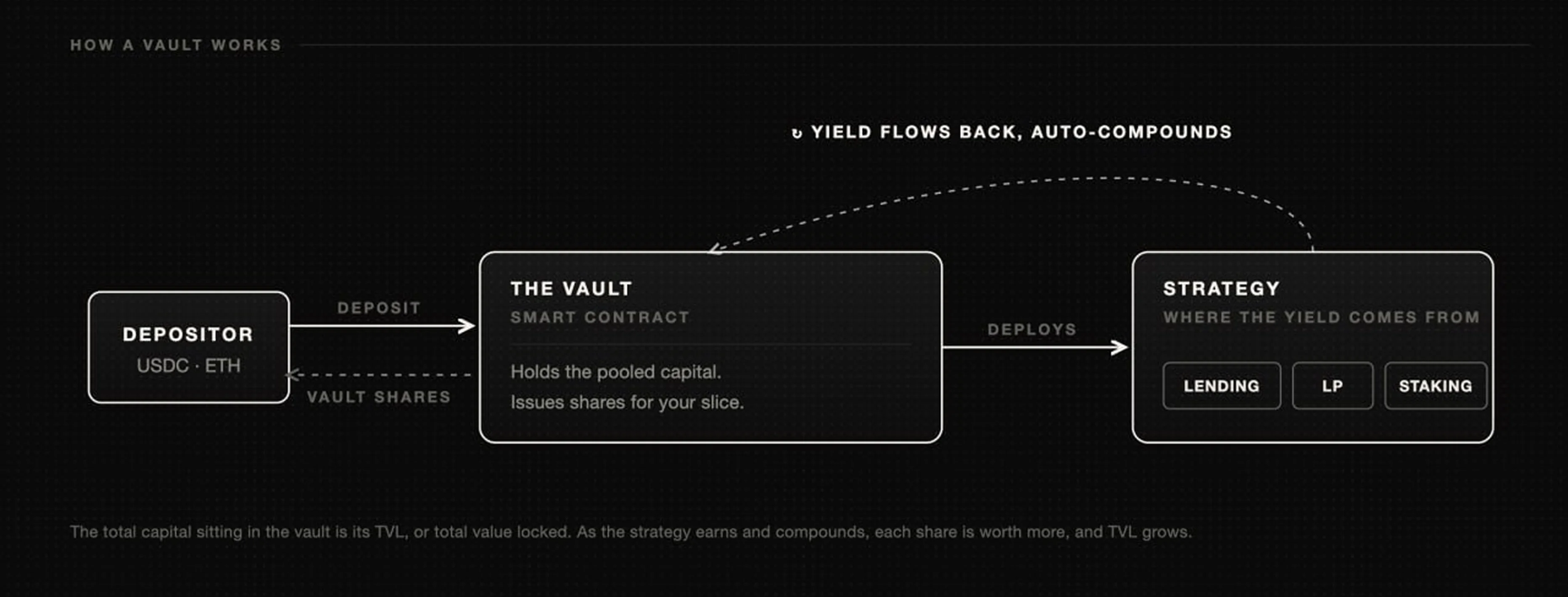
The defining shift of this cycle is the curator: a team or DAO that sets a vault's strategy and risk parameters without ever holding your funds. Safety is enforced by code, not a handshake, through timelocks, guardians, and hard per-market caps, so depositors pick a curator the way they'd pick a fund manager. Morpho sits at the center, with roughly $7B in TVL and a curator layer that allocates deposits across isolated lending markets (DeFiLlama). It matters enough that Apollo Global Management, which runs $940B in traditional assets, signed a deal to acquire up to 9% of MORPHO's supply over four years (RockawayX).
Marketing a vault is different because the buyer verifies before committing. The person deciding will open DeFiLlama, check the audit, look up the yield source, and read how the team behaved the last time something broke. You aren't persuading. You're supplying evidence.
Why deposits follow trust, not yield
Post-Stream, the APY number is table stakes and the trust signals are the differentiator. Lead with track record, transparency, and team, because a high APY next to a thin story now reads as a warning. The serious curators have already repriced around this. Steakhouse, Gauntlet, and Morpho's own vault teams don't lead on “highest APY” anymore. They lead on capital preservation, public risk reports, and surviving stress events.
So transparency stops being a virtue statement and becomes the marketing itself. Real-time NAV and price-per-share, proof of reserves, position disclosure, “watch it update on-chain” is the pitch.
Publishing your numbers out-trusts publishing adjectives. That's the single biggest break from Web2 marketing.
— The Lunar Strategy vault playbook
Depositors have a fairly consistent order they judge you in, and the yield sits near the bottom of it.
| Order | Trust signal | What it proves |
|---|---|---|
| 01 | On-chain track record & NAV | The strategy has actually performed, and you can watch it update live. |
| 02 | Proof of reserves & position visibility | The assets are really there, and you can see where they sit. |
| 03 | Audits & security posture | The contract has been reviewed; caps and guardians exist. |
| 04 | TVL & retention | Other capital has validated it, and stayed. |
| 05 | Team credibility in incidents | How they behaved when something broke. This is the product. |
| 06 | Yield, stated plainly | Named in one sentence a smart allocator believes. |
For a curated vault, the curator's track record, risk method, and behavior when something broke is the product, not a supporting asset. Reputation is a channel. The sophisticated debate has already moved off “which curator has the best APY” and onto conflict of interest: should the entity setting risk parameters also profit from the vault? Engage that in the open and you sound like 2026. Shout a number and you sound like the cycle that just blew up.
Vaults are B2B, not B2C
Here's the reframe most vault content misses. Whales and dolphins account for 70 to 99% of vault AUM. Retail depositors, under $10K, contribute less than 1% (Lagoon Finance, citing Keyrock). So “attracting deposits” isn't a consumer growth funnel with a whale rounding error on top. It's closer to enterprise business development wearing DeFi clothes: a handful of allocators, funds, and HNW LPs move the number, and everyone else is noise on the chart.
Whales & dolphins: 70–99% of vault AUM. Retail (<$10K): <1%. — Lagoon / Keyrock, 2026
That changes where you spend. Broad reach and follower counts don't move this capital, because it verifies on-chain data instead of impressions. What moves it is curator reputation, direct relationships, and a private, curated channel where vetted deal flow lives without the chatter.
Across the vaults we’ve worked with, the thing that actually moves TVL is unglamorous: building relationships with LPs directly, one to one or in private forums rather than public feeds. A vetted, invite-only space — a private Telegram, a curated allocator list — tends to do the real closing, while the public channels mostly feed it. No chatter, just terms and due diligence for people who are there to allocate. And a focused email to a genuine LP list will out-convert broadcast reach every time.
Capital-targeted ads | one market-neutral vault Six figures deposited on a low-four-figure spend roughly 25× in a week | Most of it from a handful of large wallets
Even paid works better aimed at capital rather than reach. One market-neutral vault we worked with ran capital-qualified programmatic ads and turned a few thousand dollars of spend into six figures of deposits in a week, most of it from a handful of large wallets. Low click-through, large converters. The goal was never to be seen by everyone; it was to be found by the few wallets that matter.
The DeFi vault marketing funnel: attention, trust, deposit, retain, refer
Growing a vault means moving capital down a funnel: from first hearing about you, to trusting you, to depositing, to staying, to bringing others. Each step has its own question in the depositor's head, its own levers, and its own number to watch. Because the capital at the bottom is skeptical, the middle does more work than in a normal funnel. This is Lunar's five-stage model.
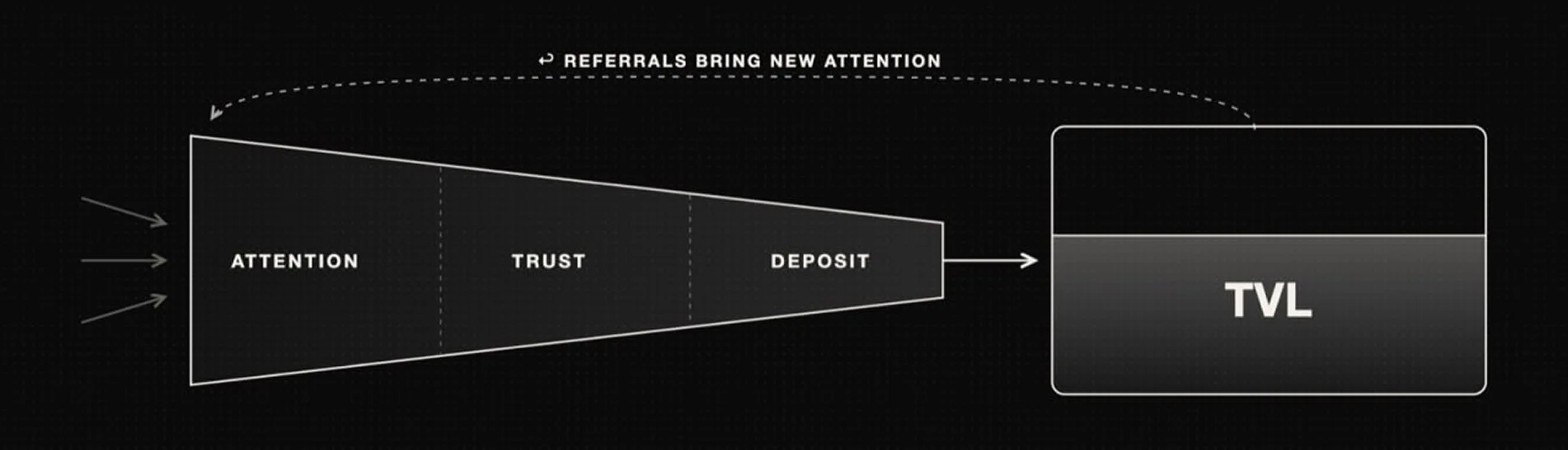
01 · Attention — “I've never heard of this. Is anyone using it?”
- Levers: founder and team posting, credible KOL and curator coverage, explainer content, PR, aggregator and ratings visibility, co-marketing off integrations.
- Trap: buying reach with a headline APY and no story. It spikes traffic for a weekend and pulls in capital that leaves as fast as it came.
- Metric: reach, new wallets and visitors, ranking placement, share of voice.
02 · Trust — “Is this safe? Where does the yield come from, and who's behind it?”
- Levers: real-time NAV and dashboards, proof of reserves, audits with plain-language summaries, track record, curator reputation, a clear yield source, third-party ratings.
- Trap: treating transparency as a docs page nobody links to. If a depositor has to dig for the audit, they assume the worst and close the tab.
- Metric: dashboard engagement, time from first touch to deposit, drop-off between visit and commit. This is where most capital leaks.
03 · Deposit — “Why should I deposit now, and why here over the other vault?”
- Levers: the yield story in one line a depositor can repeat, clean deposit UX, clear fees, caps and waitlists that create real scarcity, cover where it fits.
- Trap: incentives that are easy to farm and easy to leave. If the reward is the only reason to deposit, it's the only reason to stay.
- Metric: visitor-to-depositor conversion, TVL added, average deposit size, cost per dollar of TVL.
04 · Retain — “Should I keep my capital here, or rotate to a better rate?”
- Levers: steady reporting, re-engagement, sticky yield and sensible lockups, tiered loyalty rewards, honest incident comms.
- Trap: going quiet once the capital is in. Silence reads as risk, and a depositor who feels forgotten starts looking for the exit.
- Metric: TVL retention and churn, net deposits vs. withdrawals, holding period, sticky vs. mercenary share.
05 · Refer — “This works for me. Who else should be in on it?”
- Levers: referral programs gated by deposit quality, depositor testimonials, curator and integration endorsements, public case studies.
- Trap: waiting for referrals to happen on their own. Advocacy compounds when you make it easy and worth doing.
- Metric: referred deposits, referral rate, share of new TVL from existing depositors.
Distribution: the highest-leverage move most teams skip
The biggest TVL does not come from retail posts. It comes from getting picked up. A CEX, a fintech, a wallet, or a large curator plugs you into a flow of capital you could never reach one wallet at a time, and one integration can dwarf a whole campaign.
The model to study is Kraken DeFi Earn, launched January 2026, which routes exchange deposits into on-chain vaults run by professional risk teams like Veda, Sentora, and Chaos Labs, depositing into Morpho, Aave, and Sky. Tens of millions flowed in within weeks (RockawayX). That's capital reaching a vault through an intermediary it already trusts, without ever touching a wallet. If your vault is the one a curator picks for that pipe, you've done more for TVL than a quarter of posting ever will.
Ratings work as a growth channel: Credora-rated Morpho vaults grew ~25% faster than unrated ones. — RedStone via RockawayX, Nov 2025
Getting there starts with being indexed and rated. DeFiLlama, vaults.fyi, and the DIA Vaults Map (tracking 3,700-plus vaults) are the discovery and trust surfaces, and being listed and ranked well is table stakes, not a bonus. A rating is a third party vouching for your risk posture in a format allocators already scan.
Incentives without manufacturing mercenary TVL
Points and emissions still have a place, but the market has learned to read them, and a too-perfect chart is now a red flag: smooth, exponential TVL growth reads as engineered. Real DeFi yield from a repeatable source, lending spreads, funding-rate capture, RWA coupons, beats emissions because it doesn't require constant re-marketing to hold the capital in place. If your honest answer to “where does the yield come from” is “token emissions,” you have a farm, not a vault.
When you do run incentives, design them so the reward isn't the only reason to stay: cap the token budget (roughly 2% of supply is a sane ceiling) and normalize pro-rata at the end so you never over-distribute; run weekly time-weighted TVL pools so rewards track capital that stays; gate referrals behind a minimum deposit and hold period. And trust real money more than you'd think: on one large vault we saw, the top whale held a large share of TVL but earned a noticeably smaller share of the points under pure pro-rata with no caps.
Points-farmed TVL is rented, not owned. You can rent a big number for a launch, but you can't retain it.
— The Lunar Strategy vault playbook
The metrics that matter beyond TVL
TVL is the scoreboard, and the most gameable number in the building. Vaults live on net flows, not gross deposits, so the metrics that predict health sit one layer down. These are the funnel metrics that actually predict health, not the vanity ones.
| Metric | Why it matters |
|---|---|
| 30 / 60 / 90-day retention | Campaigns spike and decay within ~72 hours. The retention curve tells you whether the capital was ever real. |
| Net deposits vs. withdrawals | Gross inflows hide the exits. Net flow is the number a vault actually lives on. |
| Average holding period | How long capital stays before it rotates. Longer = stickier, cheaper to keep. |
| Sticky vs. mercenary share | How much of TVL is real-yield capital versus incentive farmers who leave when rewards taper. |
| Cost per retained dollar | Cost per dollar that stayed, not per dollar that showed up. A free dollar that leaves next week cost more than a paid one that compounds. |
None of that is measurable if you can't see where deposits come from. Tag your links, run a “how did you hear about us” on the way in, and track each deposit's origin, so you can tell which channel brought capital that stayed and which brought capital that left the next week. Once you can see the funnel, growth stops being a guess.
Where to start
Pick the room you're selling to first, allocators, DeFi-native LPs, or retail, because the proof and the channel change with it. Then, in order: state your yield source in one sentence a smart allocator would believe. Get indexed and rated everywhere depositors look. Build the trust stage before you buy any attention, because attention without proof just fills a leaky funnel faster. Open one private, high-intent channel and feed it. Tag everything. Only then spend on reach, and aim it at capital, not applause.
If you're launching, the same trust-first logic shapes the whole token launch sequence, and it sits inside the wider crypto marketing playbook we run for every project.
We're taking on a handful of vault projects that want to accelerate. It's LP relations, how to grow your TVL, how to communicate positioning, all the GTM frameworks and everything we've learned.
— Jack & Shann, announcing the Vault Accelerator on Lunar Live
The Vault Accelerator
We teach this whole system in the open. The Vault Accelerator is a free four-week live cohort that walks vault teams through this exact playbook: positioning on trust and real yield, transparency as marketing, distribution and LP sourcing, and an incentive engine that doesn't blow up. We give it away because the teams that want it run for them end up hiring us to run it.
Hosted by Shann & Jack (Lunar) with K from Turtle.

FAQ
What is a DeFi vault?
A smart contract that takes your deposit, issues you a share token representing your slice of the pool, and runs an automated yield strategy across one or more protocols so you don't manage positions by hand. As the strategy earns and compounds, each share is worth more. Most follow the ERC-4626 standard, and many are run by independent curators who set risk parameters without ever holding your funds.
What is DeFi marketing?
The work of attracting and retaining on-chain capital for a protocol or vault. It differs from consumer marketing because the buyer verifies everything before committing: audits, on-chain track record, yield source, team behavior in past incidents. For vaults it leans closer to enterprise business development than retail growth. See our guide to how crypto and DeFi marketing are changing in 2026.
What does TVL mean?
TVL stands for total value locked: the total capital sitting in a vault, protocol, or the whole of DeFi at a given moment. For a vault, it's the sum of every depositor's stake. It's the headline scoreboard number, but on its own it says nothing about whether that capital is sticky or about to leave, which is why the metrics further down this page matter more.
Can TVL be manipulated, and how does it look artificially high?
Yes. TVL can be inflated with aggressive emissions that rent capital, incentive loops, double-counting the same collateral across composable protocols, or a whale wallet parked temporarily to hit a milestone. The tell is the shape of the curve: smooth, exponential growth is almost always engineered, because real capital arrives lumpy and reacts to news.
Is a high TVL good?
Only if the capital stays. TVL is a snapshot; it says nothing about whether those deposits are sticky real-yield capital or mercenary farmers who exit the moment rewards taper. A vault with lower but retained TVL is healthier than one with a bigger number churning within days.
What is a good TVL ratio?
There's no magic number. The ratios worth tracking compare TVL to durability and value, not size: the share that's sticky versus mercenary, net flows over a 30/60/90-day window, and how TVL maps to the real revenue the vault generates.