



























Web3 security is getting harder and more expensive to ignore.
In 2025, the industry lost over $3.35 billion to hacks, exploits, and operational failures, a 37% increase year over year. Many of the biggest incidents were not caused by complex, unknown bugs, but by preventable security mistakes such as access control issues, key mismanagement, and architectural blind spots.
A Web3 security audit won’t guarantee safety. What it does is reduce risks before launch and force clarity around smart contract logic, permissioning models, upgrade paths, off-chain infrastructure, operational controls, governance structures, and increasingly, multi-chain integrations.
As projects expand beyond a single chain and prepare for token launches, exchange listings, or cross-chain deployments, choosing the right blockchain security audit firm can significantly affect both security posture and go-to-market readiness.
Below are five of the best Web3 security audit companies in 2026, and how to decide which fits your build.
TL;DR: Best Web3 Audit Firms by Use Case
| Firm | Best For | Key Strength | Ideal Stage |
|---|---|---|---|
| Halborn | Full-stack security | Smart contracts + infrastructure + ops | Growth-stage & complex systems |
| CertiK | Large-scale audits | Formal verification + monitoring + operational & key risk coverage | Launch + post-launch |
| Cyberscope | Multi-chain deployments & token launches | EVM + non-EVM audits + listing-ready verification | Pre-launch & multi-chain expansion |
| Nethermind | Multi-Chain Smart Contract Security, ZK, and Formal Verification | ZK proof systems security + formal verification + multi-chain audit depth | ZK, L2 infra & critical protocols |
| Zellic | High-value DeFi & complex protocols | Deep manual review + adversarial testing | Pre-launch for high TVL systems |
1) Halborn: Best for Full-Stack Web3 Security
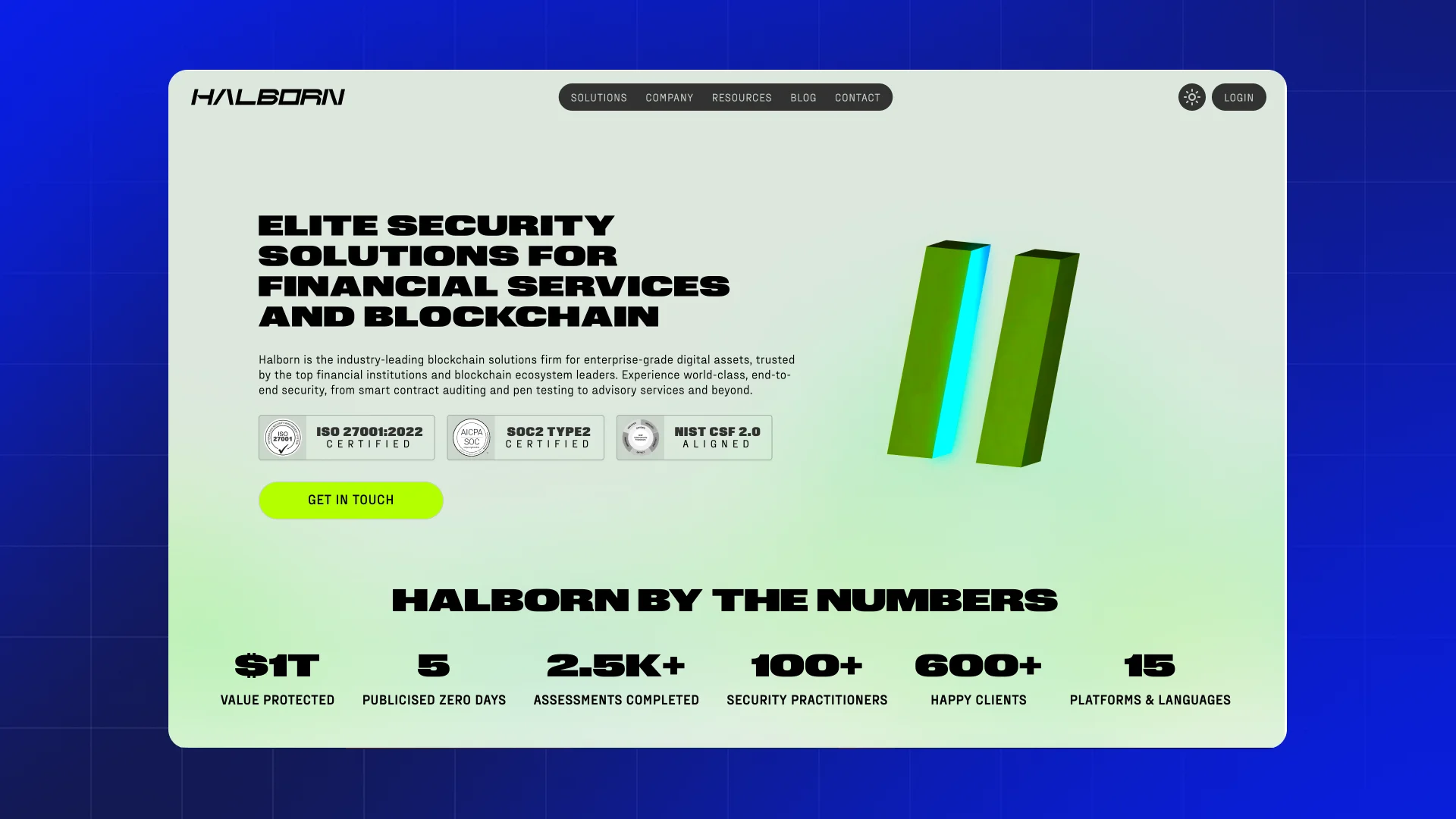
Halborn takes a wide-angle approach to security, not just smart contracts. Founded in 2019 and based in Miami, it pairs on-chain audits with traditional cybersecurity work such as penetration testing and infrastructure reviews.
Here’s what they tend to be strong at:
- Full-stack coverage: looks past contracts into APIs, cloud setup, wallet integrations, and internal workflows.
- Ops and key risk: digs into the weak points that often cause the biggest losses, such as keys, multisigs, permissions, and signing processes.
- Threat research: publishes forward-looking analysis on trends like off-chain compromise and AI-assisted social engineering.
If your “system” is bigger than the contracts (it usually is), Halborn is built for that in-depth review.
2) CertiK: Best for Formal Verification & Ongoing Monitoring
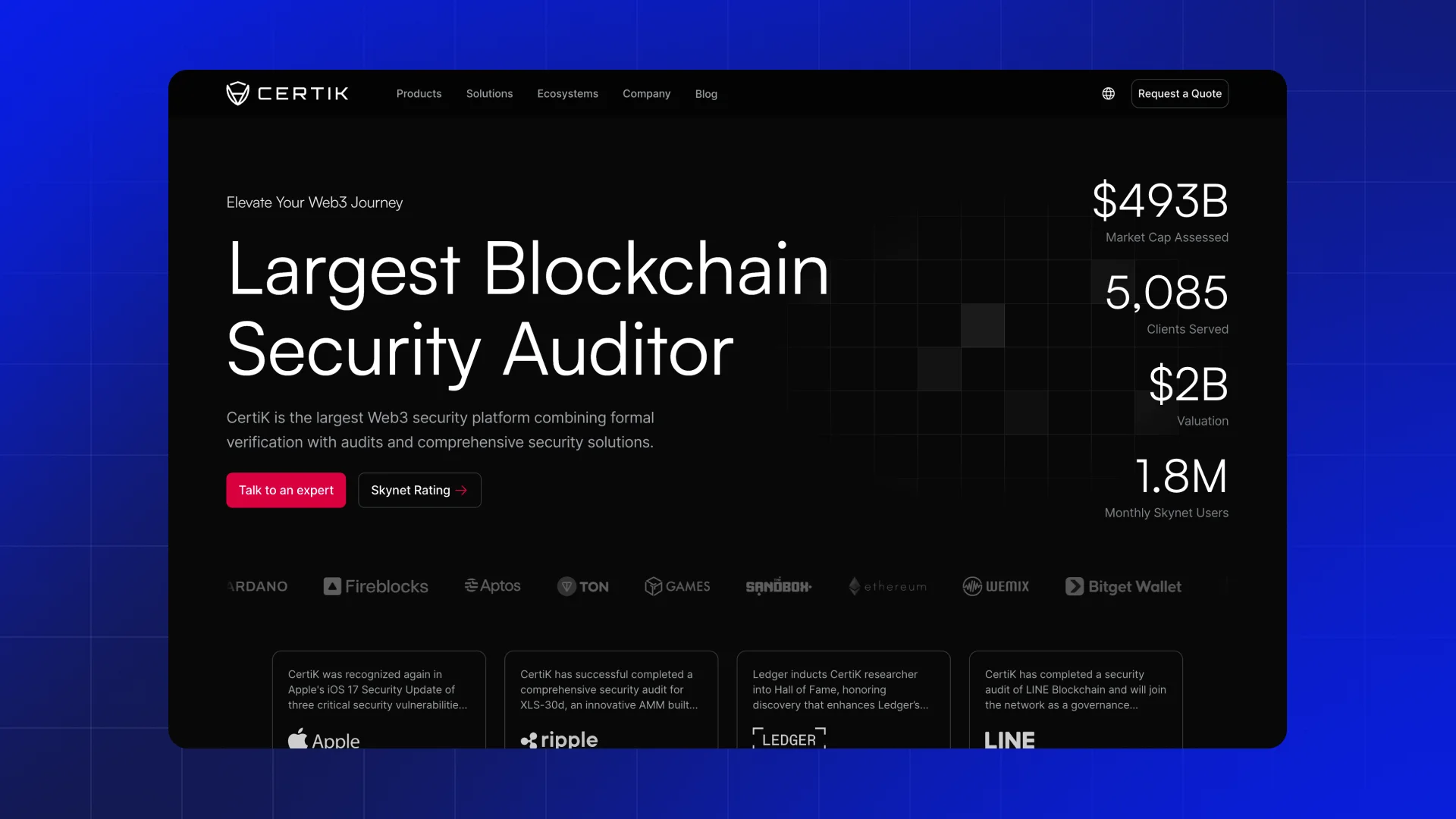
CertiK is one of Web3’s biggest audit providers by volume. Founded in 2017 by academic computer scientists, it’s closely tied to formal methods and security research at scale.
They’re best known for:
- Formal verification: uses mathematical proofs to validate critical behavior, especially in high-risk code paths.
- Pattern-driven reviews: a large audit history helps spot recurring bug classes quickly.
- Post-launch monitoring: tooling that tracks signals and changes after deployment, since many risks appear later.
- Industry reporting: publishes widely referenced annual data on losses and attack categories.
- Research contributions: includes Ethereum Foundation–funded zkVM research.
When you want a big bench plus monitoring options, CertiK is a straightforward pick.
3) Cyberscope: Best for Multi-Chain Audits and Listing-Ready Verification
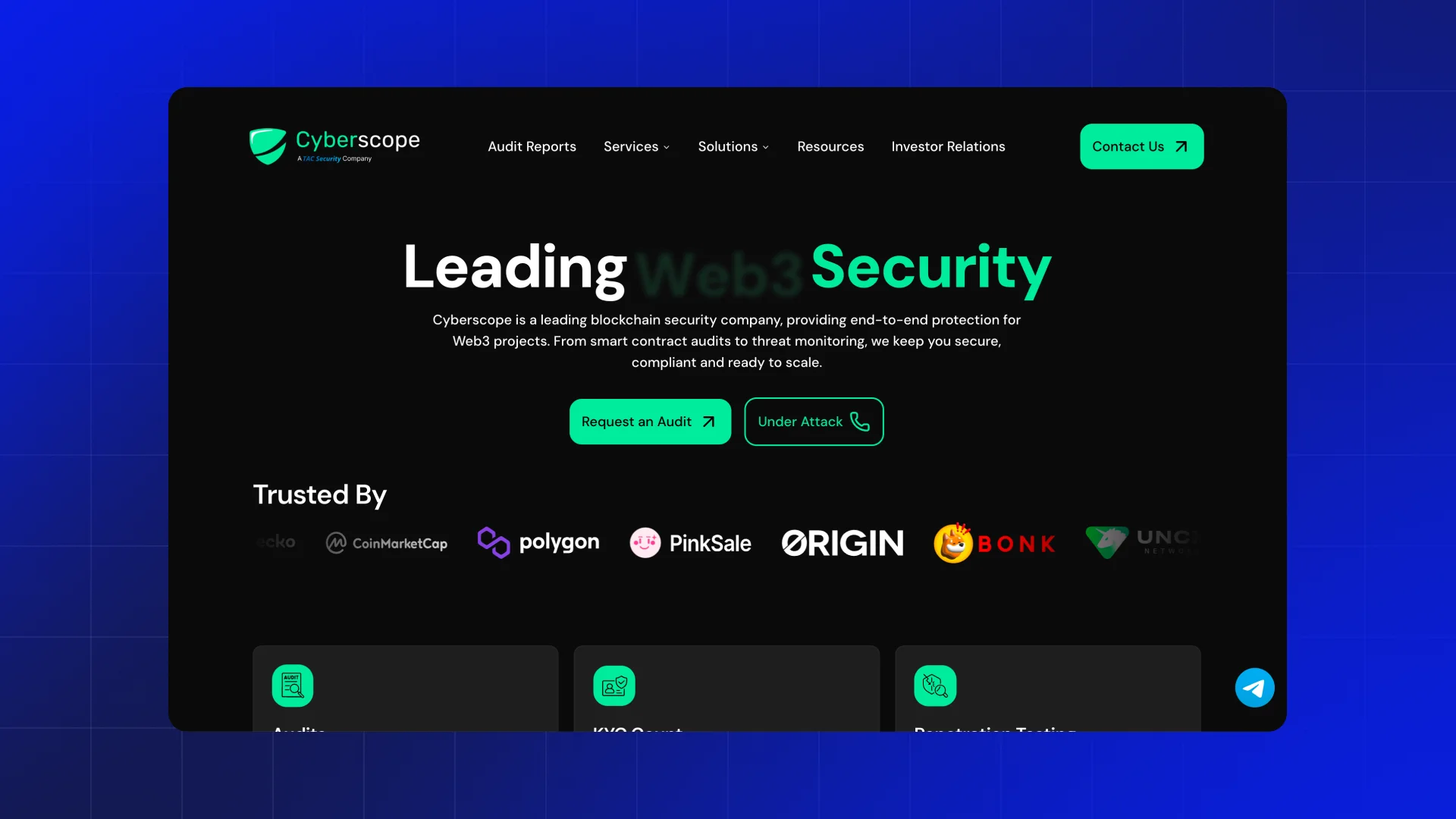
Cyberscope launched in Greece in 2022 and has grown rapidly, completing thousands of smart contract audits and hundreds of KYC verifications across a broad client base. Its coverage spans major ecosystems, making it particularly useful for teams operating beyond a single chain or supporting multi-chain assets and integrations.
Their core strengths include:
- Multi-chain audit coverage: audits across a wide range of networks, including both EVM and non-EVM environments. This is especially relevant for teams shipping across different stacks or bridging assets.
- Broad security menu: In addition to smart contract audits, Cyberscope offers Layer 1 and NFT reviews, penetration testing, formal verification, bug bounty support, and real-time monitoring.
- Proprietary tooling: Internal tools support automated contract analysis, wallet address risk checks, code similarity detection, and function/event signature search. These tools help accelerate triage and surface recurring patterns.
- Listing and launch readiness: Audit outputs are structured to align with common token launch and exchange listing requirements, helping teams satisfy go-to-market and verification expectations alongside core security review.
If you need a multi-chain audit provider that also supports verification workflows and practical launch logistics, Cyberscope fits a “secure and launch-ready” use case.
4) Nethermind Security: Best for Multi-Chain Smart Contract Security, ZK, and Formal Verification
Nethermind Security's work sits at the intersection of multi-chain smart contract audit coverage, zero-knowledge security, and formal methods, a combination most companies can't staff. Forty percent of the team holds PhDs in cryptography, formal methods, or distributed systems, and the research background shows in practice: the team uncovered a soundness bug in Halo2 that traditional code review missed, and completed the first formal verification of functional correctness of RISC-V-based zkVMs - systems underpinning Ethereum L1 proving. Multiple Ethereum Foundation grants fund this work, with the open-source Clear tool providing reusable verification infrastructure for proof systems built on Halo2 and Plonky3.
Beyond individual engagements, the team holds a seat on the zkSync Security Council and received Arbitrum DAO approval as an audit provider, the kind of institutional standing that comes from sustained ecosystem involvement, not just client volume. Clients include World, Lido, EtherFi, Optimism, RISC Zero, and Succinct Labs, with work spanning ZK circuits, Layer 2 proving infrastructure, identity systems, and application-layer components across Solidity, Cairo, Rust, and Noir.
The tooling offering adds two distinct layers. AuditAgent is an AI tool trained on Nethermind's audit history that flags common vulnerability patterns before manual review starts: across 29 real audits it achieves roughly 30% average recall, which narrows the surface area auditors need to cover without replacing their judgment. AgentArena takes a different approach: multiple independent AI agents compete to find vulnerabilities in the same codebase, with a third party-based arbiter deduplicating and scoring findings. It's a model that works well for protocols with audit budgets looking to maximize coverage breadth.
Teams can learn more and get in touch at nethermind.io/nethermind-security.
5) Zellic: Best for High-Stakes Protocols and Deep Security Reviews
Zellic is a security firm known for adversarial-style audits; the team approaches reviews like attackers, looking for unexpected ways systems can break.
Founded in 2021 by experienced security researchers (with backgrounds in competitive hacking and vulnerability research), Zellic has built a strong reputation with major Web3 infrastructure and DeFi projects.
Here’s what they tend to be strong at:
- Adversarial reviews: focuses on real attack paths and edge cases, not just common patterns.
- High-severity bug finding: in 2025, Zellic completed 338 reviews and reported a large number of critical and high-impact issues across those engagements.
- Advanced coverage: audits span EVM and non-EVM systems, including Move (Aptos/Sui), Solana, Cosmos, ZK circuits, and applied cryptography.
- Top-tier client base: has worked with projects like LayerZero, Sui (Mysten Labs), StarkWare, Solana Foundation, Hyperliquid, Scroll, Monad, and others.
- Broader audit options: acquired Code4rena in 2024, adding a hybrid model that combines deep review with competitive researcher coverage (Audits+).
If you’re shipping a complex protocol, handling serious value, or building systems with cryptography or ZK components, Zellic fits a “maximum scrutiny” audit style.
How to Choose the Right Web3 Audit Firm
Most teams choose an auditor based on brand reputation alone. That is not enough.
Match your risk profile to the audit style.
1) Identify Your Biggest Failure Mode
Ask:
- Is your risk primarily contract logic?
- Is architecture the weak point?
- Are operational controls fragile?
- Are you building ZK systems?
- Do you manage high-value treasuries?
Recent industry losses show that access control and operational compromise remain leading causes of major incidents.
Your audit scope should reflect that reality.
2) Decide If You Need Ongoing Monitoring
A one-time audit does not cover:
- Governance changes
- Contract upgrades
- Dependency shifts
- Role changes
If your system evolves frequently, monitoring becomes baseline security, not optional.
3) Align Scope With Timeline
Fast audits can catch obvious issues. They may not uncover deeper architectural risk.
Be realistic about:
- Code freeze maturity
- Documentation completeness
- Upgrade complexity
4) Consider a Second Independent Audit
For complex DeFi, ZK, or L2 systems, a second audit can catch blind spots. Treat redundancy as risk management, not a checkbox.
What a Web3 Security Audit Can and Cannot do
What It Can Do
- Identify common vulnerability patterns
- Stress-test permissioning assumptions
- Evaluate upgrade logic
- Reduce preventable pre-launch risk
- Improve documentation clarity
What It Cannot Do
- Prevent phishing attacks
- Stop key compromise on its own
- Guarantee safety after upgrades
- Replace operational security practices
Audits reduce preventable risk. They do not eliminate uncertainty.
FAQ: Web3 Security Audits
How often should a Web3 project get audited?
At minimum:
- Before mainnet launch
- After major upgrades
- After new feature releases
- After permissioning changes
For frequently shipping teams, ongoing monitoring is recommended.
Is a smart contract audit enough to prevent hacks?
No.
Many major exploits begin outside the contract layer, including key compromise, phishing, or misconfigured multisigs.
Smart contract audits should be paired with:
- Hardware key policies
- Least-privilege access controls
- Incident response planning
- Monitoring tools
How much does a Web3 audit cost?
Costs vary based on:
- Lines of code
- Protocol complexity
- Architecture depth
- Formal verification needs
- Timeline urgency
Basic audits can range from tens of thousands of dollars. Complex protocol reviews can exceed six figures.
What should teams prepare before starting an audit?
Prepare:
- Clear threat model
- Architecture documentation
- Upgrade plan
- Frozen code scope
- Admin role definitions
- Multisig policy
- Operational workflow documentation
The more context auditors have, the more valuable the review.
Final Thoughts
The best Web3 security audit firm is not necessarily the most famous. It is the one aligned with your system’s actual risk surface. If your build is architecture-heavy, ZK-focused, or operationally complex, choose accordingly. Security in 2026 is no longer just about contract code; it is about systems.