

























The Web3 Go-To-Market Problem
Most Web3 projects fail because they mistake marketing execution for a go-to-market strategy. A real Web3 GTM aligns positioning and narrative, audience prioritization, channel sequencing, and incentive design before any campaigns are launched.
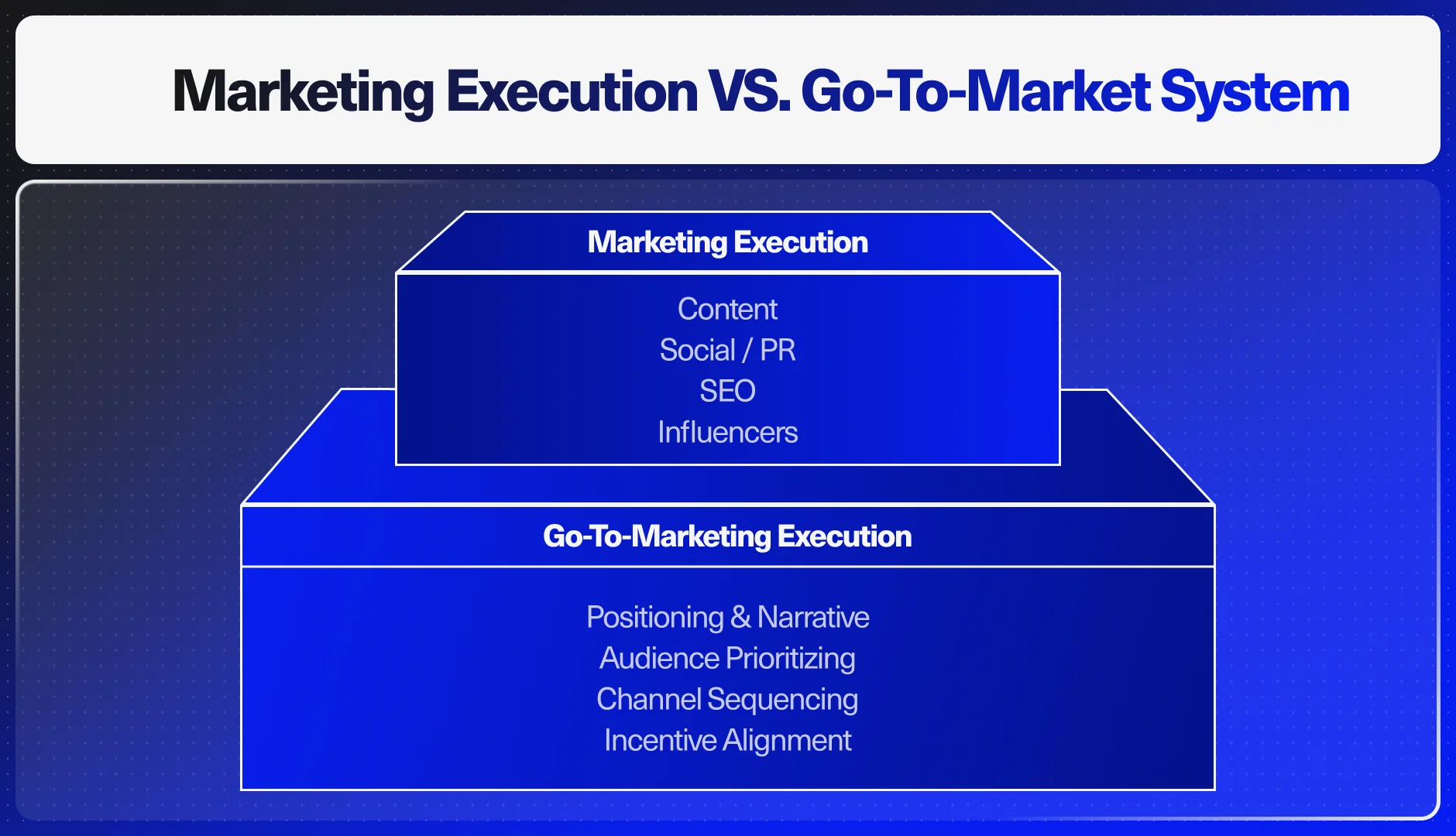
Marketing is the distribution layer. Go-to-market is the operating system underneath it. When teams skip the system and jump straight to execution, they aren’t scaling, they’re guessing.
Web3 projects often fail because they launch without a coherent go-to-market strategy. Crypto marketing agencies get hired, content gets published, influencers get activated, and budgets get spent, but none of it compounds toward a clear outcome.
Without a GTM system, marketing becomes a series of disconnected tactics. Capital gets deployed before narrative clarity exists. Channels are activated before the right audiences are prioritized. Community is treated as a broadcast list rather than a stakeholder group.
In Web3, timing and sequencing matter more than volume. A protocol that launches without narrative clarity struggles to earn mindshare, even with a strong product. A DeFi platform that runs paid campaigns before establishing a real product-market signal burns budget without building momentum. A token launch that treats the community as an acquisition channel attracts short-term participants, not long-term believers.
This is the core Web3 go-to-market problem: execution outpaces strategy. And when strategy comes second, everything downstream suffers.
What Go-To-Market Means in Web3
Go-to-market in Web3 is not the same as traditional GTM. Web2 companies can rely on predictable funnels, paid acquisition, and centralized control. Web3 projects operate in a decentralized environment where trust is earned publicly, adoption is community-driven, and token dynamics add a layer of complexity that doesn't exist in traditional markets.
In Web3, your go-to-market strategy must account for multiple stakeholder groups with different motivations. Users want utility. Developers want tools and documentation. Investors want clarity on token mechanics and long-term value. Each group requires a different message, delivered through different channels, at different times.
Token dynamics introduce another variable. If your project includes a token, your GTM strategy must align incentives across all participants. Poor token design or misaligned launch mechanics can undermine even the best marketing. Regulatory considerations add friction. Trust is harder to build when anonymity is common and scams are prevalent. Your GTM strategy must address these realities rather than ignore them.
The Web3 GTM Stack
A strong Web3 go-to-market strategy isn’t a collection of tactics. It’s a system. We refer to this system as the Web3 GTM Stack: four interdependent layers that must be designed before execution begins.
- Positioning and Narrative
Positioning defines the mental space your project occupies relative to competitors and alternatives. It’s not a tagline or a value proposition; it’s how people instinctively understand what you are and why you matter. Narrative is how that positioning becomes memorable. It frames the problem, the solution, and the opportunity in a way that resonates emotionally and intellectually. Without clear positioning, Web3 projects blend into the noise.
- Audience Prioritization
Web3 projects don’t have a single audience. They serve users, developers, liquidity providers, token holders, and partners, all with different incentives and levels of sophistication. A GTM strategy forces prioritization. You can’t speak to everyone at once. The right strategy defines who comes first, who comes later, and why, based on stage and goals.
- Channel Sequencing
Channels are not interchangeable. Pre-launch, the goal is credibility and trust within narrow, high-signal communities. At launch, reach expands through coordinated media, social, and influencer activation, often supported by specialized crypto PR agencies. Post-launch, focus shifts to retention, ecosystem growth, and sustained engagement. When channels are activated out of sequence, the budget gets wasted and the momentum stalls.
- Incentive Alignment
In Web3, incentives shape behavior. If a project includes a token, the GTM strategy must align incentives across early adopters, contributors, and the broader community. Poor incentive design attracts short-term participants and undermines long-term growth. Proper alignment rewards participation that strengthens the ecosystem, not behavior that extracts value. Together, these four layers form the Web3 GTM Stack. Weakness in any one layer compromises everything built on top of it.
Where Most Web3 Go-To-Market Strategies Break
Most Web3 go-to-market failures follow the same patterns. The issue isn’t effort; it’s mis-sequencing and misalignment.
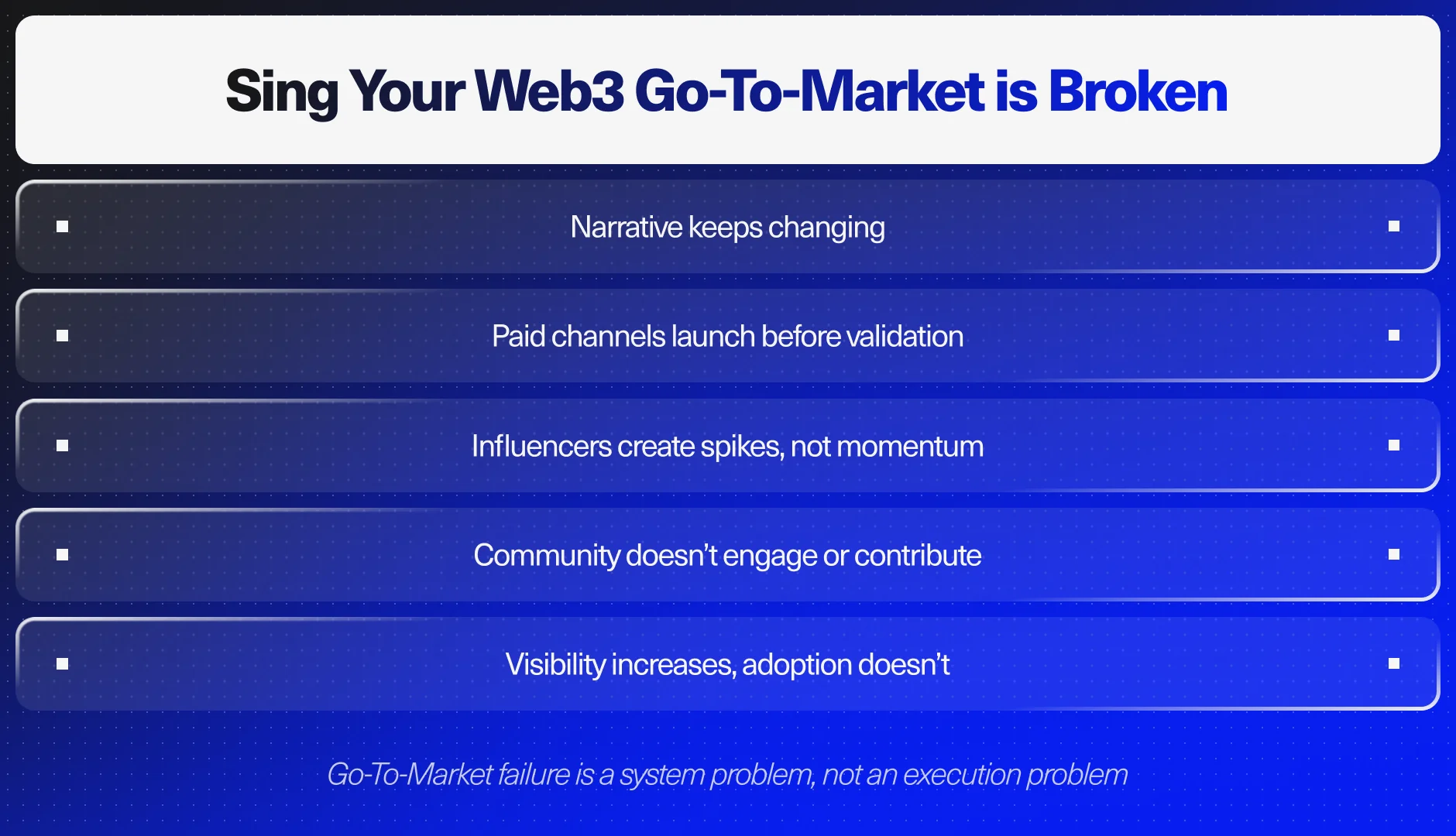
Common Failure Signals in Web3 GTM
If more than one of the following is true, your go-to-market strategy is likely broken, even if activity looks high.
- Narrative keeps changing - Your messaging shifts every few weeks because there’s no clear positioning anchoring decisions.
- Paid channels activate before validation - Ads run before a repeatable activation or product-market signal exists, burning budget without learning.
- Influencers drive spikes, not momentum - Campaigns generate short-term attention but no sustained engagement once promotion ends.
- Community is treated like a broadcast list - Announcements go out, but dialogue, contribution, and ownership don’t come back.
- Metrics focus on visibility, not adoption - Impressions and follower counts are tracked, but retention, usage, or contribution aren’t.
These are not execution problems. They are system failures.
Why These Mistakes Happen
Teams assume a strong product will explain itself. In Web3, it won’t. Clarity is a competitive advantage, and without it, attention dissipates quickly.
Another common mistake is equating activity with progress. Campaigns launch, content ships, partnerships get announced, but none of it compounds because there’s no shared strategic direction guiding decisions.
Over-reliance on influencers is another trap. Influencers can amplify a narrative, but they cannot create one. As many CMOs in crypto have learned, when narrative ownership is outsourced, momentum disappears once promotion stops.
Finally, many teams misunderstand community. In Web3, community members aren’t passive audiences; they are contributors, advocates, and long-term stakeholders. Treating them as a one-way channel undermines trust and long-term growth.
How Lunar Strategy Approaches Web3 Go-To-Market
We approach go-to-market as a research-backed, process-driven discipline, not a bundle of execution tactics. The work starts before channels, campaigns, or content are discussed.
Every engagement begins with understanding the product, the market landscape, competitive positioning, and stakeholder incentives. From there, we identify where clarity already exists and where assumptions are mistaken for strategy. Most GTM failures aren’t caused by bad execution. They’re caused by decisions being made without a shared strategic framework.
Our approach is intentionally stage-aware. Pre-TGE projects face different risks than post-launch protocols. Infrastructure products require different positioning than consumer-facing applications. Ecosystem expansion demands a different sequencing model than initial market entry. Strategy only works when it reflects the realities of the stage you’re in.
Across early-stage launches and scaled ecosystems alike, we consistently see the same pattern: teams that pause execution to align narrative, audience prioritization, and sequencing outperform teams that move fast without coherence. Momentum compounds when everyone - founders, contributors, and partners - is operating from the same strategic map.
We work closely with founders and protocol teams to translate technical complexity into clear narrative frameworks. We define audience hierarchies, design messaging systems that scale across channels, and sequence execution to maximize learning while minimizing wasted spend.
Our Web3 Go-To-Market Strategy service is built for teams that understand the difference between activity and progress. It’s for founders who want to build momentum deliberately, not reactively, and who recognize that execution only works when the system underneath it is sound.
GTM Execution Is Not Random Tactics
Content, SEO, social media, PR, and influencers are execution layers. They're tools, not strategies. Running them without a go-to-market strategy is like building a house without a blueprint. You might end up with walls and a roof, but nothing fits together.
A go-to-market strategy defines the order of operations. It tells you which channels to activate first, which audiences to prioritize, and how to measure success at each stage. It ensures that every piece of content, every campaign, and every partnership serves a larger objective.
Execution without strategy leads to fragmented messaging, wasted budget, and lost momentum. Teams run campaigns that don't connect. They chase metrics that don't matter. They pivot constantly because they never had a clear direction to begin with.
Strategy before execution isn't slower. It's faster. It eliminates guesswork. It gives your team clarity on what to build, who to target, and when to push. It turns random activity into coordinated momentum.
Who Needs a Web3 Go-To-Market Strategy
If you're preparing for a token generation event, you need a GTM strategy. TGE is a one-time moment. You don't get a second chance to launch. The narrative, timing, channel activation, and community preparation must align. Without a strategy, you risk launching into silence or attracting the wrong participants.
If you're launching a new protocol, you need a GTM strategy. Protocols compete on adoption. Adoption requires clarity, trust, and developer engagement. A strong GTM strategy ensures you're building mindshare in the right communities before you launch and sustaining it after.
If you're building infrastructure products, you need a GTM strategy. Infrastructure is harder to market than consumer applications. Your audience is smaller, more technical, and harder to reach. Your GTM strategy must account for long sales cycles, education-heavy content, and relationship-driven growth.
If you're entering new markets or scaling an existing ecosystem, you need a GTM strategy. Expansion requires understanding new stakeholders, adapting messaging, and sequencing channels in unfamiliar environments. A strategic approach reduces risk and accelerates learning.
Strategy Before Spend
If you’re planning a launch, TGE, or ecosystem expansion, the real question isn’t which channels to activate; it’s whether your go-to-market system is coherent.
If narrative clarity, audience prioritization, channel sequencing, and incentives aren’t aligned, execution won’t compound, no matter how strong the tactics are.
This is usually the point where teams realize they don’t need more marketing. They need a clearer go-to-market strategy.
When a Web3 Go-To-Market Strategy Is Necessary
If you’re preparing for a token generation event, a go-to-market strategy isn’t optional. TGE is a one-time moment; narrative, timing, incentives, and channel activation must align, or the launch underperforms permanently.
If you’re launching a new protocol, go-to-market determines adoption. Adoption depends on trust, clarity, and developer engagement, all of which require strategic sequencing before execution begins.
If you’re building infrastructure, go-to-market is even harder. The audience is smaller, more technical, and slower to convert. Without a strategy, teams default to tactics that create noise instead of progress.
If you’re entering a new market or scaling an existing ecosystem, strategy reduces risk. It creates a shared map for decision-making, learning, and execution as complexity increases.
If any of these apply, the next step isn’t more activity, it’s strategic clarity. A focused go-to-market conversation can surface blind spots, align priorities, and define what execution should actually support.
Frequently Asked Questions
What is a Web3 go-to-market strategy?
A Web3 go-to-market strategy is a structured plan that defines how a crypto or blockchain project will launch, gain adoption, and scale. It includes positioning, audience segmentation, channel sequencing, and incentive alignment tailored to the unique dynamics of decentralized markets.
How does go-to-market in Web3 differ from Web2?
Go-to-market in Web3 accounts for token dynamics, community-driven adoption, regulatory considerations, and decentralized trust mechanisms. Unlike Web2, where centralized control and predictable funnels dominate, Web3 GTM requires alignment across multiple stakeholder groups with different motivations.
When should a Web3 project develop a GTM strategy?
Before launch. A GTM strategy should be developed during the planning phase, not after the product is live. Pre-TGE projects, protocol launches, and infrastructure products all benefit from strategic planning before activating marketing channels.
What are common mistakes in Web3 go-to-market execution?
Common mistakes include launching without narrative clarity, running paid ads before product-market signal, over-relying on influencers, and treating the community as a one-way broadcast channel. These errors waste budget and fail to build sustained momentum.
Do all Web3 projects need a formal GTM strategy?
Not all, but most. If your project involves a token launch, multi-sided adoption, or complex stakeholder alignment, a formal GTM strategy reduces risk and increases the likelihood of a successful launch and scale. Without a strategy, execution becomes random.