


























Key Takeaways
- Projects with dedicated community management retain 3x more members at 90 days than self-managed communities (Community Roundtable, 2025).
- Discord suits DeFi, gaming, and developer communities; Telegram outperforms for trading groups and CIS/Asian markets.
- Community health is measured by DAU/MAU ratio, message velocity, and sentiment ratio, not total member count.
- The hire that actually matters is a community strategist who designs the incentive structure, not a moderator executing tasks.
What does crypto community management actually involve?
Crypto community management is a full-time function that covers moderation, content publishing, member support, ambassador coordination, and sentiment monitoring. The scope goes well beyond replying to messages. Our community management service and our 14 tips for building a crypto community are good starting points for understanding what genuine community infrastructure looks like.
What separates Web3 community management from traditional social media management is the adversarial environment. Crypto communities attract FUD campaigns, coordinated scam attacks, and bot armies at scale. Moderation in Web3 is a security function as much as a hospitality one.
Crypto community managers operate across moderation, content, ambassador programs, and sentiment monitoring, a scope that typically requires 40+ hours per week for communities above 2,000 active members (Lunar Strategy, 2025).
Discord vs Telegram: which platform should your Web3 project prioritise?
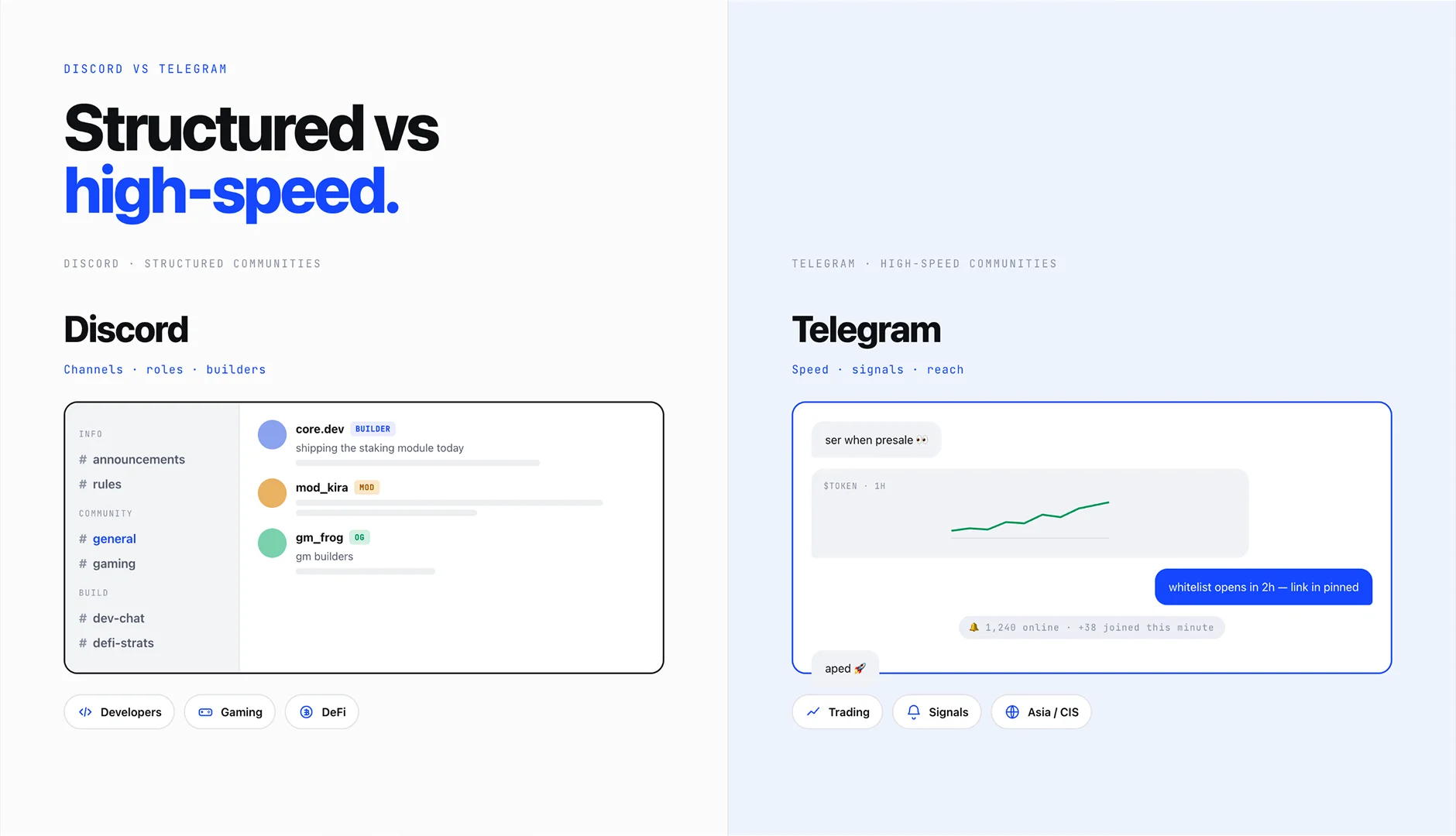
Discord and Telegram serve different community profiles, and the wrong choice costs months of growth. Discord dominates DeFi, gaming, and developer communities. Telegram outperforms for trading groups, CIS markets, and Asian audiences. For how AI tools are changing how teams manage both platforms, see our article on growing your community in the age of AI.
Discord vs Telegram Suitability by Community Type (out of 10):
- DeFi: Discord 10 / Telegram 7
- NFT: Discord 10 / Telegram 8
- Gaming: Discord 10 / Telegram 6
- Trading: Discord 7 / Telegram 10
- Developer: Discord 9 / Telegram 5
Source: Lunar Strategy portfolio analysis, 2025
Discord's role-based architecture makes it the right choice for communities that need layered access. You can gate alpha channels, token-holder sections, and contributor roles behind wallet verification, which creates genuine exclusivity rather than the illusion of it. The pre-TGE community build that feeds into this architecture is mapped out in the token launch strategy guide.
Telegram's advantages are speed and reach. Messages propagate instantly, pinned announcements hit every member, and groups can scale to 200,000 members without performance degradation. For announcements that need to reach the broadest possible audience immediately, Telegram outperforms.
Running both platforms is viable, but it requires separate content strategies and dedicated coverage for each. A Telegram channel mirroring Discord announcements is not a strategy, it's overhead that delivers diminishing returns.
Discord is the primary community platform for approximately 68% of DeFi, NFT, and gaming crypto projects; Telegram leads for trading communities and projects targeting CIS and Asian markets (Nansen, 2025).
How do you build a crypto community from zero to launch-ready?
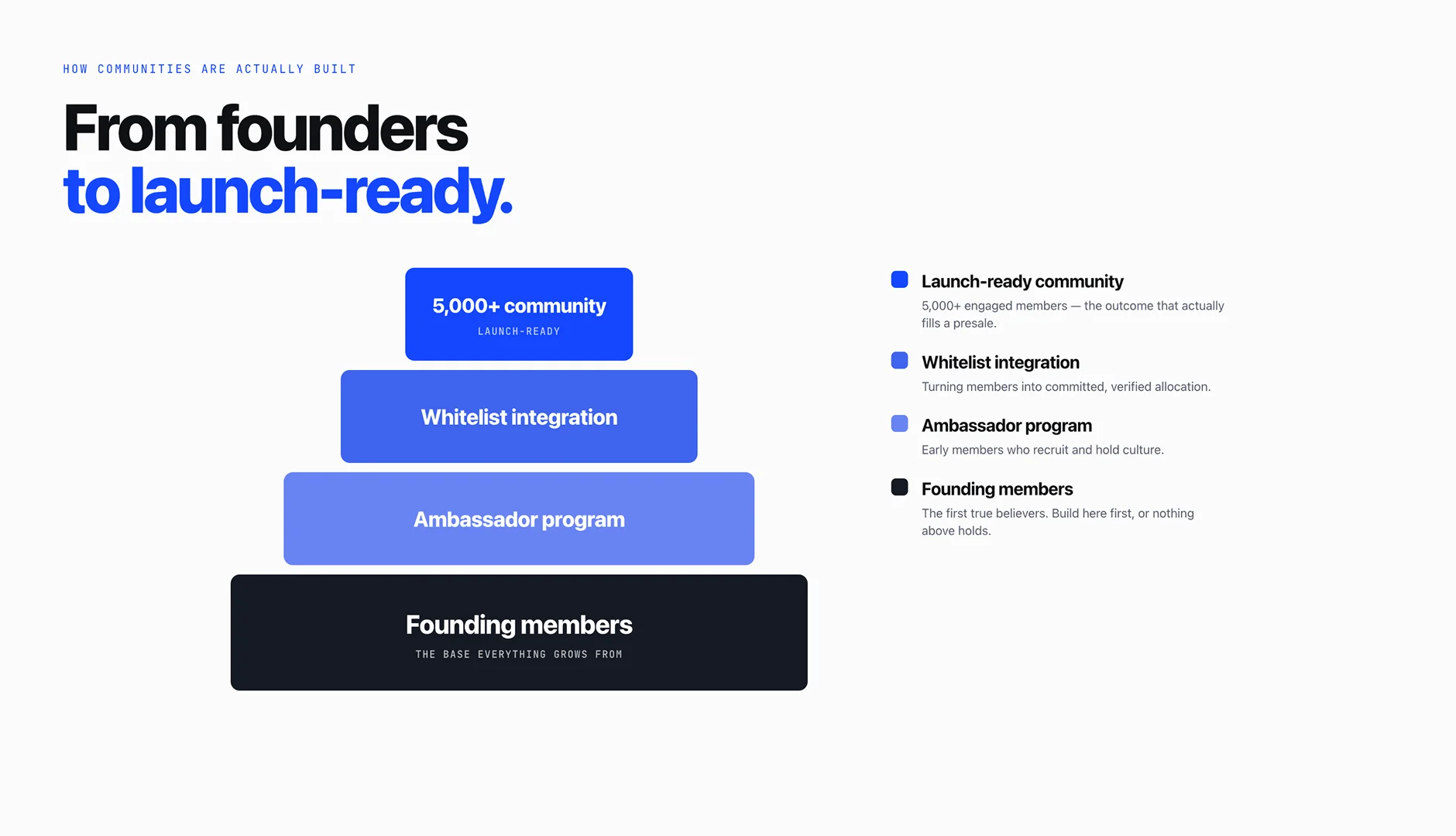
Stage 1: Founding Members (Weeks 1-2, 50-200 members)
The founding members phase is the most consequential and the most commonly rushed. Hand-pick 50-200 early supporters who genuinely believe in the project. These are not random whitelist entrants, they are the people who will set the culture and answer questions for the next 10,000 members.
Stage 2: Ambassador Program (Weeks 3-6, 200-800 members)
Build your ambassador program from the founding cohort. Give ambassadors clear incentives, OG roles, early allocation access, direct team access, and clear responsibilities. Ambassadors answer questions, create content, and moderate during off-hours.
Stage 3: Whitelist Integration (Weeks 7-10, 800-3,000 members)
Stage 4: Launch-Ready (TGE Week, 2,000-5,000+ members)
Content cadence matters from day one. A posting schedule of one founder update, two engagement posts (polls, questions, memes), and daily moderation presence sustains momentum between major milestones.
Crypto projects that reach TGE with 5,000+ Discord members and a DAU/MAU ratio above 15% record 2.3x higher day-1 trading volume than those below the threshold (Nansen, 2025).
How do you handle FUD, scams, and bad actors in a crypto community?
FUD classification framework
Classify FUD into three categories: legitimate criticism (requires a public, factual response within 10 minutes), coordinated attacks (requires immediate ban + IP block + cross-platform alert), and price speculation or panic (requires a calm factual reply and thread lock if it escalates).
Legitimate criticism gets a public reply within 10 minutes, escalation to the founder if the issue is material, and a formal update to the community roadmap or FAQ. Acknowledging valid concerns publicly builds more trust than defending every decision.
Moderation tooling
Combot and MEE6 handle automated spam filtering and join verification on Discord and Telegram. Guild.xyz and Collab.Land handle token-gated access.Wickbot handles Discord security. Manual moderation remains essential, automated tools catch bots but miss sophisticated coordinated FUD.
Community rules architecture follows a simple principle: specific beats general. "No FUD" is unenforceable. "No price speculation in the #general channel" is enforceable. Every rule should have a corresponding enforcement action attached to it.
Moderation response times under 10 minutes correlate with a 34% improvement in community sentiment scores compared to communities with response times over 60 minutes (Lunar Strategy data, 2025).
What metrics actually measure crypto community health?
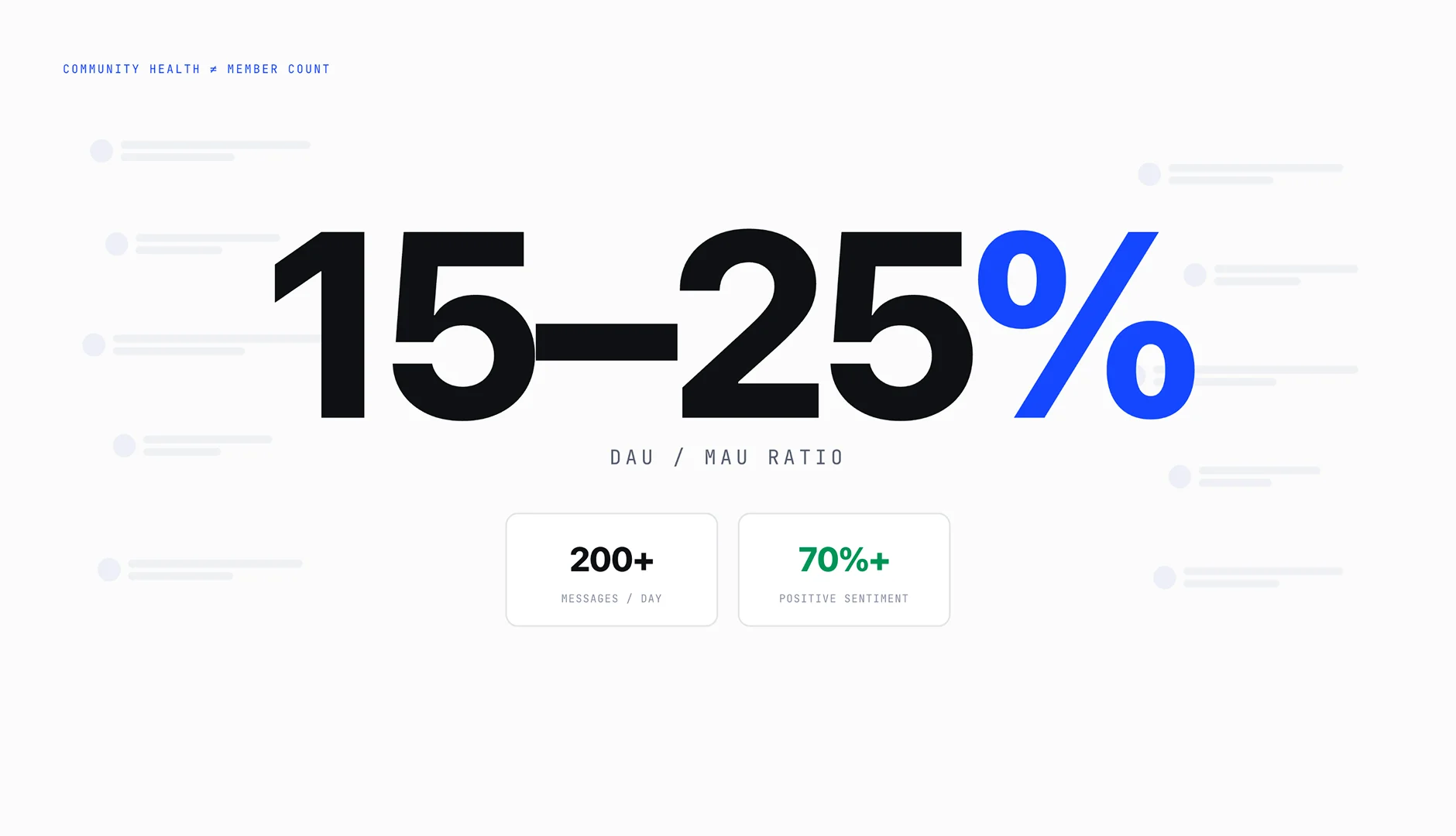
The three metrics that genuinely predict community health are DAU/MAU ratio, message velocity, and sentiment ratio. Member count is a vanity metric. A community of 50,000 members with a 3% DAU/MAU ratio is a ghost town.
DAU/MAU Ratio
Healthy range: 15-25%. Below 10% is a warning signal. DAU/MAU is calculated by dividing daily active users (members who send at least one message or reaction) by monthly active users. Discord Server Insights and Combot both provide this metric directly.
Message Velocity
Healthy range for a community of 5,000 members: 200+ messages per day. Fewer than 80 messages per day means the bulk of members are passive observers. Benchmark this against your specific community size, a 500-member community at 200 msgs/day is healthier than a 10,000-member community at the same rate.
Sentiment Ratio
Healthy range: 70%+ positive messages. Automated sentiment tools misread crypto slang. Sample 200 messages per week across main channels manually. The warning signal to watch is the decoupling pattern: growing member count alongside falling DAU and worsening sentiment means the community is being hollowed out by bots or inactive accounts.
A healthy crypto community maintains a DAU/MAU ratio of 15-25%, 200+ messages per day per 5,000 members, and a sentiment ratio above 70% positive (Lunar Strategy benchmark data, 2025).
When should you hire a crypto community management agency vs build in-house?
For projects pre-TGE or during TGE, when the founder's attention is on product and fundraising, an agency covers the community function at a fraction of the cost of a full-time hire. In-house makes more sense post-TGE, once your community culture is established.
The cases where an agency is the right call: you're 60 days out from TGE and your community is self-managed by the founder; you're running both Discord and Telegram with separate content strategies; you need someone to be online during Asian and European trading hours simultaneously.
In-house community managers in Western Europe and the US command $60,000-$90,000 per year (LinkedIn Salary, 2025). Crypto agency retainers run $3,000-$8,000 per month for comparable full-coverage service.
Frequently Asked Questions
How much does crypto community management cost?
Crypto community management agency retainers typically run $3,000-$8,000 per month for full-coverage service including moderation, content, ambassador coordination, and analytics. In-house community managers in Western Europe command $60,000-$90,000 per year.
What tools do crypto community managers use?
Core tools are MEE6 and Combot for automated moderation and analytics on Discord and Telegram, Guild.xyz and Collab.Land for token-gated access, and Wickbot for Discord security. Manual moderation remains essential for sophisticated FUD campaigns.
How do you deal with FUD in a crypto community?
Classify the FUD first: legitimate criticism requires a public factual response within 10 minutes; coordinated attacks require immediate ban and cross-platform alert; price panic requires a calm factual reply and thread lock if it escalates. Response time is the key variable.
Should a crypto project use Discord or Telegram?
Discord is the better choice for DeFi, NFT, gaming, and developer communities. Telegram outperforms for trading groups and projects targeting CIS and Asian markets. Running both requires separate content strategies; mirroring announcements across platforms is not a strategy.
Community is the moat, not the channel
Every channel you invest in, KOLs, paid ads, content SEO, drives traffic somewhere. If that destination is a hollow community with no engagement, the traffic evaporates. The community is what converts it.
To get a structured community growth plan for your stage, book a meeting here.