





























TLDR
- In DeFi marketing, positioning comes first. Vault positioning is the answer to due diligence, published before anyone has to ask for it. Allocators want to know who is behind the vault, where the yield actually comes from, and who eats the loss.
- Ask vault teams what blocks their growth and the same answers repeat: distribution, first capital, and making a stranger believe the yield is real. Almost nobody says the rate is too low.
- The framework has five parts: who's behind it, the strategy in one sentence, how you protect the money, the proof stack, and who you say it to.
- Vault capital is top-heavy. A handful of wallets can be around 70% of the book, so one private channel can move more TVL than a campaign aimed at thousands.
- A bear market pays you in time. Trust compounds in the quiet, and demand arrives all at once.
What actually blocks vault growth
Ask a vault team what blocks their growth and you will almost never hear that the yield is too low. We run a free accelerator for vault and yield teams with Turtle, and we run growth for vault products directly. The same answers come back every time, in the same order.
Distribution comes first, by a wide margin. Getting the first capital in the door from a standing start. No default discovery surfaces for a new product on a new chain. No LP relationships to open with. Bootstrapping seed liquidity before a launch. Landing the curator relationships that put you in front of money you cannot reach yourself. Team after team has a working product and no route to the people who would fund it.
Trust comes next. Proving to a stranger that the yield is real, that the backtest deserves belief, that an unfamiliar yield source is worth underwriting at all.
Put those two side by side and the pattern is hard to miss. A team that cannot get discovered and a team that cannot convince a stranger its yield is real are asking the same question, which is why capital does not move when it sees the product. That question is a positioning question, and it comes before any channel.
DeFi vault positioning is the set of decisions that tells an allocator who runs the vault, where the return comes from, what protects the deposit, what proves it, and who the product is for. It is the answer to due diligence, written before anyone asks.
Retention barely comes up in those conversations, and that is not because retention is solved. Most teams asking about growth have not had enough deposits to lose yet. Skip positioning now and you inherit a retention problem later, because rented capital arrives on an incentive and leaves on a schedule.
If you want the full path from first impression to retained TVL, we mapped it in our DeFi vault marketing funnel guide. This article is about the part that sits before it.
Why positioning comes before every channel
You cannot distribute a message you have not defined. Every channel you open carries the message you set, so a weak position does not stay small. It gets amplified. Your X bio carries it. Your homepage hero carries it. The curator who lists you carries it, in their words, to their audience. The allocator who forwards your link to a partner carries a version of it you never wrote.
That is the whole argument for building a vault positioning strategy first and buying attention second. Fix the sentence and every downstream asset improves at once. Skip it and you pay a marketing budget to move a message that does not convert.
Timing makes the case sharper. It is a bear. Capital got selective and yields compressed. Our read on the market, delivered in session one of the cohort, was blunt about that: capital is picky right now, and when demand returns it moves fast, and it goes to the products it already trusts.
That is the trade a quiet market offers you. A bear market pays you in time. Every week you publish the same proof number, name the same engine, and answer the same allocator question is a week banked. Trust compounds in the quiet. Demand arrives all at once.
The teams that win the next cycle are not the ones who show up when the money does. They are the ones whose position was already legible when the money started looking. If you are planning the wider launch motion around that, our crypto go-to-market strategy playbook covers the sequencing.
The three questions every allocator asks first
Before an allocator reads a word of your marketing, they run three questions. Our co-founder Jack framed them for the cohort in his own words, from the seat of someone who has sat on both sides of a deposit.
- How would I underwrite this asset? What kind of thing is it, what does it behave like, and what box does it go in when I model it next to everything else I hold?
- Where does the yield actually come from? Not the rate. The engine. Lending spreads, funding-rate capture, market-neutral basis, RWA coupons, market making. If the answer takes three paragraphs, the answer is no.
- What is the risk profile, and who eats the loss? When the market turns, what breaks first, what protects the deposit, and whose balance sheet absorbs the damage.
Every product page you have ever admired is answering those three, in that order, in public. Every product page that reads as noise is answering none of them.
Here is the part teams miss. The allocator will not ask you. Asking costs them a meeting and reveals interest they may not have. They will read the page, fail to find an answer, and move on, and you will never learn that it happened. Deposits that never come look exactly like a quiet week.
The kicker Jack landed in session one, and the line worth writing on the wall: positioning is answering all three before they ask.
The 5-part DeFi vault positioning framework
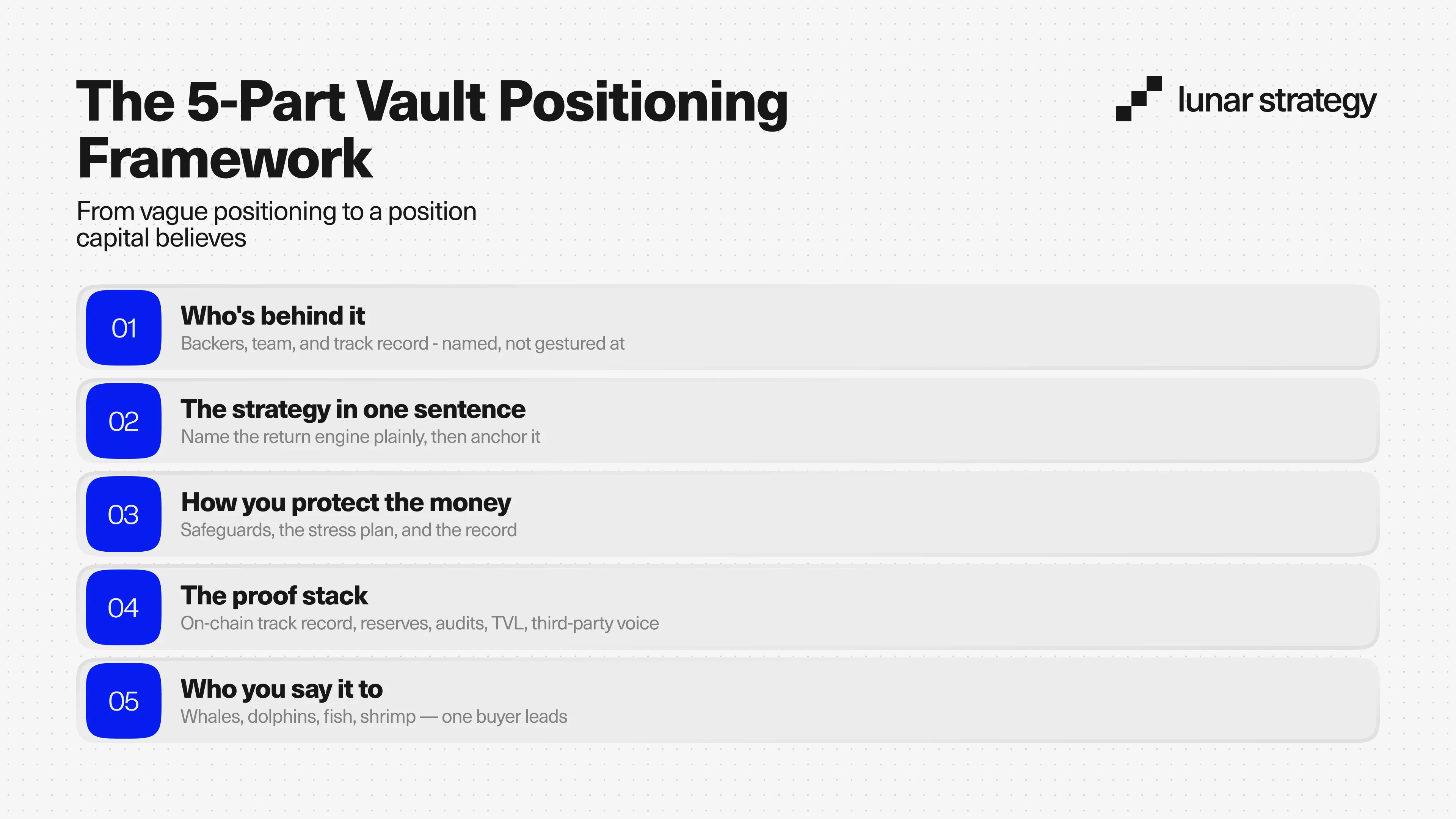
1. Who's behind it
LPs back people before they back products. It is the first trust signal in the stack and most teams bury it three scrolls down, under the yield chart.
Three things belong high on the page. Backers, meaning named investors, launch partners and auditors. Team, meaning who runs it, what they built before, and why they can run this strategy specifically. Track record, meaning prior TVL, prior products, and on-chain history someone can click.
Gauntlet is the clean public case. The most experienced risk team in DeFi since 2018, $1.6B+ allocated across vaults, and a $125M Series C led by SBI. When the product is risk management, the team's record is the positioning, and a funding round becomes third-party proof.
No track record yet? Borrow one. Ondo co-announces every milestone with a brand the buyer already trusts, and Ondo Global Markets crossed $1B in TVL doing it. Name the partner, not the category.
2. The strategy in one sentence
Name the engine plainly, in language a smart allocator finishes reading without a follow-up question. Not one of the products at the top of the market hides the mechanism. Ethena leads with basis. Maple leads with overcollateralized institutional lending. Falcon says "basis spread arbitrage" and publishes a sUSDf APY around 0.9% rather than hiding a soft number, which reads as more trustworthy, not less.
Use this template and fill every slot:
[Product] is the [category] for [audience] that earns [return source], proven by [strongest proof].
The move, before and after. "A high-yield DeFi vault, up to 18% APY on stablecoins" becomes "a market-neutral stablecoin vault for allocators that earns from funding-rate capture, proven by a live on-chain track record and real-time proof of reserves." Same product. Same rate. One of them gets a second meeting.
Then anchor it. Ethena benchmarks its rate against Apple Card, Revolut, Wise, US Treasuries and bank savings on its own homepage. Position against what your buyer would otherwise do with the money, not against the vault next door.
3. How you protect the money
The risk question is coming. Answer it with safeguards and it becomes a reason to deposit. This is not a confession section and it should never read like one. It is a controls section.
Three things go on the page. The safeguards: limits, monitoring, audits, insurance, named rather than gestured at. The plan: what happens in a stressed market, in plain terms. The record: how the team handled it last time, because steadiness is the signal.
The failure nobody markets for is not an exploit. It is a promise the product could not keep at the moment it was asked to. Usual incentivised locked capital, then changed the USD0++ floor price and de-pegged it. Renzo watched ezETH de-peg roughly 70% after a confusing airdrop-allocation chart set off a stampede. Neither was a hack.
Answer these four before you publish a rate. What is the slowest asset in the book, and how long does it take to turn into cash? What redemption speed does your marketing promise in writing? If 25% asked for their money on the same day, what happens? Who speaks when it does, how fast, and what do they show?
You are the one who publishes the promise. If the front of the product says instant and the book behind it is slow, marketing is what makes that mismatch travel further and faster.
4. The proof stack
Trust is the product, and most teams already own the proof they never surface. Surfacing it is half the marketing. Order it strongest first:
- On-chain track record: live performance, history, NAV or price-per-share.
- Proof of reserves and real-time position visibility.
- Audits and the security posture behind them.
- TVL and retention: depositors who stayed, not peak deposits.
- Team credibility: background, risk methodology, how incidents were handled.
- Third-party voice: quotes from partners and LPs, in their words.
The ladder matters because of one rule. A link beats a claim, and a quote from an LP beats both. "Fully collateralized" is a claim. A reserves dashboard is a link. An allocator saying why they sized up is borrowed trust you did not have to build.
One upgrade turns proof into a habit. A proof-of-reserves page is a one-off nobody revisits. A weekly proof post is something the market starts to price in. Publish the same number every week and the number becomes the trust. And never hardcode APY or TVL in scheduled copy, because a stale figure reads as sloppy or dishonest and you do not get to pick which.
5. Who you say it to
Vault capital is not a crowd. It is a pyramid, and each tier deposits for a different reason and
Here is the paradox. The narrowest layer holds most of the book. In practice a handful of wallets can sit at around 70% of TVL. Across our own vault engagements the pattern holds: wallets over $100K can be around 72% of the book across roughly twenty addresses, while the bottom two thousand users account for around 3%.
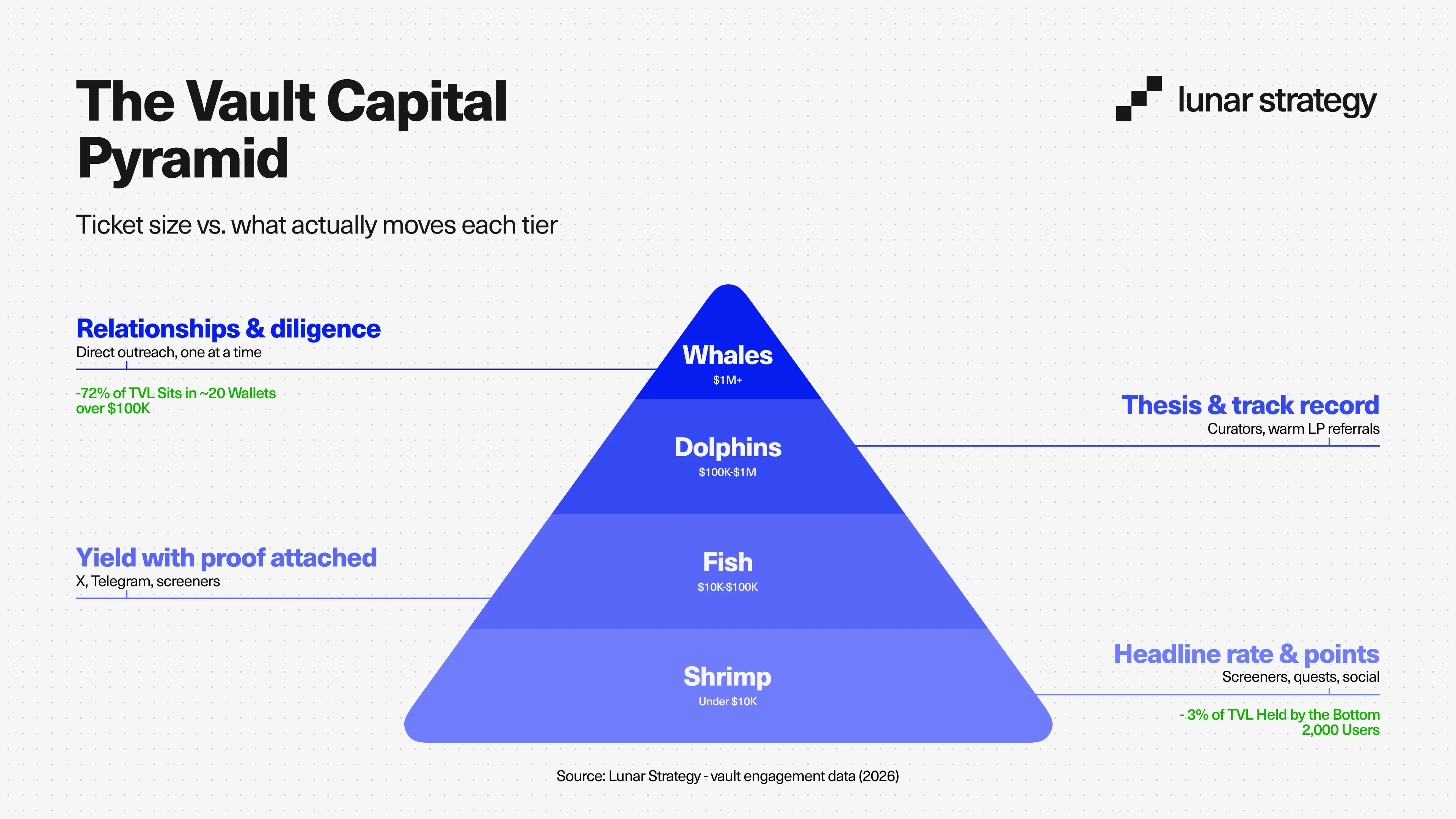
Retail campaigns move mindshare. A private channel for the top twenty wallets moves TVL. Run both, and never confuse which one is which.
Vault positioning in practice: 6 real examples
Six live pages, six different ways to answer the same three allocator questions. Every line below is what the product says about itself in public.
The Morpho vault page is the bar worth measuring against. It is a single screen that names who curates the vault, what the strategy does, what the terms are, and how much capital already sits there. Nothing about it is clever copy. All of it is decisions made before the page was designed.
Notice what none of these do. None leads with the rate as the headline. None describes itself as a high-yield DeFi vault. Every one of them names the engine or names the buyer, and the strongest ones do both. The pattern holds across wrappers, from a synthetic dollar to a savings app to a curated lending market, which tells you the wrapper was never the thing that mattered.
Want the wider view on where attention is going next year? We wrote up what is shifting in crypto marketing in 2026.
The 60-second homepage test
We ran this live in session one, on real homepages, with the room watching. Open your own site, give yourself sixty seconds, and answer five questions honestly.
- Can I tell who is behind it? Names, backgrounds, backers, above the fold or one click away.
- Is the engine named in one sentence? If a reader has to reach the FAQ to learn where the yield comes from, the answer is no.
- Are the safeguards on the page? Limits, monitoring, audits, insurance, named. Controls on the page beat claims in the chat.
- Is the proof on the page, or buried? Live NAV, reserves, audit links, retained TVL, reachable without a search.
- Do I know who it is for? Say the person who would deposit. If the page speaks to allocators and retail at once, it converts neither.
Most vault homepages score two out of five. That is the useful part, because the fixes are copy and layout decisions, not engineering. Every page we opened in the session had the proof already sitting somewhere in the product. It was in a docs subpage, in a Dune dashboard nobody linked, in a PDF from an audit six months old.
Score your page, then fix the lowest-scoring box first. That is the highest-leverage marketing hour you will spend this month, and it costs nothing but attention. Then apply the same list to the two competitors you lose deals to, and see what they answer that you do not.
Where to start this week
Three moves, in order, and none of them needs a budget.
Write a statement for each of the three layers. Positioning: what this is and where the return comes from. Audience: which of the three rooms you lead with, meaning allocators and institutions, DeFi-native LPs, or retail. Messaging: the one sentence that survives a screenshot, using the template from part two.
Pull three real proof points you could screenshot today. A NAV page, an audit link, a reserves dashboard. If you cannot find three, that is the first thing to fix, and it is a product task before it is a marketing one.
Pressure-test it. Hold your statement next to your closest competitors and the other actors who read you before capital lands: the curators who might list you, the rating layers that screen you, the auditors who legitimise you. Three rooms, three languages, one position. If the story changes per room, it breaks in all three.
If the sentence survives all of that, publish it everywhere at once. The hero, the bio, the deck, the first line of every intro email.
The Vault Accelerator
The Vault Accelerator is a free cohort run by Lunar Strategy and Turtle for teams growing TVL. Session one, Position the Product, ran on August 6, 2026 with vault and yield teams from across DeFi in the room. We taught the five parts, then ran the sixty-second homepage test live on screen.
The sessions ahead go deeper, with outside experts: distribution and where LPs actually come from, the incentive engine and how to design points you can afford, then launch and retention. Everything is recorded and the worksheets are shared.
Join the next cohort session →
FAQ
How do I position a DeFi vault?
Answer three questions in public, before anyone asks them: who runs it, where the yield comes from, and what protects the deposit. Then write one sentence in this shape: [Product] is the [category] for [audience] that earns [return source], proven by [strongest proof]. Put the engine in the sentence rather than the rate, name your safeguards on the page instead of in a chat reply, and pick one buyer to lead with. You can serve allocators, DeFi-native LPs and retail at the same time, but the one you lead with sets your language and the proof you open with.
What makes allocators trust a vault?
Verifiable things, ordered strongest first. A live on-chain track record, proof of reserves, audits, retained TVL rather than peak TVL, team credibility, and third-party voices. A link beats a claim, and a quote from an LP beats both. Consistency does the rest. A proof-of-reserves page is a one-off that nobody revisits, while publishing the same proof number every week becomes a habit the market prices in. How a team handled its last bad week is worth more than any adjective on the homepage.
Does APY matter for vault growth?
It matters for the smallest tier and almost nothing above it. Under $10K, the headline rate and points drive the deposit. Above $100K, the allocator wants the thesis, the track record, the terms and the risk doc, and the rate is a line item in that document. Rate-led growth also leaves the way it came. Berachain's Boyco pre-deposit campaign pulled in over $2.2B within days, and TVL fell around 88% inside a year. Falcon publishes a sUSDf APY around 0.9% openly and reads as more trustworthy for it.
How long does positioning take to work?
The page edits take a week. The compounding takes months. It usually takes four or five touch points before a depositor converts, and in a selective market those touch points are spread across an X profile, a curator listing, a warm referral and your homepage. That is why the sequence matters more than the speed. Fix the sentence, publish the proof weekly, and open one direct channel to your largest wallets. Trust compounds in the quiet, and demand arrives all at once.
Working on your vault's positioning? The Vault Accelerator is free, and the next session is open.