
























Key Takeaways
- 53.2% of tokens tracked since 2021 are now inactive. 86.3% of those failures occurred in 2025 alone (CoinGecko, 2025). The failure pattern is GTM sequencing failure, not product failure.
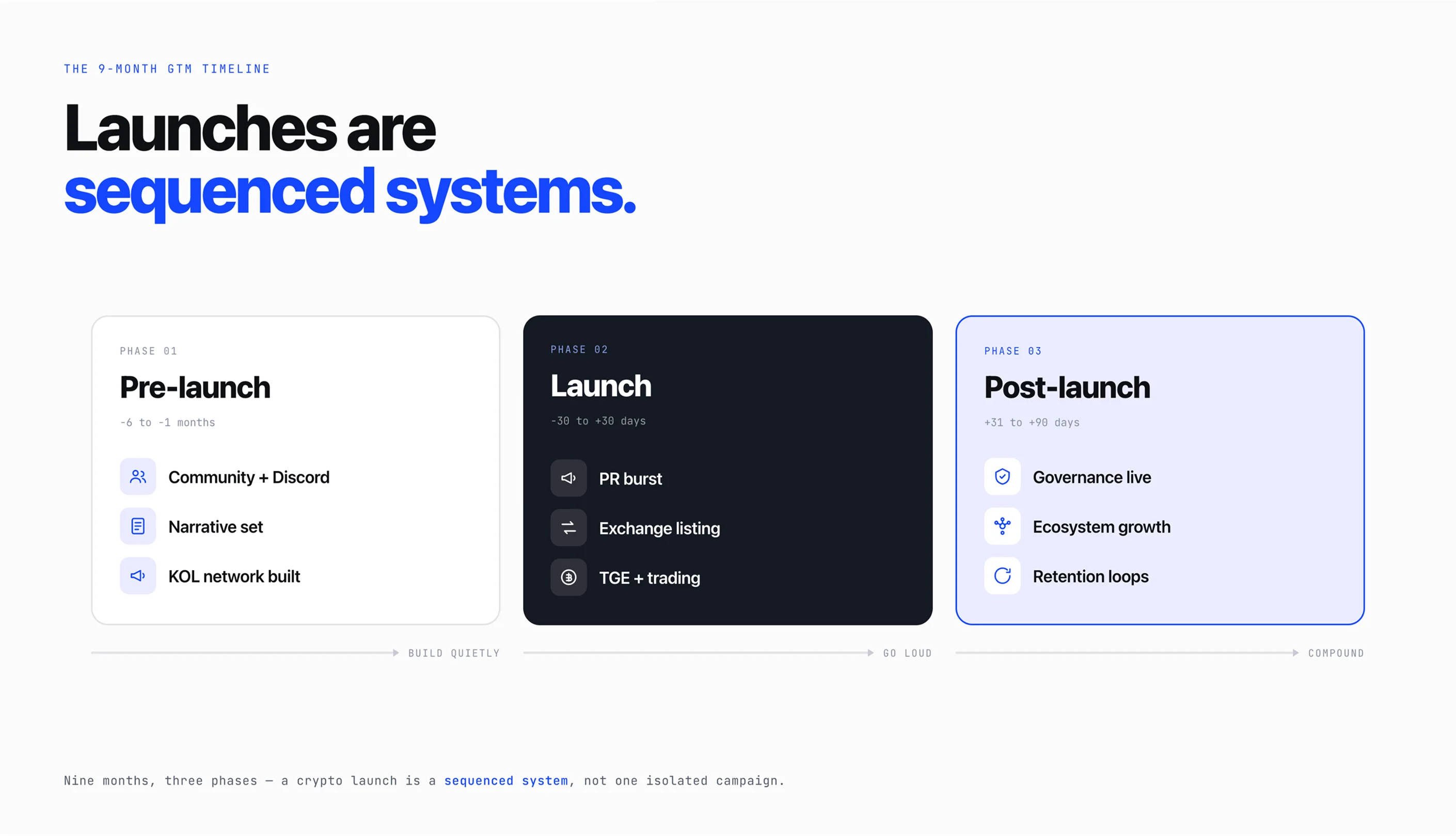
- A complete crypto GTM strategy spans three phases: pre-launch (months -6 to -1), launch window (day -30 to day +30), and post-launch retention (day +31 to +90).
- Community must be built before KOLs are activated. Reversing this order is the most common and most preventable GTM failure.
- Exchange listing outreach should begin 2-3 months before TGE. Projects that approach exchanges 6 weeks out consistently end up on lower-tier venues.
- Most GTM budgets underinvest in post-launch. Projects that plan their post-TGE content calendar before TGE day retain community DAU at a measurably higher rate.
What is a crypto go-to-market strategy?
A crypto GTM strategy is the full campaign plan for bringing a token, protocol, or Web3 product to market. It covers community pre-building, narrative positioning, KOL seeding, PR sequencing, exchange listing coordination, liquidity preparation, and post-launch retention. It differs from B2B or SaaS GTM in three structural ways.
First, the buyer and the user are usually the same person. Token holders are users, governance participants, and distribution channels simultaneously. Second, the community is a precondition for adoption, not a byproduct of it. Third, the launch moment (TGE) is a public, on-chain event that cannot be quietly revised or iterated.
The narrative lock prerequisite
Before any community or marketing investment begins, the team must be able to answer in one sentence: what does this project do, who is it for, and why is the token architecturally necessary? That answer must hold under journalist questioning and KOL briefing, not just in internal slide decks. Teams that cannot articulate it clearly produce inconsistent KOL briefings, confusing PR coverage, and communities whose members cannot explain why they joined.
Crypto GTM also has mechanics that do not exist in traditional go-to-market at all: tokenomic incentive design as user acquisition, airdrop mechanics as a distribution tool, KOL seeding as narrative distribution rather than advertising, and exchange listing timing as a marketing variable.
53.2% of all tokens tracked on GeckoTerminal since July 2021 are now inactive, with 86.3% of those failures concentrated in 2025 alone (CoinGecko, 2025; BeInCrypto, 2025). The failure pattern is almost always GTM sequencing failure, not product failure.
The three-phase model below structures the rest of this guide: pre-launch (narrative lock, community, KOL seeding), launch (PR, exchange, TGE), and post-launch (retention, narrative evolution, ecosystem grants).
Pre-launch phase: what happens in months -6 to -1?
The pre-launch phase runs from 6 months to 1 month before TGE. This is where most GTM campaigns are won or lost. Projects that skip or compress this phase arrive at TGE without the community quality, narrative clarity, or KOL relationships needed to drive organic volume on day one. 71% of Web3 users trust communities over exchanges (44%), media (39%), or influencers (28%) as their primary information source (Edelman via Amra & Elma, 2026). The community built before TGE is the highest-leverage asset in the entire GTM plan.
| Window | Channel | Activity |
|---|---|---|
| 6 to 5 Months | Narrative | Lock the one-sentence description: what it does, who it is for, why the token is architecturally necessary. Must hold under journalist questioning and KOL briefing. |
| 6 to 4 Months | Foundation | Discord and Telegram server architecture live. Website, litepaper, and documentation published. Founding member program and whitelist waitlist activated. |
| 4 to 2 Months | Community + KOL | Community-first: social proof must exist before KOL audiences arrive. Micro-KOLs (25K-100K) activated first. Testnet and incentive programs generate on-chain activity for listing committees. |
| 4 to 2 Months | Testnet | Incentive program live. On-chain activity becomes the most credible PMF signal for exchange listing committees. |
| 3 to 1 Months | PR | Background briefings to CoinDesk, The Block, Decrypt, Cointelegraph (off-record). Feature placements confirmed. Embargo set for TGE day. |
| 3 to 1 Months | Exchange | CEX and launchpad outreach begins. 2-3 month lead time is the minimum for listing committee review, legal, and liquidity prep. |
| 2 to 1 Months | KOL (Macro) | Macro-KOL activation follows community social proof. Whitelist mechanics go live with referral multipliers and tiered allocation. |
A real-world benchmark from April 2025: during the BELIEVE token launch, 5 mid-tier KOLs activated after community social proof had been established drove 12,436 new wallets in 48 hours at $2.70 per wallet, producing day-1 trading volume of $1.1M (CryptoKOLZ, 2025). The community-first sequencing is directly observable in that result.
For the Discord and Telegram setup and community building tactics that underpin this phase, see our 14 tips for building a crypto community.
KOL seeding strategy: the Whisper-Tease-Shout model
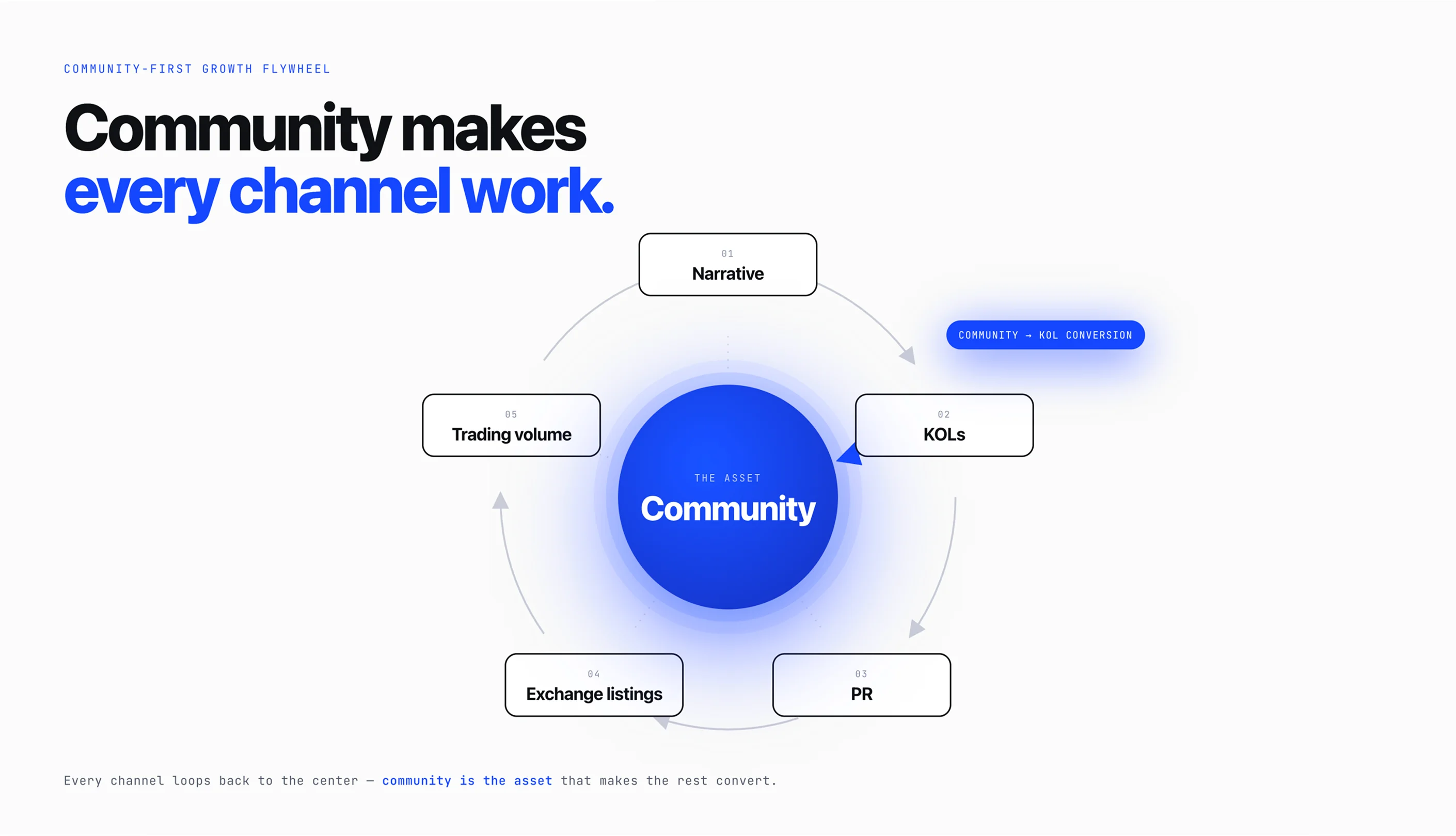
KOL strategy for a token launch is about sequencing, not reach. Projects that activate macro-KOLs first fail because the audience arrives before the community exists to convert it. 62% of crypto projects reported increased token adoption after KOL collaboration (AADS, 2024), and the average crypto KOL campaign returns $6.50 per $1 spent (Surgence, 2025). Both figures assume correct sequencing.
| Phase | Window | KOL tiers active | Goal | Budget weight |
|---|---|---|---|---|
| Whisper | 12 to 8 Weeks | 3-5 thought-leader and nano-KOLs (5K-25K) | Narrative credibility. Audience already understands the category and can evaluate on merit. | 5-10% |
| Tease | 8 to 3 Weeks | 10-20 micro and mid-tier KOLs (25K-500K) | Social proof and FOMO seeding. Community must already be active before this phase fires. | 25-35% |
| Shout | 3 to TGE Weeks | All tiers including macro-KOLs (500K+) | Full activation. Macro reach lands on a warm community with | 50-65% |
KOL budget benchmarks (2025-2026)
| KOL tier | Follower range | Rate per deliverable / campaign (2025-2026) |
|---|---|---|
| Nano-KOL | 5K-25K | $200-$1,500 per deliverable |
| Micro-KOL | 25K-100K | $500-$5,000 per campaign |
| Mid-tier KOL | 100K-500K | $5,000-$25,000 per campaign |
| Macro-KOL | 500K+ | $25,000-$100,000+ per campaign |
KOL vetting criteria
Budget allocation matters less than who gets the budget. Vet KOLs on four criteria: on-chain-active audience (check wallet activity, not just follower counts), engagement rate above 3% on crypto-specific content, documented follow-through from prior campaigns, and no history of undisclosed paid promotions on projects that subsequently failed. The last criterion is checkable via on-chain data and X/Twitter archive searches.
62% of crypto projects reported increased token adoption following KOL collaboration (AADS, 2024). Average crypto KOL campaigns return $6.50 per $1 spent (Surgence, 2025). Both figures depend on the Whisper-Tease-Shout sequencing. Macro-KOL-first campaigns consistently underperform these benchmarks.
For the full KOL campaign structure including fundraising mechanics, see the guide to strategic fundraising with KOLs and our influencer strategy service.
PR timeline: the 12-week sequence
Crypto PR is a sequenced campaign, not a press release blast. The highest-impact window is the 2 weeks around the exchange listing announcement, and that window only converts if the preceding 6 weeks of background briefing and narrative seeding have happened first.
Weeks -12 to -8: Background briefings
Off-the-record conversations with journalists at CoinDesk, The Block, Decrypt, and Cointelegraph. The goal is not coverage yet. The goal is context: journalists who understand the project before the embargo lifts write better stories faster.
Weeks -8 to -4: Technical credibility
Bylined articles, research notes, or protocol explainers in Tier 2 media. These establish the founder's voice and signal expertise before the launch narrative goes public.
Weeks -4 to -2: Feature placements
One or two major Tier 1 features timed to coincide with testnet completion or a significant partnership announcement. These are the pieces that KOL audiences share and that build narrative momentum heading into TGE.
Weeks -2 to TGE: Exchange listing announcement
The listing goes public two weeks before TGE, not on TGE day. This timing allows the announcement to compound: announcement generates coverage, coverage generates social discussion, social discussion generates anticipation. Projects that announce on TGE day miss this compounding cycle entirely.
TGE day: Coordinated push
Pre-written, pre-approved, embargoed releases go live across all tiers simultaneously. Community channels amplify. KOLs activate their Shout-phase content. The community that already exists drives organic volume in the first 24 hours.
One principle that counterintuitively improves Tier 1 placement rates: strategic silence on tokenomics specifics until the PR window opens. Projects that drip-release tokenomics details over months give journalists nothing new to write about when the launch moment arrives.
For the pre-TGE content calendar mechanics and presale campaign structure, see our pre-listing crypto investments guide. For crypto PR as a standalone service, see our PR service page.
Exchange listing timing and liquidity strategy
Exchange listing is both a product decision and a marketing decision. In 2025, 2,147 token listings occurred on major exchanges, with 71% of Big 5 exchange listings being primary spot listings (TechFlow, 2025). Competition for quality listing slots is intense.
CEX vs. DEX listing strategy
| Funding stage | Tier 1 CEX target | Tier 2 CEX target | DEX-first |
|---|---|---|---|
| Pre-seed / Bootstrapped | Not recommended. Build metrics first. | Possible with strong community traction. | Recommended. Build on-chain volume first. |
| Seed ($1M-$5M) | Conditional. Start outreach early (3+ months). | Recommended. Co-listing is common. | Viable if no CEX relationship in place. |
| Series A+ ($5M+) | Target this tier. Begin outreach 2-3 months before TGE. | Strong option. Co-listing standard. | Optional supplement only. |
The 2-3 month outreach rule
Begin exchange and launchpad discussions 2-3 months before TGE. Teams that approach exchanges 6 weeks before TGE consistently end up on lower-tier exchanges with insufficient liquidity depth. The listing committee review process, legal documentation, and liquidity preparation all require this lead time even when the exchange is interested from the first conversation.
Liquidity preparation
Budget for market-making at TGE. Inadequate liquidity creates price volatility that destroys community confidence within 48-72 hours of launch. Market-maker agreements should be finalised before the listing announcement is published, not after. Running 3-4 launchpads rather than a single launchpad diversifies initial community acquisition and eliminates single-point-of-failure risk.
Airdrops and testnet incentive programs as GTM tools
Airdrops and testnet incentive programmes are user acquisition mechanisms. The top 5 airdrops of 2025 distributed $4.5 billion to 199 million participants (CoinLaw, 2025). Despite that reach, 64% of recipients sold at TGE and 50-70% of tokens were dumped within 30 days.
Why the snapshot airdrop model fails
The snapshot airdrop model attracts Sybil farmers, inflates vanity metrics, and destroys token price on day one. LayerZero removed 803,273 wallets (59% of all applicants) as Sybil accounts. Linea filtered approximately 800,000 additional wallets. These are not edge cases. They are the expected outcome of a poorly designed airdrop that rewards presence over participation.
The downstream GTM damage is concrete. A community inflated by Sybil accounts and airdrop hunters has no social proof value for KOLs, no governance participation, and no word-of-mouth potential.
The points programme model
For projects preparing for a 2026 TGE, multi-season points accumulation programmes have become the standard. Points allow projects to weight allocations based on genuine activity, build anti-Sybil profiles before distribution, and track engagement granularly across protocol interactions. The result: targeted distribution drives 4-8x more buyer participation than wide-spray models (CoinLaw, 2025). Design your whitelist mechanics and points programme together. For the full presale campaign structure, see our pre-listing crypto investments guide.
The top 5 airdrops of 2025 distributed $4.5 billion to 199 million participants; 64% sold at TGE, and 50-70% of tokens were dumped within 30 days (CoinLaw, 2025). LayerZero removed 59% of all applicants as Sybil accounts. Targeted, activity-weighted distribution drives 4-8x more buyer participation than spray-and-pray models.
GTM budget allocation
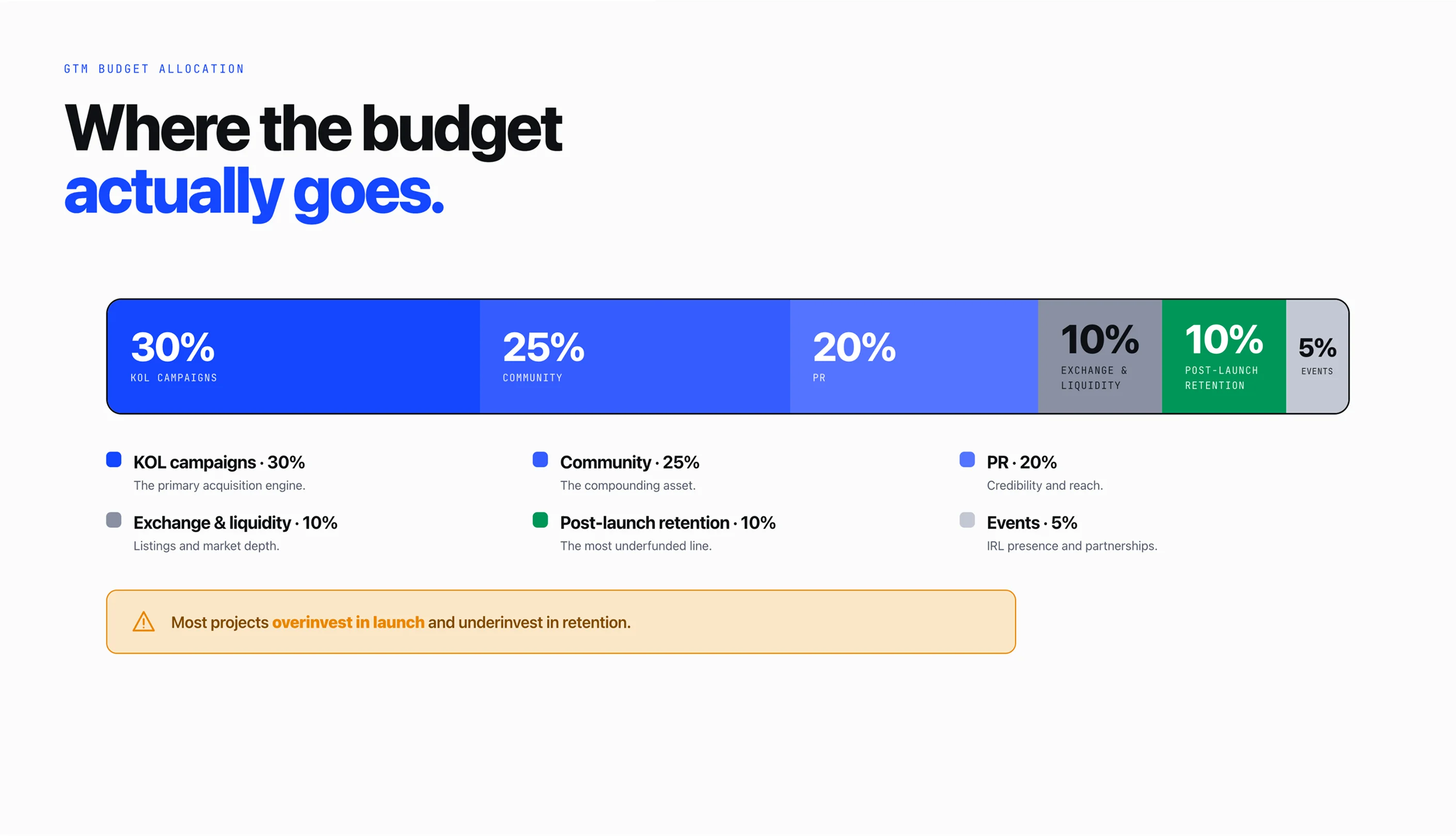
Budget allocation matters more than total budget. 47% of blockchain companies dedicate more than 30% of their total company budget to marketing, with global blockchain marketing spend reaching $4.2 billion in 2026 (Forte Analytics / Amra & Elma, 2026). The most common failure pattern is front-loading 70-80% of spend into the 2-week TGE window and leaving nothing for the 30-90 days after.
Budget by project stage
- Pre-seed / bootstrapped: $10,000-$25,000 per month for early community building and micro-KOL campaigns.
- Seed-funded ($1M-$5M raise): $50,000-$150,000 for the full pre-launch phase.
- Series A+ ($5M+ raise): $250,000-$1M+ for an institutional-grade launch including market-making and Tier 1 CEX listing. Market-making alone can consume $50,000-$150,000.
Recommended split for a $100K seed-funded launch
| Channel | Allocation | $100K example | Notes |
|---|---|---|---|
| KOL campaigns (all tiers) | 30% | $30,000 | Highest pre-TGE leverage. Whisper-Tease-Shout structure. |
| Community building and management | 25% | $25,000 | Foundation layer. Must precede KOL activation. |
| PR and media | 20% | $20,000 | Agency retainer plus placements. Background briefings start 8 weeks before TGE. |
| Exchange listing and liquidity | 10% | $10,000 | Market-making agreements finalized before listing announcement. |
| Post-launch retention reserve | 10% | $10,000 | Non-negotiable. Fund the 30-90 day content calendar and governance incentives. |
| Events and partnerships | 5% | $5,000 | Ecosystem integrations, side events, co-marketing. |
47% of blockchain companies dedicate more than 30% of their total company budget to marketing, with global blockchain marketing spend reaching $4.2 billion in 2026 (Forte Analytics / Amra & Elma, 2026). The allocation failure pattern is consistent: 70%+ of GTM budget concentrated in the TGE window, nothing reserved for post-launch community and narrative.
For a full breakdown of what a Lunar Strategy GTM engagement covers, see our GTM strategy service page.
Post-launch retention: the 90-day framework
Post-launch is where most crypto GTM strategies end. It is where the project's long-term trajectory is actually determined. Community DAU drops of 70%+ within 30 days of TGE are normal for projects with no post-launch content plan. 71% of Web3 users say they trust communities over all other information channels (Edelman via Amra & Elma, 2026). The community that stays after TGE is the primary asset for long-term growth.
| Window | Activity |
|---|---|
| 1-7 Days | Celebrate and signal. Share trading analytics publicly within 24 hours. Publish first 'what's next' roadmap post within 48 hours. Holder recognition in community channels. |
| 7-30 Days | Ecosystem reveals. Partnership announcements and integrations held for post-TGE release. First governance vote. First post-TGE KOL campaign targeting existing holders. |
| 30-60 Days | Narrative evolution. Shift from launch narrative to growth narrative. New hooks: protocol metrics, ecosystem milestones, developer activity. Projects that stay in launch mode for 60+ days post-TGE lose narrative momentum. |
| 60-90 Days | Retention mechanics. Staking programmes, liquidity mining incentives, governance participation rewards. These should be designed before TGE, not improvised after DAU starts declining. |
Metrics to track post-TGE
- Discord and Telegram DAU retention at 30, 60, and 90 days
- On-chain unique active wallets (30-day rolling)
- Governance participation rate
- Protocol revenue or TVL growth
- Token price: a lagging indicator and a poor GTM metric on its own
For the community management playbook covering Discord moderation, Telegram strategy, and ambassador programmes, see our community management service.
The five GTM mistakes that kill token launches
The five most common GTM mistakes are strategic and sequential, not technological. Each is preventable. The failure data is clear: 53.2% of tokens are now inactive, and 86.3% of those failures occurred in 2025 (CoinGecko, 2025).
Mistake 1: Premature listing. Listing before community quality is established creates price volatility that destroys early holder confidence. The first 48 hours set price expectations and community sentiment for months.
Mistake 2: Community quantity over quality. A Discord of 50,000 airdrop farmers is not the same asset as 8,000 members who understand the project and can explain it unprompted. The former creates vanity metrics. The latter creates social proof.
Mistake 3: Macro-KOL activation first. Sending a macro-KOL audience into a project with no social proof produces low conversion rates and sometimes active negative sentiment when the community looks empty. The Whisper-Tease-Shout sequence exists to prevent this.
Mistake 4: No narrative lock. Projects that cannot pass the one-sentence description test produce inconsistent KOL briefings, confusing PR coverage, and communities whose members cannot explain why they joined or why the token is necessary.
Mistake 5: No post-TGE plan. Most GTM budgets treat TGE as the finish line. Projects that sustain community and token health post-TGE planned their 30-day post-TGE content calendar before TGE day and reserved 10-15% of their GTM budget for the post-launch phase.
The mistake that appears most often across client work: treating the exchange listing announcement as the beginning of the marketing campaign rather than its midpoint. By the time the listing is announced, the community needed to drive organic volume on day one either exists or it does not. It cannot be built in two weeks.
Frequently Asked Questions
How long does a crypto go-to-market strategy take to execute?
A complete crypto GTM strategy takes 6-9 months from the start of community building to TGE. Projects that compress this to 6-8 weeks consistently underperform on day-1 trading volume and 30-day community retention. The minimum viable pre-launch window is 3 months. Six months is the professional standard.
How much does a crypto go-to-market campaign cost?
A seed-funded project ($1M-$5M raise) should allocate $50,000-$150,000 for the full pre-launch phase, split across community management, KOL campaigns, PR, and exchange outreach. Series A+ projects typically invest $250,000-$1M+. The allocation error to avoid: spending 70%+ of the budget in the 2-week TGE window with nothing reserved for post-launch retention.
Should you list on a DEX or CEX first?
If the target is a Tier 1 or Tier 2 CEX within 6 months of TGE, launching DEX-first is generally inadvisable. Major CEXs evaluate secondary listing candidates primarily on volume and on-chain activity metrics, which are difficult to build through a DEX alone. Co-listing (CEX and DEX simultaneously) is the most common approach for projects with exchange relationships in place. Begin exchange outreach 2-3 months before TGE.
What community size do you need before a token launch?
Raw community size is a vanity metric. What matters is engagement quality: governance participation rate, message velocity in core channels, and the proportion of members who can explain the project narrative unprompted. Projects launching with fewer than 5,000 genuinely engaged Discord and Telegram members typically lack the social proof needed to convert KOL audiences on TGE day.
How do you measure the success of a crypto go-to-market strategy?
The metrics that matter: day-1 trading volume and holder count; 30-day and 60-day community DAU retention; governance participation rate; on-chain unique active wallets at 30/60/90 days; protocol revenue or TVL growth. Token price alone is a poor GTM success metric. It is a function of market conditions as much as campaign performance.
What is the difference between a crypto GTM strategy and a token launch marketing strategy?
A crypto GTM strategy is the full strategic framework: product positioning, community architecture, exchange strategy, tokenomic incentive design, and narrative development. A token launch marketing strategy is a subset of GTM focused on marketing execution: channel mix, KOL sequencing, PR timing, and budget allocation. The GTM strategy is the map. The launch marketing strategy is the campaign plan that executes it.
Conclusion
A crypto GTM strategy is a sequenced 9-month system where community precedes KOLs, KOLs precede PR, PR precedes exchange listing, and all of it must be planned before any of it begins. Projects that treat these as independent, parallel activities arrive at TGE without the community quality, narrative clarity, or media momentum to sustain the first 24 hours.
The principles that separate the 47% that survive from the 53% that do not: narrative lock first; community before KOLs; 2-3 months exchange outreach lead time; post-TGE calendar planned before TGE day; 10% of GTM budget reserved for post-launch retention. The 86.3% that collapsed in 2025 followed predictable failure patterns. Wrong sequencing. No narrative lock. Macro-KOLs activated too early. Budgets spent entirely on the launch window with nothing left to sustain the community that appeared on day one.
If you want to pressure-test your GTM plan against Lunar Strategy's 300+ project track record, see our GTM strategy service or book a free consultation here.