



























TL;DR
- A KOL is a crypto influencer: someone whose followers trust their opinion. One paid post from a KOL can cost anywhere from about $200 to five figures.The biggest names ask for tens of thousands.
- Prices are all over the place because most KOLs set their price by follower count, nobody publishes their rates, middlemen take a cut, and paying in tokens hides the real cost.
- The fix is to compare every price by how many people actually see the post. The standard way to do that is called CPM: the cost for every 1,000 views. In our campaigns, a fair CPM has been around $20.
- At that rate, a small test campaign costs about $5,000, a launch about $20,000, and a major push about $100,000 in KOL fees.
- Views only tell you who saw the post. To know if it was worth the money, also track how much you paid for each real user it brought in.
- X changed its rules in 2026. Paid crypto posts are now allowed if they carry a "Paid Partnership" label (except in the UK, EU and Australia).
This article walks through it in order: what a KOL campaign is, what KOLs actually charge, why the prices make so little sense, how to compare them fairly, what a full campaign costs, and how to tell afterwards whether the money was well spent.
You Asked for Five Prices and Got Five Different Answers
Say you're launching a crypto project and want people to hear about it. You message five crypto influencers who all seem like a good fit for your audience, and you ask each one what they charge for a single post about your launch.
One says $400. One says $1,200. One says $2,500 plus some of your tokens. One offers a "package" of three posts and an X Space for $6,000. One just asks what your budget is.
You have no idea which of these is fair. There's no public price list to check against. Your co-founder thinks the $400 one is a bargain. Your advisor says the $2,500 one "moves markets.” So you either overpay to be safe, or go cheap and hope for the best.
Then launch week comes. The $2,500 post gets 9,000 views and a pile of emoji replies. The $400 post gets 40,000 views and real questions about how your product works. You paid six times more for the worse result, and you only found out after the money was gone.
This happens to almost every team that buys influencer posts in crypto. It isn't random, and it isn't because you're bad at negotiating. There are clear reasons prices look like this, and once you see them, getting a fair deal is mostly simple math.
First, What Is a KOL Campaign?
KOL stands for "Key Opinion Leader." In crypto, it means an influencer whose audience listens to what they say about projects, tokens and products. Most crypto KOLs are on X, and many also post on YouTube or run channels on Telegram.
A KOL campaign is when a project pays several KOLs to post about it, usually around a big moment. That could be a token launch (often called a TGE, short for "token generation event,", a product launch, or a fundraising round.
Projects do this because a lot of crypto news spreads through people, not just ads. Many crypto users decide what to try based on who they follow. An ad helps people see your name. A post from someone they trust gives them a reason to try it.
The catch is that buying these posts is messy. That starts with the price.
What Crypto KOLs Charge
KOL prices are almost never published. What we know comes from a few places: leaked price lists, legal cases, studies, and our own campaigns. Put together, the picture looks like this:Before you use these numbers, keep two things in mind.
Follower count is a rough guide at best. Two accounts with 100,000 followers can get 5,000 views or 80,000 views on a typical post. This table tells you what KOLs ask. It doesn't tell you what a post is worth. We'll get to that shortly.
These numbers are a starting point. Prices move with the market, and most deals are never made public. The next section shows every public figure we could find.
What the Public Record Shows
Here is every public price we could find, newest first.
Two things stand out.
The biggest names charge five figures, but they're the exception. Most crypto KOLs work in a far lower range.
Prices for similar accounts vary wildly. The same 2025 list that showed five-figure prices also showed accounts working for a few hundred dollars. With no public prices to compare against, every quote is a guess.
So for a normal crypto project, most single posts land between a few hundred and a few thousand dollars, and the biggest names charge five figures. But that range is so wide it barely helps. To understand why it's so wide, you need to look at how these prices get set in the first place.
Why KOL Prices Are All Over the Place
Almost everything about how KOL posts are sold pushes the price away from what the post actually delivers.
Most KOLs price by follower count. It's the easiest number to point to. But followers don't make a post valuable. Views do. Two accounts with 100,000 followers can reach ten times as many people as each other, and they'll often quote you the same price.
Followers are easy to inflate. Researchers have found that automated accounts make up a much bigger share of the replies on crypto accounts than in other topics. If the price is based on followers, some of what you're paying for may not be real people.
Nobody publishes their prices. There's no public price list and no standard contract. Every deal happens in private messages, so every KOL starts from what they got last time or what they think you'll pay. That's why one of your five answers was "what's your budget?"
Middlemen take a cut. Many KOLs are reached through brokers, group chats or managers who add their own fee. In our experience, you can end up paying two or three layers of people for the same post, without knowing what the KOL actually received.
Busy periods push prices up. When the crypto market is hot and lots of projects are launching at once, demand for KOLs goes up and so do prices. From what we've seen, the same KOL can cost about double in a busy month compared with a quiet one.
Paying in tokens hides the real cost. "No cash, just tokens" sounds cheap. It usually isn't. We explain why later in this article.
Almost nobody shares results. Projects rarely publish what a paid post actually delivered. So there's no pressure for prices to match results, and a KOL with a fake audience can charge the same as one with a real one.
Only the buyer loses when it fails. The KOL gets paid when the post goes live. So does the broker. If the post brings in nobody, you're the only one who takes the loss.
Put all of that together and you can see why asking for a "rate card" or looking harder at follower counts doesn't help. You need a way to compare prices that doesn't depend on what the seller tells you. That way exists, and it's simple.
The Fix: Compare Every Price by Views (CPM)
The fairest way to compare KOL prices is to ask: how much am I paying for every 1,000 people who actually see this post?
The formula: price ÷ average views per post × 1,000 = CPM
For example, if a KOL charges $900 and their posts usually get 35,000 views, their CPM is $900 ÷ 35,000 × 1,000 = about $26. In other words, you'd pay about $26 for every 1,000 people who see the post.
To get the average views, don't use follower count, and don't use the one post that went viral. Open their profile, look at their last 20 regular posts, and take a rough average.
Here's what happens when you compare three KOLs this way:
KOL A has by far the biggest account, and is by far the worst deal. You'd pay more than ten times as much as with B for every person reached. You'd never notice that by looking at followers.
So what's a fair CPM? In our campaigns, it has been around $20.
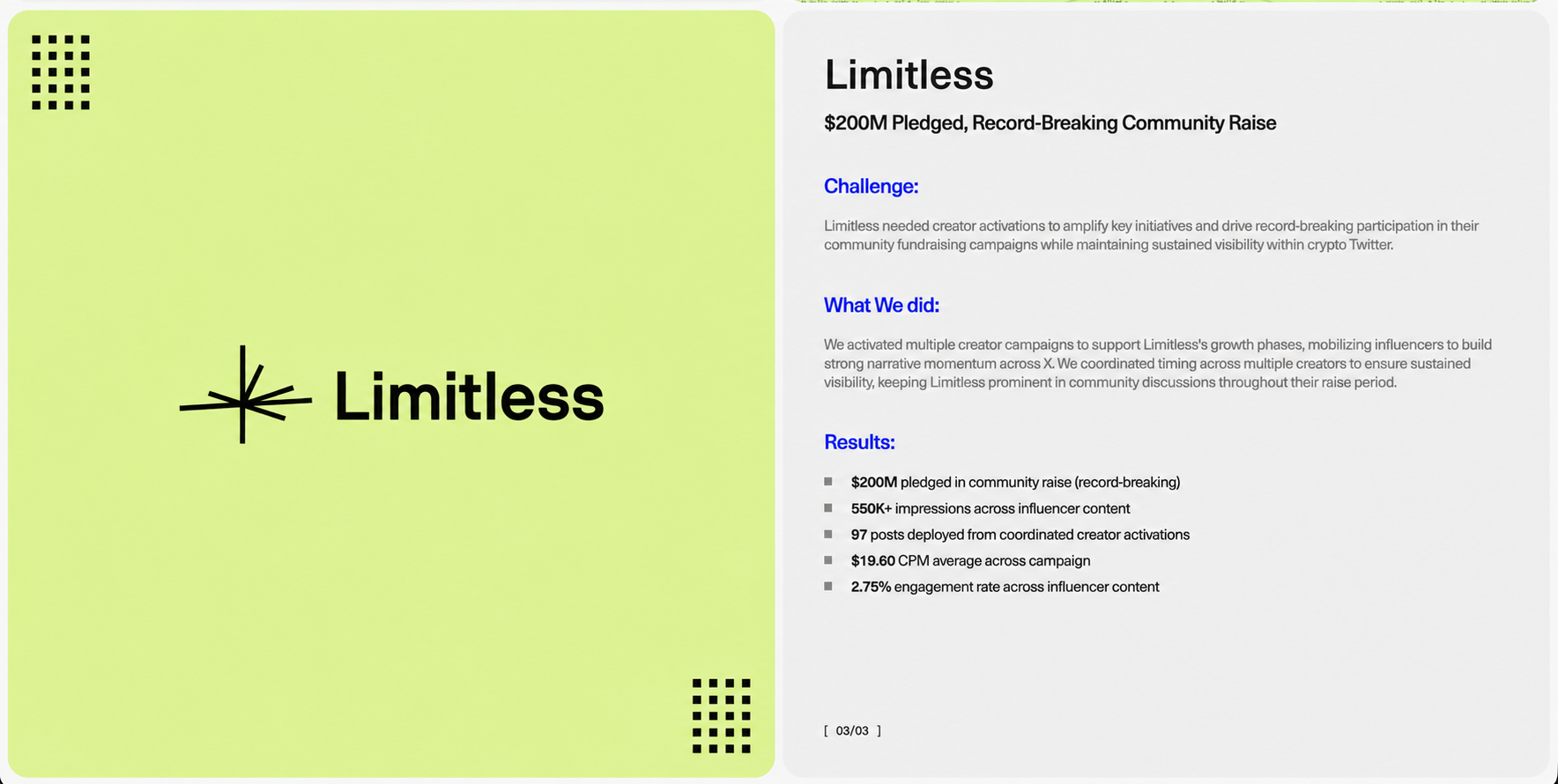
- For Limitless, we averaged a $19.60 CPM across 97 posts.
- For Warden Protocol, it was about 20 at the busiest point of the campaign.
Outside data points to the same conclusion: the 2024 study mentioned earlier ($399 for about 15,000 views) works out to roughly $27.
As a rough rule of thumb:
- Under $30: healthy.
- $30 to $60: needs a good reason, like a very specific audience or a strong track record with projects like yours.
- Well above $60: you're usually paying for followers who aren't watching.
These are our guidelines, based on our campaigns. There's no official industry standard for crypto KOL CPMs.
Once you have a fair CPM in mind, you can flip the formula around and work out what any single post should cost.
What a Post Should Cost, Based on Its Views
If you know an account's average views, this table shows roughly what one post is worth at a CPM of $20 to $30:
This is the most useful table in the article.
Say a KOL quotes you $5,000, and their posts average 20,000 views. That's a $250 CPM, more than ten times the fair range. Now you can say so, politely, with numbers.
Treat it as a starting point, not a hard rule. A researcher whose 15,000 readers are all serious users of DeFi (decentralized finance, meaning crypto apps for lending, borrowing and trading) can be worth more than $450 to a lending app.
An account whose 150,000 views come from people chasing quick price jumps may be worth less than $3,000 to a project that needs long-term users. But CPM gets the conversation onto solid ground.
So far we've talked about "a post" as if every post were the same. It isn't, and the format changes both the price and how you should measure it.
How the Type of Post Changes the Price
KOLs sell several kinds of content. Here's how the common ones usually compare, and how to check what each one really delivers:
A note on packages: they can be a good deal with KOLs you've already tested.
They're a poor way to try someone new, because you're locked in before you know whether their audience responds. And a "package" is sometimes just a way to sell you posts you didn't ask for. Always ask for the price per post.
Where a KOL's audience lives matters just as much as what they post, and it's easy to miss.
Regional KOLs: Cheaper Isn't Always Better Value
KOLs who post in other languages, for example in Korea, Turkey, Southeast Asia or Latin America, often quote lower dollar prices than English-language accounts of the same size. That's our experience and something buyers commonly report, though no public study measures it. It can be great value if their audience is where your future users are.
But a lower price doesn't automatically mean a better deal. Run the same CPM check, and look at a few extra things:
- Is the audience really local? Some "regional" accounts have mostly bought or foreign followers.
- Can those people actually use your product? Whether your token is on local exchanges, whether your app supports their language, and whether your product is even allowed in their country all matter.
- Can your campaign run there? When X started allowing paid crypto posts in 2026, it kept that option unavailable in the EU, UK and Australia.
So before you book, ask every KOL for a screenshot showing where their audience is located.
Now you know how to price a single post. The next step is to turn that into a budget for a whole campaign.
What a Full KOL Campaign Costs
Once you have a target CPM, budgeting is straightforward. Decide how many views the campaign needs, then multiply. These numbers use a $20 CPM:
Here's a real example. The Limitless campaign got more than 550,000 views from 97 posts at a $19.60 average CPM. That works out to roughly $10,800 in KOL fees, or about $110 per post. That campaign supported a record $200 million community fundraise. It didn't need famous names. It needed many of the right small and mid-size accounts.
KOL fees aren't the only cost. Plan for these too:
- Management time. Finding KOLs, checking them, writing the brief, approving posts and following up. That's either your team's hours or a fee to whoever runs it for you.
- Tracking. A unique link or referral code for each KOL, so you can see who brought in clicks and sign-ups, not just views. More on why this matters below.
- Supporting content. Images, demo videos, or a clear web page the KOLs can point people to.
- Posts that don't work. Even with careful checks, some KOLs will underperform. Keep about 10% to 20% of the budget for this, and drop those accounts next time.
If you hire an agency, ask two questions before you sign: how much does each KOL actually receive, and what is the agency's fee for? Some agencies charge a fee on top of what the KOLs get, some build their cut into the prices they quote, and some do both. None of these is wrong, but you should know which one you're paying for. We compared the largest KOL agencies using outside data in The Strategic Role of KOLs in Crypto Marketing in 2026.
That covers paying in cash. But many KOLs will offer to be paid in your project's tokens instead, and that's where budgets most often go wrong.
Paying in Tokens: What It Really Costs
Many KOLs will accept tokens instead of cash, or on top of it. It feels like you're saving money. Often it's the most expensive option.
The real cost is what the tokens are worth when the KOL can sell them. Tokens given to early supporters are usually locked for a while. If you give a KOL $10,000 worth of tokens at your early price, and the token is worth five times that when it unlocks, you actually paid $50,000. Decrypt reported that in one airdrop (a free giveaway of tokens), some KOL allocations were worth up to around $350,000.
Early unlocks lead to selling. CoinDesk reported that on one project, KOLs could sell up to 23% of their tokens on the first day. When KOLs sell right as you launch, the token's price drops and your community feels it.
The KOL's reason to post changes. A KOL who holds your token has a reason to keep talking about you. That can be good. It can also mean they push hardest just before their tokens unlock, then go quiet.
To price a token deal honestly, write down three numbers: how many tokens, a realistic value when they unlock (not your early-round price), and when they unlock. Compare that total to a cash price on the same CPM. If the token deal only looks cheap at your lowest possible valuation, it isn't cheap.
Token deals can work well when the tokens unlock slowly and the KOL has clear tasks to deliver. If you're considering one, we explain how to set it up in Should You Do a KOL Investor Round Before Launch and The Full Guide to Strategic Fundraising with KOLs.
Whether you pay in cash or tokens, 2026 brought new rules that affect every KOL deal. If you last looked at this a year ago, they're worth knowing.
What Changed in 2026, and What It Means for Your Budget
X now allows paid crypto posts, as long as they're labeled. On March 2, 2026, X lifted its ban on paid crypto promotions. Paid posts now need X's "Paid Partnership" label, a tag the creator switches on when posting, under X's paid partnerships policy. The option isn't available in the EU, UK or Australia. For your budget, this means labeled posts are now the normal way to do this. Put the label in your agreement with each KOL, and check where their audience is before you pay.
Apps that paid people to post are gone. In 2025, some apps rewarded ordinary users with points or tokens for posting about crypto projects. Kaito's "Yaps" program was the best known. It filled timelines with near-identical posts. In January 2026, X banned apps that pay people to post, citing a surge of "AI slop & reply spam," and Kaito announced it would shut Yaps down. Cheap, high-volume posting is no longer available on X, so attention has to come from people who choose to post about you. That favors real KOLs, and it makes budgets built on "a thousand accounts for a few thousand dollars" out of date.
The practical takeaway: pay for labeled posts from accounts with real views. If a price is cheap because the post will be hidden, it's the most expensive option on your list.
So far, everything has been about what you pay to get seen. But being seen isn't the goal. Getting real users is. That needs one more number.
Beyond Views: What Each Real User Cost You
CPM tells you what you paid for people to see a post. It doesn't tell you whether anyone cared. For that, you need cost per real user.
The formula: what you paid a KOL ÷ number of people they brought who did something real = cost per real user
"Something real" is whatever matters for your product. In crypto, it's often a wallet connect. It could also be a deposit, a sign-up, or a test transaction.
To count this, each KOL needs their own tracked link. Without it, you can't tell who brought in whom.
Here's a worked example for one KOL:
This KOL's CPM looked expensive at $50. But if a returning user is worth more than $67 to your project, they were a good buy, and probably better than a $20 CPM account whose clicks never turn into users.
After one campaign with tracked links, you'll know the real cost per user for every account you paid. That becomes your own price list, based on results instead of promises. We go deeper on measuring marketing results in How Crypto Marketing Agencies Measure ROI.
Measuring results also shows you the costs that never appear on an invoice.
Questions to Ask Before You Pay
Send these to every KOL before you agree on a price. How they answer tells you almost as much as the answers themselves.
- What are your average views on regular posts over the last month? Then check it yourself.
- Where is your audience located? Ask for a screenshot of the audience by country.
- Can you share results from a similar campaign? Clicks, sign-ups, anything beyond views.
- Do you receive tokens as a payment option? This should be disclosed, not discovered later.
- What's the price per post inside this package? Then work out the CPM.
How to Get a Fair Price, Step by Step
Here's everything in this article as one process:
- Set your goal in views. Decide how many views the campaign needs, then set your budget using a target CPM.
- Choose KOLs for fit and trust first.
- Ask the questions above. Then work out the CPM for each price yourself.
- Negotiate using CPM. If a KOL's CPM is far above your target, show them the math. Many will adjust. Those who won't are telling you something.
- Give every KOL a tracked link. After one campaign, you'll have your own real price data.
- Rebook the ones who worked. Move your budget toward the KOLs with the lowest cost per real user, and drop the rest.
Once you've set the budget, the next step is telling the KOLs what to post. We cover that, with a free template, in How to Brief a KOL.
What We've Seen
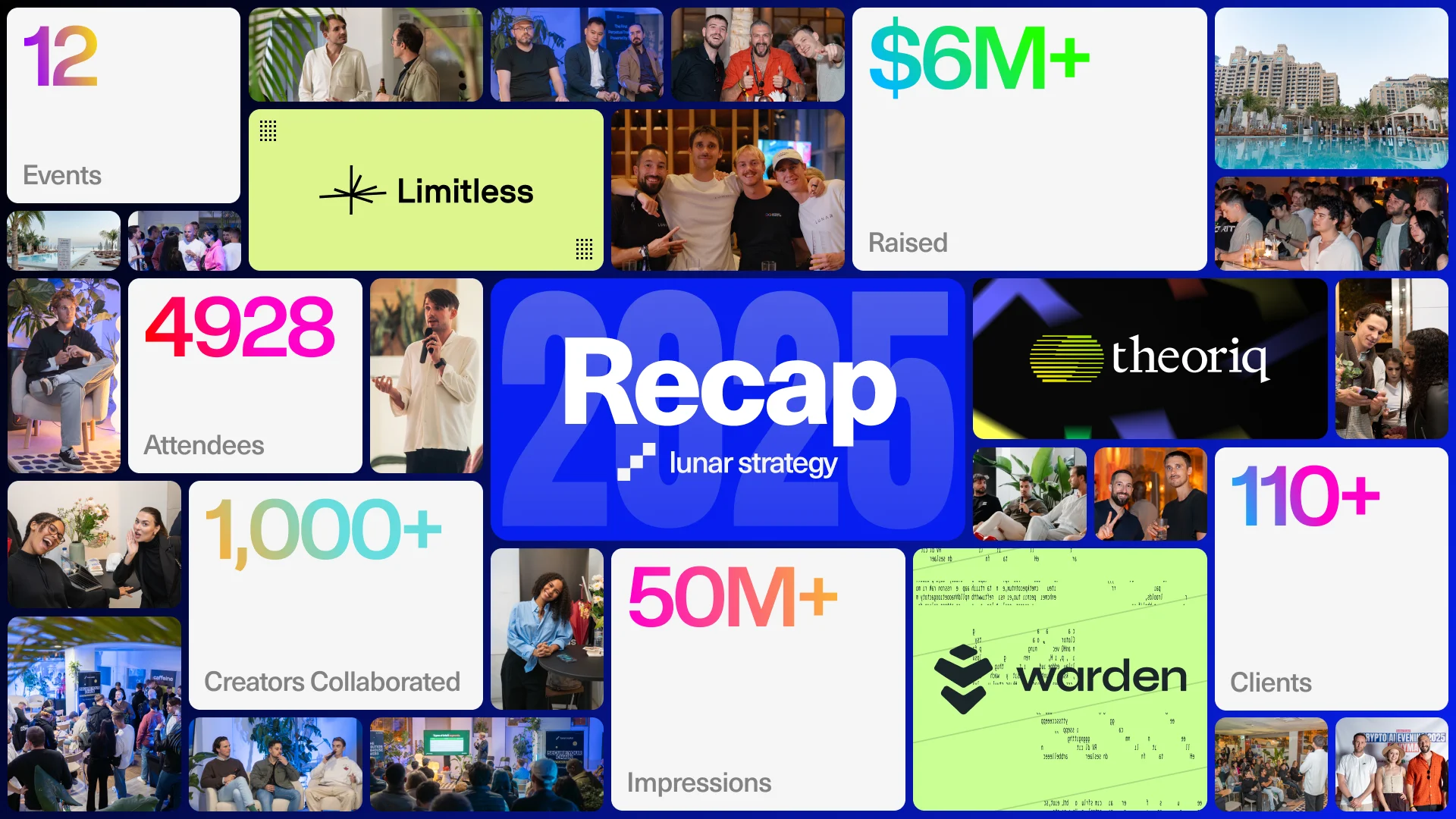
We've launched more than 300 crypto projects since 2019. Across those campaigns, one pattern holds: the budget goes furthest when prices are based on real views and the money is spread across many accounts that fit the audience.
For Limitless, 97 posts at a $19.60 average CPM supported a record $200 million community fundraise. For Warden Protocol, 75 creators across X and YouTube helped bring in 5 million users in six weeks, at about a $20 CPM at the busiest point. For TheorIQ, influencer content reached more than 7 million views, and its community sale was 40 times oversubscribed, with $78 million pledged.
None of those campaigns bought the cheapest posts. They bought the right posts, priced on how many people actually saw them.
Let's Talk Strategy
The price of a KOL post only matters next to what it delivers. Price on views, check that the audience is real, track real users, and your budget will go much further.
You explain what you're building and we'll explain how we'd support it.