




























Key Takeaways
- 11.6M tokens failed in 2025 alone; most had active marketing spend. The measurement framework was wrong (CoinGecko Research, January 2026).
- Cost Per Wallet (CPW) is the primary campaign metric in Web3. Wallet-bearing visitors convert 7x higher than non-wallet visitors (Addressable, February 2025, 245 campaigns).
- The 90-day cohort retention mark is the retention breakeven: users who stay past day 90 typically remain 12+ months.
- a16z confirmed in September 2025 that no established LTV:CAC benchmarks exist in Web3. Any agency claiming a "healthy 3:1 ratio" is using a Web2 metric in a Web3 context.
- Ask your agency for read access to their Dune, Spindl, or Cookie3 dashboards. If they can't provide it within 48 hours, they're not measuring on-chain outcomes.
Why do traditional marketing metrics fail in Web3?
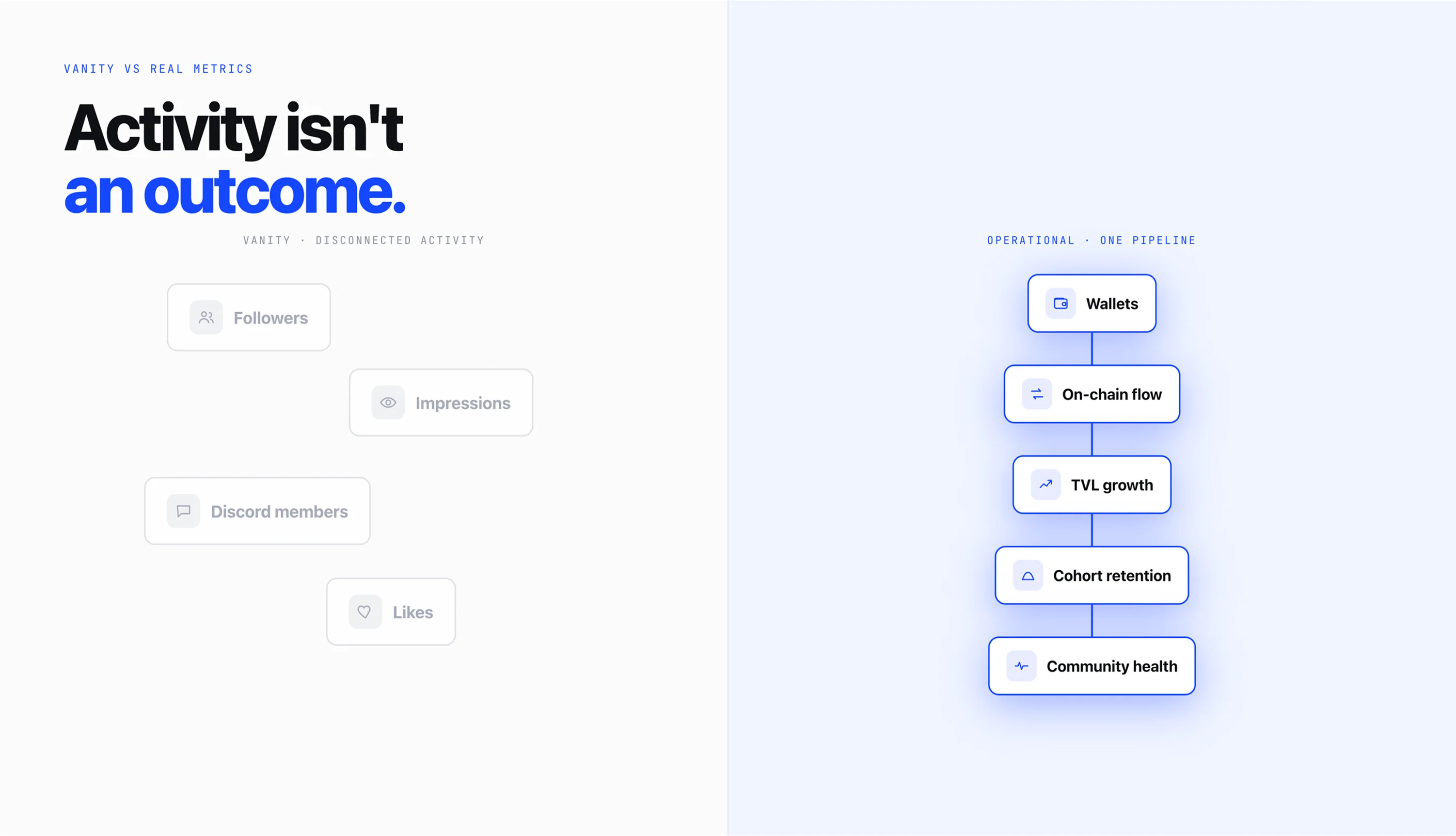
Standard Web2 metrics break in crypto because the conversion event is on-chain, not on a landing page. Only 15% of landing page visitors connect their wallet in DeFi funnels, and 55% of those who do connect never complete a first transaction (Blockchain-Ads, March 2026). Standard CTR and conversion rate figures describe a funnel that ends before anyone touches the product.
The attribution problem runs deeper than most agencies admit. Crypto users switch wallets frequently, route through VPNs, and bridge assets across chains mid-session. Standard UTM tracking misses 60-80% of actual on-chain conversions. A user who clicked your ad in January may not appear in your attribution data until they claim an airdrop in March, through a different wallet address.
Impressions are especially misleading in Web3. Bot activity on X is substantially higher than on any other major platform. Discord member counts can be inflated to arbitrary numbers with a $50 bot order. Neither metric tells you whether a real person with real capital interacted with your protocol.
The table below names the vanity metrics most agencies still report, and what they should replace them with:
| Vanity Metric | Why It Fails | Real Replacement |
|---|---|---|
| Discord member count | Bot-inflatable, zero activation signal | DAM ratio (daily active / total members) |
| Twitter/X followers | Purchasable; no wallet correlation | Wallet-bearing visitor rate |
| Impressions | No intent signal in crypto context | CPW / CPMA |
| Whitelist signups | Frequently airdrop-farmed | Whitelist-to-wallet conversion rate |
| "Brand awareness reach" | Unauditable in any useful sense | Branded search lift (Google Search Console) |
In September 2025, a16z crypto analyst Maggie Hsu published that no established LTV:CAC benchmarks exist in Web3, and the standard Web2 3:1 ratio does not apply because crypto CAC is fundamentally distorted by token incentives and airdrop farming (a16z crypto, September 2025). Any agency claiming they "maintain a healthy 3:1 LTV:CAC" in crypto is either measuring something that is not LTV, or applying a Web2 benchmark where it has no validity.
Tier 1 campaign-level ROI metrics
The most important campaign-level metric in Web3 is Cost Per Wallet (CPW), not Cost Per Click. Wallet-bearing visitors convert at 7x higher rates and have 18x higher login rates compared to non-wallet visitors, based on an Addressable study of 245 campaigns and 439,000 visitors (Addressable, February 2025). CPC counts everyone who clicks a link. CPW counts the audience that can actually use your product.
Cost Per Wallet (CPW)
CPW is calculated as: Total campaign spend divided by number of new wallets acquired. The rule of thumb: if CPW exceeds three times the benchmark for your vertical, pause the campaign and diagnose the root cause before increasing spend.
| Vertical / Channel | CPW | Notes |
|---|---|---|
| Developer CTF campaigns (Reddit) | $0.36 | Lowest CPW; self-selected on-chain developer audience |
| Meme tokens (programmatic) | $1.48 | High volume, low intent; activation rate typically poor |
| Stablecoin broad targeting | $1.86 | Moderate CPW; decent intent signal from audience |
| DEX campaigns (X/Twitter) | $3.07 | Higher than programmatic; better intent from crypto-native platform |
| Derivatives trader acquisition | $22.50 | Highest CPW; specialised audience with high LTV potential |
| Early-stage projects (general) | $50-$150 | Realistic baseline before wallet-based targeting is refined |
Activated Wallet Rate (AWR)
CPW tells you how much you paid to acquire a wallet. AWR tells you whether those wallets actually did anything. Define it as: wallets that completed at least one meaningful on-chain action post-acquisition. The 65% activation gap (wallets that connect but never complete a first transaction) is the most common waste point in Web3 marketing spend.
What counts as a "meaningful action" must be defined before the campaign launches, not after. For a DeFi protocol: first deposit. For an NFT collection: first mint. For a TGE: whitelist wallet verification. Without a pre-campaign definition, an agency can always retroactively move the goalposts.
Cost Per Meaningful Action (CPMA)
CPMA extends the CPW calculation to the full acquisition funnel: Total campaign spend divided by wallets that completed the pre-defined meaningful action. It is consistently higher than CPW, which is the point. An agency reporting CPMA instead of just CPW is telling you they are focused on outcomes rather than reach.
For how CPW targets fit into a full token launch marketing plan, see the token launch marketing strategy guide.
Retention metrics that predict long-term value
Campaign-level metrics tell you if acquisition is working. Retention metrics tell you if the product and community are holding the users you paid to acquire. The 90-day mark is the retention breakeven threshold: users who remain active past day 90 typically stay 12+ months. Everything before day 90 is acquisition cost. Day 90 onward is LTV.
DeFi user acquisition funnel
| Funnel stage | Conversion rate | Drop-off | Implication |
|---|---|---|---|
| Landing page visitors | 100% | – | Baseline; standard web analytics covers this stage |
| Wallet connected | 15% | 85% drop | Only 15% can interact with the product at all |
| First on-chain transaction | 6.75% | 55% of connected | Activation gap: the primary waste point in Web3 spend |
| Regular users | ~4% | 41% of transacted | Of every 100 visitors, ~4 become retained users |
Weekly Active Wallets (WAW)
WAW counts unique wallets that performed at least one on-chain interaction in the last seven days. It beats MAU for crypto because monthly active metrics can hide severe churn that only becomes visible at weekly resolution. A healthy WAW/MAU ratio is 0.4 or above (40% of monthly active wallets are also weekly active). Below 0.2 is a ghost-town signal regardless of what the community dashboard shows.
Cohort retention and the 90-day threshold
88% of 2024 crypto airdrops had negative returns after 90 days, and only 8 of 62 tracked launches actually held value (Keyrock, 2024). Airdrop-acquired users almost never become 90-day retainers. Community-acquired users do, by a wide margin.
This matters for channel allocation. If your agency is front-loading spend on airdrop mechanics without a post-airdrop retention plan, you are paying to acquire users who will dump on day 30. The campaign looks successful in the moment and devastating three months later.
Community DAM ratio
The DAM (Daily Active Members / Total Members) ratio is the most honest signal of community health. A healthy DAM ratio is 5-10%. Below 2% indicates a ghost community where member count is high but actual engagement is negligible. New member 7-day retention below 30% signals a broken onboarding sequence. Fix the onboarding before adding more members.
For the community management tactics that build cohorts capable of clearing the 90-day threshold, see the crypto community management guide.
Business-level ROI: CAC, TVL attribution, and earned media
Business-level metrics connect marketing spend to protocol outcomes: TVL, trading volume, or ecosystem developer growth. DeFi protocols average $85 Customer Acquisition Cost (CAC) per user at full funnel depth, but wallet-based ad targeting delivers 50-70% lower CAC than standard demographic targeting (HypeLab, March 2026, 200+ publisher network).
CAC by channel
| Channel / Protocol type | Avg CAC | Notes |
|---|---|---|
| Quest / learn-to-earn | $15 | Lowest CAC; self-selected qualified audience; high activation rate |
| Wallet-based targeting | $50 | 50-70% lower than demographic targeting (HypeLab, 2026) |
| Crypto gaming | $42 | Strong intent; lower than DeFi average |
| DeFi average (full funnel) | $85 | Benchmark across HypeLab's 200+ publisher network |
| X/Twitter (standard demographic) | $137 | High reach, poor targeting precision without wallet data |
| Google/Meta (standard demographic) | $212 | Highest CAC; broad audience with low on-chain intent |
TVL attribution
For DeFi protocols, TVL attribution connects marketing cohorts to actual deposits. The method requires cross-referencing Dune Analytics query data with UTM sources and wallet address mapping. The red flag threshold: when more than 70% of TVL comes from a single acquisition cohort, that is mercenary capital. It will exit the moment incentives change. Healthy TVL distribution comes from multiple smaller cohorts with varied acquisition dates.
Earned media value and branded search lift
Crypto-native media readership fell 33% across 2025, dropping from 105.85 million visits to 70.78 million by December (Yellow.com, 2025). This means EMV benchmarks from crypto PR carry a structural discount vs. Web2 equivalents.
The most underused PR measurement in Web3 is branded search lift in Google Search Console: tracking the change in queries for your protocol name or token ticker before and after a PR push. It is a direct, verifiable signal that earned media generated real audience awareness, not just a placement number.
Which metrics matter most for your project type?
| Project Type | Primary KPI | Secondary KPI | Underperformance Flag |
|---|---|---|---|
| DeFi Protocol | TVL per acquired cohort | 90-day yield farmer churn rate | >70% TVL from single cohort |
| TGE / Token Launch | Whitelist-to-wallet conversion rate | 30/60/90-day holder retention | Sub-20% 90-day holder retention |
| NFT / Gaming | ARPU vs. token velocity | Secondary market volume contribution | Floor price declining while mints rise |
| Layer-1 / Infrastructure | Developer wallet activations | GitHub commits from marketing cohort | DAU/MAU ratio below 20% |
Metrics by campaign lifecycle stage
Pre-TGE (day -90 to -1): CPW by channel and community DAM ratio are the leading indicators. You are building the wallet-bearing audience that will convert on TGE day.
Launch week: Whitelist-to-wallet conversion rate and activated wallet rate become the primary dashboards. These numbers tell you in real time whether the community you built is transacting, or just watching the chart.
30-90 days post-TGE: Cohort retention, 90-day holder rate, and WAW/MAU. This is where most projects stop investing in reporting, and where most communities collapse.
6 months and beyond: TVL attribution, developer ecosystem growth, and branded search trend. If your protocol is generating genuine utility, these numbers compound.
The Web3 analytics tool stack
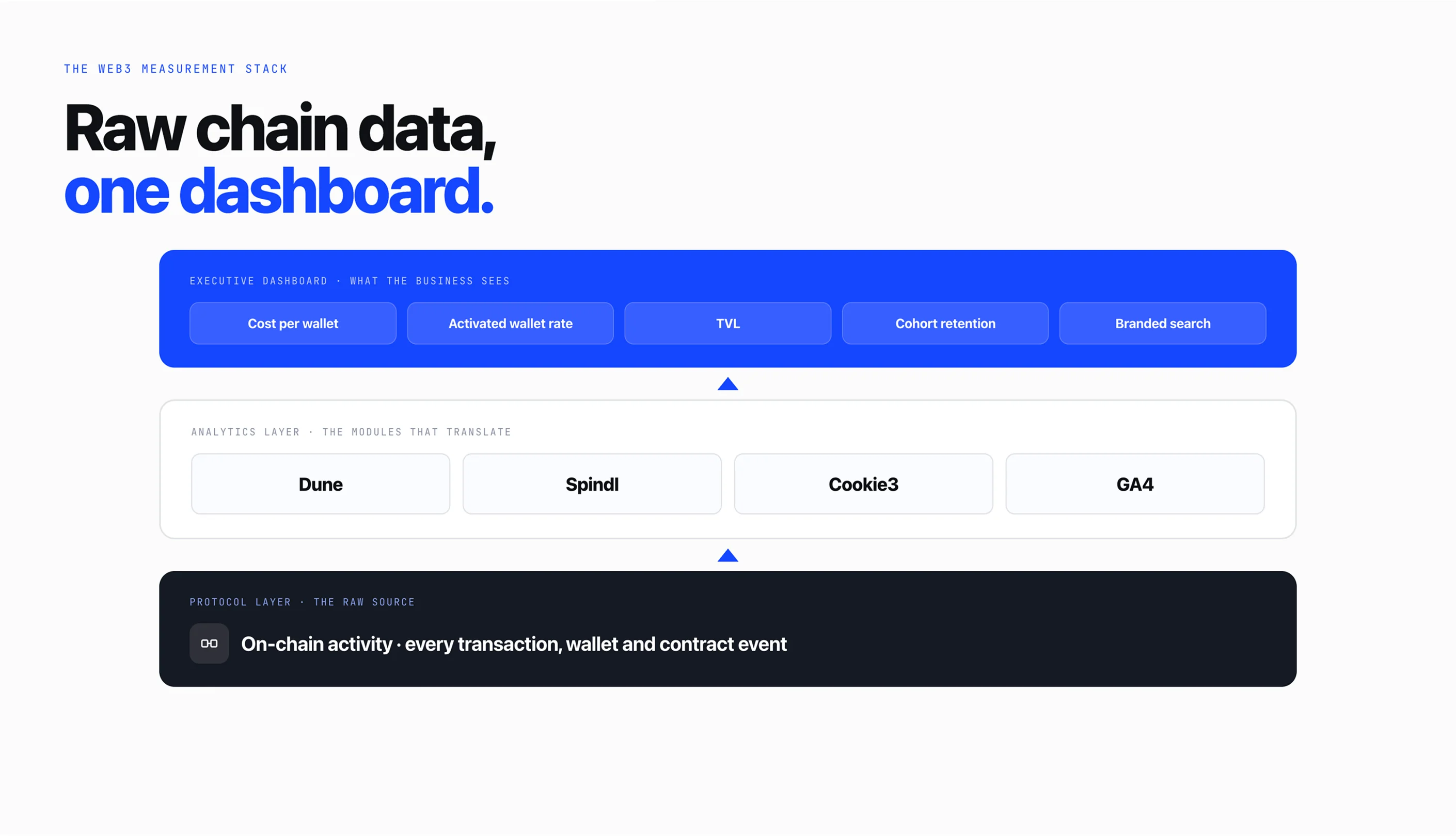
Attribution in Web3 requires a different toolset than Web2. The standard GA4 + Google Ads pipeline misses on-chain events entirely, stopping at the link click rather than the contract interaction.
| Tool | What It Tracks | Free / Paid | Best For |
|---|---|---|---|
| Dune Analytics | On-chain wallet activity, custom SQL queries | Free (public) | Protocol TVL, cohort analysis, WAW |
| Spindl | Wallet-to-conversion attribution, CPW | Paid | DeFi/TGE paid campaign attribution |
| Cookie3 | Wallet-level behaviour analytics, segmentation | Paid | User segmentation, retention cohorts |
| Formo | Landing page to wallet conversion | Paid | Pre-TGE whitelist and mint funnels |
| GA4 + UTM | Web traffic, referral sources | Free | Top-of-funnel traffic, branded search lift |
No single tool covers everything. An effective Web3 attribution stack requires at least 2-3 of these running in parallel, with Dune as the on-chain verification layer for whatever the other tools report.
The Kaito mindshare metric deserves specific attention. Rather than tracking follower counts or engagement rates on X, Kaito measures share of attention: what percentage of total crypto conversation in a given category mentions your protocol vs. competitors. It surfaces whether a KOL campaign actually moved the narrative, or whether you paid for posts that generated likes but no shift in mindshare.
For branded search lift, the workflow is straightforward: export brand query data from Google Search Console before and after a PR campaign, filter for your protocol name and token ticker, and compare weekly query volume. A meaningful PR push should produce a measurable lift in branded search volume within 1-2 weeks of publication.
How to hold a crypto marketing agency accountable
The eight questions below are the fastest filter available for evaluating any agency's reporting discipline. A good agency should answer all eight with specific numbers and named tools in under 15 minutes.
When Lunar Strategy took over a campaign from a previous agency for a DeFi protocol client, the handoff deck contained a monthly report showing 2.3 million impressions, 47,000 new X followers, and a 34% community growth rate. The wallet activation rate was 0.3%. Ninety-day cohort retention was below 8%. The agency had been reporting success for eight months while the protocol's core metrics were deteriorating. Every metric in the report was accurate. None of them measured anything that mattered to the protocol's survival.
The 8 questions to ask before signing a retainer
1. What is your CPW target for our project type, and what triggers a campaign pause?
A good answer names a specific dollar range for your vertical and a specific multiple (e.g., "we pause any channel where CPW exceeds 3x the baseline for your protocol type"). A bad answer talks about "reaching target audiences" without a number.
2. How do you define "meaningful action" for our TGE or protocol, and is that definition in the contract?
Pre-campaign definition in writing prevents mid-campaign goalpost movement. If an agency will not commit to a specific action definition before launch, they will define it to match whatever numbers their campaign achieves.
3. What on-chain attribution tool do you use, and can we have read access to the dashboards?
Reputable agencies use Spindl, Cookie3, or Dune dashboards to track wallet-level attribution. Read access for the client should be standard, not a premium option. If they hesitate on this question, that is the answer.
4. What is your 90-day cohort retention benchmark, and which past campaigns achieved it?
Any agency running Web3 campaigns for more than a year should have retention benchmarks from previous campaigns. Ask for the actual numbers, not case study summaries.
5. How do you separate organic community growth from paid acquisition in your reports?
Mixing organic and paid growth into a single community growth metric is a reporting integrity issue. Attribution requires separating the sources. If they cannot do it, they do not know what is working.
6. What does your monthly report include, and which metrics are tied to deliverables vs. general market movement?
A market rally lifts every protocol's metrics. Attribution requires distinguishing what improved because of the campaign vs. what improved because the entire market moved. Agencies that do not separate these are claiming credit for Bitcoin price action.
7. If a KOL campaign coincides with a token price drop, how do you isolate KOL impact from price action?
A credible answer involves Kaito mindshare data, community DAM ratio before and after the campaign window, and wallet-level conversion tracking. Not just impressions from the KOL's posts.
8. Do you offer performance-linked compensation, and if not, why not?
This question is not about whether performance fees are the right structure. It is about whether the agency has thought seriously about aligning their incentives with yours. Agencies that have never considered it tend to be retainer-maximisers.
At Lunar Strategy, the internal CPW management rule is straightforward: if any channel exceeds 3x its vertical benchmark CPW for two consecutive reporting weeks, that channel is paused pending a root cause analysis before additional spend is released. This is tracked per channel, not blended. Blending lets expensive channels hide behind cheap ones. Every client has read access to their Dune dashboard and Spindl attribution reports from campaign day one.
What a good monthly report includes
- CPW by channel (paid, KOL, community referral), separated, not blended
- Activated wallet rate and 30-day cohort retention
- Community DAM ratio and 7-day new member retention
- Branded search lift (Google Search Console: brand queries vs. prior period)
- TVL or trading volume attributed to marketing cohort (for DeFi protocols)
- Campaign spend breakdown vs. on-chain outcome per dollar
Any report that leads with impressions and follower counts without these metrics is not measuring business outcomes. It is measuring activity.
Red flags in agency answers
- "We reached 2 million impressions" with no CPW data, no wallet activation rate
- "Your community grew 40%" with member count reported and no DAM ratio
- "We placed you in 15 publications" with no branded search lift, no media quality scoring
- "Kaito mindshare increased 18%" as the only metric in the entire report
For the criteria framework for evaluating any crypto marketing agency, see our guide to choosing a crypto marketing agency.
Frequently Asked Questions
What metrics should a crypto marketing agency report every month?
A complete monthly report should include: CPW by channel (separated, not blended), activated wallet rate, 30-day cohort retention, community DAM ratio, 7-day new member retention, branded search lift from Google Search Console, and TVL or trading volume attributed to the marketing cohort for DeFi protocols. Any report that leads with impressions or follower counts without these metrics is not measuring business outcomes.
How do you calculate ROI on a token launch marketing campaign?
Divide total marketing spend by the number of wallets that held tokens past 90 days. Cross-reference with whitelist-to-wallet conversion rate and 30-day post-TGE holder retention. 88% of 2024 crypto airdrops had negative 90-day returns (Keyrock, 2024). ROI calculation requires on-chain attribution, not web analytics.
What is Cost Per Wallet (CPW) and why does it matter more than CPC?
Cost Per Wallet measures how much you spend to acquire a verified crypto-native user with an active wallet who can actually interact with your protocol. Wallet-bearing visitors convert 7x higher and log in 18x more than non-wallet visitors (Addressable, February 2025, 439K visitors). CPC counts everyone who clicks a link; CPW counts the audience that can use your product.
What is the difference between vanity metrics and real Web3 KPIs?
Vanity metrics are inflatable without on-chain effort: Discord members, X followers, whitelist signups. Real KPIs require genuine user action: activated wallet rate, 90-day cohort retention, TVL attribution, community DAM ratio. A project can buy 50,000 Discord members in a weekend. It cannot fake 90-day on-chain retention.
How do I know if my crypto marketing agency is delivering real results?
Ask for read access to their attribution dashboards (Dune, Spindl, or Cookie3). Request the CPW and activated wallet rate for each channel. If they cannot provide these numbers within 48 hours, they are not measuring them. Per a16z crypto analyst Maggie Hsu (September 2025), no standardised LTV:CAC benchmark exists in crypto. Any agency claiming a specific ratio is applying a Web2 metric where it does not hold.
The measurement framework summary
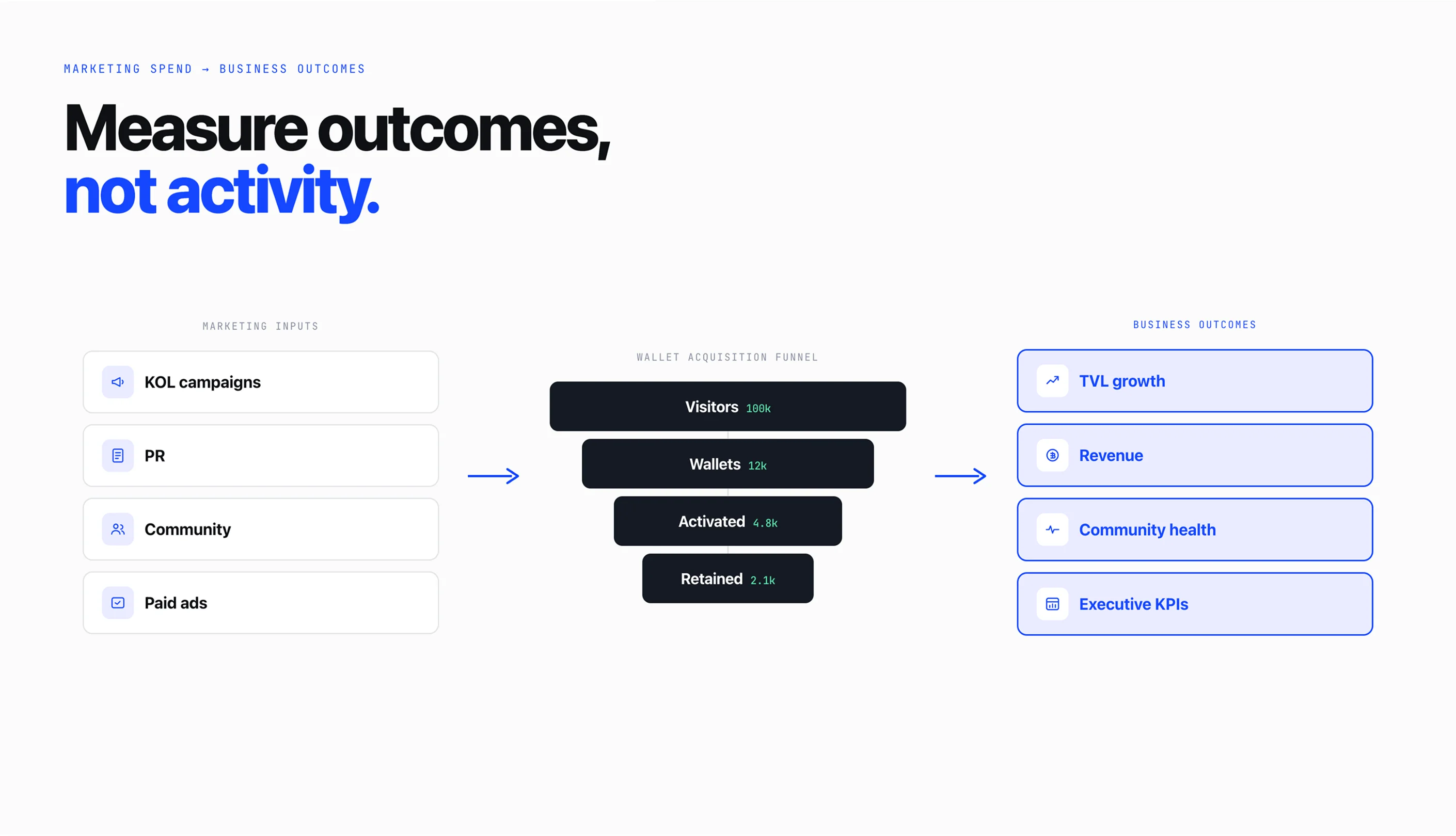
Most of the 11.6 million tokens that failed in 2025 had active marketing spend. The agencies running those campaigns were reporting success, measured in impressions and Discord members and whitelist signups that had no connection to on-chain outcomes.
- Tier 1: CPW, activated wallet rate, CPMA - campaign-level signals tied to on-chain acquisition
- Tier 2: WAW, 90-day cohort retention, community DAM ratio - the retention layer that predicts LTV
- Tier 3: CAC by channel, TVL attribution, branded search lift - the business case your investors will ask about
- Tool stack: Dune + Spindl/Cookie3 + Kaito + GA4 - the minimum for attribution honesty
- Accountability: read access to dashboards from day one, metric definitions in the contract, and the a16z reminder that Web2 benchmarks do not transfer
The eight questions in the accountability section are the fastest filter. Any agency that can answer all eight with specific numbers in 15 minutes is worth talking to further. Any agency that cannot is optimising for their retainer, not your outcomes.
Lunar Strategy has run crypto marketing campaigns for Polkadot, Cardano, ICP, and OKX. Every campaign runs on the framework above: CPW targets defined before launch, meaningful action defined in the contract, and client read access to Dune and Spindl dashboards from day one. See our community management service for how this applies to community attribution, or book a free consultation here to map the measurement framework to your specific project.