







.png)
















TL;DR:
- Tokenomics is the plan for how your token works: how many tokens exist, who gets them, when they can be sold and why anyone would want one. You don't have to design it yourself, but you have to understand it, because investors, exchanges and buyers will ask you to defend it.
- The stakes are high. In 2025, 100 of 118 major token launches were trading below their launch valuation by December, and most of the damage was built into the design long before the marketing started.
- Start with six questions: why the project needs a token, what the token does, how many will exist, who gets them, when they unlock and how many are on sale on launch day. If you can't answer one in a sentence, that's where the work is.
- Then build the right team: a tokenomics designer to model it, a lawyer to confirm what the token legally is, an auditor for the contracts and, closer to launch, a market maker and a marketing partner. Ask each of them to explain their choices in plain words.
- Judge the result the way a buyer will: a Keyrock study of more than 16,000 unlocks found about 90% pushed prices down, with team unlocks hitting hardest. Long, gradual lockups and a clear reason to hold are the green flags, and your launch marketing should be planned around the unlock dates, not on top of them.
Every token launch starts with a spreadsheet: how many tokens, who gets them and when they unlock. In 2025, that spreadsheet decided more launches than any campaign did. Memento Research tracked 118 major token launches and found 100 of them, or 84.7%, trading below their launch valuation by December, with the median token down 71% (CryptoSlate). None of the 28 that launched at $1 billion or more was above that level by year end.
Most founders don't build that spreadsheet themselves, and they shouldn't: it's specialist work for economists, lawyers and engineers. But the founder signs off on it, defends it to investors and exchanges, and lives with it for years. This guide covers what you need to do that well: what tokenomics is, the six questions to ask, who to hire, how to tell a sound structure from a risky one, and where marketing comes in.
Tokenomics is the plan for how your token works
Tokenomics is the plan for how a crypto token works as an economy: how many tokens exist, who receives them, when holders can sell and what makes people want to hold one. Market cap counts only the tokens that can trade today, while fully diluted valuation (FDV) counts every token that will ever exist (CoinMarketCap).
If you've raised money for a startup, you already know half of this. Splitting your tokens works like a cap table: founders, investors and early supporters each get a share, usually locked for a while. The difference is that a token trades in public from day one, so anyone can see your cap table, and anyone holding an unlocked share can sell it. Every plan comes down to four parts:
- Supply: how many tokens will exist, and whether new ones keep being created.
- Allocation: who gets them: team, investors, community and a treasury the project controls.
- Vesting: when each group can sell. Vesting means tokens are released gradually, often after a waiting period called a cliff.
- Utility: what the token does, and why someone would want to hold it.
Answers to those four parts are your tokenomics. The real question is whether they are good answers.
You don't have to design it, but you have to own the answers
Founders tend to make one of two mistakes. Some start from a template and split the pie chart before deciding what the token is for. Others hand the whole thing to an advisor and sign whatever comes back. Both skip the part only the founder can do: deciding why the token exists and what it should reward. Every number in the model should follow from that decision.
Timing is the other trap. a16z crypto, which invests in tokens and so has a stake in launches going well, calls launching too early "the most common mistake that projects make in web3," and warns that tokens "can attract users, but they cannot make them stick around" (a16z crypto). A token amplifies a product that works. It rarely rescues one that doesn't. The sharpest version of the question came from a founder:
What problem does the token solve that equity or a traditional cap structure doesn't?
Nathaniel Sokoll-Ward, Co-founder, Manifest Finance, via CryptoSlate (December 2025)
That question is the first of six every founder should be able to answer.
The six questions every founder should be able to answer
Specialists will bring you models and spreadsheets. These six questions are how you check their work. Go through them in order, because each answer shapes the next: the purpose decides what the token does, and what it does decides how much supply makes sense. For each one: why it matters, what a good answer sounds like and the warning sign.
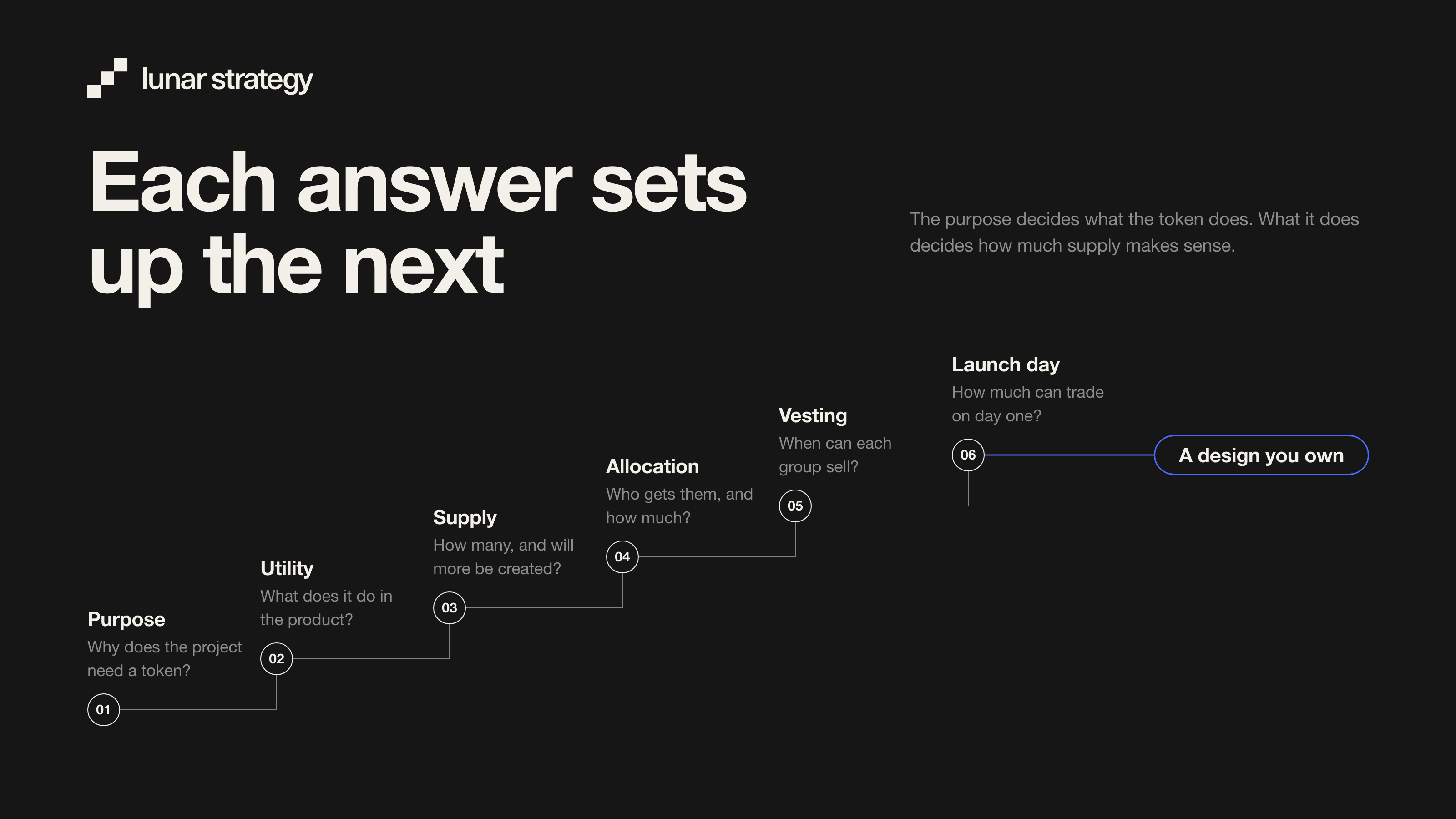
01 · Purpose
Why does this project need a token at all?
- Why it matters: a token is hard to undo. Once it trades, your community starts judging the product by a chart.
- Good answer: the token does something equity or loyalty points can't, such as paying for the network, securing it or giving users a real share in it.
- Warning sign: the main reason is to raise money, or that every competitor has one.
02 · Utility
What does the token do inside the product?
- Why it matters: utility is where lasting demand comes from: paying fees (every Ethereum transaction pays gas in ETH), staking to secure a network, unlocking features or voting.
- Good answer: one sentence a user understands, such as "you stake it to earn a share of fees."
- Warning sign: voting is the only use. Uniswap's UNI was a governance token for years, and only when its fee switch went live in late December 2025 did Coin Metrics describe it as "shifting UNI from governance-only to direct value accrual" (Coin Metrics).
03 · Supply
How many tokens will exist, and will new ones keep being created?
- Why it matters: new tokens dilute holders like new shares do. Bitcoin is capped at 21 million, while many projects keep issuing tokens as rewards.
- Good answer: if new tokens keep coming, something also takes tokens out, such as fees that are burned (permanently destroyed) or spent in the product.
- Warning sign: rewards that grow faster than real use. In February 2022, Axie Infinity reported that about four times more of its SLP token was being created each day than burned (Axie Infinity).
04 · Allocation
Who gets the tokens, and how much?
- Why it matters: buyers screenshot the allocation chart first, because it shows who might sell.
- Good answer: every slice has a named owner and a purpose, and the community share really goes to users.
- Warning sign: wallets nobody can explain, or a "community" slice that is really a treasury the team controls.
05 · Vesting
When can each group sell?
- Why it matters: unlock dates are public, and they are when new supply reaches the market.
- Good answer: insiders locked for at least a year, then released gradually, with each group's dates spread apart.
- Warning sign: one big cliff where several groups unlock on the same day.
06 · Launch day
How many tokens can be bought on day one, and at what price?
- Why it matters: this sets your float (the share of tokens that can trade at launch) and your FDV, the numbers traders check first.
- Good answer: enough float that a few wallets can't set the price, at a valuation that makes sense next to similar live tokens.
- Warning sign: a tiny float at a very large valuation, the design behind many of 2025's worst launches.
If one of the six has no clear answer yet, that is where your specialists should spend their time first.
Who to hire: the specialists behind a token launch
No single person covers all six questions. Most teams put together a small group of specialists, some for a few weeks and some for years. The table shows who they are, when you need them and one question to ask before you sign. The questions are our own checklist, not an industry standard: each one tests whether the person can explain their work to you.
| Specialist | What they do | When you need them | Ask before hiring |
|---|---|---|---|
| Tokenomics designer also called a token economist | Turns your goals into supply, allocation and vesting numbers, and models how they behave over time | Early, once purpose and utility are clear | "Can you explain every number in this model in plain words?" |
| Token engineer | Stress-tests the model with simulations, using tools such as the open-source cadCAD | Before the design is final, especially if you pay rewards | "What breaks first if usage is half of what we expect?" |
| Crypto lawyer | Defines what your token legally is and how you can offer it. The SEC's March 2026 guidance sorts crypto assets into five categories, and the EU's MiCA rules require a white paper for most offers | Before any sale, airdrop or public announcement | "In which countries can we offer this token, and how?" |
| Smart contract auditor | Reviews the token and vesting contracts for bugs before they go live | Before deployment, with the report published | "Which contracts are in scope, and will you recheck our fixes?" |
| Market maker | Keeps buy and sell orders on exchanges so the token trades smoothly. Binance now requires projects to disclose who it is and the contract terms | A few weeks before listing | "Can we publish the terms of this deal?" |
| Launch marketing partner | Turns the design into a story buyers understand and plans announcements around unlock dates | About 90 days before launch | "How will you explain our tokenomics to people who aren't experts?" |
Read the market maker's contract closely. A CoinDesk investigation found that Movement Labs had a draft deal lending one counterparty 5% of its token supply, with terms allowing it to sell once the valuation passed $5 billion, and about 66 million MOVE were sold after listing (CoinDesk). In 2024, the FBI created its own token to catch market makers allegedly faking volume, and charged 18 people and firms (US Department of Justice). Our overview of crypto market makers explains what a fair deal looks like.
How to tell if your token structure is good
There is no official standard split. We looked for a credible, recent dataset behind the usual "right percentage for the team" and found none, so treat any fixed number as an opinion. What you can do is compare your design with recent large launches and with what the data says about selling.
| Question | Green flag | Red flag |
|---|---|---|
| Purpose | A one-sentence reason the token must exist | "We need to raise money" |
| Utility | Users need the token to do something in the product | Voting only, or a story about the price going up |
| Supply | New tokens are matched by tokens taken out | Rewards growing faster than real use |
| Allocation | Every slice has a named owner and purpose | Unknown wallets, or a treasury labeled as community |
| Vesting | Insiders locked a year or more, then released monthly | Several groups unlocking on the same day |
| Launch day | Enough float that a few wallets can't set the price | A single-digit float at a very large valuation |
The vesting row matters most for your price. Keyrock, a crypto market maker, studied more than 16,000 unlock events across 40 tokens: team unlocks caused the worst drops, around 25%, and prices often started falling about 30 days before the unlock date. Long, gradual vesting for the team is not a favor to investors. It protects the price your community paid.
The biggest 2025 launches settled on similar terms. Monad gave its team about 27% and investors about 19.7%, with all team tokens locked for the first year and everything fully unlocked by late 2029 (Monad). Lighter gave its team 26% and investors 24%, both on a one-year lock followed by three years of linear vesting (The Block). a16z crypto recommends the same shape for insiders: four years in total, the first fully locked (a16z crypto).
For a launch built the other way around, look at Hyperliquid in November 2024: 31% of supply went to users, fully unlocked, core contributors were locked for a year, and the project announced "no allocations for private investors, centralized exchanges, or market makers" (The Block). You don't have to copy it, but buyers could see exactly who might sell, and when. That clarity is what a good structure looks like from the outside.
Your tokenomics is your first launch message
Once the design is final, buyers read it before your thread or your KOL campaign. Funds are especially wary of launch day: Jeff Dorman, chief investment officer at Arca, told CryptoSlate in December 2025 that he didn't know "a single liquid fund that has bought a new token on TGE in over two years." If professional money sits out the token generation event (TGE), your first buyers are the people your marketing reached, and the design decides whether they stay.
This is where marketing does its real work, and it starts before launch:
- Explain the design in plain words. Publish the allocation, unlock dates and reason to hold before launch, so your community hears it from you first.
- Plan announcements around unlock dates. Keep partnerships, listings and KOL waves away from weeks with large unlocks, when sellers are waiting.
- Reward behavior you want repeated. Airdrops should go to people who use the product, not wallets that show up once. Our guide to airdrop marketing covers how.
- Sequence the launch. Our 90-day pre-TGE playbook lays out what to do before the token goes live.
Marketing can't fix a weak design. It can make a sound one easy to understand and easy to trust.
Where to start
Start with the first two questions, because they decide everything else. If you can't say in one sentence why the project needs a token and what users will do with it, pause the launch plan and work on the product first. If you can, take these steps in order:
- Brief a tokenomics designer and a lawyer together, so the model and the legal structure develop side by side, and ask for the model in a format you can question line by line.
- Review the draft with the six questions and the table above, with your co-founders and lead investor in the same meeting.
- Book the auditor and the market maker early, since both take weeks, and get every market-maker term in writing.
- Bring in your launch marketing partner about 90 days out, once the design is stable enough to explain. For the wider choice of launch format, see our token launch strategy guide.
How Lunar helps you launch a token the market understands
We've worked with more than 300 crypto projects since 2019, and the launches that go well are the ones where product, brand and token tell the same story. Lunar isn't a tokenomics design firm; that work belongs to the specialists above. Our part starts where the design meets the market: our Web3 consulting and go-to-market team reviews your token's utility, builds the narrative that explains it and plans the launch calendar around your unlock dates. For what goes wrong when this is skipped, see how to avoid a flopped TGE.
Plan your token launch with Lunar →
Tell us what you're launching and when, and we'll show you how the market is likely to read it.
Frequently Asked Questions
Is crypto tokenomics the same as AI tokenomics?
No. In crypto, tokenomics means the economic design of a token: supply, allocation, vesting and utility. AI companies have also started using "tokenomics" for the cost of running language models, where a token is a fragment of text a model reads or writes. The two share a word and nothing else, and this guide covers only the crypto meaning.
What does FDV mean in crypto?
FDV, or fully diluted valuation, is the token's price multiplied by every token that will ever exist, including locked ones. Market cap uses only the tokens trading today. A large gap between the two means many tokens are still waiting to unlock, so buyers expect more supply to reach the market later.
What is the difference between a cliff and vesting?
A cliff is the waiting period before any locked tokens are released, often 12 months. Vesting is the gradual release that follows, usually monthly over two or three more years. A one-year cliff with three years of vesting means nothing unlocks in year one, then a little unlocks every month until year four.
How much of the supply should go to the team?
There is no standard number, and the terms matter more than the percentage. Buyers look at how long the team is locked, whether release is gradual after the cliff, and whether the share fits the work ahead. In the large 2025 launches above, team and investors together held roughly 45-50%, always with long lockups.