

























A Token Generation Event (TGE) is the process of launching a token and distributing supply to users, investors, and ecosystem participants to bootstrap adoption, governance, and liquidity. Context: Why Most TGEs Fail
In recent years, thousands of new crypto tokens have entered the market, yet the majority fade into obscurity within months. As of 2026, TGEs have moved far beyond the speculative ICO era. Today’s launches are more disciplined, community-driven, and fiercely competitive.
Success is no longer about hype alone. Projects must deliver:
- Technology that works at launch
- Token economics that withstand scrutiny
- Communities that remain active after distribution
As markets mature and expectations rise, weak foundations are punished quickly, often irreversibly.
The Shift in 2026: Execution Over Hype
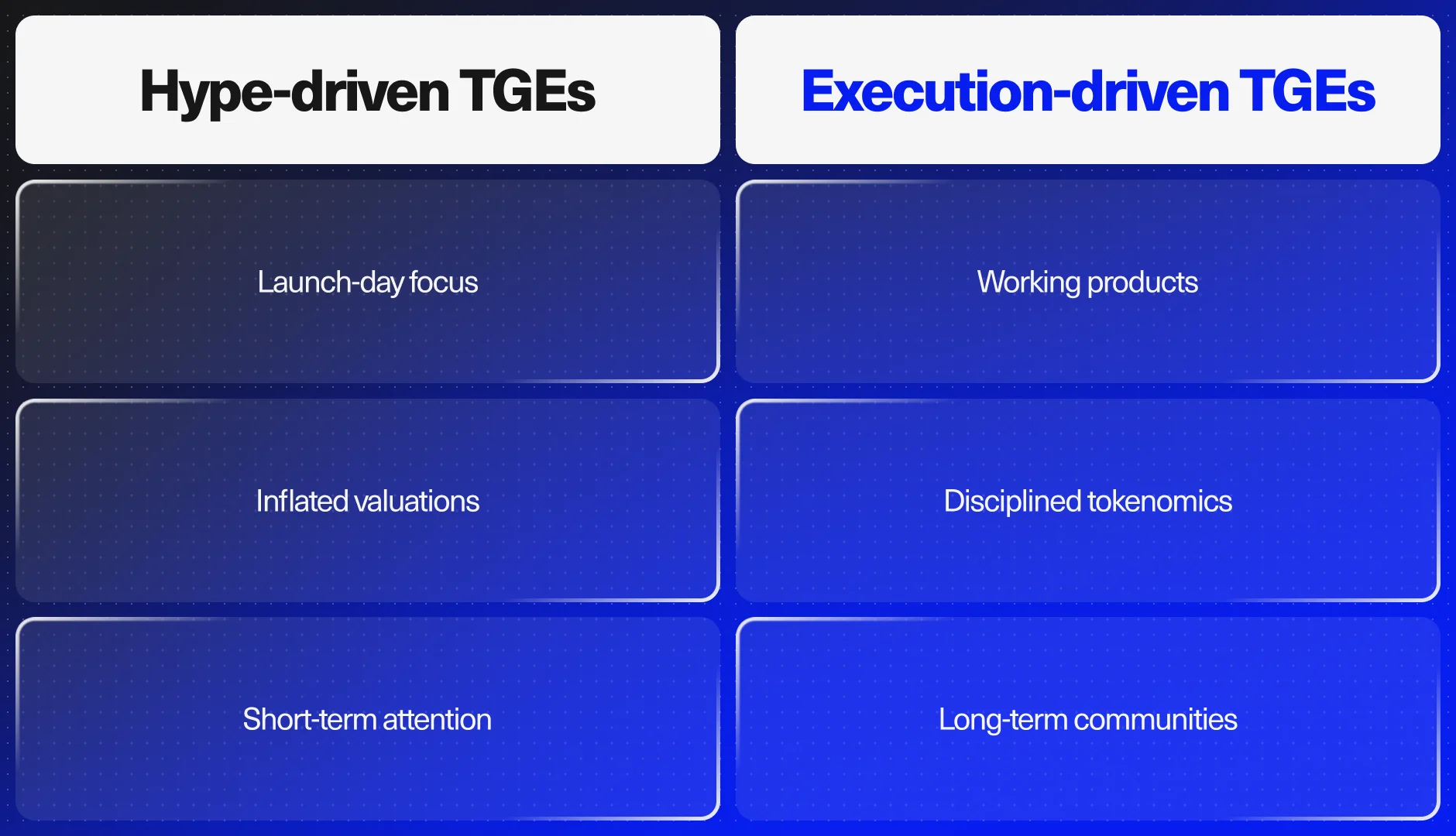
Modern TGEs are judged less by launch-day excitement and more by long-term execution. Teams are expected to demonstrate real utility, credible economics, regulatory awareness, and sustained community engagement before tokens ever go live.
This article breaks down what separates successful TGEs from failed ones in 2026, highlights high-performing sectors such as DeFi, DePIN, and AI + Crypto, and analyzes real-world hits and misses to extract repeatable lessons.
TL;DR
- Most TGEs fail due to weak fundamentals, not lack of attention
- Successful TGEs in 2026 are built on working tech, sound tokenomics, and real communities
- DeFi, DePIN, and AI + Crypto remain major TGE arenas, but execution determines outcomes
- Avoiding a flopped TGE requires strategy, timing, and disciplined preparation
The New Rules of TGEs
.webp)
A Token Generation Event is a project’s public entry into the crypto market, similar in visibility to an IPO, but far less forgiving. In the multichain ecosystem of 2026, success depends on several fundamentals aligning at launch.
- Technical Readiness Is Non-Negotiable
The foundation of any successful TGE is working infrastructure. Smart contracts must be thoroughly audited, and backend systems must handle launch-day demand.
History has shown that technical failures destroy trust instantly. High-profile incidents, such as major bridge and protocol exploits, have made investors far less tolerant of unfinished or rushed launches. If the product breaks on day one, recovery is unlikely.
- Tokenomics Must Withstand Scrutiny
Token economics are now examined as closely as the technology itself. Investors closely analyze Fully Diluted Valuation (FDV), circulating supply, vesting schedules, and unlock timelines.
Projects with inflated FDVs and low initial circulation often face immediate sell pressure once unlocks begin. Sustainable TGEs balance early liquidity with long-term incentives, avoiding structures that reward short-term speculation over ecosystem growth.
- Community Can’t Be Manufactured
In 2026, artificial traction is easy to spot. Bot-filled Discords and inflated social metrics no longer convince anyone.
Successful TGEs are preceded by real engagement, including:
- Testnet participation
- AMAs and developer sessions
- Governance simulations or early voting trials
Communities built this way are more resilient after launch and less likely to disappear once tokens become tradable.
- Legal and Compliance Readiness Matters
Regulatory scrutiny continues to increase across jurisdictions. Projects are expected to implement appropriate safeguards, including KYC processes, geo-restrictions, and careful public messaging.
Compliance is no longer optional, it’s part of risk management. Poor legal preparation can delay listings, restrict access, or derail a launch entirely.
- Strategy, Timing, and Narrative Alignment
Winning TGEs follow deliberate playbooks. Teams often combine private allocations with public airdrops to balance institutional support and grassroots participation.
Timing also matters. Launching during extreme market downturns can suppress even strong projects.
Aligning narratives, such as DeFi sustainability, DePIN utility, or AI + Crypto execution, with real delivery increases the odds of standing out.
When these elements align, a TGE has a realistic chance of cutting through market noise instead of being forgotten within weeks.
Hot Verticals: Where the Action Is
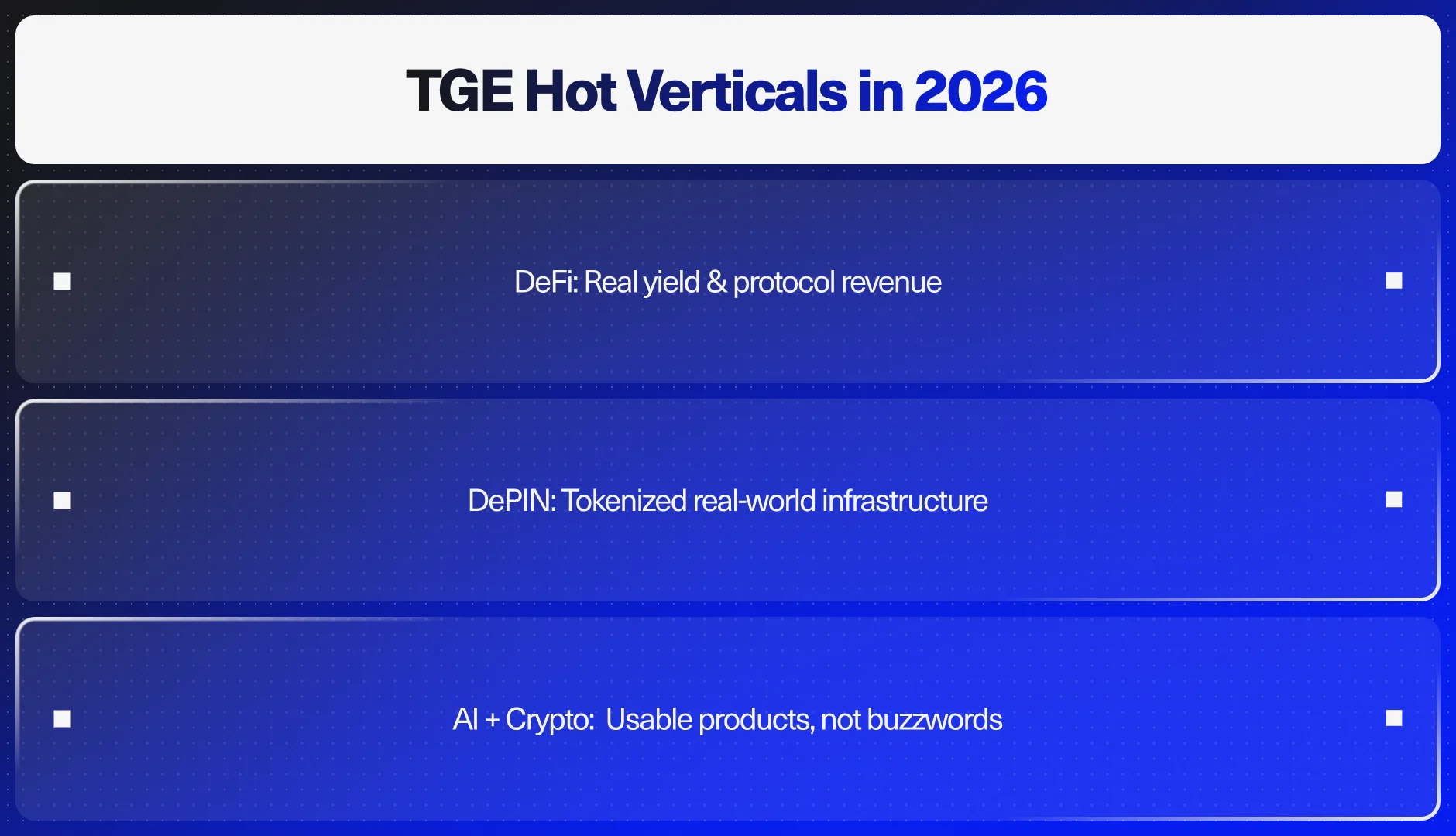
In 2026, TGE activity is concentrated in a small number of high-conviction sectors. Each vertical attracts capital for different reasons, and each comes with its own execution risks.
DeFi: From Incentives to Real Yield
Decentralized finance has matured significantly since the era of unsustainable four-digit APYs. Today, investors prioritize real yield, returns generated from actual protocol revenue rather than inflationary token emissions.
Successful DeFi TGEs tend to share a few traits:
- Clear fee-generation mechanisms
- Sustainable incentive structures
- Security-first design
Airdrops remain an effective user acquisition tool, but poorly designed distributions often lead to short-term speculation. Lock-up periods, staking requirements, and fee-sharing models, popularized by protocols such as Uniswap, help align token holders with long-term protocol health.
In DeFi, trust and execution matter more than novelty.
DePIN: Real-World Utility Takes Time
Decentralized Physical Infrastructure Networks (DePIN) bridge blockchain incentives with real-world systems such as connectivity, energy, and data collection.
Unlike purely digital protocols, DePIN projects often face longer timelines due to hardware deployment and physical constraints. Adoption depends heavily on community participation and patience.
Projects like Helium demonstrated that token incentives can bootstrap real infrastructure, but only when expectations are managed carefully. DePIN TGEs succeed when tokens are clearly tied to measurable output, such as network usage or energy production.
The payoff can be substantial, but DePIN rewards teams that plan for long execution cycles.
AI + Crypto: Substance Over Buzzwords
AI + Crypto has emerged as the most scrutinized TGE vertical in 2026. After waves of vague “AI-powered” claims, investors now demand demonstrable functionality.
Projects that succeed in this category deliver:
- Working AI tools at or before launch
- Clear developer or user use cases
- Token utility tied directly to system usage
Platforms such as Virtuals Protocol gained traction by shipping usable AI infrastructure rather than relying on narrative alone. In DeFAI specifically, interest centers on autonomous agents that improve execution, risk management, or capital efficiency in measurable ways.
In AI + Crypto, hype decays quickly, only delivery sustains momentum.
Key Insight Across Verticals
While DeFi, DePIN, and AI + Crypto differ in mechanics, successful TGEs across all three share one trait: precision in execution.
Narratives attract attention, but foundations determine outcomes.
TGE Case Studies: Hits and Misses
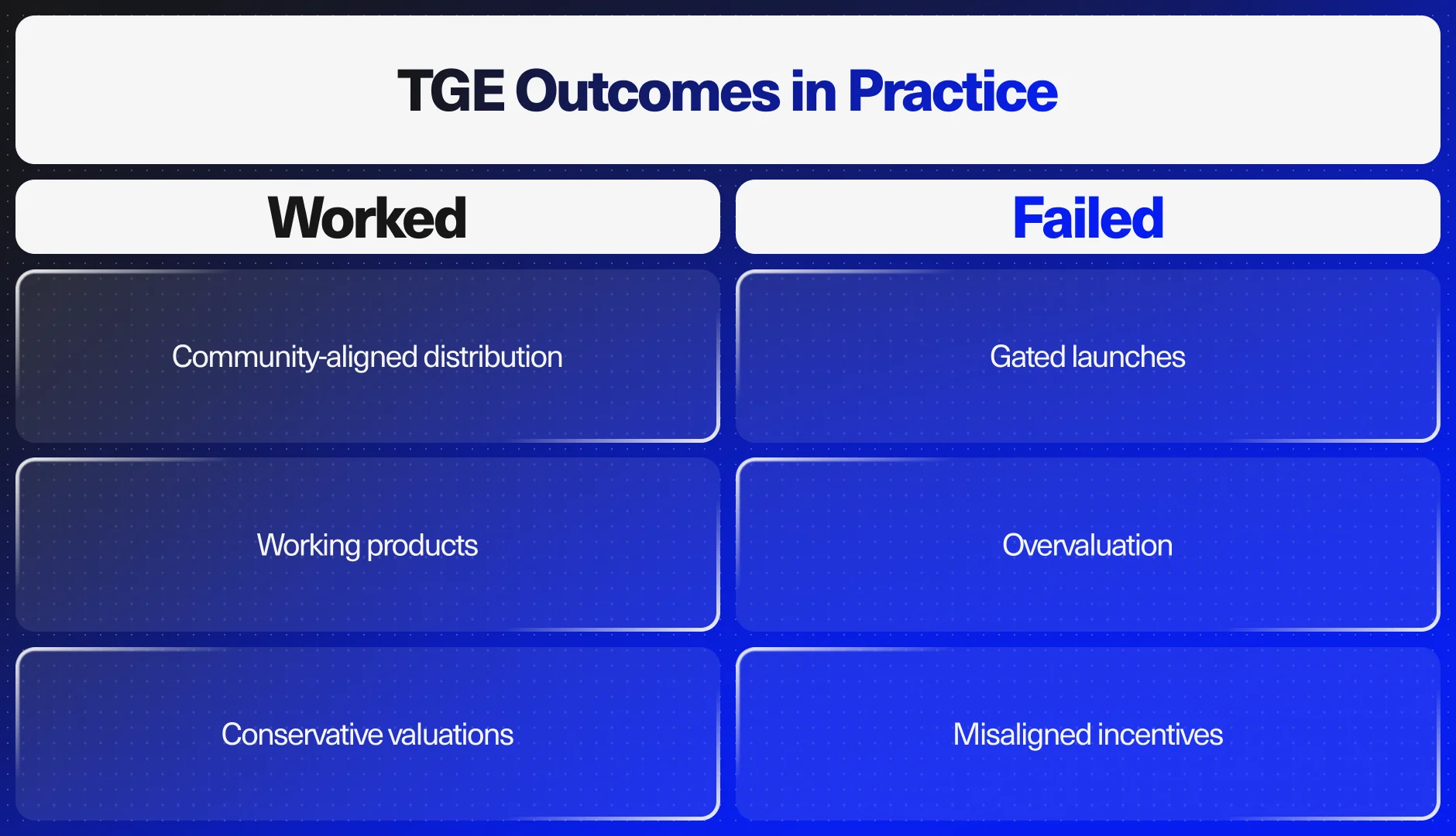
Real-world launches highlight a consistent pattern: execution beats hype. The following examples illustrate how strategy, structure, and community alignment directly influence TGE outcomes.
Arbitrum – Hit
Arbitrum’s TGE succeeded because it prioritized community alignment over short-term capital extraction.
Instead of a traditional token sale, Arbitrum distributed tokens through a targeted airdrop focused on active users and developers within the Ethereum ecosystem. This ensured that tokens reached participants already contributing to network growth.
Key factors behind the success:
- Airdrop design that rewarded real usage
- Governance rights that gave token holders meaningful influence
- Proven technology already handling significant Ethereum transaction volume
The result was a deeply engaged community and a token that retained relevance well beyond launch. Arbitrum demonstrates how aligning incentives with existing users creates long-term resilience.
Virtuals Protocol – Hit
Virtuals Protocol capitalized on the AI + Crypto narrative, but its success came from delivery, not branding.
The project launched with working AI tooling, including agent-based infrastructure that addressed real developer needs. Token utility was directly tied to participation in the ecosystem through staking, governance, and usage incentives.
Why it worked:
- Shipped functional AI products before hype peaked
- Tokenomics rewarded builders and long-term participants
- Clear linkage between token value and platform usage
Virtuals Protocol shows that in AI + Crypto, substance is the differentiator. Execution turned narrative momentum into sustained adoption.
Sui – Miss
Sui’s TGE struggled despite strong technology and high-profile backing. The failure stemmed from execution missteps, not technical shortcomings.
A gated launch excluded large segments of the community, while an extremely high Fully Diluted Valuation set unrealistic expectations. As token unlocks accelerated, selling pressure increased and community trust deteriorated.
Where it went wrong:
- Overvaluation relative to circulating supply
- Limited community access during launch
- Misalignment between expectations and delivery timelines
Sui’s experience underscores a hard lesson: even strong tech cannot compensate for poor launch strategy.
Key Lesson from the Case Studies
Across both successes and failures, the pattern is clear:
- Community-aligned distribution outperforms exclusion
- Working products outperform narratives
- Conservative tokenomics outperform aggressive valuation
In 2026, TGEs will be won through restraint, transparency, and execution, not hype cycles or marquee investors.
Lunar Strategy: TGE Execution in 2026
As Token Generation Events become more competitive and scrutinized, strong technology alone is no longer enough. Successful TGEs require disciplined execution across strategy, positioning, distribution, and community readiness.
Lunar Strategy works with pre-TGE projects at the execution layer, helping teams translate solid fundamentals into credible launches that can withstand post-TGE pressure, similar to the execution playbooks used by top crypto marketing agencies in 2026.
Rather than operating as a short-term marketing vendor, Lunar Strategy partners with teams that demonstrate real product progress and long-term intent.
How Lunar Strategy Supports Pre-TGE Teams
Lunar Strategy’s TGE Accelerator is designed for projects preparing for launch in 2026 across L1, L2, DeFi, DePIN, and AI-native sectors.
The program focuses on:
- TGE go-to-market strategy aligned with market conditions and narrative timing
- Positioning and messaging frameworks that reflect real utility and restraint
- Influencer-led distribution through a verified network of 1,000+ Web3 KOLs
- PR and earned media execution aligned with product readiness
- Design and Web3 social media systems that support clarity and trust
- Community and ecosystem readiness before token distribution
Who the Accelerator Is Built For
Lunar Strategy typically works with teams that:
- Have a working prototype or MVP
- Demonstrate product–market fit or early traction
- Maintain an engaged, organic community
- Prioritize long-term execution over short-term hype
In a market where overvaluation and rushed launches are punished quickly, disciplined preparation is often the difference between a resilient TGE and a flopped one.
TGE FAQs (2026)
What is a Token Generation Event (TGE)?
A Token Generation Event (TGE) is the process of launching a blockchain token and distributing supply to users, investors, and ecosystem participants to enable adoption, governance, and liquidity. In 2026, TGEs are judged less on hype and more on execution, fundamentals, and long-term viability.
Why do most TGEs fail?
Most TGEs fail due to weak foundations rather than lack of attention. Common causes include unfinished products, inflated valuations, poor tokenomics, artificial community growth, and rushed launch timelines that don’t align with market conditions.
What makes a successful TGE in 2026?
Successful TGEs in 2026 are built on:
- Working technology at or before launch
- Conservative, transparent tokenomics
- Real community engagement prior to distribution
- Clear regulatory and compliance considerations
- Disciplined timing and narrative alignment
Projects that prioritize execution over hype tend to outperform after launch.
How important is tokenomics for a TGE?
Tokenomics are critical. Investors closely analyze Fully Diluted Valuation (FDV), circulating supply, vesting schedules, and unlock timelines. TGEs with aggressive valuations and early unlock pressure often experience rapid sell-offs and loss of trust.
Are airdrops still effective for TGEs?
Yes, but only when designed carefully. Airdrops that reward real usage, long-term participation, or staking behavior tend to perform better than broad, no-strings distributions. Poorly designed airdrops often lead to short-term speculation and rapid exits.
Which sectors perform best for TGEs in 2026?
The most active TGE sectors in 2026 include:
- DeFi protocols with real yield and fee generation
- DePIN projects with measurable real-world output
- AI + Crypto platforms that deliver usable products
Across all sectors, execution quality matters more than narrative trends.
How does market timing affect a TGE?
Market conditions significantly impact TGE outcomes. Launching during periods of extreme volatility or broad market downturns can suppress demand, even for strong projects. Many teams delay launches to align with improving sentiment and liquidity conditions.
What role does community play in TGE success?
Community is one of the strongest predictors of post-TGE resilience. Projects that engage users through testnets, governance trials, and ongoing participation before launch tend to retain attention and activity after tokens become tradable.
How can projects reduce the risk of a flopped TGE?
Projects can reduce TGE risk by:
- Launching only when products are usable
- Keeping valuations realistic
- Designing token distributions for long-term alignment
- Avoiding exclusionary or opaque launch mechanics
- Preparing distribution, messaging, and infrastructure well in advance
Disciplined preparation consistently outperforms rushed execution.