



























TL;DR:
- Crypto marketing regulations apply where your reader is, not where your company is registered, so the EU's MiCA, the UK's FCA regime and US law can each judge the same post. All three start from one test: is the message fair, clear and not misleading?
- These rules are enforced, and 2027 tightens them. The FCA issued 1,528 alerts about unauthorized crypto firms and promotions in 2025, and next year brings US stablecoin marketing rules in January, the UK's new crypto regime in October and a review of MiCA's marketing rules.
- Before anything goes out, run it through four gates: who will see it, what you are promoting, who is saying it and what the words promise. Each gate has one failure that regulators and ad platforms look for first.
- Keep a record of every approved post: the final version, the reviewer, the legal route and the disclosures used. This guide is a marketer's map, not legal advice, so anything aimed at a regulated market still needs a lawyer.
In 2025, the UK's Financial Conduct Authority (FCA) issued 1,528 alerts about unauthorized crypto firms and promotions, according to its own freedom-of-information release in February 2026 (FCA). That is about four a day, from a regulator whose crypto oversight is still limited to promotions and anti-money laundering checks. The EU closed its last MiCA grace period on July 1, 2026, and in the US the SEC now treats the way a token is marketed as evidence of what it is.
Most of these failures start in a content calendar, not a legal department. Founders, marketing leads and agencies write the words regulators judge, often in a thread, a KOL brief or an ad set with no lawyer in the loop. This guide covers what MiCA, the FCA and US law let you say, how KOLs and ad platforms change the picture, and a four-gate check to run before you publish. It is not legal advice: regulated launches need counsel in each target market.
Every rulebook starts with the same question: whose screen is this on?
Crypto marketing regulations follow your audience
Crypto marketing regulations are the rules on how crypto-assets and crypto services may be promoted, and they apply wherever the message is received. A foundation registered in the Cayman Islands that targets UK followers is promoting in the UK. For an international launch, three regimes matter most, and they share one standard: fair, clear and not misleading.
- EU, MiCA: the Markets in Crypto-Assets Regulation sets content rules for marketing about token offers and for crypto-asset service providers (CASPs), the licensed exchanges, brokers and custodians. It has applied in full since December 30, 2024.
- UK, FCA: since October 8, 2023, promoting "qualifying cryptoassets" to UK consumers has been a regulated activity, with prescribed risk warnings and a criminal penalty for illegal promotions.
- US, SEC and FTC: there is no single crypto advertising code. Securities law applies when a token is sold as an investment, and the FTC's rules on endorsements and deceptive claims apply to everyone.
Exchanges learned this first. Bybit paused its UK business before the FCA regime began, and its CEO Ben Zhou explained the logic to The Block in September 2023: "if you use English as a language, they will see you as trying to solicit their users" (The Block). PayPal paused UK crypto purchases from October 1, 2023, and Binance stopped onboarding new UK users that month after the FCA restricted the firm approving its ads (Cointelegraph).
Who regulates crypto marketing
MiCA, FSMA and the GENIUS Act are laws. The names that appear on warnings, fines and court filings belong to the bodies that apply them, and each market splits the work in two: a financial regulator decides who may promote crypto at all, while a consumer or advertising watchdog judges whether the message is honest. Knowing which one is reading your post tells you which rulebook it will be measured against.
| Body | Market | Who they are | Their role in crypto marketing |
|---|---|---|---|
| ESMA | EU | European Securities and Markets Authority, the EU's markets regulator | Writes the MiCA guidelines national regulators follow, such as the reverse-solicitation rules on SEO and influencers |
| EBA | EU | European Banking Authority | Supervises the issuers of the largest stablecoins under MiCA, including their marketing (MiCA, Art. 117) |
| National regulators | EU | One or more per country, such as AMF (France), BaFin (Germany) and CONSOB (Italy) | License exchanges and other CASPs, and can order marketing changed, suspended or banned (MiCA, Art. 94) |
| FCA | UK | Financial Conduct Authority | Sets the crypto promotion rules, authorizes firms and prosecutes illegal promotions |
| ASA | UK | Advertising Standards Authority, the independent ad watchdog | Rules on whether ads in any medium, crypto ads included, are misleading or irresponsible |
| SEC | US | Securities and Exchange Commission | Decides when a token sale is a securities offering and enforces paid-promotion disclosure |
| CFTC | US | Commodity Futures Trading Commission | Oversees digital commodities and crypto derivatives |
| FTC | US | Federal Trade Commission | Enforces endorsement disclosure and bans deceptive claims and fake reviews, for every product |
| Treasury and bank regulators | US | The Treasury, plus the OCC, Federal Reserve and FDIC | Write and enforce the GENIUS Act stablecoin rules, with Treasury policing its marketing ban |
MiCA itself is not a regulator: it is the rulebook that ESMA, the EBA and national regulators apply.
European Union (EU)
For most token offers in the EU, no marketing may go out until the crypto-asset white paper is published, and every piece must then be consistent with it (MiCA, Article 7). MiCA does not pre-approve ads. National regulators can ask to see them and assess them after the fact. That makes the white paper your copy source: if it doesn't support a claim, the claim doesn't belong in a tweet.
| Who is marketing | MiCA article | What every marketing communication must do |
|---|---|---|
| Offeror of a token anything other than an ART or EMT | Art. 7 | Be clearly identifiable as marketing, fair, clear and not misleading, and consistent with the white paper; say a white paper is published, with website, phone and email; carry the mandatory statement |
| Issuer of an asset-referenced token (ART) | Art. 29 | The same core rules, plus a clear statement that holders can redeem against the issuer at any time |
| Issuer of an e-money token (EMT) | Art. 53 | The same, with redemption at any time and at par value |
| Crypto-asset service provider (CASP) | Art. 66 | Fair, clear and not misleading, identified as marketing; never mislead about the real or perceived advantages of a crypto-asset; warn clients of the risks |
The Article 7 statement must appear word for word: "This crypto-asset marketing communication has not been reviewed or approved by any competent authority in any Member State of the European Union. The offeror of the crypto-asset is solely responsible for the content of this crypto-asset marketing communication." The white paper and the marketing must also stay on your website for as long as the tokens are held by the public.
Small offers are not a free pass. Offers to fewer than 150 people per member state, under €1 million over 12 months, or only to qualified investors skip the white paper, but Article 7's core rules still apply (MiCA, Article 4). The exemption disappears if any communication announces a plan to seek admission to trading, so a "listing soon" teaser can turn an exempt offer into a full one. For breaches of Articles 4 to 14, member states must allow fines for companies of at least €5 million or 3% of annual turnover.
The bigger 2026 change hits firms outside the EU. ESMA said in April 2026 that unlicensed firms serving EU clients after July 1 "will be in breach of EU law" (ESMA). Its guidelines on reverse solicitation, the narrow exception for clients who come to a firm on their own, list "country-specific search engine optimisation" and paid EU-based influencers as examples of soliciting (ESMA). For an unlicensed exchange, an EU-targeted SEO or KOL campaign isn't neutral marketing. It's evidence.
United Kingdom (UK)
The first UK question is who may send the promotion, not what it says. Section 21 of the Financial Services and Markets Act 2000 (FSMA) bans promoting qualifying cryptoassets unless one of four routes applies, and an illegal promotion is a criminal offense punishable by up to two years in prison, a fine, or both (legislation.gov.uk). The FCA's policy statement PS23/6 sets out the four routes (FCA):
- Authorized firm: an FCA-authorized firm communicates the promotion itself.
- Approved promotion: an authorized firm with the FCA's approver permission, required since February 7, 2024, signs off on an unauthorized company's promotion.
- Registered crypto business: a firm registered with the FCA under the anti-money laundering rules relies on the Article 73ZA exemption. The new regime removes this route from October 25, 2027.
- Exemption: the promotion fits an exemption in the Financial Promotion Order, such as one aimed only at certain high-net-worth or sophisticated investors.
Once you have a route, the content rules in the FCA Handbook apply (COBS 4.12A). Every promotion carries the prescribed warning: "Don't invest unless you're prepared to lose all the money you invest. This is a high-risk investment and you should not expect to be protected if something goes wrong." Refer-a-friend and new-joiner bonuses are banned, first-time investors get a 24-hour cooling-off period, and firms must assess appropriateness before anyone buys.
"In the UK today, if you go to any crypto website, including Kraken's, you see the equivalent to a cigarette box."
Arjun Sethi, co-CEO, Kraken, to the Financial Times, via The Block (November 2025)
Kraken wants lighter rules, and the FCA replied that this is "our rules working as intended." Many teams chose to leave instead. Pump.fun blocked UK users in December 2024 after an FCA warning and told Decrypt "This is permanent" (Decrypt). Blocking is a legitimate choice, but it has to be complete: a geoblocked app with a UK-focused creator campaign is still talking to UK consumers.
United States (US)
The US has no crypto-specific advertising code, so the risk sits in what your marketing implies. In March 2026, the SEC and CFTC issued a joint interpretation that sorts crypto assets into five categories: digital commodities, digital collectibles, digital tools, stablecoins and digital securities (SEC). The first three are not securities in themselves, but the release says "how an issuer markets and promotes" a token matters for whether it is sold as an investment contract, and "issuer" includes agents and promoters.
So a campaign that promises returns from the team's work can turn a non-security token sale into a securities offering. That brings in Section 17(b) of the Securities Act: anyone paid to promote a security must disclose the payment and its amount. Kim Kardashian was paid $250,000 for an Instagram post about EMAX tokens, tagged it "#AD" and still settled for $1.26 million, because the amount was missing (SEC order). The case dates from 2022, but the rule it applied hasn't changed.
Three more federal rules apply to crypto marketing whether or not a token is a security:
- FTC Endorsement Guides (revised July 2023): any material connection between a brand and an endorser that the audience wouldn't expect "must be disclosed clearly and conspicuously" (16 CFR Part 255).
- FTC fake reviews rule (in force since October 21, 2024): buying or selling fake followers, views or other "indicators of social media influence" is unlawful (16 CFR Part 465).
- GENIUS Act (signed July 18, 2025): once in effect, it is unlawful to market a product in the US as a payment stablecoin unless it is issued under the Act, or to suggest stablecoins are government-backed or deposit-insured (Congress.gov). It takes effect on January 18, 2027.
The bill most often mentioned next to GENIUS is not law. The CLARITY Act (H.R. 3633) would give the CFTC oversight of most token trading and keep token fundraising under the SEC. It passed the House 294-134 in July 2025, then fell 49-50 on a Senate procedural vote on September 15, 2026, and no new vote is scheduled (Congress.gov). Until that changes, the joint SEC and CFTC release is the line your marketing is judged against.
In all three markets, the riskiest sentence is usually written by someone you paid.
KOLs and influencers
Paid creators are where compliance breaks most often, because the brand gives up control of the words but keeps the liability. The FCA's social media guidance, FG24/1 (March 2024), says unauthorized influencers who promote without approval "may be committing a criminal offence," and that each post must comply on its own, with the risk warning visible rather than cut off by the platform (FCA). It singles out memes as "particularly prevalent in the cryptoasset sector."
| Market | Rule | What the paid creator must do |
|---|---|---|
| EU | MiCA Art. 91 | Disclose positions in a token before voicing an opinion on it; profiting from an undisclosed position is market manipulation |
| EU | ESMA finfluencer factsheet (2025) | Label paid content "Ad", "Paid partnership" or "Sponsored" |
| UK | FCA FG23/3 and FG24/1 | Post only promotions with a legal route, disclose commercial relationships, keep the full risk warning in each post |
| US | FTC 16 CFR 255 and Securities Act 17(b) | Disclose material connections clearly and, for securities, the payment and its amount |
Disclaimers don't help. ESMA's factsheet for finfluencers says "This is not investment advice" "will not protect you" (ESMA). The FCA has moved from warnings to courts: its June 2025 international week of action brought 3 arrests and over 650 takedown requests (FCA), and in February 2026 seven influencers who pleaded guilty to promoting an unauthorized trading scheme were sentenced, most of them with fines (FCA). That case involved forex, not crypto, but the same section 21 offense covers crypto promotions.
That makes the KOL brief a compliance document as much as a creative one. It should list the approved claims, the banned phrases, the disclosure label and the risk warning for each market, and who signs off before anything posts. Our KOL brief template shows the structure, and what a KOL is in crypto covers how these deals usually work.
Ad platform rules
For most token projects, paid search and social ads are closed long before a regulator gets involved. Google, Meta, X, Reddit and TikTok all require licenses for exchange and wallet ads, and most ban ads for token sales outright. Since April 23, 2025, Google has accepted only MiCA-authorized CASPs for crypto exchange and wallet ads in the EU, after national transition periods that ended in France on June 30, 2026 (Google Ads).
| Platform | Who can advertise crypto services | What is banned |
|---|---|---|
| Google Ads | Certified advertisers with a MiCA CASP license (EU), FCA registration (UK) or FinCEN registration plus state licenses (US) | Ads for ICOs and DeFi trading protocols |
| Meta | Advertisers with a recognized license and Meta's written permission | Exchange, lending and trading-wallet ads without permission |
| X | Advertisers that meet country licensing rules and are certified per product type | ICOs, IEOs and decentralized exchange offerings; crypto derivatives in the UK |
| Licensed exchanges and wallets managed by a Reddit sales rep | Single tokens, ICOs and IDOs, celebrity endorsements | |
| TikTok | In the EU and UK, licensed exchanges and custodial wallets with TikTok's permission, shown to 18+ only | ICOs in the US and Canada; coins such as Bitcoin and non-custodial wallets in the EU and UK |
The practical result is that a pre-launch project usually can't buy reach for its token at all, so budgets flow to KOLs, PR and community. That moves the legal exposure from a platform's review queue to your own copy and your creators, which is exactly where a pre-publish check earns its place.
The Four-Gate Check
We built the Four-Gate Check for teams without a lawyer in the content loop. It doesn't replace legal review; it tells you which posts need one. Run the gates in order, because each answer narrows the rules for the next, and keep a short record at each one: it is what you show a regulator or an ad platform if they ever ask.
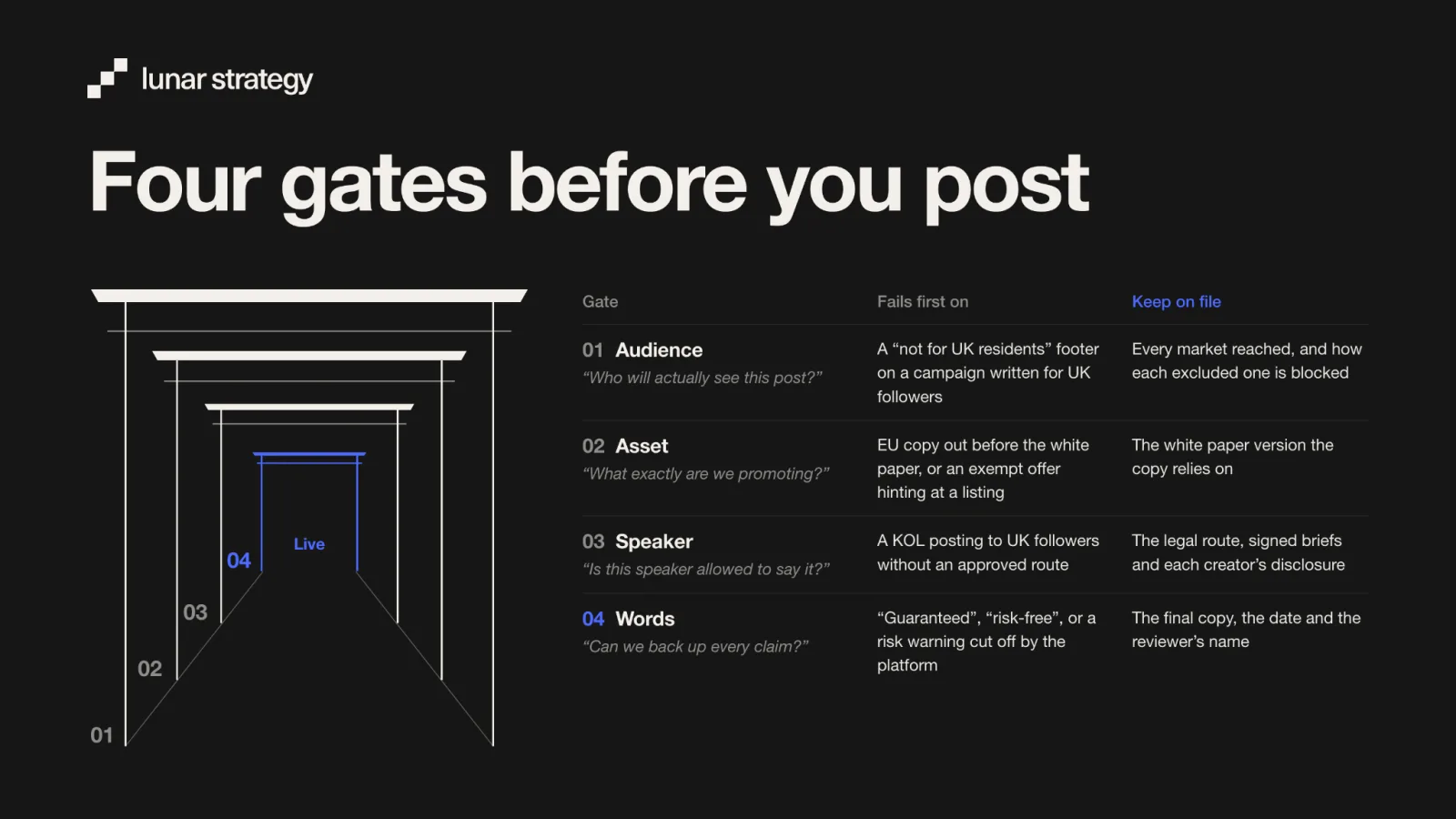
01 · Audience. Start with who will actually see the post, not who you wrote it for. List every market it reaches through its language, geotargeting, creator audiences and events, and for each market you exclude, write down how it is blocked on your site, app, ads and creators. The classic failure is a "not for UK residents" footer on a campaign written for UK followers, because regulators judge who a message targets, not its small print.
02 · Asset. Next, pin down exactly what you are promoting: the token type, whether it is a token offer or a service such as trading or staking, and where the white paper stands. In the EU, nothing goes out before the white paper is published, and an exempt offer must never hint at a listing. Note the white paper version the copy relies on. If the token design is still moving, our guide to tokenomics for founders covers what to settle first.
03 · Speaker. Then ask who is saying it and whether they are allowed to. Your own channels, a licensed partner, a UK approver and a paid creator each carry different rules. For the UK, name the legal route before anything posts. For creators, check the "Ad" label and their token holdings, plus the payment amount in the US if the token could be a security. The most common slip is a KOL posting to UK followers without approval, so keep signed briefs and each creator's disclosure on file.
04 · Words. Last, test every claim about returns, yields, safety, insurance or regulators against the white paper or product docs, and cut "guaranteed" and "risk-free" outright. Check that the MiCA Article 7 statement and the full FCA risk warning are in place and not cut off by the platform. Tone counts too: in January 2026, the UK's Advertising Standards Authority ruled that Coinbase ads "trivialised the risks" of crypto investment (ASA). Archive the final copy with the date and the reviewer's name.
The same four gates apply to announcements sent to media, so run your crypto press releases through them too.
What changes in 2027
Most of the copy rules in this guide carry into 2027 unchanged. The FCA's final rules for the new UK regime keep crypto in its strictest marketing category, so the risk warning, the 24-hour cooling-off period and the bonus ban all stay (FCA PS26/13). What tightens is who may speak, to whom, and what paid voices must disclose.
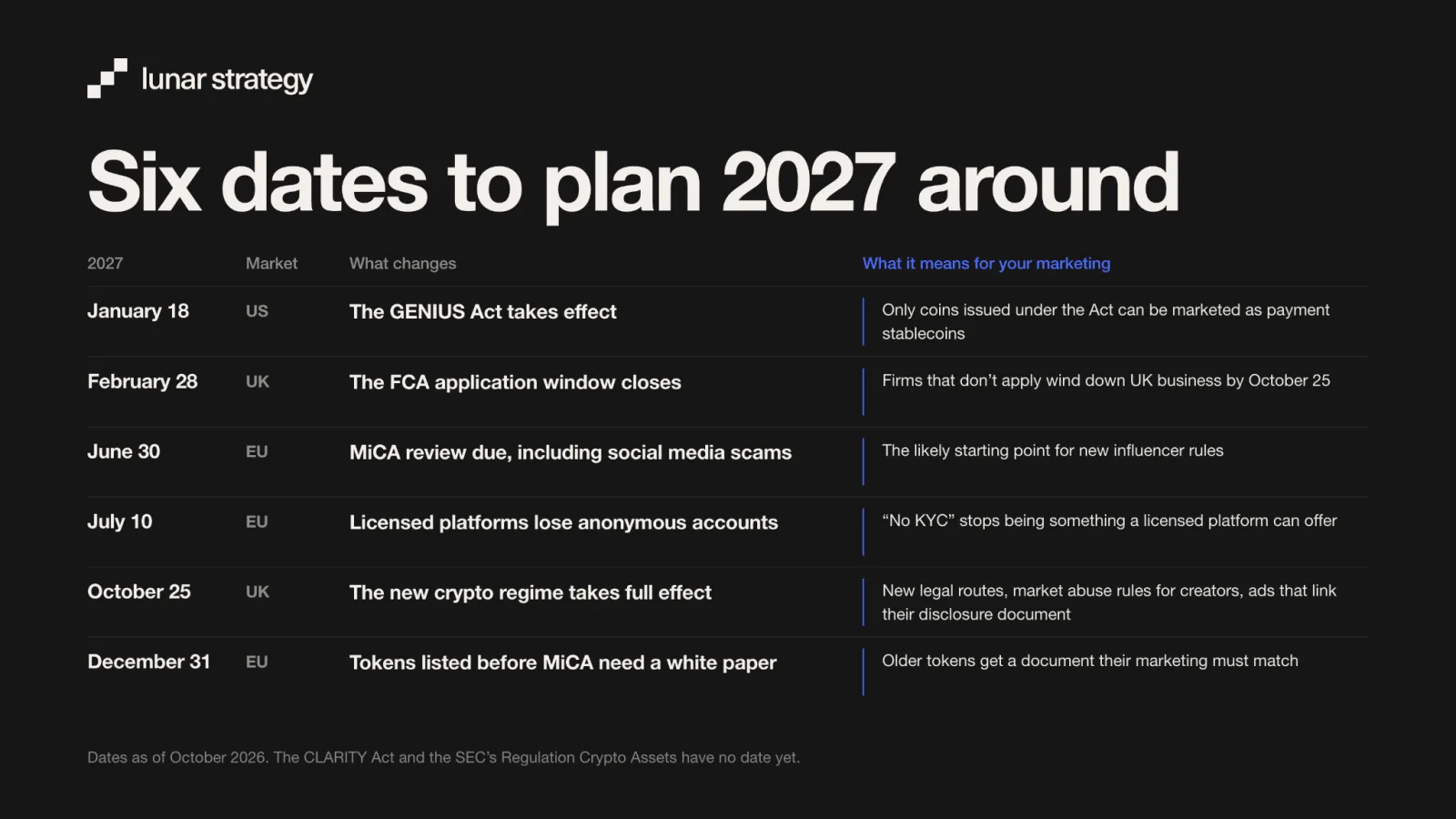
Six dates set the calendar:
| Date | Market | What changes | What it means for marketing |
|---|---|---|---|
| January 18, 2027 | US | The GENIUS Act takes effect, along with the OCC's final rule | Only coins issued under the Act can be marketed as payment stablecoins |
| February 28, 2027 | UK | The FCA application window for the new regime closes | Firms that don't apply must wind down UK business before October 25 |
| June 30, 2027 | EU | The Commission's MiCA review is due, with a required look at marketing scams on social media (MiCA, Art. 140) | The likely starting point for new influencer rules |
| July 10, 2027 | EU | CASPs may no longer keep anonymous accounts or ones that hide transactions, including through privacy coins (AMLR, Art. 79) | "No KYC" stops being something a licensed platform can offer |
| October 25, 2027 | UK | The new crypto law, SI 2026/102, takes full effect | New authorization routes, market abuse rules and token ad disclosures |
| December 31, 2027 | EU | Tokens listed before December 30, 2024 need a MiCA white paper (Art. 143) | Older tokens get a document their marketing must match |
The UK change is about routes, not wording. When the new regime starts, the Article 73ZA exemption only covers firms whose applications are still pending, and firms relying on an approver need their own authorization if their activity is in scope (FCA). Offshore exchanges are not spared: Parliament chose not to create an exclusion for overseas firms dealing directly with UK consumers, a decision the FCA confirmed in September 2026 (FCA PS26/18).
For creators, the bigger shift is the UK's new market abuse regime. SI 2026/102 names talking up a token in the media after taking a position in it, then profiting from the price move, as market manipulation, alongside spreading misleading information or rumors online. Token sale and listing ads must also name their regulated disclosure document and, when written and online, link to it (FCA PS26/9). A KOL who quietly holds the token they promote is no longer only a disclosure problem.
In the US, January brings the stablecoin rules and the rest depends on rules still being written. The OCC's final rule bars stablecoin names built on "United States" or "USG" and says a misrepresentation "cannot be cured by a general disclaimer" (Federal Register). The SEC's proposed Regulation Crypto Assets would let token issuers advertise their raises, as long as their disclosures match their website, social accounts and promotional materials (SEC). It is a proposal with no adoption date, and the CLARITY Act lapses when the new Congress sits in January unless the Senate acts first (CoinDesk).
The EU's 2027 is about the next rulebook. In its September 2026 input to the MiCA review, ESMA asked for direct obligations on influencers and third parties who promote crypto, and for the option to ban some marketing practices, because national regulators struggle to apply today's high-level rules to them (ESMA). A separate proposal would move supervision of the largest exchanges to ESMA, and EU governments agreed their position in October 2026 (Council of the EU). Neither changes your copy next year, but both point at the same target: paid promotion.
Where to start
Start with gate 01 for your next campaign. List every market it will reach, then choose one of three positions for each:
- Comply: meet the local rules yourself, with the license, route and disclosures they require.
- Partner: work through a licensed exchange, an FCA approver or a CASP that can carry the promotion.
- Block: exclude the market everywhere, including your site, app, ads and creators.
Then take the posts with the most reach in your calendar, usually the token announcement, the KOL wave and the launch-day threads, and run them through the four gates with your lawyer before the dates go public. For the launch sequence itself, see what a TGE involves and our 90-day pre-TGE playbook.
Lunar is a marketing agency, not a law firm, and nothing in this guide is legal advice. Across more than 300 crypto projects since 2019, our part has been the layer between the law and the launch calendar: messaging audits that keep the narrative to what you can back up, KOL briefs that spell out disclosures, and launch plans that put the white paper before the first post. Your lawyer decides what is allowed. We help you say it well.
Get a messaging audit before your next launch →
Send us your launch plan and target markets, and we'll flag the posts your lawyer should see first.
Frequently Asked Questions
What counts as a financial promotion in the UK?
Any communication, in any medium, that invites or induces someone to engage in investment activity. The FCA's 2024 social media guidance confirms that posts, memes, short videos and influencer content can all be financial promotions, and the rules apply to each post on its own. For qualifying cryptoassets, that includes tweets, Telegram messages and Discord announcements aimed at UK consumers.
Do free airdrops fall under MiCA?
Crypto-assets offered for free sit outside MiCA's offer rules, including Article 7. But an offer stops counting as free if recipients must provide personal data in exchange, or if the offeror receives fees, commissions or other benefits from them. An airdrop that requires an email sign-up, for example, can fall back inside the rules.
Does MiCA apply to marketing aimed at the UK?
No. The UK left the EU before MiCA was adopted, so UK promotions follow FSMA and the FCA's rules, while EU promotions follow MiCA. A campaign aimed at both markets has to meet both: the MiCA statement and white paper rules for EU readers, and a legal route plus the FCA risk warning for UK readers.
Can you advertise a meme coin?
In the US, the SEC's staff said in February 2025 that the meme coins it described are not securities, but fraud around them can still be prosecuted by other agencies (SEC). Paid ads are another matter: Reddit bans ads for single tokens, and Google and X ban token sales, so most meme coin marketing runs through creators and community.
Would the CLARITY Act change what you can say in crypto marketing?
Not much. The bill would move oversight of most token trading to the CFTC, but selling a token to raise money would stay under the SEC, with its disclosure rules (Congressional Research Service). Claims made during a token sale, and paid promotion of it, would still be judged as they are today. The FTC's endorsement and fake-review rules don't depend on the bill at all.