























TL;DR:
- KOL means Key Opinion Leader. In crypto, it's a creator on X, YouTube or Telegram whose audience trusts their judgment enough to act on it: research a token, join a Discord, connect a wallet.
- The catch is that the label now gets used for anyone with a big account who takes paid posts. Reach is easy to buy and trust isn't, and only trust makes people act.
- So pick KOLs by role first, then by size. Researchers, traders, builders, educators, community callers and regional voices each move a different audience.
- How a KOL gets paid matters as much as who they are. Early tokens with short unlocks and no disclosure let a KOL sell into the buying their own post created.
- Before you pay anyone, run 7 quick checks: replies, paid-post ratio, past calls, views against followers, wallet history, peer engagement and whether they ever say no.
Most projects meet KOLs through a spreadsheet of names, follower counts and prices per post. Launch day comes, the posts go out on schedule, and the dashboard shows impressions but almost no wallets or sign-ups.
The channel is rarely the problem (why influencer marketing fails in crypto is usually about selection). The word is: "KOL" no longer tells you whether anyone listens to the account you're paying. This guide covers what a KOL really is, the main types, how campaigns and payment work, and how to check an account before it goes on your list.
KOL meaning in crypto: trust, not reach
A KOL in crypto is a Key Opinion Leader: a trader, researcher, builder or educator whose followers trust their read on a project enough to act on it. What separates a KOL from a generic influencer is credibility on a specific topic, not follower count, which is why a focused analyst can move more wallets than a celebrity.
The term comes from traditional marketing, where it described doctors and industry experts whose views shaped what others bought. On X it now covers anyone who promotes projects, from a researcher with 15K followers to a celebrity with 50 million. The original idea was about trust: people listen because this person has been right before and doesn't say yes to everything. Today's usage is mostly about reach, and those are very different things to pay for.
| Influencer | KOL | |
|---|---|---|
| Why people follow them | Entertainment, personality, lifestyle | Their judgment on a topic |
| What they're good at | Getting a lot of eyes on something | Getting people to take something seriously |
| What happens when they post about you | Views and a short spike | Research, questions, wallet connects |
| How they're usually priced | Follower count | Should be track record, often isn't |
| What they risk by promoting junk | Not much | Their reputation, which is their whole business |
The last row is the one that matters: a real KOL's audience remembers whether the last projects they pushed held up. The HAWK memecoin in December 2024 shows the opposite case, an internet personality with huge reach and almost no crypto credibility. The token went from a $16.6 million market cap to $491 million in about three hours, then fell more than 90% and buyers filed a lawsuit (Cointelegraph). Reach created the spike. Nothing kept people around after it.
Types of crypto KOLs: pick by role, then by size
Start with the role, not the follower count: each type moves a different kind of person, and the perfect account for a memecoin can be useless for a developer tool.
| Type | What they post | Good for |
|---|---|---|
| Researchers and analysts | Long threads, token breakdowns, deep dives | Credibility with serious buyers and funds |
| Traders | Charts, entries, market calls | Attention and volume around a TGE or listing |
| Builders and developers | Tech, tooling, architecture | Developer adoption, infrastructure, L1 and L2 projects |
| Educators and YouTubers | Plain-language explainers | Onboarding newer users; content that keeps getting found for months |
| Community and alpha callers | Telegram and Discord groups, early calls | Fast activation, whitelist and airdrop campaigns (check these hardest) |
| Regional KOLs | Local-language accounts (Korea, Turkey, Vietnam, India, LatAm) | Markets English-language X barely reaches; often the most underpriced |
Size comes second, as a filter on the shortlist:
- Macro KOLs (roughly 500K+ followers): broad reach, highest price, least room to explain anything in depth.
- Mid-tier KOLs (roughly 50K-500K): strong authority in one niche; usually the core of a campaign.
- Micro KOLs (roughly 10K-50K): smaller, closer audiences that reply and ask questions.
- KOCs (Key Opinion Consumers): everyday users who share first-hand experience with a product; they overlap heavily with UGC creators.
Thirty well-chosen micro and mid-tier KOLs explaining a project in their own words over two weeks look like a real conversation. Three macro names posting on the same morning look like an ad buy, because they are one.
How a crypto KOL campaign works
A KOL campaign matches a project with creators whose audience fits its chain, category and market, then runs their posts as a sequence, not a single burst. In the campaigns we run, four parts decide whether the budget turns into users or just impressions.
- Brief. What the project does, why it matters now, what readers should do next, plus links, dates, off-limits claims and the disclosure required. Brief the message, not a script: the KOL's voice is what you pay for. Our KOL brief template walks through each field.
- Content. A thread, video, Space or Telegram post in the KOL's own words, with a clear paid label.
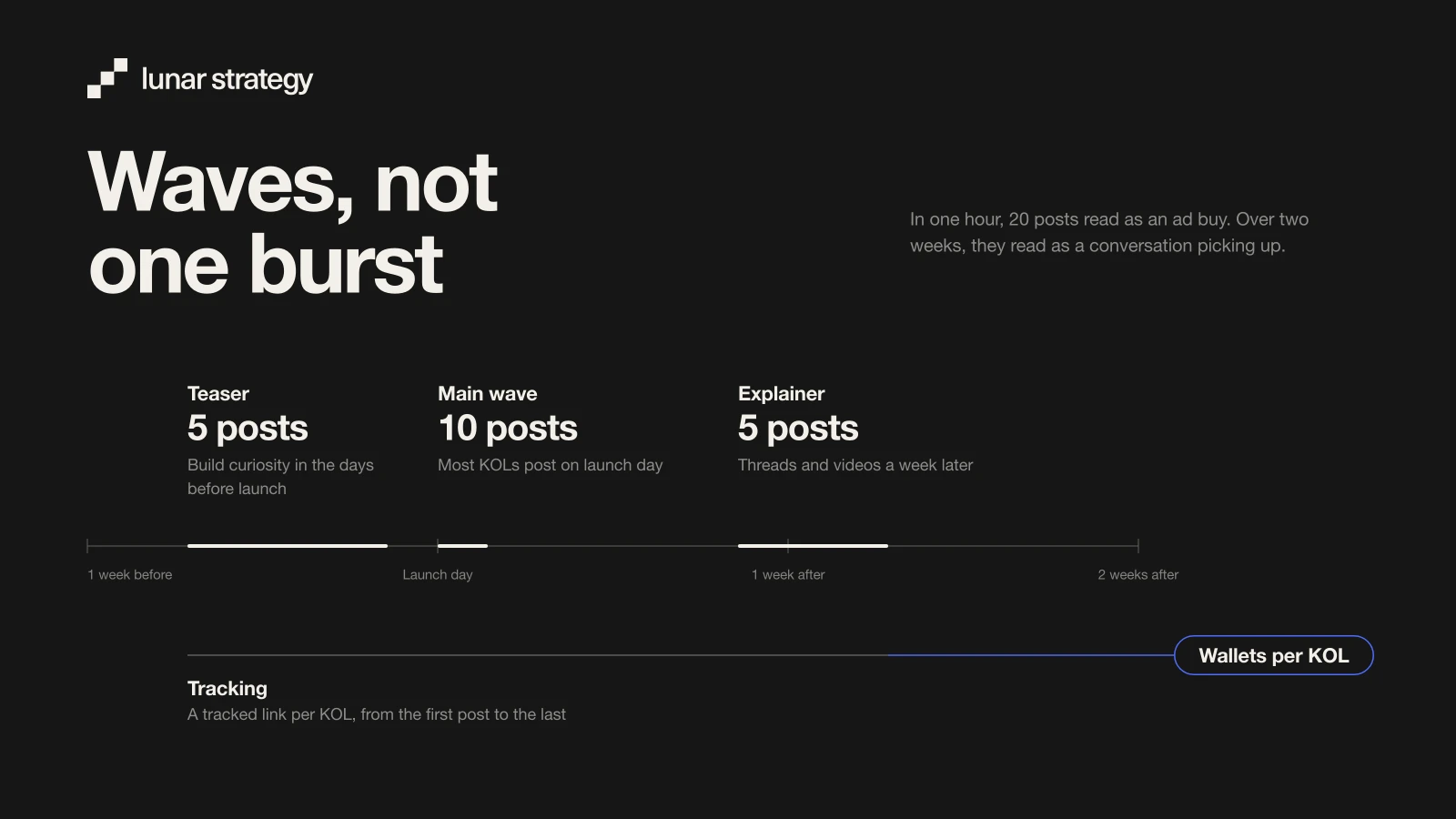
- Waves. A teaser wave before launch, a main wave on the day, an explainer wave a week later, so the posts read as a conversation picking up.
- Tracking. A tracked link per KOL, compared on clicks, Discord joins, wallet connects and sign-ups.
Tracking is the step most teams skip, and the one that pays back: after two campaigns you know exactly which accounts to drop and which to book again.
Why projects use KOLs, and why the label got diluted
Projects use KOLs because paid channels are narrow for crypto. Google, for example, only allows crypto exchange and wallet ads from certified advertisers, country by country (Google Ads policy), and crypto audiences scroll past anything that looks like an ad. A trusted creator explains the product in the audience's terms and answers questions in the replies, which no banner can do. That value is also why the label got stretched. Every cycle put "KOL" on a different kind of account, and each left followers more skeptical.
| Era | Who got called a KOL | What went wrong |
|---|---|---|
| ICO years (2017-2018) | Celebrities promoting token sales | Paid posts with no disclosure, later SEC penalties |
| Bull run (2021-2022) | Celebrities and big accounts on Instagram, X, YouTube | Bigger paychecks, same missing disclosure |
| KOL rounds and memecoins (2024) | Accounts paid in early, discounted tokens | KOLs able to sell into their own followers' buying |
| Paid posts exposed (2025) | Hundreds of mid-size crypto accounts | A leaked list showed almost nobody labeled ads |
| InfoFi (2025-early 2026) | Anyone farming points by posting | Timelines flooded until X cut off apps that pay users to post in January 2026 |
Two numbers explain why audiences now discount most promotional posts. In September 2025, on-chain investigator ZachXBT shared a list of crypto influencers offered paid promo deals and said roughly 160 accepted, while fewer than five labeled their posts as ads (The Block). And a peer-reviewed study in the Review of Accounting Studies, covering about 36,000 tweets from 180 prominent crypto influencers in the two years to December 2022, found that promoted coins rose 1.83% the day after the tweet, then were down 6.53% after 30 days (Indiana University Kelley School of Business, 2024).
None of this means KOL marketing doesn't work. It means the label is no longer proof of anything, so you have to check.
How crypto KOLs get paid, and why it matters for your launch
How a KOL gets paid shapes what they'll say, and when they'll stop saying it. These are the five common deals.
| Model | How it works | What to watch for |
|---|---|---|
| Cash per post | A flat fee for a post, thread or video | Pricing based only on follower count |
| Token allocation | Tokens instead of, or on top of, cash | Unlocks that let them sell on launch day |
| KOL round | A private sale for KOLs before the TGE, often at a discount | Earlier unlocks than regular buyers, and no disclosure |
| Ambassador retainer | A monthly fee for ongoing posts and presence | Posts that stop sounding like real opinions |
| Referral or affiliate | A cut of the sign-ups or volume they drive | Pressure to push volume over fit |
None of these is bad on its own: a KOL holding tokens under a long lockup has real reason to want the project to succeed. The risk is early tokens plus short unlocks plus no disclosure. In May 2024, CoinDesk reported that KOLs in these rounds were getting discounted valuations and the option to sell sooner than other early investors; one project, Creator.Bid, let KOLs access up to 23% of their allocation on the day of its public airdrop.
In that setup, the KOL's best move is to post and sell into the buying it creates. If you pay in tokens, lock them for longer than your public buyers wait, write it into your tokenomics and make sure the arrangement is disclosed. Budgets and rate structures are covered in How Much Does a Crypto KOL Campaign Cost.
How to spot a real KOL in 20 minutes
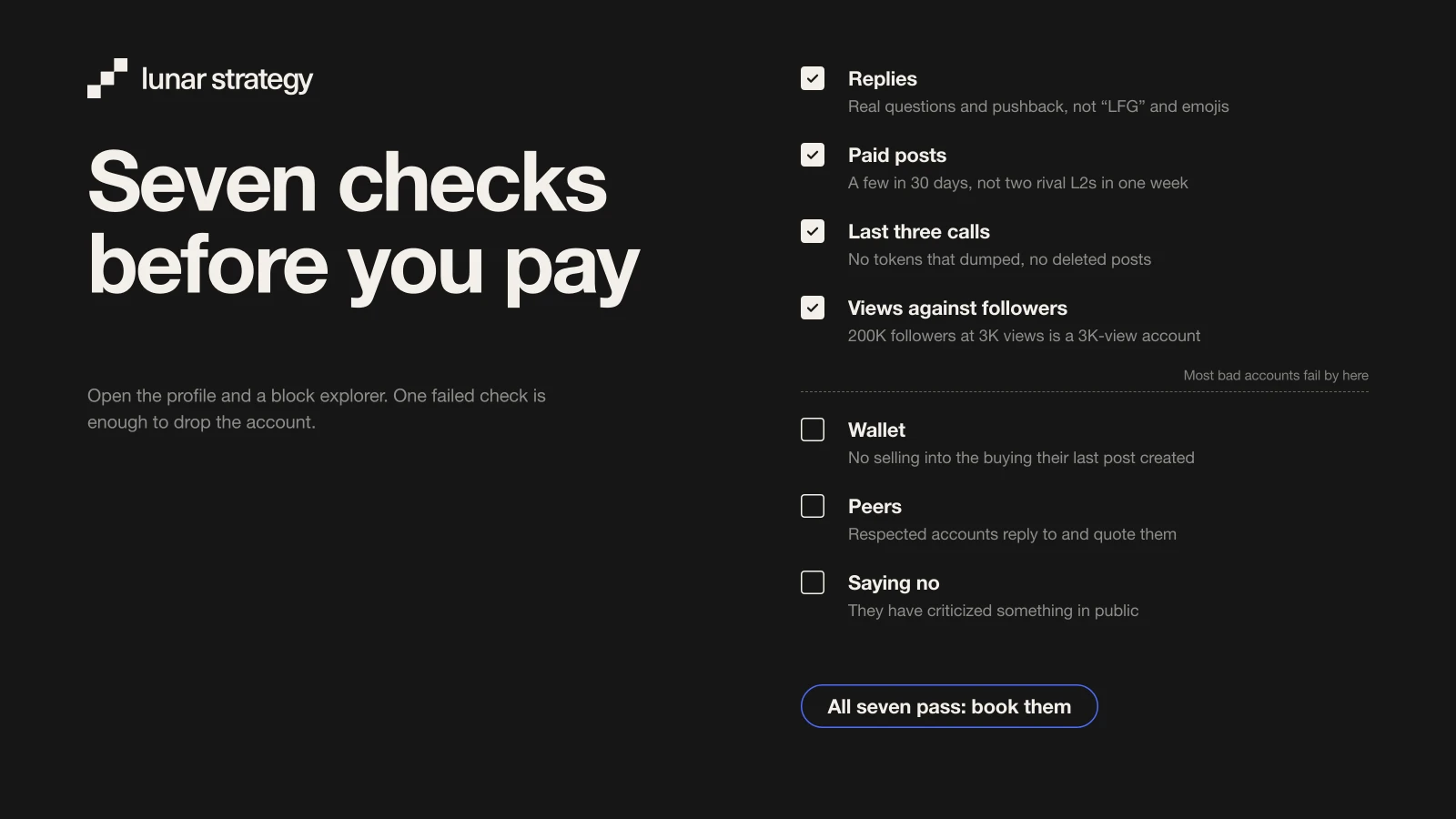
You don't need a paid tool for this. Open the profile and a block explorer and work through seven checks; most bad accounts fail one of the first four.
- Read the replies, not the likes. Real audiences ask questions and push back. If the replies could sit under anyone's post ("LFG", emojis), nobody is listening.
- Count the paid posts. In the last 30 days, a few are normal. Two rival L2s in one week means a rate card, not an opinion.
- Check their last three calls. Tokens that dumped after launch, followed by deleted posts, tell you everything.
- Compare views to followers. 200K followers averaging 3K views is a 3K-view account. Price it on views.
- Look at their wallet. If it's public, did they sell into the buying their own post created last time?
- See who engages with them. Respected peers replying and quoting them is very hard to fake.
- Look for moments they said no. A KOL who never criticizes anything isn't giving opinions.
Some answers end the conversation before the checks:
- They won't share basic stats (average views, audience location) before you pay.
- They promise a number of likes, followers or a "guaranteed pump".
- They want full payment upfront with no delivery schedule.
- They ask for tokens with no lockup, or a shorter one than your public buyers get.
- They refuse to label paid posts.
Disclosure is no longer optional
Labeling paid posts used to be optional in crypto. In most markets it's now a rule, and an unlabeled post puts both you and the KOL at risk:
- United States: the FTC says influencers must disclose any paid relationship in a way that's "hard to miss", and the SEC has fined celebrities who promoted tokens without saying they were paid.
- On X: paid posts need the Paid Partnership label, and X does not allow crypto paid partnerships at all in the UK, the EU and Australia.
- United Kingdom: the FCA's crypto marketing rules have applied since October 2023.
- European Union: MiCA Article 7 requires crypto marketing to be clearly identifiable as marketing, fair, clear and not misleading.
A clearly labeled post from a trusted KOL still works: audiences don't punish disclosure, they punish finding out later. Put the label in the brief and the contract from day one. This is general information, not legal advice.
How Lunar runs KOL campaigns
We've worked with more than 300 crypto projects since 2019, and the KOL campaigns that worked share one pattern: the right people, briefed on one story, posting in their own words over weeks, not hours.
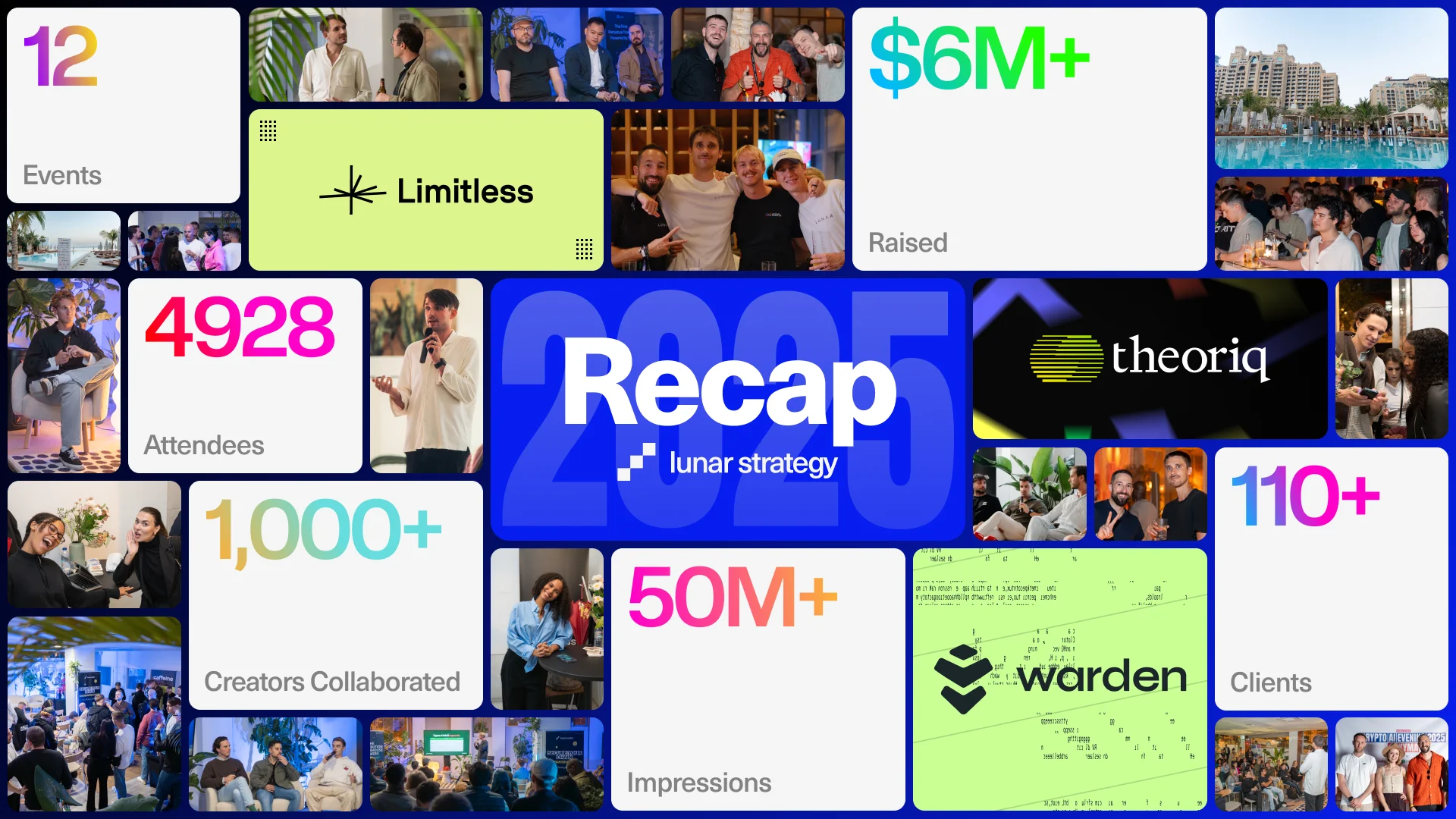
For Warden Protocol, we activated 75 creators across X and YouTube and produced 90+ pieces of content around one narrative; the campaign onboarded 5M users in six weeks. For Limitless, 97 coordinated posts averaged a $19.60 CPM and a 2.75% engagement rate, supporting a community raise with $200M pledged (Lunar Strategy, 2026). Neither campaign leaned on a handful of big names, and every account was checked before it went on the list.
Plan your KOL campaign with Lunar →
Tell us what you're building and we'll show you which KOLs we'd shortlist, and why.
Frequently Asked Questions
What does KOL stand for in marketing?
KOL stands for Key Opinion Leader. Outside crypto, the term has long described doctors, experts and creators whose recommendations shape what their audience buys, especially in healthcare and consumer marketing in Asia. Crypto adopted it for creators on X, YouTube and Telegram whose opinions move how people research and trade.
What is the difference between a KOL and a KOC?
A KOL (Key Opinion Leader) is followed for expertise and judgment on a topic. A KOC (Key Opinion Consumer) is a regular user with a smaller audience who shares first-hand experience with a product. KOCs are cheaper and feel more authentic, so many campaigns pair a few KOLs for credibility with many KOCs for volume.
Are crypto KOLs paid?
Most are, in cash, tokens or both, and some invest through KOL rounds before a token launches. Being paid isn't the problem; hiding it is. Paid posts should carry a clear label, which on X means the Paid Partnership label in the markets where crypto partnerships are allowed.
What is a KOL round?
A KOL round is a private token sale or allocation reserved for KOLs before a project's TGE, often at a lower price than other investors and sometimes with earlier unlocks. It isn't wrong in itself, but it creates a conflict of interest when the KOL can sell into the buying their own posts create. We weigh the trade-offs in should you do a KOL round before launch.
How do I find crypto KOLs?
Start from the audience you need, not a list. Look at who your target users already follow, who respected accounts in your niche quote, and who covered similar projects well. Then run the seven checks above, or work with an agency that vets accounts and tracks results per creator.
Are micro KOLs worth it?
Often more than big accounts. Micro KOLs (roughly 10K to 50K followers) usually have closer audiences that reply, ask questions and act. Their lower prices also let you test several at once, measure each one with its own tracked link and rebook only the accounts that actually moved users.