







.png)




















TL;DR:
- A TGE (token generation event) is the moment a crypto project creates its token on-chain and hands out the first allocations to its team, investors and community. It is also the day the token stops being a line in a term sheet and becomes a market anyone can price.
- The minting itself is one transaction, but the outcome is settled months earlier. Arrakis, a market maker for token issuers, studied more than 120 launches and found that only 1 in 10 weak token launches recovered in 2025, as The Defiant reported.
- So close the market decisions before you announce a date: how much supply circulates, who gets tokens and at what cost, where the token trades, who is paying attention and what you say the week after. Together they make up the TGE Readiness Map.
- Most teams spend months on the token's structure (tokenomics, contracts, vesting) and leave marketing for the final weeks. Attention needs the same lead time: for Avalon Labs in 2025, our PR and creator campaign started before the token existed, so people were already following the project when it went live.
- After launch, judge the TGE by who stayed, not by the first hour of trading. Track holders, liquidity and the next unlock for 30 days, and plan that month as carefully as the day itself.
The call with your lead investor is wrapping up when she asks what sounds like small talk: "So when's the TGE?" Someone on your side says Q1. Nobody can say what has to be true by then: how much of the supply trades on day one, who gets tokens and at what cost, where the token trades, and who will be paying attention when it opens.
That silence isn't a technical problem: minting a token is one transaction. The day is decided by market choices about supply, distribution, liquidity and attention, and across more than 300 crypto projects, we keep seeing teams pick the date first and make those choices under its pressure. A TGE goes the way the decisions made before it go. This guide is for founders and marketing leads planning a first token launch, and it ends with the five decisions to close before you commit to a date.
A TGE is the day your token becomes a market
In crypto, a TGE (token generation event) is when a project mints its token on a blockchain and distributes the first allocations to its team, investors and community. It is not the same as a token sale or an exchange listing, although the three often happen within days of each other. A TGE doesn't have to raise money at all: some tokens reach holders only through an airdrop or a launchpad distribution (Binance Academy).
Technically, it's a deployment: publish the contract, mint the supply, send allocations to wallets and vesting contracts. What sets it apart is what follows within hours: people can hold, move and usually trade the token, so its price, holders and release schedule go public at once.
- Always part of a TGE: a token contract, a minted supply and the first allocations.
- Often the same day: an airdrop claim, a sale, a DEX pool or a listing.
- Never created by the TGE itself: demand.
Because so many events cluster around one date, the vocabulary blurs.
TGE, ICO, IDO, listing: the words people mix up
Investors, exchanges and your community use these terms loosely, but each means different work. An ICO, for example, can run months before the token exists (Chainlink). The quickest way to tell them apart: who runs it, whether it raises money, and when trading opens.
| Term | Who runs it | Does it raise money? | When trading opens |
|---|---|---|---|
| TGE | The project, on-chain | Not necessarily | When a DEX pool or exchange opens |
| ICO | The project, on its own site | Yes | Often weeks or months after the sale |
| IEO | A centralized exchange (with KYC) | Yes | On that exchange |
| IDO | A DEX or launchpad | Yes | Straight on the DEX |
| Airdrop | The project | No | At or after the TGE |
| Listing | The exchange | No | It is the opening |
Airdrops and listings each need their own plan (see our airdrop marketing guide and how to get your token listed). Only the TGE has a fixed moment on-chain, and it's busier than most teams expect.
What actually happens on TGE day
On the day, a TGE runs on one clock shared by engineering, community, the trading venue and whoever writes the announcements. Each step depends on something decided earlier: how many tokens the claim releases, which venue opens trading, what the announcement may promise. When those decisions are late, the day becomes improvisation in public.
- Before the window: get the contracts audited, deploy and verify them, fund the vesting and claim contracts, and test the claim on mainnet.
- Hour zero: publish the official contract address in one channel and point every other channel to it.
- Claims and trading: open the claim or sale, then seed the DEX pool or confirm the exchange's opening time.
- After trading opens: CoinGecko lists a token as active only once it trades on an exchange it tracks (CoinGecko).
A weak start rarely recovers, and timing isn't the reason
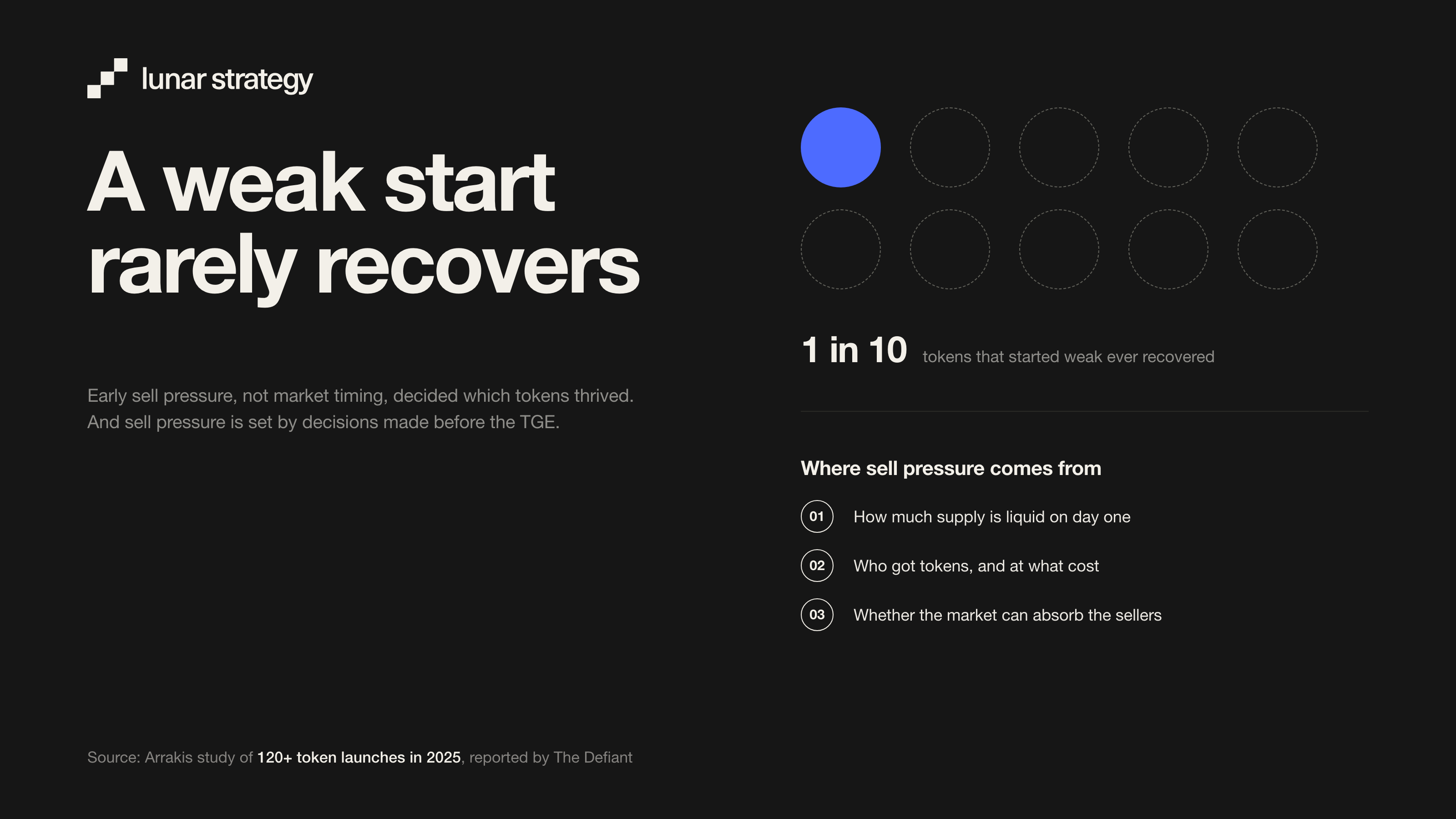
Arrakis, a firm that runs market making for token issuers and so has a stake in how launches go, studied more than 120 token launches from 2025. As The Defiant reported, only 1 in 10 tokens that started weak ever recovered, and early sell pressure, not market timing, decided which ones thrived. And sell pressure comes from decisions: how much supply is liquid on day one, who got it and at what cost, and whether the market can absorb the sellers. A strong launch week can't undo any of them.
"In reality, the token launch is supposed to be the start of the project."
Brian Huang, co-founder, Glider, in Cointelegraph Magazine
Most teams plan the other way around: the date goes into the investor update, the exchange talks and the roadmap, and every other decision squeezes in around it. Pick the date last, after the five decisions below are closed, because a public date turns open questions into deadlines. Our breakdown of how to avoid a flopped TGE covers the failure patterns.
The TGE Readiness Map: five decisions to close before day one
We use the TGE Readiness Map to judge whether a team is ready to announce a date. Each stage answers a question the market asks on day one: what to decide, the trap, and the signal that it's done.
01 · Supply: "How much can be sold on day one?"
- Decide: the float (the share of supply trading at launch), the vesting schedule (tokens released over time, not all at once) and lockups (periods when the team and investors can't sell).
- Trap: sizing the float to the last round's valuation, not to real demand.
- Signal: an unlock calendar a holder reads in a minute. See tokenomics for founders.
02 · Distribution: "Who gets tokens, and what did they pay?"
- Decide: the mix of sale, airdrop, points, investor and team allocations.
- Trap: an untested claim. Farm Frens' founder told Decrypt the team "didn't account for the fact that mainnet would be significantly slower than our tests".
- Signal: eligibility rules published early and a claim rehearsed on mainnet.
03 · Liquidity: "Where does it trade, and how deep is the market?"
- Decide: a DEX pool, an exchange listing or both, and whether a market maker supports them.
- Trap: announcing the date before the venue confirms in writing.
- Signal: venues, pairs and opening time agreed.
04 · Attention: "Who is watching when it opens?"
- Decide: the story, the community and the creators and media who carry it.
- Trap: starting two weeks out, when good creators are booked.
- Signal: an active community and briefed creators before the date goes public.
05 · Day after: "What do you say in week two?"
- Decide: the 30 days after launch, including how you'll explain the next unlock.
- Trap: treating the TGE as the finish line.
- Signal: a post-launch calendar finished before launch day.
Run the map in order, because each stage constrains the next. Stage 04 is where well-built launches most often fall short: teams pour months into supply, distribution and liquidity, as they should, and give the campaign a few weeks. But attention is built the way tokenomics is, over time, which is why our 90-day pre-TGE playbook starts with it. For Avalon Labs, a CeDeFi lending platform for Bitcoin holders, we ran a 16-day pre-TGE campaign combining PR with 15 KOLs, which put Avalon in Kaito's top 20 Pre-TGE arena with 1.17% mind-share over seven days (Lunar Strategy, 2025). Kaito's leaderboards were a 2025 tool, since X banned apps that pay users to post in January 2026, but the lesson holds: the attention existed before the token did.
Judge the launch by the next 30 days, not the first hour
The first hour of trading gets the screenshots, but the following month tells you whether the launch worked. Review these weekly for 30 days; each points to the map stage to revisit:
| Metric | What it tells you | Map stage |
|---|---|---|
| Circulating supply vs. plan | Whether claims and unlocks release tokens as designed | 01 · Supply |
| Holders who stayed | Launch-day wallets still holding after 7 and 30 days | 02 · Distribution |
| Liquidity depth | How much can trade without moving the price sharply | 03 · Liquidity |
| Organic mentions | Whether people discuss you without being paid to | 04 · Attention |
| Days to the next unlock | Time left to give holders a reason to stay | 05 · Day after |
Where to start if your TGE is on the calendar
Write one line for each stage of the map: your float, distribution rules, venues, launch story and plan for week two. Any line you can't fill in is the first thing to work on, and the reason not to announce a date yet. Then set your 30-day metrics, so the team agrees on success before the chart moves. For teams building toward a TGE, our go-to-market work defines the narrative, the target audiences and a structured rollout plan before the date goes public.
Plan your TGE go-to-market with Lunar →
Tell us where you are on the map, and we'll say what we'd close first.
Frequently Asked Questions
Is a TGE the same as an airdrop?
No. The TGE is when the token is created and first allocated; an airdrop is one way to hand out part of the supply for free, based on past activity. Many projects open the airdrop claim at the TGE, but either can happen without the other.
What does "unlocked at TGE" mean?
It's the share of an allocation that can be sold on launch day. A hypothetical term sheet might give investors 10% at TGE and the rest monthly after a 12-month cliff, a waiting period with no releases. The more each group gets at TGE, the more supply can hit the market on day one.
Do you need a white paper for a TGE in the EU?
Often, yes. Under the EU's MiCA rules, the disclosures for a public offer of crypto-assets take the form of a white paper, and ESMA keeps a register of them (ESMA). Rules depend on the token and the offer, so check with counsel.