



























Most Web3 projects that switch agencies mid-campaign report the same regret: they chose based on the wrong signals. A polished website, a long client logo wall, and a persuasive founder pitch are not predictors of campaign performance. The criteria that actually matter are different, and most of them are not what agencies lead with. Our crypto marketing complete playbook is a useful reference for understanding what a well-run campaign actually looks like.
Key Takeaways
- Most Web3 projects evaluate agencies on price and follower count, the two weakest predictors of campaign success.
- A strong crypto marketing agency should provide named protocol references, community engagement benchmarks from managed accounts, and a clear KPI framework before you sign.
- Avoid agencies that take token equity as the primary fee, refuse to share past campaign metrics, or have no experience managing community in a bear market.
- The 10-point checklist in this guide covers every evaluation criterion from contract structure to bear market contingency planning.
- Projects that launch with a Discord community of 5,000+ engaged members before TGE show measurably stronger post-launch price stability.
Which criteria actually predict crypto marketing agency performance?
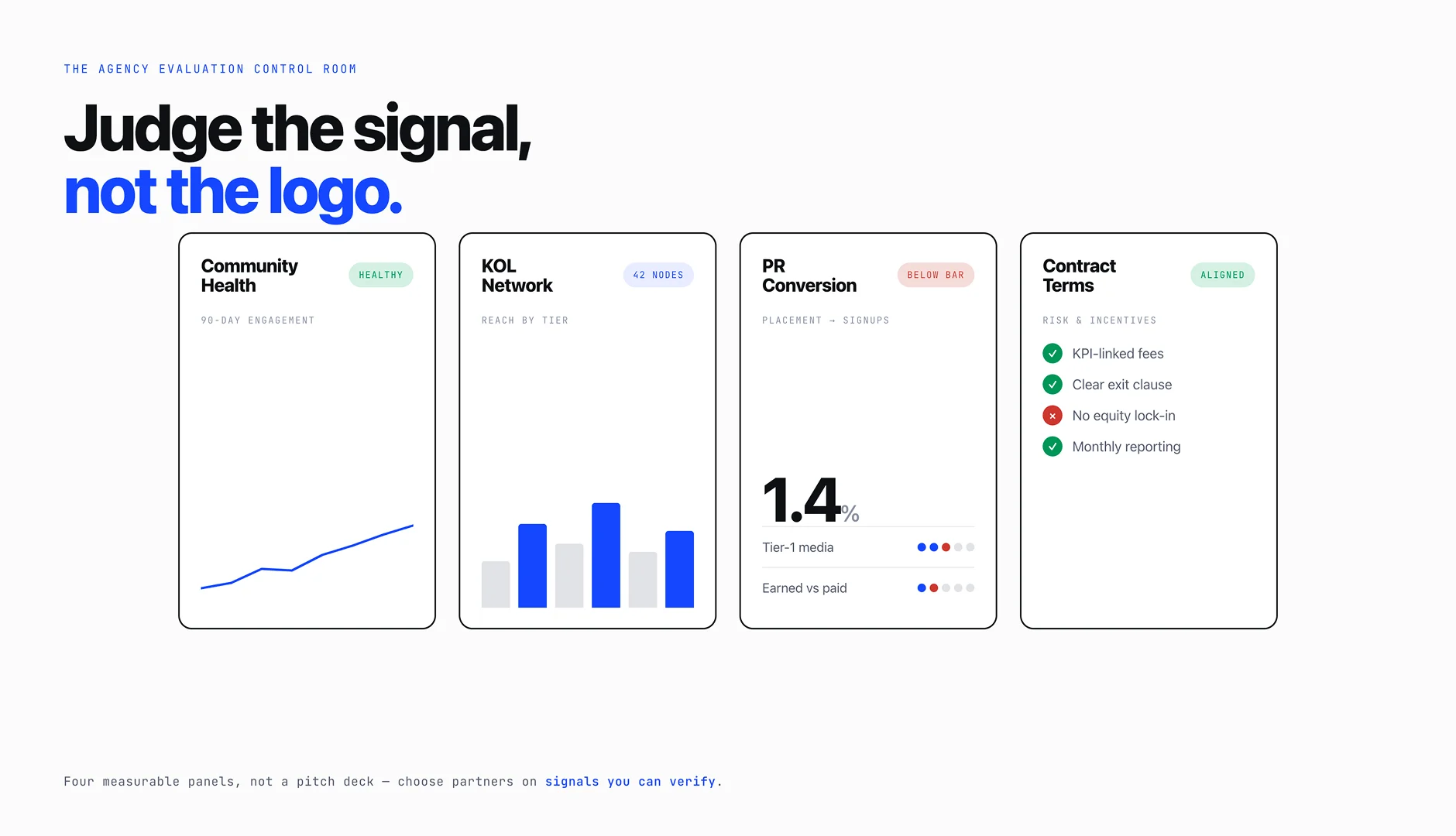
The three criteria that actually predict agency success are KOL network depth, community management track record, and PR media relationships. These are also the hardest to fake, they either show up in verifiable campaign data or they don't. For what strong PR actually looks like as a deliverable, see our PR service page.
Projects that build engaged communities of 5,000+ members before TGE show measurably stronger post-launch price stability and community retention (Nansen, 2025).
The best crypto marketing agencies are usually harder to get into than their competitors. They reject projects that don't fit their sector or stage focus. An agency that will take any project at any stage is one that has optimised for revenue rather than results.
What questions should you ask a crypto marketing agency before signing?
Five questions separate strong agencies from ones that will waste your budget:
- Show me community health metrics from three accounts you currently manage. You want active user rates, not raw member counts. Ask for DAU/MAU ratio, message velocity, and sentiment data from live Discord or Telegram servers.
- Name the top 10 KOLs in your network and their typical engagement rates. A real network has names. A purchased list has handles. Real KOLs can be verified; list brokers cannot.
- What is your PR media placement rate? How many pitches does it take to secure one Tier 1 placement? Honest agencies know their conversion rate. According to the Muck Rack State of PR report (2025), a healthy pitch-to-placement ratio for specialised B2B is roughly 15-25%.
- How do you adapt strategy between bull and bear markets? This question exposes whether the agency has operated through a full market cycle. Bear market community management is a different job from bull market growth.
- What are your contract exit terms? Thirty-day notice is reasonable. Ninety-day notice with forfeiture clauses is a trap. Get the exit clause in writing before you sign anything else.
According to the Muck Rack State of PR report (2025), a healthy pitch-to-placement ratio for specialised B2B coverage is approximately 15-25%. Agencies quoting above 50% are either overpromising or working with low-quality targets.
What are the red flags when hiring a crypto marketing agency?
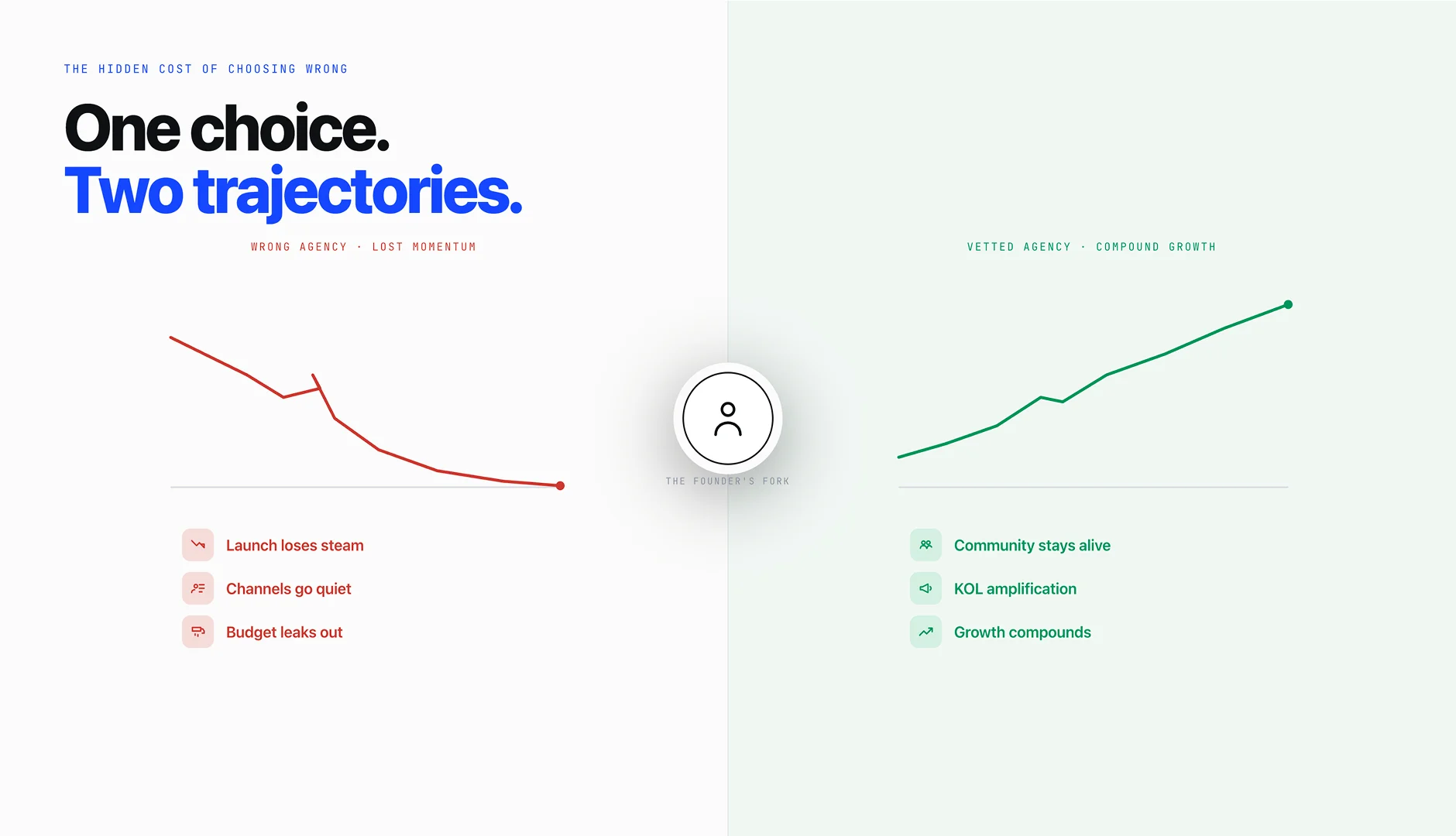
The five red flags below appear in the majority of agency relationships that fail inside 90 days:
Red flag 1: Token equity as the primary fee. Equity-for-services is not inherently wrong. But when token equity replaces cash as the primary compensation, the agency's incentive shifts from long-term results to short-term token price. That misalignment causes real damage.
Red flag 2: No refusal policy. A genuine agency turns down projects. If an agency will work with any project in any sector, it has no specialisation, and no reputation to protect. For why KOL campaigns in particular go wrong when agencies have no standards, see our article on why influencer marketing fails in crypto.
Red flag 3: Case studies with no named protocols or metrics. "We grew a DeFi protocol's community by 3x" is not a case study, it's a claim. Ask for protocol names, specific numbers, and contact details for the client CMO.
Red flag 5: Guaranteed rankings or guaranteed token price movement. No legitimate agency guarantees either. Search rankings and token price are both influenced by factors outside any agency's control.
TokenInsight's 2026 market survey estimates that 30-40% of crypto agency proposals in bull market conditions include guaranteed outcome language that cannot be legally or practically delivered.
How should you evaluate a crypto marketing agency's KOL network?
Three metrics distinguish a real KOL network from a purchased list: engagement rate relative to follower count, historical campaign association, and audience overlap with your target user profile.
Historical campaign association tells you whether the KOLs actually work in your space. Real KOLs can name three to five tokens they have promoted in the past 12 months. Purchased list brokers cannot. For a deeper look at how KOL networks actually drive results, see our breakdown of the strategic role of KOLs in crypto marketing.
Audience overlap is the metric most teams skip. A gaming KOL with 200,000 followers is irrelevant for a DeFi protocol. Ask the agency to map their KOL roster to your target user profile, DeFi users, NFT collectors, infrastructure developers, before you commit to a campaign.
What contract terms should you negotiate with a crypto marketing agency?
Four contract clauses determine whether you have a workable partnership:
Monthly vs quarterly commitment. Monthly retainers give you flexibility but cost more. Quarterly commitments typically come with a 10-15% fee reduction. Commit quarterly only after a successful monthly trial.
Performance milestones and reporting cadence. Define KPIs before signing, not after. Community growth targets, KOL campaign reach, PR placement count, every metric should have a number attached before work begins.
Exit clauses. Thirty days is reasonable. Sixty days is acceptable. Ninety days with a retainer forfeiture is a red flag. Ask specifically: "What happens if we terminate early, do we forfeit any fees already paid?"
Token equity clauses. If an agency requests token equity, cap it at 5-10% of the total fee value, require a vesting schedule tied to deliverables, and ensure the equity does not create a conflict of interest on KOL recommendations.
The 10-point crypto marketing agency evaluation checklist
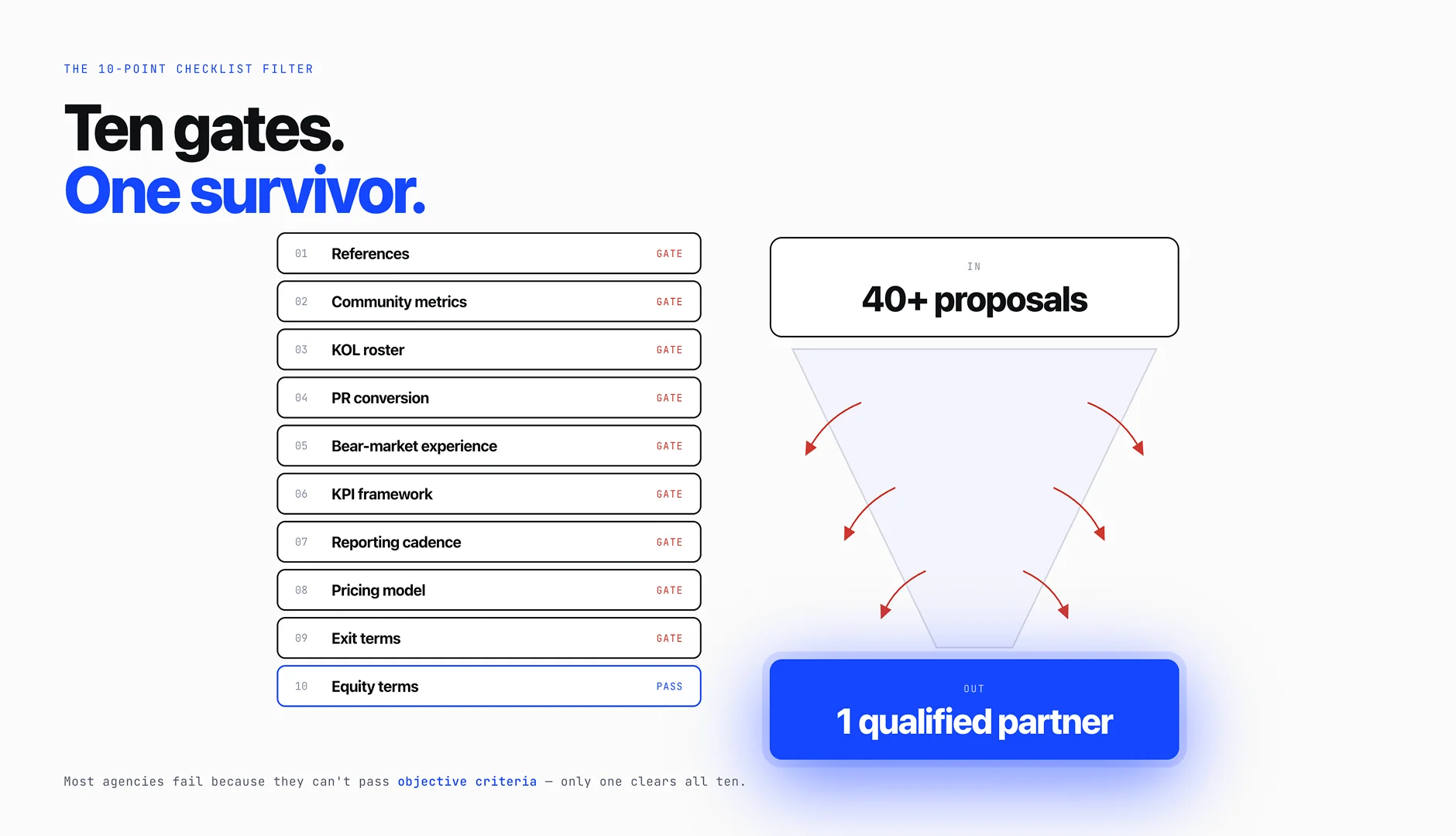
Use this checklist before signing with any crypto marketing agency. Every item is a binary pass or fail.
- Named protocol references with contactable CMOs. Not a logo wall, actual names and contacts.
- Community engagement benchmarks from live accounts. Active user rate, not raw member count.
- KOL network roster with engagement rate data. Named KOLs, not categories.
- PR placement rate stated clearly. Percentage of pitches that convert to Tier 1 placements.
- Bear market strategy experience documented. Specific examples, not platitudes.
- Dedicated community manager identified. Named, not outsourced to a VA.
- KPI framework agreed upfront, in writing. Before the contract is signed.
- Exit clause under 60 days. No retainer forfeiture on exit.
- No guaranteed price or ranking promises. Any guarantee is a red flag.
- Token equity terms defined and capped. Vesting schedule tied to deliverables.
The bottom line: Founders who work through all 10 points before signing almost never report the same regret as those who sign on portfolio and price alone.
Frequently Asked Questions
How much does a crypto marketing agency cost per month?
Crypto marketing agency retainers range from $5,000 per month for entry-level packages to $15,000-$30,000 per month for full-service engagements including community, KOL, PR, and SEO. Full-service enterprise packages run higher.
How long should I commit to a crypto marketing agency contract?
Three months is the minimum for meaningful results in community building and PR. Six months is more realistic for KOL campaign performance data. Start with a monthly trial, commit to quarterly once the agency has demonstrated performance against defined KPIs.
Can a crypto marketing agency guarantee results?
No legitimate crypto marketing agency guarantees specific outcomes. Token price, exchange listings, and search rankings involve variables outside any agency's control. Agencies that guarantee specific outcomes are either misrepresenting their capabilities or planning to manipulate metrics.
What is the difference between a crypto marketing agency and a Web3 PR agency?
A crypto marketing agency handles the full growth stack: community management, KOL campaigns, PR, SEO, and token launch strategy. A Web3 PR agency focuses exclusively on media placements and journalist relationships. PR agencies typically don't run community or KOL campaigns.
Conclusion
Choosing the wrong crypto marketing agency costs twice: the retainer you paid and the launch momentum you never recovered. The 10-point checklist is not box-ticking, it is the filter that separates agencies with real track records from agencies with polished websites.
For a sharper sense of where KOL campaigns specifically go wrong, see our article on why influencer marketing fails in crypto. If you have shortlisted agencies and want a second opinion, book a meeting with our team.