























Most Web3 projects hire a marketing agency six weeks after they needed one. The window between whitepaper and TGE closes faster than founders expect. KOL networks, Discord community infrastructure, and tier-1 media relationships each take months to build. Starting late means those channels aren't ready when TGE day arrives. Our crypto marketing complete playbook covers the full campaign structure if you want the birds-eye view first.
Key Takeaways
- Web3 marketing agencies run channels traditional agencies can't execute: KOL seeding, Discord/Telegram community management, TGE strategy, and crypto-native PR.
- The average crypto project allocates 15-30% of its fundraise to marketing in the first 12 months post-launch (Crypto Fundraising Benchmarks, 2025).
- Agencies that deliver results own one or two channels deeply, rather than offering everything at average quality.
- KOL-driven awareness accounts for over 40% of token discovery at launch, making influencer network quality a key agency selection criterion (CoinGecko, 2025).
What services does a Web3 marketing agency provide?
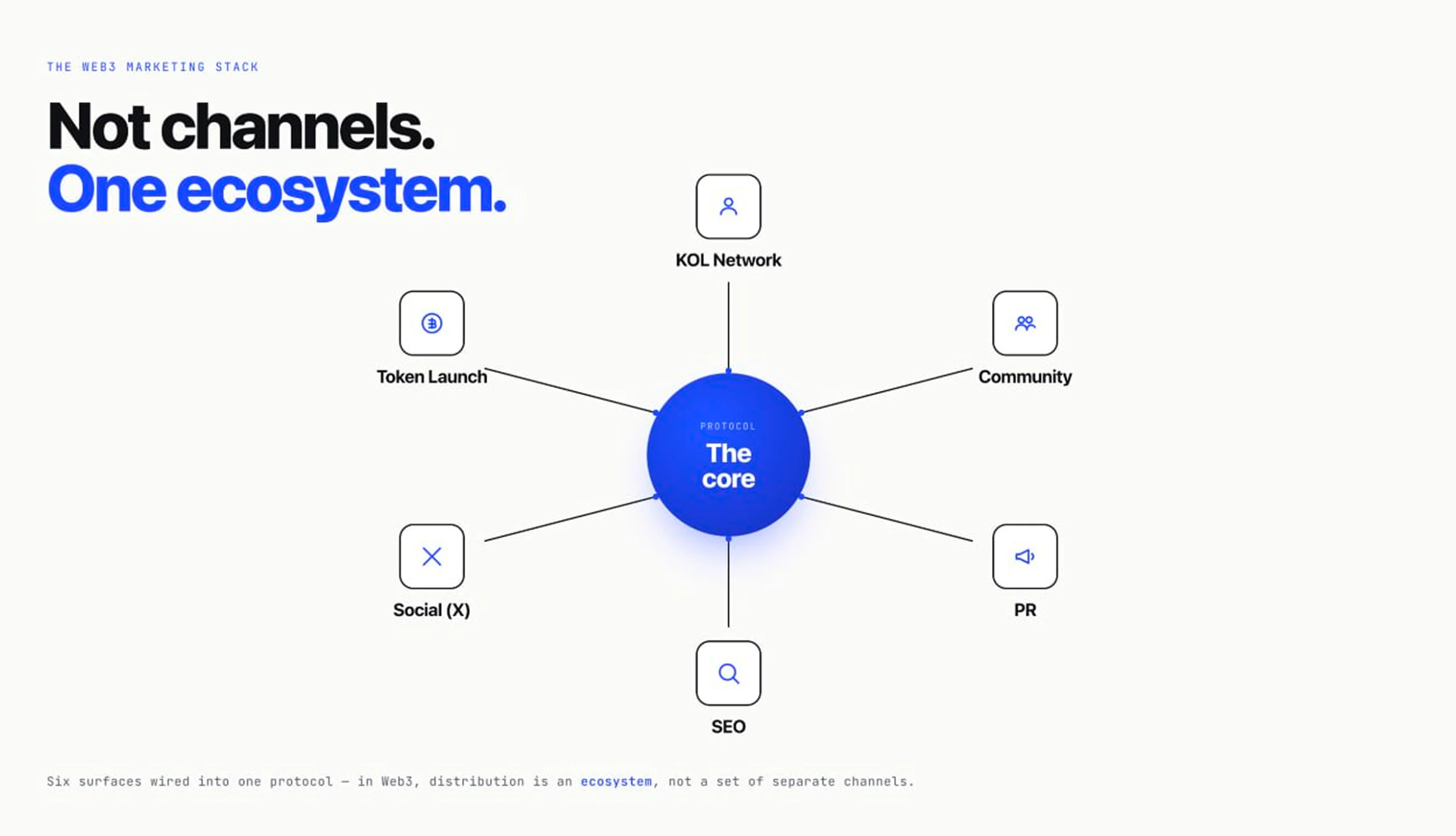
KOL and influencer campaigns involve seeding narratives with crypto-native content creators who hold genuine audience trust. This is not influencer marketing in the Instagram sense, it's a distribution network built on community credibility, not reach metrics. Our breakdown of the strategic role of KOLs in crypto marketing shows how the channel actually produces results at each stage.
Crypto community management means building and operating Discord servers and Telegram groups as active communities, not passive notification channels. A well-managed community converts KOL traffic into engaged token holders. A poorly managed one loses 70% of new members within a week.
PR and media outreach targets Tier 1 crypto outlets: CoinDesk, The Block, Decrypt, and Cointelegraph. Placements here work differently from traditional PR, journalists expect data, protocol specifics, and ecosystem context, not product announcements. You can see how we structure media outreach on our PR service page.
A full-stack Web3 marketing agency activates KOL, community, PR, SEO, social, and TGE services simultaneously, a coordination model that requires crypto-specific expertise that general marketing agencies do not have (Lunar Strategy, 2025).
How is a Web3 marketing agency different from a traditional agency?
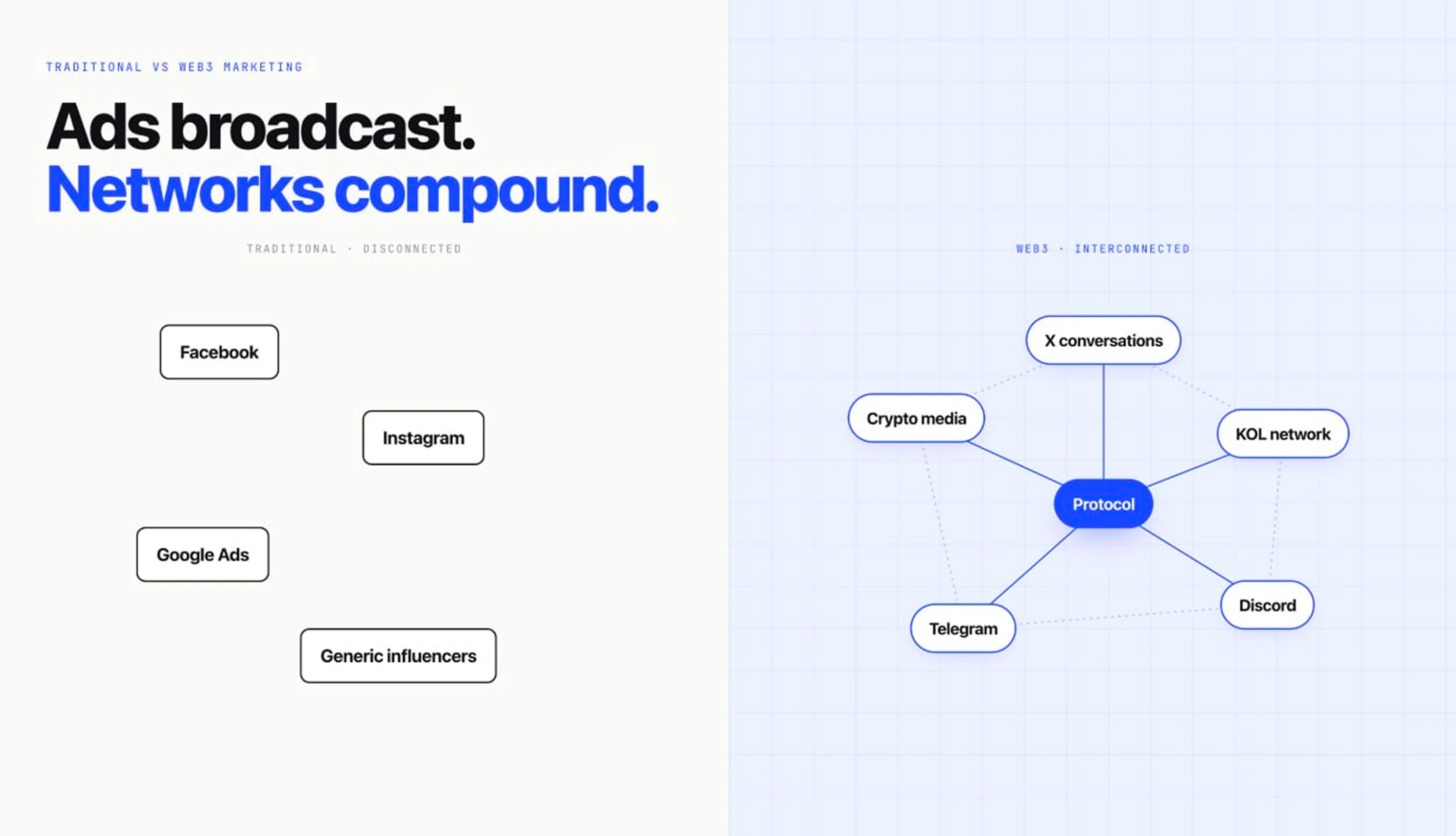
The gap is structural, not just stylistic. Traditional agencies are built for brand awareness through paid media, influencer reach through Instagram and TikTok, and conversions through landing page optimisation. None of those mechanics apply to crypto.
Web3 Agency vs Traditional Agency: Capability Comparison (out of 10)
KOL / Influencer: Web3 = 9.5 Traditional = 3.0
Community Mgmt: Web3 = 10 Traditional = 1.5
Crypto PR: Web3 = 9.0 Traditional = 2.0
Blockchain SEO: Web3 = 8.5 Traditional = 4.0
Paid Media: Web3 = 5.0 Traditional = 9.0
Brand Creative: Web3 = 6.0 Traditional = 9.5
The failure modes are predictable when traditional agencies handle Web3 briefs. They route budgets to Instagram and Facebook, where crypto advertising restrictions make effective campaigns nearly impossible. They treat Discord as a social media channel rather than a community infrastructure. They pitch journalists with press releases designed for product launches rather than ecosystem stories.
Bear and bull market cycles add another layer of complexity that traditional agencies are unprepared for. Messaging that works in a bull market, price performance, "get in early" narratives, actively damages brand reputation in a bear market. Web3-native agencies have operated through both cycles and understand how to adapt strategy accordingly.
Traditional digital marketing campaigns running for crypto projects generated 74% lower engagement than crypto-native campaigns using the same budget, according to CoinGecko's 2025 token launch analysis.
Which channels do Web3 marketing agencies actually specialise in?
Channel specialisation separates strong agencies from weak ones. CoinGecko's 2025 token launch analysis shows KOL campaigns drive 42% of initial token awareness, X/Twitter organic 28%, community referrals 15%, PR 10%, and SEO/content 5% at launch, compounding from there.
Token Launch Awareness Share by Channel (CoinGecko, 2025):
- KOL Campaigns: 42%
- X/Twitter Organic: 28%
- Community Referrals: 15%
- PR Placements: 10%
- SEO / Content: 5% (but compounds post-launch)
X/Twitter is the primary narrative layer for Web3 projects. Agencies run it through thread strategy, coordinated KOL amplification, and founder personal brand development. The mechanism is different from consumer social media, the goal is narrative credibility with an audience of token holders and potential investors, not viral reach.
Crypto PR targets placement in CoinDesk, The Block, and Decrypt. These outlets reach the institutional investors and fund managers who move markets. A single feature in CoinDesk generates more credibility than six months of social media posts. You can see how we run media outreach on our PR service page.
KOL campaigns drive 42% of token launch awareness, followed by X/Twitter organic at 28% and community referrals at 15% (CoinGecko Token Launch Analysis, 2025).
When should a Web3 project hire a marketing agency vs build in-house?
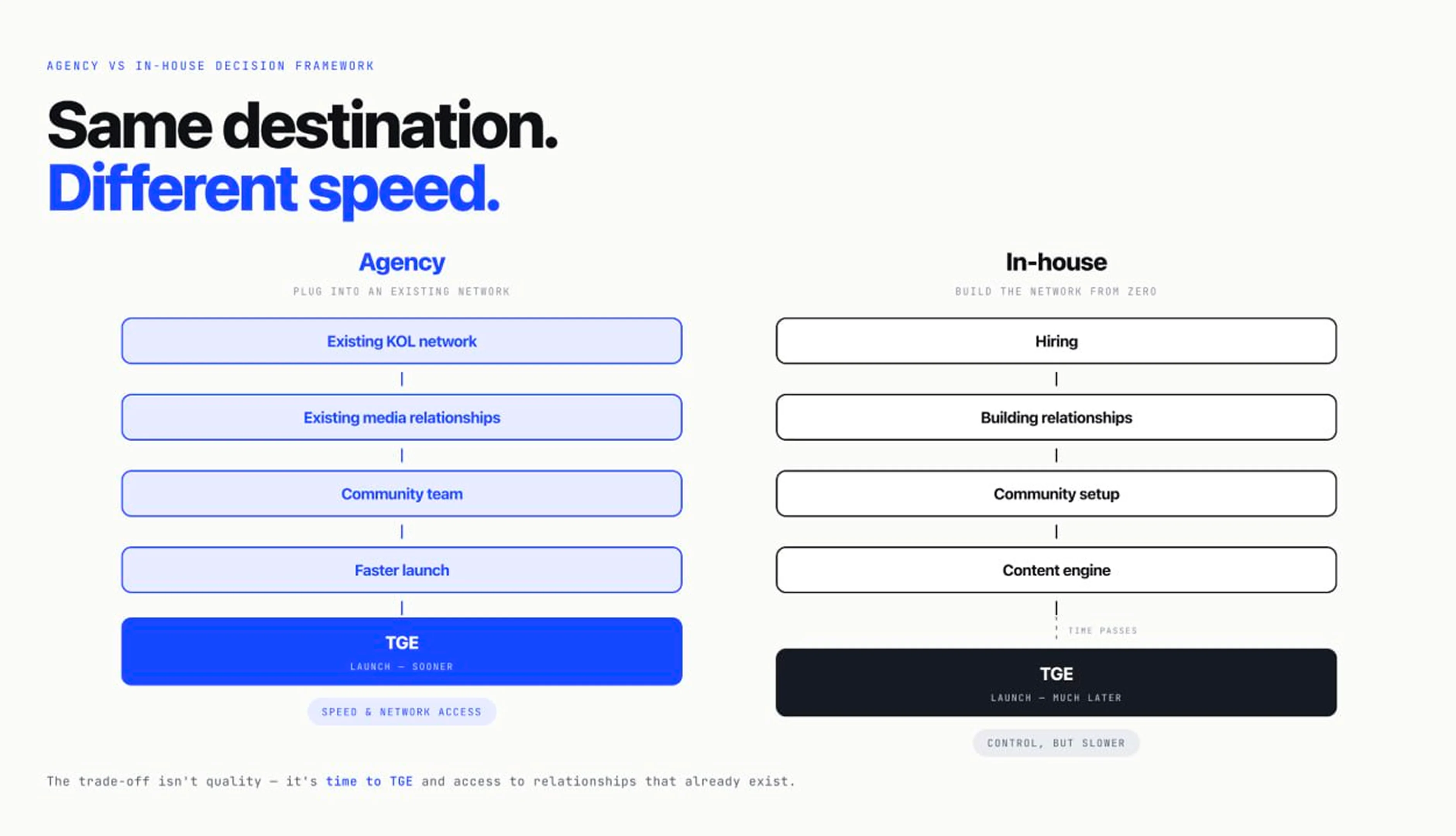
Hire an agency before you think you need one. Build in-house once you have product-market fit.
Hire an agency when:
- You have no CMO and need to move fast. An agency brings a full team immediately.
- You're inside a 6-month pre-TGE window. The KOL network takes time to activate properly.
- You need immediate access to Tier 1 media contacts or a vetted KOL roster.
- Your team has deep technical or product expertise but no distribution experience.
- You're entering a new geography or language market where your team has no existing relationships.
Build in-house when:
- Your community is self-sustaining and generating organic growth without prompting.
- You have clear product-market fit and a repeatable content engine already running.
- You're post-Series A with budget to hire a CMO, a community lead, and a content team separately.
- Your brand narrative is fully established and you need execution, not strategy.
The real variables are speed and network access. Agencies compress timelines and arrive with pre-built relationships. In-house teams build deeper product knowledge over time but take 6-12 months to hit full effectiveness.
Early-stage Web3 projects using external agencies in year one generated 3.1x more community members and 2.4x more Tier 1 media placements than those relying exclusively on in-house marketing (Lunar Strategy data, 2025).
What does a Web3 marketing agency cost in 2026?
Monthly retainers for Web3 marketing agencies range from $5,000 per month at the entry tier to $40,000 per month or more for full-service engagements.
Entry tier ($5,000-$10,000/month): Typically covers one or two channels. Common deliverable set: social media management (X/Twitter), community moderation, basic content.
Mid tier ($10,000-$25,000/month): Multi-channel execution. Usually includes community management (Discord plus Telegram), KOL coordination (5-10 micro KOLs per month), and PR outreach.
Full-service tier ($25,000-$40,000+/month): Complete go-to-market ownership. Includes everything in the mid tier plus dedicated strategy, SEO, paid amplification, and TGE planning.
Equity and token arrangements exist and are sometimes offered by agencies as part of a hybrid deal. One hard red flag: any agency that takes token equity as the primary compensation without a cash retainer base has a misaligned incentive structure.
How do you evaluate a Web3 marketing agency before signing?
Named case studies with real protocols are the first test. Ask for campaign-level results: how many KOLs activated, what Discord growth rate, what PR placements achieved. Generic "we grew a DeFi protocol" claims are not case studies.
KOL network quality matters more than quantity. A roster of 500 micro-KOLs with inflated follower counts is worth less than a curated network of 50 KOLs with genuine engaged audiences in your target sector.
Live community metrics are the third check. Request read access to one or two Discord servers they currently manage. Look at daily active users, message velocity, and the quality of moderation. A well-managed server is immediately visible, and so is a poorly managed one.
Frequently Asked Questions
What does a Web3 marketing agency charge per month?
Web3 marketing agency retainers typically range from $5,000 per month for single-channel entry engagements to $40,000 per month or more for full-service retainers including community, KOL, PR, and TGE strategy.
Can a Web3 marketing agency guarantee token price performance?
No reputable Web3 marketing agency guarantees token price outcomes. Price is determined by market conditions, tokenomics, and macro crypto cycles, none of which any agency controls. Agencies that guarantee price performance are either manipulating markets or misrepresenting their capabilities.
How long does it take to see results from a Web3 marketing agency?
KOL campaigns produce awareness results within 7-14 days of activation. Community growth shows measurable momentum within 30-60 days. PR placements typically require 4-8 weeks from pitch to publication. SEO compounds over 3-6 months. Expect meaningful outcomes across all channels within a 90-day engagement.
What's the difference between a crypto PR agency and a Web3 marketing agency?
A crypto PR agency focuses exclusively on media placements, press releases, and journalist relationships. A Web3 marketing agency handles the full growth stack: community management, KOL campaigns, PR, SEO, social media, and TGE strategy. Most full-service Web3 agencies include PR as one service line rather than the entire scope.
Does Lunar Strategy work with early-stage projects?
Yes. Lunar Strategy works with projects from pre-seed through to the scaled protocol stage. Entry-tier engagements are scoped to match early-stage budgets, with the option to expand as fundraising closes. The KOL network and PR relationships are available from day one, regardless of project size.
Conclusion
Crypto audiences live on X/Twitter, Discord, Telegram, and crypto media. Facebook ads and Instagram influencers reach different people. That is why Web3-native distribution exists as a separate category.
If you are ready to explore what a 90-day engagement looks like, book a free consultation here.