

























TL;DR
- The first 90 days with a crypto marketing agency should end with proof, not just activity. By day 30 you should already have an audit, a roadmap and your social channels active. By day 60 the right channels for your project should be running, and by day 90 a report should show what your money bought.
- Most agency relationships go wrong for the same reasons: nobody agreed on what success looks like, tracking was never set up, and reports count likes instead of users.
- Not every channel moves at the same speed. KOL campaigns and paid tests show signals within weeks. SEO and PR take months, so judge them by progress, not by final results.
- Every account must stay in your name from day 1. The agency gets access, never ownership.
- You can hold any agency to this with weekly alignment calls, a report every 30 days and a simple scorecard you agree on in week 1.
Three Months In, You Have Reports but No Users
Picture this. You run a DeFi project, and three months ago you signed a crypto marketing agency. The kickoff call was great.
The agency had a big client list, a confident team and a plan that covered everything: KOLs, PR, community, content.
Now it's day 90. Your inbox has twelve weekly reports. They're full of impressions, follower growth and "strong engagement." Your Discord grew by 8,000 members. Then your co-founder asks a simple question: "How many people actually used the app because of this?"
Nobody can answer. Not you, and not the agency.
You didn't do anything unusual. You hired a team, paid on time and approved what they sent. But somewhere between the kickoff and the report, nobody defined what "working" meant.
This happens to a lot of teams, and it's not only an agency problem.
One Web3 gaming team completed 100% of its grant deliverables and still reached only about 55% of the user conversions it expected. Every task was done. The result wasn't there.
This article explains what a crypto marketing agency should deliver at day 30, day 60 and day 90, why the first three months so often go wrong, and how to check your agency's work yourself, starting this week.
What Should a Crypto Marketing Agency Deliver in the First 90 Days?
In the first 90 days, a crypto marketing agency should audit your project, deliver a roadmap and start posting within the first 30 days, run the channels that fit your project by day 60, and by day 90 show a report that ties spend to wallets, users or pipeline, with a report every 30 days and weekly calls.
A KPI (key performance indicator) is a number you agree to track because it shows whether the work is paying off: new wallets, activated users, qualified leads or active community members.
Every project needs a different mix of channels, so the details will vary. The rhythm shouldn't. Here is the whole 90 days on one page: share it with your agency in week 1 and check it together at each report.
The scorecard does one important thing: it makes both sides measure the same thing from the start. Agencies and clients rarely disagree about effort. They disagree about what counts as progress.
If you're still choosing a partner, start with what a crypto marketing agency does and our 10-point checklist for choosing one. If you've already signed, the rest of this article is for you.
Before looking at each month, it helps to understand why the first 90 days go wrong so often.
Why the First 90 Days Often Go Wrong
Most crypto teams and most agencies work hard in the first three months. The problem is rarely effort: the work isn't pointed at a result both sides agreed on. These are the causes that come up most often.
Nobody wrote down what success means. The contract lists services: "KOL campaigns, PR, community management." It doesn't say what those services should produce. Without a target, any result can be called a success, and any result can be called a failure.
Clients and agencies see the problem differently. In a 2025 survey of marketers and agencies, clients who ended an agency relationship most often blamed delivery (61%) and value (61%). Agencies mostly blamed budget cuts (75%), and only 18% named delivery. Both sides were looking at the same relationship and telling different stories.
The first month is spent only on planning. Some agencies spend 30 days on decks and calls while nothing goes live. Your community sees a quiet project, and you have no real data to learn from.
Tracking is set up late, or never. If the tracking links, analytics goals and wallet attribution aren't ready before the first campaign, the first campaign produces no usable data. Wallet attribution means connecting a campaign to the wallets that interacted with your product after seeing it. Without it, an on-chain project can't tell which channel brought real users.
Reports measure what's easy, not what matters. Impressions, likes and follower counts are easy to collect and always go up. They say very little about whether anyone used your product.
The project is slow on its side. Agencies need access, information and quick answers. If logins take two weeks and every post waits five days for approval, month one is gone before any work starts.
Accounts end up in the wrong name. It's convenient to let the agency create the ad account or the community server. It becomes a serious problem the day the contract ends.
Each of these has a fix, and most of the fixes happen in the first 30 days.
Days 1-30: Audit, Roadmap and First Posts
The first month is not only for planning. A good agency audits, plans and starts showing up for your project at the same time. By day 30, your social channels should already be active, and you should have a roadmap and a first report in hand.
Here is what a strong first month usually looks like, week by week. Treat it as a pattern, not a fixed script: each project needs a different strategy.
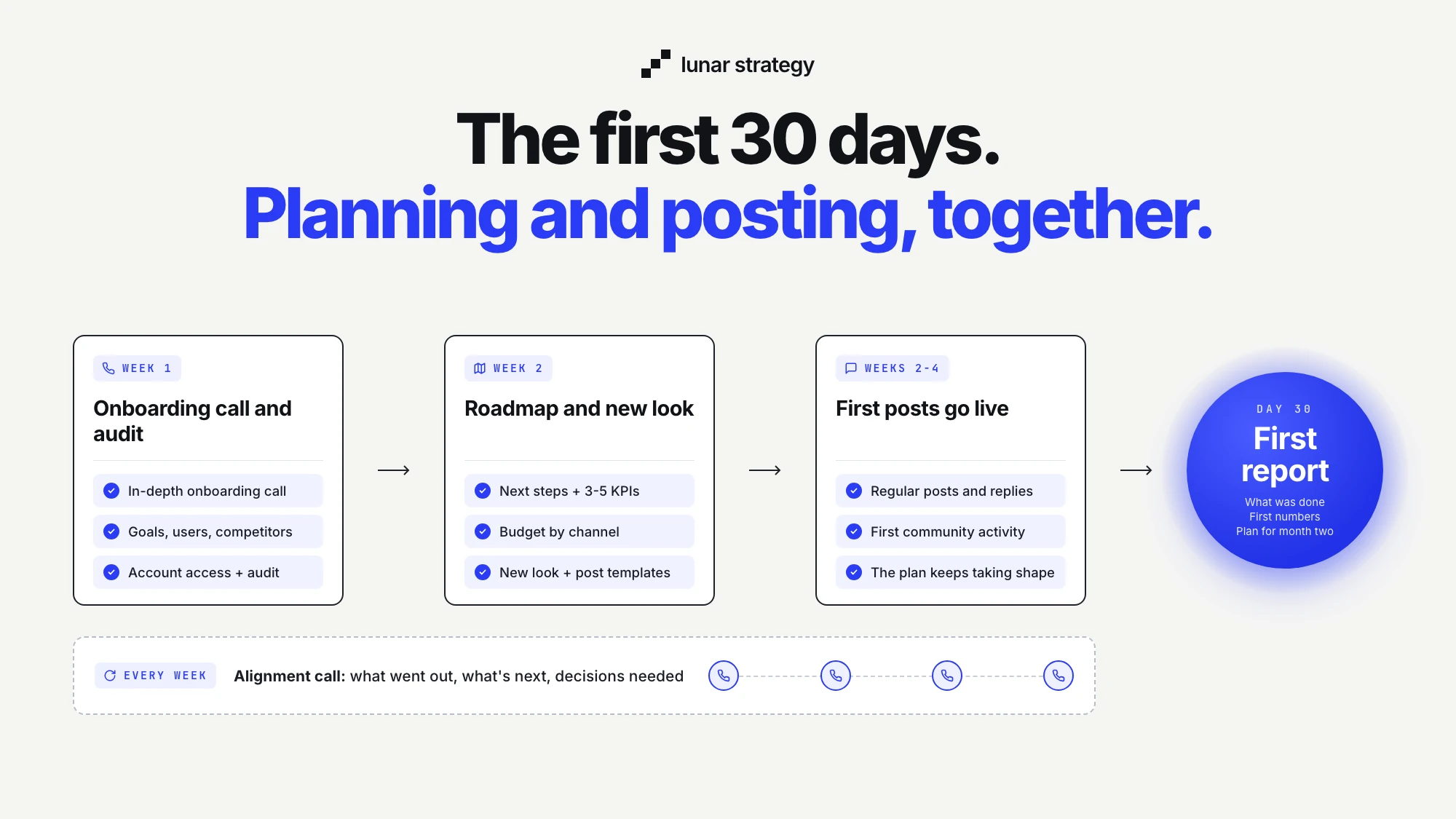
Onboarding works both ways. The agency can't move this fast without the right inputs from you, so it helps to see both sides of the first month together:
A few things in that table deserve a closer look.
The onboarding call sets the quality of everything after it. A good agency comes with questions about your product, your goals, your users and your competitors, and leaves with a clear picture of all of them. If the call is a quick sales recap, expect a generic plan.
The audit should tell you something you didn't know. A good audit looks at your current channels, your competitors and your users, and it names what's broken. If it only lists what you already told the agency on the onboarding call, it isn't an audit.
The roadmap needs numbers, not channel names. "We'll run KOLs, PR and community" is a list of services. A roadmap says what happens next, which 3 to 5 KPIs matter, what the target is for each one by day 90, and how the budget is split by channel. Ask for it in writing.
Don't wait for a perfect plan to start posting. Your audience notices a quiet account. Early posts also give you the first real data on what your community responds to, which makes the roadmap better.
Tracking comes before campaigns. Before anything goes live, there should be tracked links (UTM tags that tell your analytics where a visitor came from), goals in your analytics tool and, for on-chain products, a way to connect campaigns to wallets. A campaign without tracking is a campaign you'll never be able to judge.
Every account must be in your name. The agency gets access as a user, not ownership. If your X account, ad accounts or community servers sit under the agency's email, you lose them the day the contract ends.
Compliance is part of the plan. In the UK, the FCA's rules for crypto promotions have applied since October 2023. In the EU, MiCA has applied in full since December 30, 2024, including rules on how crypto-assets are marketed.
A good agency tells you what you can and can't say in your target markets before the first campaign goes live. This is general information, not legal advice.
Your day-30 check: go through the first report and ask, "If we hit these numbers by day 90, will we be happy?" If the answer is no, change the targets now, not in month three.
With the channels active and a roadmap in place, month two is about doing more of what fits your project.
Days 31-60: Scaling the Channels That Fit Your Project
Month two is when the plan expands. By day 60, the channels chosen for your project should be running and producing data you can read, and you should have a second report.
Not every project needs every channel. A DeFi protocol may lean on KOLs and research content, while a game may lean on community and creators. Here is what good work looks like in each of the most common channels.
KOL campaigns. KOLs (Key Opinion Leaders) are crypto creators whose audiences act on their judgment. Each one should get a clear brief, a tracked link and a disclosure label on paid posts, so you can see which creators bring users and which only bring likes. Our guide on how to brief a KOL covers what that brief should include.
PR. Pitches should be built around real news (a launch, a partnership, original data) and aimed at outlets your users actually read. Earned coverage matters more than ever.
Citations came from earned media and only a few from paid or advertorial content. Paid articles on low-quality sites rarely help. See how we approach crypto PR.
Community. Programming should have a purpose: onboarding flows, AMAs, quests or ambassador tasks. Track active members, not total members.
A Discord with 20,000 members and 40 people talking is not a community. More on that in our community management approach.
Content and SEO. Pages should be published, indexed by Google and aimed at questions your users ask. Rankings come later. At day 60, you're checking that the pages exist and that search engines can find them.
Paid tests. Small budgets, clear tracking, and only where platform rules allow crypto ads in your markets. The goal is to learn your cost per result, not to scale.
our day-60 check: in the second report, ask one question: "Which channel is producing the best early signal, and what will you do with it in month three?" A good agency already knows the answer and has a plan to move budget toward it.
With real data coming in, month three is about turning it into a decision.
Days 61-90: The Report and the Keep-or-Change Decision
The third month should end with the third report, and this one has to answer what the money bought. A good day-90 report reads like a business review, not a screenshot gallery.
Here is what it should include, in this order:
- Spend by channel, compared with the budget agreed on day 30.
- Results against each KPI, with the target next to the actual number.
- Cost per result that matters to you: cost per wallet, per activated user, per qualified lead or per active community member.
- What worked, and why, backed by the data, not by opinion.
- What to stop, and where that budget moves next.
- The plan for days 91-180, with updated targets.
If you need help choosing which numbers to track, our guide to how crypto marketing agencies measure ROI explains cost per wallet, retention cohorts and the metrics worth watching.
Then decide. There are three honest outcomes at day 90:
- Keep going if the KPIs are moving in the right direction and the agency can explain why.
- Change the plan if one channel works and others don't. Move budget toward what's working.
- Consider ending the relationship if day 90 arrives with activity reports but no link to users, wallets or revenue, and no clear plan to fix it.
To see what these three months look like in practice, it helps to compare two agencies side by side.
What This Looks Like Side by Side
Here's how two agencies might look after 90 days with the same client and the same budget. Both would look good on a sales call. These are illustrative examples, not real clients.
On paper, Agency A had the better quarter: more followers, more Discord members, more KOL posts. But none of it can be connected to a single user. Agency B grew more slowly and can show what each dollar did.
That's the difference the scorecard is meant to catch. If you'd checked it at day 30, Agency A's missing tracking would have shown up two months earlier.
Of course, a fair review also accounts for the fact that not every channel can prove itself in 90 days.
How Fast Each Channel Should Show Results
Judge each channel by the signal it can realistically produce in 90 days, not by its long-term potential. Some channels move in weeks. Others compound over months.
SEO is the slowest to mature. Google itself says some changes take a few hours and others several months, and suggests waiting a few weeks before judging a change.
By day 90, expect progress you can see in Search Console (Google's free tool that shows how your site appears in search), not top rankings for competitive terms. Our crypto SEO service is built around that timeline.
PR works in a similar way. A single good article can keep sending visitors and building trust for a long time, but you can't schedule when a journalist decides to write about you.
Knowing what each channel can do also makes it easier to spot when something is wrong.
Crypto-Specific Red Flags at Day 90
Generic agency checklists miss the problems that hit crypto projects hardest. If you see two or more of these at day 90, it's time for a hard conversation.
- Growth that looks too good. Thousands of new followers or Discord members with no increase in active users usually means bots. In the US, the FTC now bans buying or selling fake followers and views, and fake audiences also poison your data.
- No link between campaigns and wallets. For an on-chain product, a report without wallet or user attribution can't tell you what worked.
- Paid "PR" on sites nobody reads. Coverage you paid for on low-quality sites rarely reaches real users or earns trust.
- Payment only in tokens. It ties the agency's income to your token price instead of your users, which can push it toward short-term hype.
- Accounts in the agency's name. Access is fine. Ownership is not.
- Reports full of impressions and no decisions. If every report says "great engagement this month" and never recommends stopping or changing anything, nobody is managing the budget.
Red flags tell you what's wrong today. It's just as important to know what a good agency can and can't promise in the first place.
What to Expect, and What No One Can Promise
This area is full of bold claims, so it's worth being clear about what's realistic in 90 days.
No one can promise a token price. Marketing can bring attention, users and community. It can't control the market. An agency that promises a price target, or a "guaranteed pump," is promising something it doesn't control.
No one can guarantee coverage or rankings. Journalists choose what they write about, and search engines choose what they rank. A good agency can make both much more likely. It can't guarantee either.
Some results come fast, others take time. KOL campaigns and paid tests can show signals within weeks. Community quality builds over a couple of months, while SEO and PR keep building long after day 90. A fair review looks at direction and cost per result, not final scale.
Your team affects the result too. Slow approvals, missing information and changing priorities delay everything. The agency should flag these early, and you should fix them fast.
Day 90 is a checkpoint, not a finish line. The best outcome is not a perfect report. It's a clear picture of what works, what doesn't, and where the next 90 days should go.
Common Mistakes to Avoid
Before you start, it helps to know where teams most often trip up:
- Signing without agreed KPIs. If success isn't written down, every result can be argued.
- Launching campaigns before tracking is ready. The first month's data is lost and can't be recovered.
- Judging every channel by the same clock. Expecting SEO to perform like a paid test leads to cutting the channel right before it starts working.
- Counting members instead of active members. Big numbers feel good and say very little.
- Letting the agency own your accounts. It's easy at the start and painful at the end.
- Skipping disclosure on paid posts. It risks your reputation and, in many markets, breaks the rules.
- Spending the first month only on planning. Posting and planning can happen in parallel, and early posts make the plan better.
- Waiting until day 90 to check. Weekly calls and the day-30 and day-60 reports exist so problems are fixed while there's still time.
Putting It All Together
The first 90 days with a crypto marketing agency decide whether the relationship produces results or just reports. Most of the time, things go wrong for fixable reasons: nobody agreed on what success means, the first month was spent only on planning, tracking came too late, reports measured likes instead of users, or accounts ended up in the wrong name.
So work through it in order. In the first 30 days, get an audit that tells you something new, a roadmap with numbers, your channels active and a first report. By day 60, have the right channels running and a second report with data you can read.
By day 90, get a report that shows what the money bought, then decide whether to keep going, change the plan or stop.
Do that, and day 90 stops being a guess. It becomes a clear decision based on real numbers.
Frequently Asked Questions
How long does crypto marketing take to show results? It depends on the channel. KOL campaigns, paid tests and community programs can show early signals within weeks, such as tracked clicks, new wallets or active members. SEO and PR take longer, often several months. At day 90, judge direction and cost per result, not final scale.
What should a crypto marketing agency do in the first month? Start with an in-depth onboarding call to understand your product, goals and competitors. Then audit your channels and competitors, deliver a roadmap with 3 to 5 KPIs, start the design work and get your social channels active with regular posts. It should also set up tracking, hold weekly alignment calls and send a first report by day 30.
Can I leave a crypto marketing agency after 90 days? Only if your contract allows it. Before signing, ask for a 90-day review point with a clear exit clause, and make sure all accounts, content and data stay in your name, so leaving doesn't mean starting from zero.
Should I pay a marketing agency in tokens? It's risky as the only form of payment. Token-only deals tie the agency's income to your token price, which can push it toward short-term hype. If tokens are part of the deal, pair them with a cash retainer and vesting.
What KPIs should a crypto marketing agency track? Pick 3 to 5 that connect to real use of your product: new wallets, activated users, qualified leads, active community members, and cost per result for each. Followers and impressions can support the story, but they shouldn't be the main KPIs.
How often should I talk to my agency? A weekly alignment call is a good standard in the first 90 days, plus a written report every 30 days. Weekly calls catch problems early, and monthly reports show the trend.
What should a monthly agency report include? Spend by channel, results against each agreed KPI, cost per meaningful result, what worked and why, what to stop, and next month's plan. If a report has impressions but no decisions, ask for a new format.
What if my TGE happens inside the first 90 days? A token generation event (TGE) compresses the timeline. Audit and strategy still come first, but community, narrative and KOL seeding need to start earlier, and the day-90 report should show how many holders and members stayed active after launch. Our 90-day pre-TGE playbook covers that timeline phase by phase.
What's the first thing I should do this week? Share the scorecard in this article with your agency, book a weekly alignment call and agree on the targets for day 30, 60 and 90. If your agency won't commit to numbers, that tells you something too.
Let's Talk Strategy
A good agency doesn't just send reports. It agrees on what success means before the first invoice and shows you, every month, what your budget produced.
You explain what you're building and we'll explain how we'd support it.