




























TL;DR:
- X stopped letting anyone create a new X Community in April 2026, after its Head of Product tied the feature to 80% of spam reports, financial scams and malware on the platform. So a community on X is now built around an account: the people who know what you post, reply to it and come back.
- X's ranking code shows what that group is worth: a reply from someone you follow back weighs about 28 times a like, while likes sent from a group chat count for nothing. That makes a few hundred people who talk with you more valuable than thousands of silent followers.
- Start with a position people can repeat in one sentence, such as "explains new DeFi protocols in plain English", and make your bio and pinned post say it. Your profile is where a curious reader decides to follow, so it comes before any growth tactic.
- Your first followers come from early replies under bigger posts in your niche, because a new account's own posts reach few people. Reply while a post is still climbing and has fewer than 50 replies, and add a fact, an example or a real disagreement.
- When you post, stay online for the first 2 hours: X tests fresh posts from accounts under 50,000 followers with people who don't follow you yet. Answer every reply in that window, and favor threads and explainers people read to the end.
- Once the same names keep replying, give them a place to meet: a public List of your regulars, an XChat group linked in your bio and a weekly Space. Each one does a different job: the List helps newcomers find your people, the group holds the private conversation, and the Space puts voices to names.
- To see if it's working, track repeat repliers, new mutual follows and profile visits that turn into follows, and check X's Under the Hood page for labels that limit your posts. Likes measure reach, and these numbers show whether a community is forming.
In April 2026, Nikita Bier, X's Head of Product, said Communities were used by less than 0.4% of users yet produced 80% of the platform's spam reports, financial scams and malware, and X announced it would retire the feature. The deadline passed, existing Communities kept running, and the button to create a new one never came back. Search results still tell people to tap "+" to start one, which leaves a lot of founders and creators following steps that no longer work.
The way to build a community on X in 2027 is slower and more durable: you become an account a specific group of people recognizes, you talk with them in public until they talk back, and then you give them places to meet. X's own code rewards exactly this. It gives extra weight to conversations between accounts that follow each other, and it ignores engagement that comes from people clicking a link in a group chat. This guide is for anyone starting from a small account, whether you run a project, a company or your own name.
Everything below is built from X's published ranking code and change notes, its help pages and our work with more than 300 crypto projects.
You can't create an X Community anymore, and you don't need one
To build a community on X in 2027, you grow a group of people around your account and then connect them through Lists, XChat groups and Spaces, because X no longer lets anyone create a new X Community. Existing Communities still run, and you can join them and post in them, but the feature is frozen and X has said it wants it gone.
When we checked in November 2026, the Startup Community (about 194,000 members) still had new posts that week, and the web no longer offered a way to create a Community. X never set a new shutdown date after May 30. That leaves a feature you can use as a reader and a poster, and can't rely on as a home. It also tells you where X wants groups to live: Bier pointed people to joinable XChat group chats, which held up to 500 members in April 2026, with 1,000 as X's stated target.
Here is what you have to work with on X in November 2026:
| Tool | Status in November 2026 | What it's good for |
|---|---|---|
| X Communities | Existing ones run; new ones can't be created | Joining conversations in your niche |
| XChat groups | Active, joinable by link; 500 members (April 2026), 1,000 targeted | A private room for your closest followers |
| Lists | Active; public or private | Following your niche daily and showcasing your people |
| Spaces | Active; always public | Live conversation, AMAs, recurring shows |
| Your account | Always yours | Where the community actually forms |
The last row is the one that matters. Every tool above sends people back to an account, and an account is the only piece X can't take away with a product decision.
A community on X is the people who reply to you, and the code counts them
X publishes the code that ranks its For You feed, and it gives a clear answer to what a community is worth. The ranking parameters score each post by how likely a viewer is to take each action, and X says it runs scripts that copy its production values into that file, so these are the numbers live on X. A like carries a weight of 0.708 and a reply carries 5. When the viewer and the author follow each other, the predicted reply gets a boost of 15, which puts it at about 28 times a like.
X documented that boost in a change note of its own. It started an A/B test on July 10, 2026 with values of 5, 10, 15 and 20, rolled out 20 to many users on July 13 after "great initial results", and settled on 15 on July 24, after feedback that people were seeing too little World Cup discussion from accounts they didn't follow. In X's words, the boost lifts "original posts from people you mutually follow", so every mutual you gain is a feed where your next post starts ahead.
That boost is the mechanical definition of a community on X: accounts that follow each other and talk. A post that draws five replies from mutuals sends a stronger signal than a post with a hundred likes from strangers. The same file also notes that engagement from people who open a post "directly" through a link, such as from a group chat, "has no ranking impact". Engagement pods and Telegram raids produce numbers you can see on the post and very little the feed responds to.
| Action on your post | Weight in X's code (Nov 6, 2026) | Compared with a like |
|---|---|---|
| Like | 0.708 | 1x |
| Reply | 5 | about 7x |
| Reply from someone you follow back | 20 (5 + 15 boost) | about 28x |
| Viewer follows you | 4 | about 6x |
| Mute | -58.8 | about 83x against |
| Report | -234 | about 330x against |
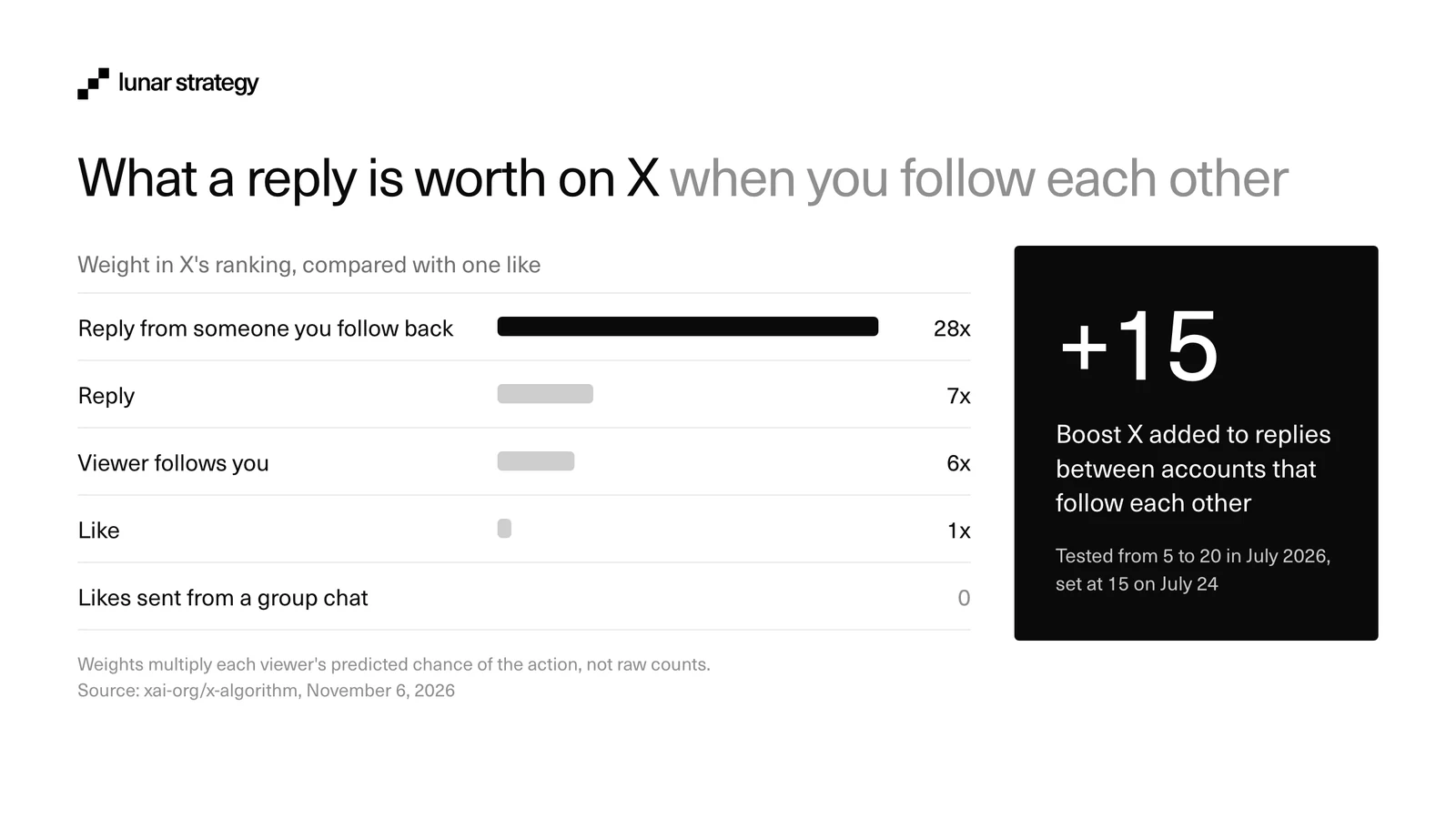
Read the table the way X asks. The weights multiply each viewer's predicted chance of an action, not the raw count of reactions, and X's update log calls it a misconception to read a report's weight as "1 report cancels out 468 likes". What the table shows is what the model tries to earn from each viewer, and at the top of that list is conversation with people who know you.
The negative rows matter as much as the positive ones. Annoying the wrong people costs more than pleasing the right ones earns, so every tactic below is built to be welcome in someone's feed. For the full picture of how ranking works, read our guide on how the X algorithm works.
Start with a position people can repeat
People follow an account when they can explain it to someone else in one sentence. "Posts about crypto and tech" describes half the platform. "Explains new DeFi protocols in plain English, with the risks" is something a reader can repeat, and a reason to come back tomorrow. Your position decides who you reply to, what you post and which people you invite into your inner circle, so it comes before any tactic.
Write it as a filter, and keep it private: I help [specific people] understand or do [specific outcome] through [your proof: experience, data or access]. If a post doesn't serve that sentence, it needs a very good reason to exist. Across the projects we've worked with, the accounts that stall at a few hundred followers usually post about everything their team finds interesting that week, so nobody can predict what they'll get next.
Then make the profile answer four questions in about three seconds:
- Who are you? A clear name and photo. For a person, a face. For a project, the logo people already know.
- What do you post about? A bio that names the topic and the reader, in plain words.
- Why trust you? One proof point: what you built, ran or measured.
- What will I get? A pinned post that shows your best thinking, such as a short "start here" thread or your most useful explainer.
Our first step with every project we work with is the same: a banner with partner logos as trust symbols, a clear photo, bio and link, and a pinned post with one call to action. Distribution sends people to the profile before anything else, so for many of them it is the first contact with the brand.
Your profile is where interest turns into a follow. X's code gives a profile click no ranking weight at all (0 in the same parameters file), so a profile visit helps you only if the page converts it.
Your first 1,000 followers come from replies under other people's posts
A new account's posts reach few people, so the first audience comes from conversations that already have one. When you reply under a post from a bigger account in your niche, its readers see your reply in the thread, and a useful reply sends some of them to your profile. The best targets are posts whose views are climbing fast and that have fewer than about 50 replies, where an early, useful reply can still sit near the top of the thread.
There is a detail in X's code that explains why this works the way it does. The For You feed filters out replies from accounts the viewer doesn't follow, so your reply won't be recommended to strangers as a standalone post. Its reach comes from the conversation under the original post, which is why position in the thread and timing matter more than volume.
| Who to reply to | How many | What a good reply looks like |
|---|---|---|
| Large accounts in your niche | 10-15 on a private List | An example, a number or a respectful disagreement, posted early |
| Peers at your size | 10-20 | Real conversation; these become your first mutuals |
| People you want to work with | 5-10 | Useful expertise, never a pitch under their post |
Put the first two groups on private X Lists and open them once or twice a day. Ten replies that add something beat eighty that say "great point". X's code labels accounts using blocks and reports relative to likes, and its bot model looks for patterns such as reply spam, so automated or copy-paste replies can cost you reach on every post you make afterwards.
Reply to the people who reply to you, every time, in the first months. Those back-and-forth threads are how strangers become mutuals, and mutuals are the people whose replies count 28 times a like.
X gives your new posts a 2-hour test, so be there for it
Original posts still matter, and X's code gives smaller accounts a fair shot at them. For accounts with up to 50,000 followers, an original post (not a reply or repost) in its first 2 hours can be placed in the For You feed of people who don't follow you until it reaches about 200 views there. How people react in that window decides whether it keeps traveling. After 48 hours, a post leaves the feed for good.
So the practical rule is simple: post when you can stay online for the next 2 hours and answer everyone who replies. A reply you write back to a mutual inside your own thread extends the conversation that the code is already weighing, and it signals to the next viewer that this is an account that talks.
We've measured this on our own accounts. Kleanthi, from our team, went through 170 posts from Lunar Strategy, our creator platform Creator Wire and Turtle. On Creator Wire and Turtle, the big hits had a median of 25-30 quotes against 0-3 for normal posts, and those quotes came from the team and partners within the first 20 minutes: the people closest to the account, acting inside the 2-hour window.
Two changes X logged in October 2026 shape what a good original looks like. On October 8, its ranking model started to predict time spent much better, and on October 13, retrieval was trained to surface posts people read all the way through. For a community, that favors the weekly explainer or thread your regulars finish and send to each other over the one-line take that collects a like and a scroll.
A rhythm a small team or a solo founder can keep looks like this:
| Activity | Per week | Why |
|---|---|---|
| Original posts | 7-14 (1-2 a day) | Each one gets its own 2-hour test |
| Longer thread or explainer | 1 | Gives new visitors a reason to follow |
| Replies under other accounts | 50-100 | Your main source of new people |
| Replies in your own threads | All of them, in the first 2 hours | Turns readers into mutuals |
| Space or live session | 1 | Puts voices to names |
| 20-minute review | 1 | See which posts brought follows |
Space your posts out through the day. X's code lowers the score of each extra post from the same author in a single feed load (the second one keeps 62.5% of its score), so five posts in an hour mostly compete with each other.
Give your followers a place to meet: Lists, XChat groups and Spaces
A following becomes a community when the people in it start to know each other. Your account has done its job once the same names keep showing up in your replies; the next step is giving them ways to find each other and talk without you being the middle of every exchange.
Public Lists. Create a public List of the people who reply to you most and the accounts that shaped your niche, and tell them they're on it. X's help center notes that people can follow a List without following each account in it, and that X shows recommendations from followed Lists in the For You feed. A well-kept List becomes a small directory of your community that newcomers can follow in one tap.
XChat groups. This is X's replacement for Communities: a group chat with a joinable link you can put in your bio or pinned post. Use it for the 50 to 500 people closest to you, for early access, questions and feedback. Keep the code in mind here: likes coordinated from a group chat have no ranking impact, so use the group for conversation and feedback.
Spaces. Spaces are live audio rooms, and they are always public: you can have 2 co-hosts and up to 11 speakers including the host, and recordings go public immediately. A weekly Space at the same time turns followers into regulars who recognize each other's voices.
Existing Communities. If a Community in your niche is still active, join it and contribute. Posts there are shown to members and followers, but X's code skips Community posts when it builds the candidate pools for recommendations, so treat a Community as a room to listen and help in, and keep your best work on your own timeline.
"Discord makes it impossible to protect your users from getting scammed, even if you ban scammers instantly they still DM users directly to scam them."
0xngmi, founder of DefiLlama, on moving support off Discord (January 2026)
Wherever the group lives, the same risk follows it, and the moderation basics in our crypto community management guide apply on X too. X closed Communities over scams, and any group that grows on X will attract impostors. Post your official links in your pinned post, never DM first about money, and tell people that publicly and often.
How to tell if your X community is growing
Follower count shows reach. A community shows up in other numbers: the same people replying week after week, more of them following you back, and visitors who arrive and stay. X's post analytics cover most of it, and a simple spreadsheet is enough for the rest.
| Metric | Where to find it | What good looks like |
|---|---|---|
| Repeat repliers | Your own replies, counted weekly | The same 20-50 names keep showing up |
| New mutual follows | Followers you follow back | Rises each month, without follow-for-follow |
| Follows per profile visit | X analytics (profile visits vs. new follows) | Improves after you fix the bio and pinned post |
| Replies per 1,000 views | X analytics, per post | Higher on posts that ask a real question |
| XChat group activity | Messages per week in the group | Members talk to each other as well as to you |
| Space regulars | Listener names across weeks | A core that comes back every session |
Two checks protect the numbers. First, open X's Under the Hood page, a pilot for accounts at least a year old with 10 or more posts in the past month, to see whether a label is limiting your posts. Since September 2026 it also shows posts withheld in a country after a legal demand, and since October 30 it lists the specific posts that got a visibility-limiting label, as long as fewer than 5% of your posts in the period carry it. Second, look at who follows you. Bot followers who never engage drag your reply rate down, so remove them when you spot them.
Where to start this week
Write your one-sentence position and fix your bio and pinned post around it. Build two private Lists, one with 10-15 larger accounts in your niche and one with 10-20 peers your size, and spend 20 minutes twice a day replying early with something worth reading. Post one or two originals a day at times when you can stay online for 2 hours, and answer every reply. After four weeks, create a public List of the people who reply most, open an XChat group for them, and start a weekly Space. Then let the metrics table above tell you what to do more of.
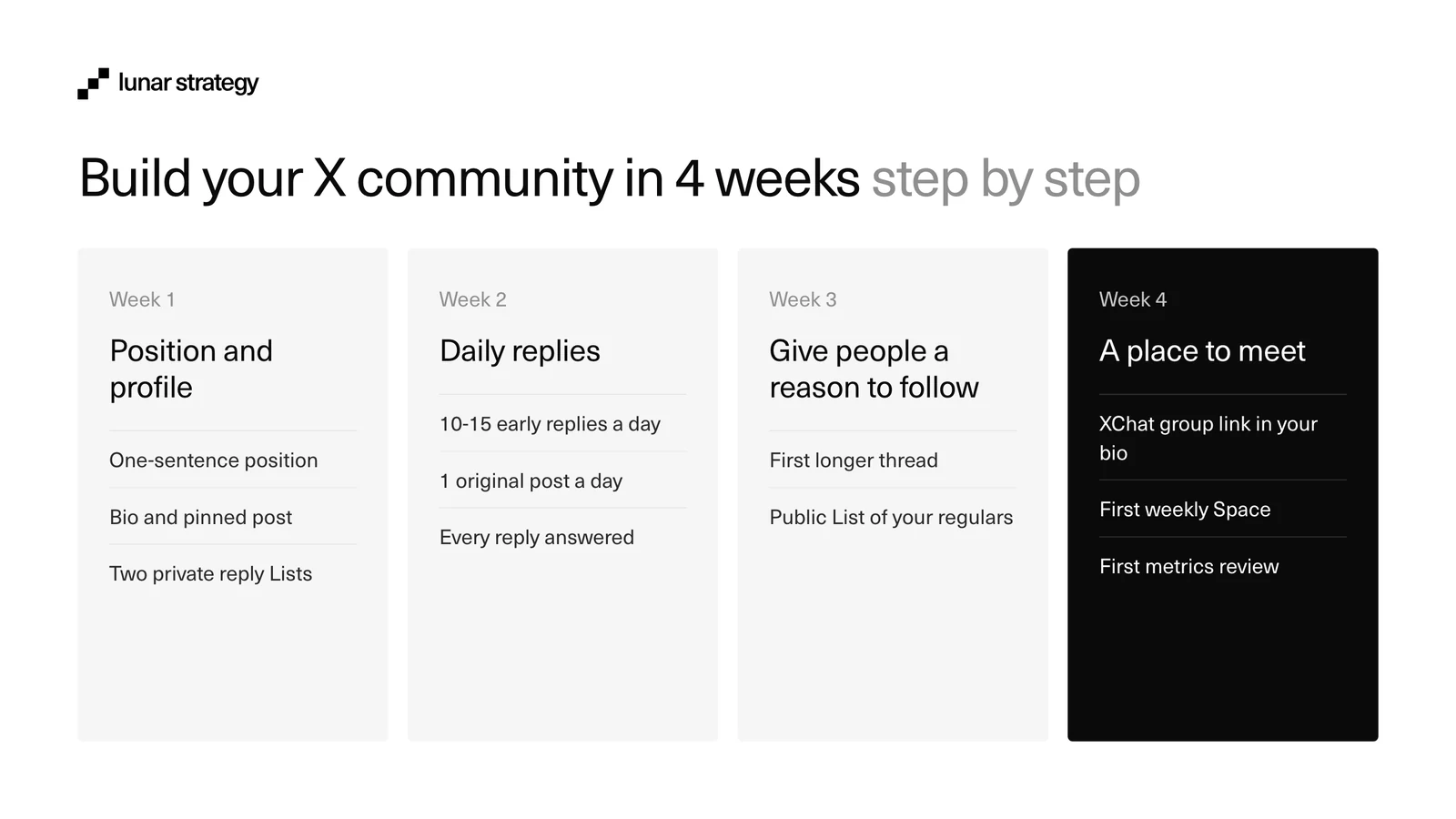
A 4-week checklist to keep you honest:
- Week 1: position sentence, bio, pinned post, two private Lists.
- Week 2: 10-15 replies a day, 1 original post a day, every reply answered.
- Week 3: first longer thread, first public List of regulars.
- Week 4: XChat group link in bio, first Space, first metrics review.
If you run a project, do this on the founder's account as well as the brand's. People talk to people first, and a founder who replies builds the mutual network the brand account then benefits from. Our step-by-step playbook for growing a crypto project on X covers the brand side in more depth.
How Lunar Strategy approaches community on X
We treat X as the front door of a community and the account as its center. For MultiversX, we had two or three tier-1 KOLs (key opinion leaders: established voices whose posts move an audience) publish original content and smaller creators quote it, which reached 276,194 impressions and 4,114 engagements.
Our community team runs the other half: moderation around the clock on Telegram and Discord, so the people you bring in from X land somewhere safe and active. If you want a plan for your project's X presence and the community behind it, start here:
Strategy, X growth and 24/7 moderation for crypto projects.
FAQ
Are X Communities shutting down?
X announced in April 2026 that it would retire Communities, first by May 6 and then by May 30. As of November 6, 2026, existing Communities still run and show new posts, but nobody can create a new one, and X hasn't published a new date. Treat them as a feature that can disappear at any time.
Can you still join or post in an X Community?
Yes. Existing Communities still accept members and posts, and you need a public account to join. Posts you make there are visible to members and your followers, and they stay on your profile if the Community is deleted. They are less likely to be recommended to new people than a normal post on your timeline.
What is a "reply guy" on X?
A reply guy is an account that grows mainly by replying under bigger accounts' posts. Done well, it's the fastest way for a small account to be discovered, because good replies borrow an existing audience. Done badly, with generic or automated replies, it gets accounts muted and reported, and those reactions weigh heavily against every post you make.
Do you need X Premium to grow a community on X?
No. We found no Premium or verified multiplier in the scorers of X's published For You code. Premium can still be worth it for its extra features, but it won't make up for a weak position. A clear position, early replies and regular conversation do far more for a small account than the badge.
Are X Lists public, and do people know they're on one?
Lists are public by default, and anyone can follow a public List; you can switch one to private when you create it. Members can see the public Lists they've been added to from their own Lists page. A public List of your most engaged followers works as a thank-you and as a directory newcomers can follow.
How do you know when X changes its algorithm?
X announces changes on its @XOpenSource account and in the "Notable Updates" log of its GitHub repository. It says scripts copy production values into the published code, and that it aims to show any experiment running on 10% or more of traffic there. The like weight, for example, moved from 0.66 to 0.708 on November 5, 2026.