




























TL;DR:
- X publishes the code behind its For You feed, and the X algorithm works by predicting how each person will react to your post. Each likely reaction gets a weight, and the total decides if and where your post appears in that person's feed.
- A like is worth very little in that math: a copied link or a reply from someone you follow back counts about 30 times more, and a predicted report counts about 355 times against you. Engagement from people who open your post through a group chat link is ignored by the ranking, which is why Telegram raids barely move reach.
- What works: post originals when you want new people, be online to reply in the first 2 hours, and write posts people want to quote, send in a DM or paste into their own chats. After 48 hours, a post leaves the feed for good.
- Quotes are the lever crypto teams underuse. In a MultiversX campaign, we had 2-3 tier-1 KOLs post original content and smaller creators quote it, which reached 276,194 impressions and 4,114 engagements.
- Judge each post by replies, quotes and shares per view in its first 2 hours, and check X's Under the Hood page to see if a label is limiting your account.
In August 2026, X expanded the open-source code of its For You feed to include the weights it uses to rank posts, and it has updated that code many times since. For the first time, anyone can read exactly how much a reply, a repost or a report is worth, how long a post stays eligible, and which accounts get a head start. The answers are specific: 48 hours of life per post, a 2-hour test window for smaller accounts, and a handful of reactions that matter far more than likes.
Crypto marketing still leans on Telegram raids, requests for likes and bookmarks, and cheat sheets built on Twitter's 2023 code, whose numbers no longer apply. The 2026 code rewards conversation, shareable information and original posts, and it quietly ignores most of the engagement crypto marketing is built to manufacture.
This guide is for founders, marketing leads and community managers who post for a crypto project. It explains the algorithm from X's own code, then turns each rule into a posting decision. We start with how the feed is built.
How the X algorithm works: it predicts each viewer's reactions
The X algorithm is the system that picks and orders posts in the For You feed. For every post and every viewer, a model called Phoenix predicts how likely that person is to like, reply, repost, share, mute, block or report it, multiplies each probability by a fixed weight, and adds the results into a single score.
X described Phoenix as running on the same transformer architecture as xAI's Grok when it first released the code in January 2026. The model reads the viewer's recent activity, so the same post gets a different score for every person who might see it. A trader who replies to market takes all day gets a high predicted reply rate on yours; a lurker who only scrolls gets a low one. Your post ends up with millions of scores, one per viewer.
That history is how the feed learns taste. Someone who keeps replying to DeFi yield breakdowns and taps "not interested" on memecoin calls will see the model raise its predictions for the first kind of post and cut them for the second, from any account.
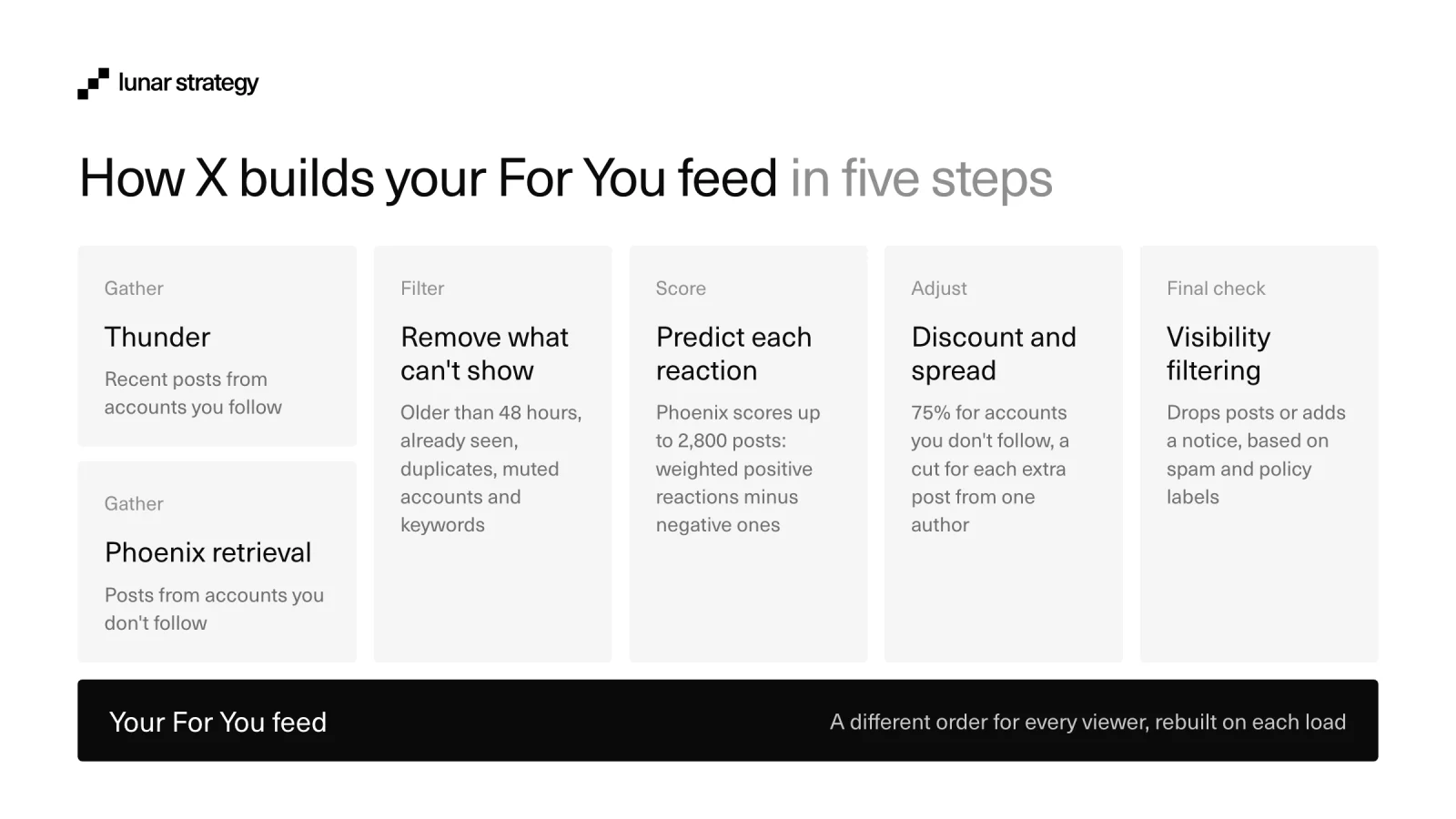
Every feed load then runs the same path:
- Gather: Thunder pulls recent posts from accounts the viewer follows (in-network, in X's terms), while Phoenix retrieval and SimClusters find posts from accounts they don't follow (out-of-network).
- Filter: X drops duplicates, posts older than 48 hours, the viewer's own posts, posts already seen, posts from muted or blocked accounts, posts matching muted keywords and subscriber-only posts the viewer can't open.
- Predict and score: Phoenix scores at most 2,800 remaining candidates, adding up the weighted positive reactions and subtracting the negative ones.
- Adjust: posts from accounts the viewer doesn't follow are discounted, and each extra post from the same author is cut.
- Final check: visibility filtering can still drop a post or show it behind a notice, based on labels for spam, violence and other policy issues.
"the X algo predicts how each person will react to your post, and that then decides if and where it shows up in their feed"
Shann Holmberg, Lunar Strategy, on X, October 2026
So the real question is: Which reactions will this post make people likely to have?
A copied link is worth 30 likes, and a bookmark is worth nothing
The weights live in one file of X's code, and they are blunt about what matters. Here is what each reaction counts for compared with a like, in the version published on November 3, 2026:
| Reaction | Weight in X's code | Compared with a like | What it means for crypto posts |
|---|---|---|---|
| Someone copies the link | 20 | 30x | Posts people paste into Telegram or Discord: data, charts, a clear explainer |
| Someone you follow back replies | 5 + 15 | 30x | Conversations with partners, builders and investors who follow you |
| Reply | 5 | 7.6x | Takes and questions people want to answer |
| Quote | 5 | 7.6x | Posts other accounts want to add their view to |
| Share by DM | 5 | 7.6x | Alpha people send to one friend |
| Follow from the post | 4 | 6x | A reason to want your next post |
| Share (other) | 2 | 3x | Shares outside DMs and copied links |
| Repost | 1 | 1.5x | Useful, but cheap |
| Like | 0.66 | 1x | The baseline |
| Opens a link | 0.2 | 0.3x | A click away from X earns little |
| Profile click, video view | 0 | 0 | Predicted, but switched off in ranking for now |
| Bookmark | Not scored | 0 | "Save this thread" adds nothing to ranking |
| Scrolls past without stopping | -0.02 | Small minus | Off-topic posts cost a little with every viewer who skips them |
Source: home-mixer/params/param.rs, xai-org/x-algorithm, checked November 3, 2026. Ratios are rounded.
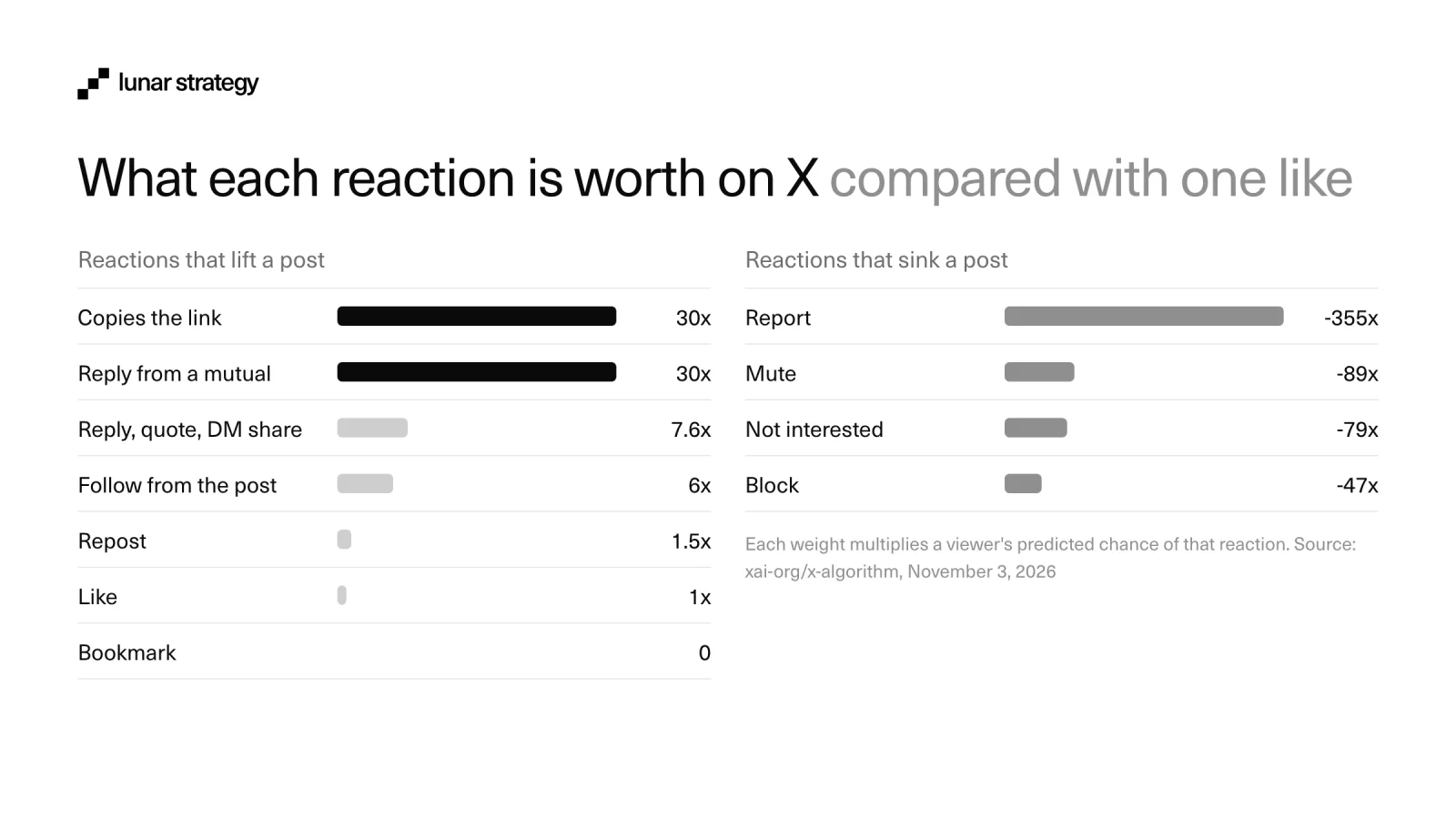
The copy-link weight is the most useful number on the list for crypto. Crypto X runs on screenshots and links dropped into group chats, so a post that someone wants to paste somewhere else (a contract explainer, a clean chart, a list of upcoming unlocks) earns the single highest positive weight in the model. Posts built only to be liked, such as "gm" or a meme with no point, compete for the weakest one.
The reply bonus for mutual follows is newer. X's own documentation in the repository says it tested the boost at values from 5 to 20 in July 2026, rolled out 20, then settled on 15 after feedback that people were seeing too little discussion of the World Cup. So a reply from someone you follow back now counts 20 instead of 5, which turns the accounts you follow into part of your distribution.
One caution X adds itself: these weights multiply predicted probabilities. They show which reactions the model values when it guesses what a given person will do, so they can't be read as an exchange rate between raw counts.
Negative reactions outweigh everything, and crypto habits invite them
Negative weights are far larger than positive ones. A predicted report counts -234, about 355 times a like, a mute -58.8 (89x), "not interested" -52.3 (79x) and a block -31.2 (47x). X explains the size in a comment in the code: a report is more than 1,000 times less likely than a like, so it needs a big weight for the prediction to affect the ranking at all.
In practice, the danger comes from patterns. The model learns, from millions of users' behavior, which kinds of posts people tend to mute, and it lowers your post for every viewer who resembles them. X also says this makes brigades weak: mass reports from bad actors mostly change what similar accounts see.
Rage bait is where this hurts crypto accounts most. A "this chain is dead" take or a dunk on a rival project can pull millions of views, and it also teaches the model that people like your audience block, mute and report you. The cost then reaches the account itself: one of X's labeling systems, Agatha, scores accounts on the blocks, reports and spam reports their posts draw compared with their likes, and those labels feed visibility filtering. One viral fight can make every later post start lower.
Across the crypto accounts we've managed, the habits that invite mutes are familiar ones:
| Habit | Reaction it invites | Better version |
|---|---|---|
| Tagging large accounts on announcements | Mute, block | Reply to their relevant post with something they'd want to quote |
| "gm", "wen" and emoji-only replies at scale | Not interested, mute | Fewer replies, each one adding a fact or a view |
| Contract addresses posted under unrelated posts | Report, block | Put the address in your own pinned post |
| "Like, repost, tag 3 friends" giveaways | Not interested | A reward for a reply that answers a real question |
| Five announcements in an hour | Mute | One original, then replies in its thread |
There is also a harder limit. If X labels a post low quality or misinformation, visibility filtering can show it behind a notice and turn off likes, replies and reposts on it. You can see whether this has happened through X's Under the Hood page, a pilot that is open to accounts at least a year old that posted 10 or more times in the past month. Check it before blaming the algorithm for a quiet month.
Raids and group-chat engagement don't move the ranking
The most expensive habit in crypto marketing is the raid: a Telegram or Discord group gets a link and floods the post with likes and replies. X's code says this adds nothing to how the model ranks you, because it only learns from engagement on posts it served in the Home feed:
"Directly navigating to a post (i.e., coordinating via groupchat) has no ranking impact."
X, comment in the For You ranking code (param.rs), 2026
A raid makes the numbers under a post look bigger, and visible numbers can still nudge a real reader. But the ranking itself treats a reply from someone who arrived through a Telegram link as if it never happened, and raid accounts that react to everything train the model to expect little from them. The same goes for paid engagement groups and most "engage-to-earn" campaigns that send people to a URL.
Automated engagement carries a second risk. X's bot model, BDSM, reads each account's stream of actions, including the timing between them, and has separate detectors for like bots, reply spam bots, repost bots, follow bots and "engagement amplifiers" (bdsm/README.md). The published pipeline includes enforcement steps that range from a captcha challenge to suspension for reply spam, with the real thresholds redacted. Copy-paste replies from a farm of accounts are the exact pattern it was trained to catch.
The useful raid is a follow. When your community follows the project account, your posts enter their feeds through Thunder, and everything they do there counts. The community manager's job becomes making sure holders follow the project and see it in their feed, then giving them posts worth reacting to. The same logic applies to KOL campaigns: engagement counts when a creator's audience finds the quote in its own Home feed, so that is where a KOL brief should aim.
The first 2 hours decide whether a smaller account's post travels
X gives new posts from smaller accounts a test slot, and the rules are specific. If your account has 50,000 followers or fewer, an original post (not a reply or repost) can be lifted to about 16th place in someone's feed, but only during its first 2 hours and only until it has 200 views in the Home feed. Each time a feed loads, X lifts at most one such post.
| Rule | Number in X's code | What to do |
|---|---|---|
| Who gets the test slot | 50,000 followers or fewer | Founder and project accounts below the line should post originals |
| How long it lasts | First 2 hours | Post when the team can reply for 2 hours |
| When it stops | 200 Home views | The first viewers decide; make the opening line count |
| How X picks | Likes per Home view, with some randomness | A post that starts strong wins the slot more often |
| Where it lands | About 16th place | Enough to reach people who don't follow you |
| When a post expires | 48 hours | Don't schedule key news for a dead window, and don't expect a late revival |
Source: cold-start and age-filter settings in param.rs and the README of xai-org/x-algorithm, checked November 3, 2026.
The selection uses a method called Thompson sampling: among eligible new posts, X samples each one's like rate from its first Home viewers, keeps the two that look best, then shows the one with the higher model score. In plain terms, the test favors posts whose first audience reacts, so a weak first line wastes the only boost a small account gets.
For a project before its token launch (TGE), this is most of the game. Most of your reach to strangers will come from originals that win this window. Post when your team is online, reply to every early comment, and publish the thread or the announcement when your audience is awake, even if it's ready earlier.
We've measured this on our own accounts. Kleanthi, from the Lunar team, went through 170 posts from three accounts we run (Lunar Strategy, our creator platform Creator Wire, and Turtle). On Creator Wire and Turtle, the big hits had a median of 25-30 quotes, against 0-3 for normal posts (our breakdown on X, October 2026). The best was the Creator Wire app launch, with 282,600 views from an account of 6,800 followers, 41 times its usual. Tim Haldorsson, Lunar's founder, quoted it after 4 minutes, the team within 20 and Turtle at 22 with its own news. We now plan the first hour of every big post that way.
Originals find new people; replies and reposts keep the ones you have
X treats your formats differently depending on who is looking. An original post can reach people who don't follow you, scored at 75% of its value for them. Your replies and reposts can't: a filter removes them from the feed of anyone who doesn't follow you, and even for followers they are scored at 75%.
That split gives each format a job. Originals are how a crypto project meets new traders, builders and investors. Replies are how it deepens relationships with people already in its orbit, and with the mutual-follow bonus, a reply to an ecosystem partner who follows you back is one of the strongest signals you can earn. Reposts mostly serve your existing followers, which suits a partner's announcement. In the same review of our accounts, using a quote of someone else's post as the main post cost the Lunar Strategy account 47% of its usual views.
Followers still matter in this system. A follower gets your originals through Thunder at full score, a non-follower at 75%, and a follow earned from a post is worth 6 likes. Keeping them takes a steady topic: the model predicts each follower's reactions from what they engaged with before, so a DeFi account that drifts into memecoin jokes and politics trains its own followers to scroll past, and those skipped posts lower its predictions with them too.
Posting volume has its own limit. When several of your posts compete for one person's feed, X keeps the first at full score and cuts each one after it:
- 1st post: 100% of its score
- 2nd post: 62.5%
- 3rd post: 43.75%
- 4th post: about 34%
- Every post after: never below 25%
So five posts in an hour mostly compete with each other. Your own reposts count too: the code files a repost under the account that reposted it, so ten partner reposts right after your announcement push the announcement down your followers' feeds. Space originals out across the day, put follow-ups in the thread of the first post, and let the team's personal accounts carry part of the conversation. X ranks authors separately, so a founder's original about the same launch doesn't take the cut.
What crypto projects should post on X
The weights point to a short list of post types, each built to earn a specific high-value reaction. Each one is a post people already like receiving.
| Post type | Reaction it earns | Weight vs a like | Crypto example |
|---|---|---|---|
| Data post or chart | Copied link, DM share | 30x, 7.6x | Weekly protocol metrics in one clean image |
| Clear explainer | Copied link, follow | 30x, 6x | "How our points convert to tokens, in 6 lines" |
| Strong take | Reply, quote | 7.6x | A view on a sector narrative, with the reason behind it |
| Real question to your audience | Reply | 7.6x (30x from mutuals) | "Which chain should we deploy on next, and why?" |
| KOL original plus quotes | Quote, follow | 7.6x, 6x | Tier-1 creator posts, smaller creators quote with their angle |
| Long post people finish | Time spent | Rising in recent updates | A thread or article on how the product works |
The last row reflects where X is heading. In October 2026, X said its ranking model now predicts time spent much better and that retrieval is trained to surface posts people read all the way through. A dense, well-structured thread that holds attention is a better bet than a punchline that gets a like and a scroll.
The KOL row is where we've seen the clearest results. For MultiversX, we curated a KOL list and a narrative for a brand-awareness campaign, activated 2-3 tier-1 KOLs for original content, and had smaller creators quote those posts. The campaign reached 276,194 impressions and 4,114 engagements (Lunar Strategy, 2025). Read through the code, the structure makes sense: originals from large accounts get out-of-network reach, and each quote is a high-weight reaction that puts the post in a new audience's feed.
Choosing who quotes matters as much as how many. Our guide on what a KOL is in crypto covers how to pick creators whose followers actually trade, and the KOL brief template shows how to ask creators for original posts and quotes.
What the 2026 code does not support
A lot of X advice in circulation predates the current code, or reads more into it than it says. These are the claims crypto teams repeat most often, checked against the November 2026 version:
| Common claim | What the published code shows |
|---|---|
| "A reply the author engages with is worth 75x" | That was Twitter's 2023 ranking model (reply 13.5, author-engaged reply 75, like 0.5). The 2026 weights are reply 5, mutual-follow reply 20, like 0.66 |
| "One report cancels hundreds of likes" | X calls this a misreading: weights apply to predicted probabilities |
| "Links in the main post cut reach by 50-90%" | No fixed link penalty in the weights. Whether a post has a link is passed to the reranking service as a feature, so its effect isn't spelled out |
| "Premium accounts get a ranking boost" | We found no Premium or verified multiplier in the published For You scoring code. Premium can still matter on surfaces this code doesn't cover |
| "Bookmarks boost reach" | Bookmarks are not one of the reactions the model predicts |
| "Mass reports can kill any account" | X says reports from bad actors mostly affect feeds of similar users, and only reports on posts served in Home count |
| "Using several hashtags gets a post filtered as spam" | We found no hashtag rule in the published For You code. Spam detection there works on account behavior, and X keeps some spam rules private |
The repository also has limits. X keeps some spam rules and the prompts of its Grok-based labeling private to stop people from gaming them, and a separate reranking service reorders the final list. Treat the code as the rules of the game; the result still depends on the posts.
How Lunar Strategy approaches X for crypto projects
Lunar Strategy runs X for crypto projects as part of its crypto social media marketing service: strategic account management, content and real-time engagement for pre-launch projects, post-TGE protocols, L1s and L2s, DeFi and AI x crypto teams. After working with more than 300 crypto projects, the approach we use matches what the code rewards: originals with a reason to be shared, a team that's present in the first hours, and conversation with the accounts that matter to the project.
When a project needs reach beyond its own followers, we pair that with influencer strategy: curated KOLs posting originals, smaller creators quoting them, and a narrative that gives each of them something to say, as in the MultiversX campaign. Community work through our community management team then makes sure holders follow and engage through their own feeds.
A 30-minute call to review your accounts and the posting plan we'd run first.
FAQ
Is the X algorithm open source?
Yes. X published the code for its For You feed on GitHub in January 2026 under the Apache 2.0 license, and expanded it in August 2026 with the ranking weights, filters and labeling systems. It's updated often, with dated change notes in the repository. Some spam rules and the prompts of its Grok-based labeling stay private to stop people from gaming them.
What is the difference between For You and Following on X?
Following shows only posts from accounts you follow. For You mixes followed accounts with posts from accounts you don't follow, ranked by the algorithm described in this guide. Most reach to new audiences comes from For You, which is why original posts matter for growth.
How often does X change its algorithm?
Often. The repository lists notable updates on August 13 and 14, September 18, October 8, October 13 and October 26, 2026, and the code is pushed several times a week. Weights like the mutual-follow reply boost have changed within days during tests, so recheck the numbers before building a strategy on one of them.
Does X use Grok to rank posts?
The ranking model, Phoenix, uses the same transformer architecture as xAI's Grok, according to X. Phoenix predicts how likely each viewer is to take each action on a post. Separately, X uses Grok-based systems to label posts that may break its rules, and those labels feed visibility filtering.
Is shadowbanning on X real?
X doesn't use the term, but its visibility filtering can drop a post from For You or show it behind a notice, based on labels attached to the post or account. The Under the Hood page shows aggregate statistics on those labels for eligible accounts, including whether a post was withheld in a country after a legal demand.
Do the same weights apply to every user?
Everyone gets the same weights and a personal score. Each weight multiplies a prediction made from that viewer's own history, so a post can rank high for an active trader and low for a casual reader. X also runs experiments where groups of users get different values, as it did with the mutual-follow boost in July 2026.