




























Key Takeaways
- A crypto PR agency secures earned media in crypto-native outlets like CoinDesk, The Block, and Decrypt. This is editorial coverage selected by a journalist, not bought through paid placements or sponsored content.
- Over 20,000 blockchain projects compete for investor attention in 2026; fewer than 5% achieve meaningful visibility in Tier 1 media. A specialist agency with direct journalist relationships is the primary lever.
- Monthly retainers at legitimate crypto PR agencies range from $5,000 to $50,000+. Project-based TGE campaigns run $15,000 to $120,000. Below $3,000/month you are paying for wire distribution, not media relationships.
- The defining capability is journalist network depth: named relationships with reporters at CoinDesk, The Block, and Decrypt who understand tokenomics, DeFi mechanics, and regulatory context. General PR firms do not have this.
- A crypto PR agency is not a substitute for a Web3 marketing agency. PR owns earned media and narrative. Marketing owns paid, community, KOL, and owned channels. The two functions are complementary.
What does a crypto PR agency do?
Fewer than 8% of crypto pitches sent to journalists ever receive a response. That number defines the market structure: the agencies that get placements are the ones with named editorial relationships, not the ones with the longest distribution lists.
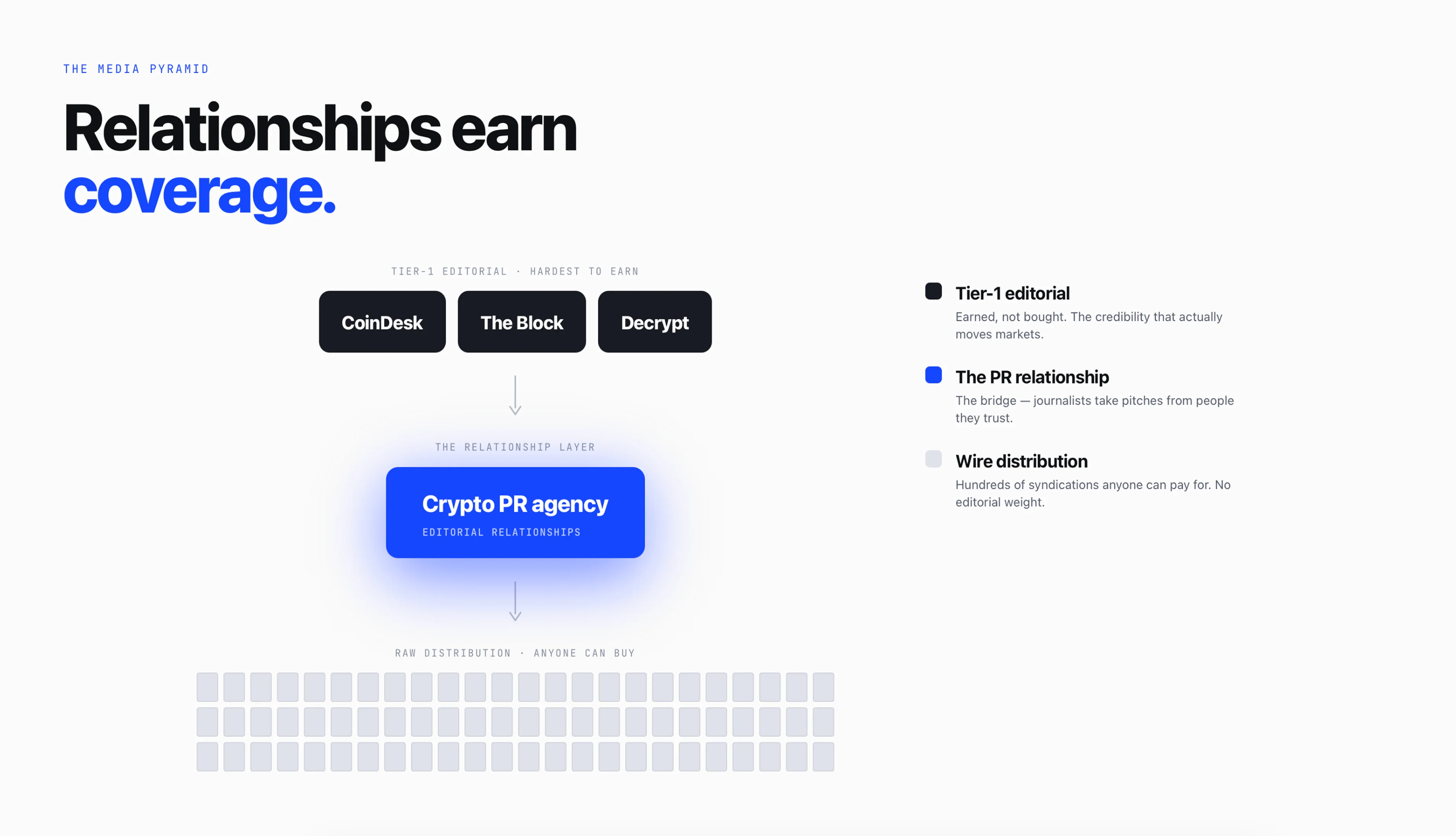
The core deliverable is earned media: editorial coverage placed by a journalist, not bought. Five primary services make up the offering.
1. Media relations and journalist pitching
Identifying reporters at CoinDesk, The Block, Decrypt, Blockworks, Messari, Forbes Crypto, and Bloomberg Crypto who cover the relevant beat, building ongoing relationships with them, and pitching stories that meet editorial criteria. A crypto PR agency knows which reporter at The Block covers Layer 2 infrastructure and which one covers exchange regulation. That specificity is what gets a pitch read.
2. Press release writing and wire distribution
A crypto-native press release is technically literate, regulatory-aware, and structured for the attention economy of crypto newsrooms. Distribution runs through crypto wire services: Chainwire, Web3 News Wire, PR Newswire Crypto, GlobeNewswire. Wire distribution is the floor, not the ceiling.
3. Thought leadership placement
Securing bylined articles and expert commentary for founders and C-suite in Tier 1 and Tier 2 outlets. This positions leadership as credible voices on protocol design, DeFi mechanics, and regulation: the kind of credibility a project website cannot manufacture.
4. Token launch communications
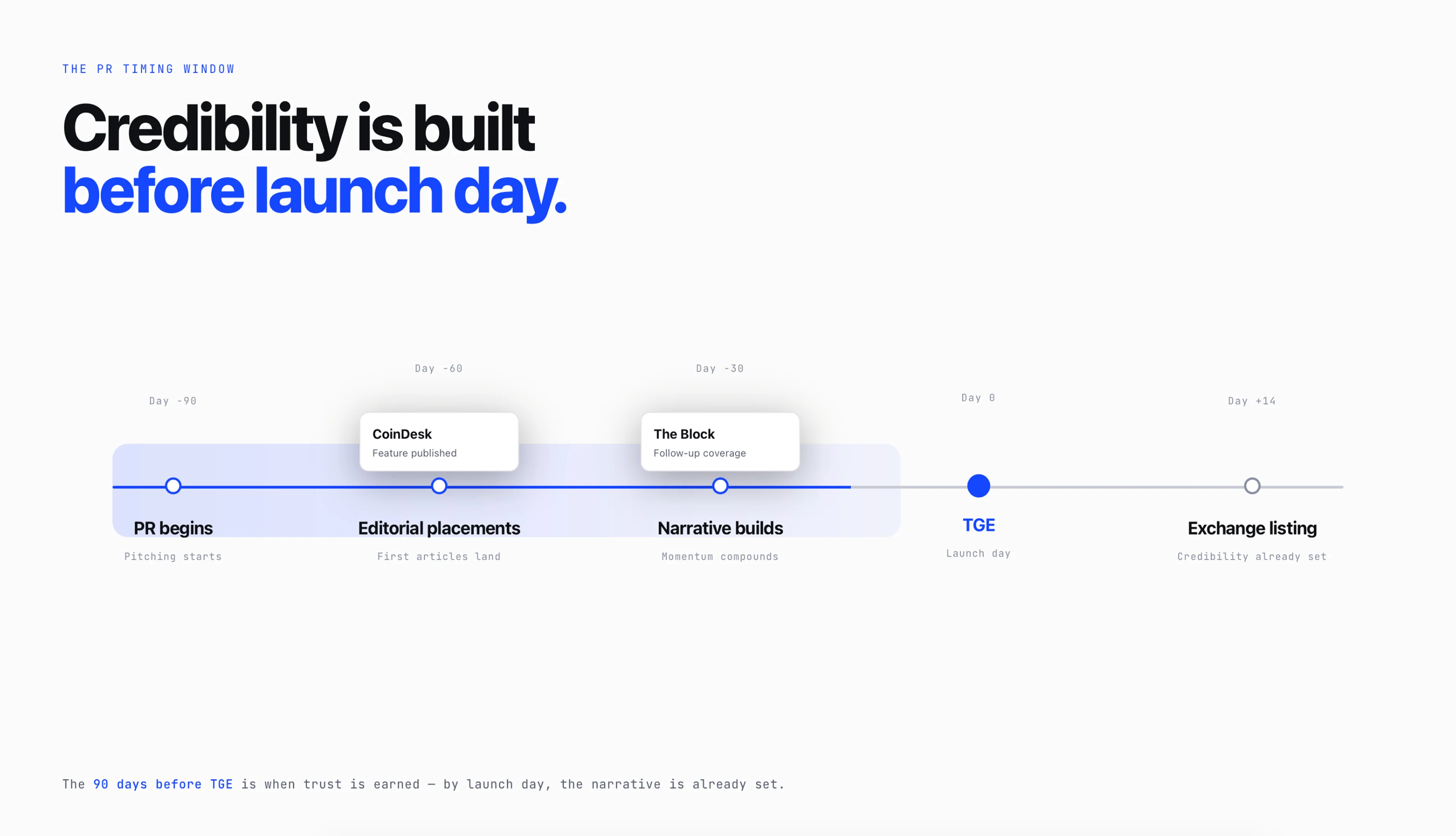
Coordinating press around TGE milestones: pre-launch narrative setting, exchange listing announcements, audit publication, mainnet launch. The timing detail most projects miss: major placements should land 7-10 days before a launch date, not on it. On launch day, editors are already covering the event. Pre-launch coverage shapes the narrative that investors read before they decide. For the full 90-day TGE framework, see the token launch strategy guide.
5. Crisis communications
Managing narrative during exploit disclosures, regulatory inquiries, team departures, or token price controversies. Speed is measured in hours. Only agencies with pre-existing journalist relationships can influence how a story is framed before it publishes; once a reporter files, the window has closed.
A crypto PR agency does not do community management, KOL activation, paid advertising, Discord or Telegram moderation, or crypto SEO. Those are marketing functions. For a full breakdown of the distinction, see our article on what a Web3 marketing agency actually does.
How is a crypto PR agency different from a traditional PR firm?
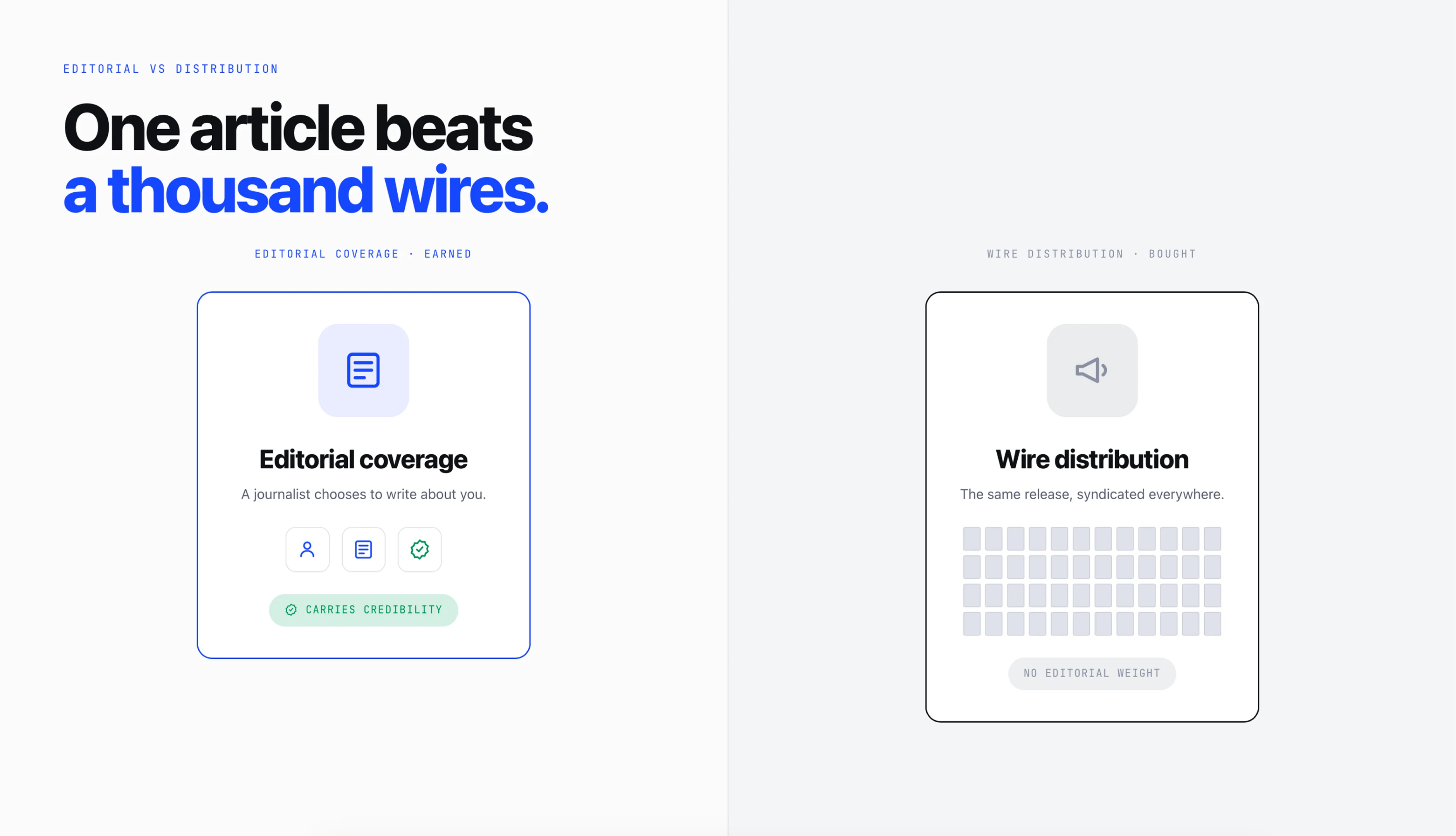
A traditional PR firm cannot get a story placed in CoinDesk. This is an operational fact rooted in what crypto journalism actually requires. The reporters at The Block cover a technically specific beat: tokenomics and token distribution schedules, DeFi protocol mechanics, on-chain data interpretation (TVL, active wallets, volume), regulatory posture across SEC/CFTC/MiCA jurisdictions, and the 24/7 news cycle of crypto markets. A pitch that would work for a TechCrunch reporter fails immediately with a crypto editor who spots a technically inaccurate claim in the second sentence.
Journalist network
A crypto PR agency has built direct relationships with named reporters at crypto-native outlets over years of consistent pitching. A general PR firm has relationships with tech, finance, and business press, none of whom cover Layer 2 scaling solutions as a primary beat. The gap is not about effort; it is about years of accumulated trust with a specific group of editors.
Editorial context
Crypto journalists evaluate pitches with technical fluency. An agency that cannot explain your protocol's consensus mechanism, or gets your tokenomics wrong in the pitch, gets filed in the delete folder before the reporter finishes the first paragraph. An agency without that fluency produces pitches that are immediately disqualified, damaging the project's credibility with the reporters who matter.
Crisis speed
In crypto, an exploit or regulatory action becomes a published story in 2-4 hours. A generalist PR firm operating in a 24-hour response window cannot manage a crypto crisis effectively. The window to shape the narrative closes before a traditional firm has drafted its first response brief.
After DeFi Summer and the 2021 bull cycle, dozens of traditional PR agencies added "Web3" to their homepage without adding the journalist relationships or technical knowledge the service actually requires. The test is simple: ask the agency to name the last five articles they placed in Tier 1 outlets and verify the bylines are editorial, not sponsored. Most agencies claiming crypto credentials do not pass it.
What is the difference between a crypto PR agency and a Web3 marketing agency?
PR and marketing are complementary functions with distinct ownership. Blurring the two is the most common mistake Web3 projects make when building their growth stack, and it is expensive: you end up paying for overlap while leaving gaps in both functions.
The division of ownership is specific:
A full-stack Web3 growth operation needs both. PR builds the credibility layer: the independent editorial record that investors, exchanges, and institutional allocators use to validate a project. Marketing builds the distribution layer: the channels that reach users, community members, and token buyers. For the marketing side of this stack, see our article on what a Web3 marketing agency actually does.
Community management, meaning Discord moderation, Telegram engagement, and community growth programs, sits entirely within the marketing stack. Our community management service covers that function. Similarly, coordinating crypto-native content creators and on-chain influencers is a marketing function covered under KOL marketing, not PR.
When does a Web3 project need a crypto PR agency?
PR is not a day-one expense. Spending on it before you have something genuinely newsworthy is one of the most common budget mistakes in Web3. Three stages define when crypto PR becomes necessary.
Pre-TGE, 3-6 months out
The editorial record that exchanges, VCs, and institutional allocators review when evaluating a project is built in this window, not at launch. An empty Google News footprint is a disqualifier for serious investors. Wire releases alone do not build this record; editorial coverage does. Starting 3-6 months before your TGE gives an agency enough runway to secure the placements that matter.
Exchange listing announcements
Listings on Binance, Coinbase, and OKX generate real editorial interest, but only for the 72-hour window around the announcement. Capturing that window requires an agency that has already pre-briefed the right reporters. Projects without an agency relationship in place typically miss it.
Protocol launches and major upgrades
Mainnet launches, protocol V2 upgrades, major new product lines. These are newsworthy milestones that generate earned media interest. The pitch timing matters: editors need context before an event, not a press release the day it happens. The pre-launch campaign mechanics are covered in our pre-listing crypto investments guide.
When PR is premature
Projects with no testnet, no on-chain activity, and no newsworthy milestone are too early for a PR programme. Journalists will not cover announcements without substance, and a press release with nothing behind it wastes the relationship capital an agency has built. If your product does not exist in a testable form, invest in building it rather than announcing it.
At Lunar Strategy, the majority of TGE clients who come to us without prior Tier 1 media relationships take 8-12 weeks to achieve their first editorial placement. That is the realistic timeline for building the context, credibility, and journalist familiarity that makes a pitch land. Projects that start 90 days before their TGE often run out of runway before the first placement publishes.
How do you evaluate a crypto PR agency?
One test disqualifies most agencies in under five minutes. Ask them to name the last three editorial placements they secured in Tier 1 outlets and provide the article URLs. Then verify three things: is it editorial (no sponsored, partner content, or promoted tag), is the byline a named reporter, and is the publication date within the last six months? Most agencies claiming crypto PR credentials do not survive this test.
A Chainstory study found that more than 62% of crypto press releases across a six-month span in 2025 originated from high-risk or confirmed scam projects. That figure reflects an ecosystem where bulk press release distribution is the norm and editorial credibility is the exception. Asking for verified editorial placements, not distribution coverage reports, filters out the majority of the market quickly.
Red flags that should end the conversation
- Guaranteed placements in specific publications (editorial decisions are made by journalists, not agencies)
- Bulk distribution volume as the primary KPI (the number of sites a press release hits is a vanity metric)
- Inability to name journalist contacts at your target publications
- Open-ended retainers with no defined deliverables
For a full framework on evaluating any crypto marketing partner, see our guide on how to choose a crypto marketing agency.
Frequently Asked Questions
What is a crypto PR agency?
A crypto PR agency is a specialist communications firm that secures earned media coverage for blockchain and Web3 projects. Core services include journalist pitching and media relations, press release writing and wire distribution, thought leadership placement, token launch communications, and crisis management. The defining capability is direct relationships with reporters at crypto-native outlets including CoinDesk, The Block, Decrypt, and Blockworks. Fewer than 8% of crypto pitches ever receive a journalist response; agency relationships are the differentiating variable.
How is a crypto PR agency different from a Web3 marketing agency?
A crypto PR agency owns earned media and journalist relationships. A Web3 marketing agency owns paid channels, community management, KOL activation, social media, and SEO. The two functions are complementary: PR builds the independent editorial credibility that marketing cannot manufacture, while marketing builds the distribution channels that PR does not manage. Most projects at the growth stage need both.
How much does a crypto PR agency cost per month?
Monthly retainers at legitimate crypto PR agencies run $5,000-$50,000+ depending on tier, scope, and market focus. Entry-level retainers ($3,000-$8,000) cover wire distribution and occasional Tier 2-3 placements. Mid-tier retainers ($8,000-$20,000) include direct journalist pitching and 2-3 Tier 1-2 placements per month. Full-service programmes ($20,000-$50,000+) cover comprehensive narrative strategy, 4-6+ Tier 1 placements per quarter, and crisis standby. Project-based TGE campaigns run $15,000-$120,000.
Do I need a crypto PR agency for a token launch?
A crypto PR agency is most valuable in the 3-6 months before a TGE, the window when the editorial record that VCs, exchanges, and institutional allocators review is being built. Wire distribution alone generates Google News coverage but rarely editorial coverage in Tier 1 outlets. For the full pre-TGE marketing framework, see our token launch strategy guide.
Can a traditional PR firm handle crypto PR?
In most cases, no. Crypto journalists at CoinDesk, The Block, and Decrypt cover a technically specific beat and evaluate pitches accordingly. A traditional PR firm without direct relationships with named crypto reporters and the technical fluency to explain protocol architecture will not get placements in Tier 1 crypto media, regardless of its broader media relationships. The test: ask the firm to name the last three editorial placements it secured in crypto Tier 1 outlets and verify the bylines are not sponsored content.
Conclusion
A crypto PR agency is a specialist service. It is not a rebrand of traditional PR, and it is not a component of a general Web3 marketing retainer. The core product is journalist relationships and the earned editorial coverage those relationships produce. Distribution volume, press release count, and media mention tallies are not substitutes for that.
For Web3 projects approaching a TGE, seeking exchange listings, or building the institutional credibility layer that serious investors require, crypto PR is necessary infrastructure. For projects without a newsworthy milestone or on-chain substance, it is premature. Spending on it before you are ready is one of the most common avoidable mistakes in the space.
Lunar Strategy has run PR campaigns for Polkadot, Cardano, ICP, and OKX. If you want an honest assessment of whether a crypto PR programme fits your current stage and what it would realistically deliver, talk to the team.
See our PR service page for a full breakdown of what we cover, or book a free consultation here.