



























TL;DR:
- An airdrop gives free tokens to a project's early users, usually in the hope of turning them into a lasting community. It is really a user acquisition budget paid in your own token, and it deserves the same scrutiny as any other spend.
- Most of that budget buys sellers. Across the largest airdrops, 78% to 94% of recipient wallets had sold most of their tokens by day 90, and organized farms now run thousands of wallets to collect as much of each drop as they can.
- The cause is the rules, not the users: people do exactly what the rules pay for. So decide whether you need an airdrop at all, then design it in five steps: who qualifies, what you pay for, how tokens unlock, what happens at the claim and the first 90 days.
- The airdrops everyone holds up as wins had something else doing the work. Hyperliquid had revenue funding token buybacks, and Jito kept its list of recipients small enough that mass farming didn't pay.
- Plan it about 120 days before launch and judge the result by retained users, not claimed wallets: how many recipients still use the product at day 30 and day 90, and what each of them cost you.
Free tokens have become one of the most expensive ways to find users. In its June 2026 State of Token Markets report, the research firm Delphi Digital found that across the largest airdrops, between 78% and 94% of recipient wallets had sold most of their allocation within 90 days. Delphi's own summary was blunt: giving tokens away to build a holder base "has mostly created sellers."
That doesn't mean airdrops can't work. It means the design decides the outcome. The rules you publish tell people what to do to qualify, and most of them will do exactly that and nothing more. This guide is for founders and growth leads planning a token launch or a points season. It covers the types of airdrop, how farmers work and how to filter them, the five design decisions that shape who stays, a 120-day plan and how to measure the result. It starts with what you're actually buying.
Airdrop marketing is paying for users with your own token
Airdrop marketing is the work of deciding who receives free tokens, for which behavior, on what unlock terms, and what those people do after they claim. Done well, an airdrop rewards the users you want more of and leads them back into the product. Done badly, it pays strangers to show up once and sell.
Thinking of it as a budget changes the first question. Instead of asking how many tokens to give away, ask what those tokens should buy: attention around launch, usage that turns into a habit, ownership spread across many independent holders, or liquidity you would otherwise pay incentive programs or market makers to provide. Teams that never pick one end up paying for whatever was easiest to count, usually transactions, and then wonder why the users vanish. The community share also has to fit next to team and investor allocations, which our guide to tokenomics for founders covers.
The goal then points to a type of airdrop. Most fall into one of five, and each one buys something different:
| Type | How it works | Best for | Main risk |
|---|---|---|---|
| Retroactive | Rewards people who used the product before a snapshot nobody announced. Uniswap's 2020 drop is the classic case | A product that already has real users | Pays for the past; nothing asks recipients to stay |
| Points season | Users earn points for actions you choose, then points convert into tokens. Hyperliquid paid out points weekly for about a year before its November 2024 airdrop | Building usage before the token exists | Farmers learn the formula and optimize for it |
| Quest campaign | Users complete set tasks on a quest platform to qualify | Awareness and first visits | Cheapest to fake, especially social tasks |
| Cross-community | Tokens go to active users of other ecosystems. Monad's 2025 drop reached about 225,000 users outside its own community | Bringing proven crypto users to a new chain or app | Recipients have no tie to you yet |
| Contributor drop | A small allocation for builders, community members and power users, checked by hand | Rewarding the people who already carry the project | Small reach, little announcement value |
Most launches combine two of these. What matters is that each one sets an expectation, and the people it attracts will behave according to the rules you chose.
Your eligibility rules decide who shows up
Once a project hints at a token, every action it might reward gets a price. Farmers, people who use a product only to qualify for tokens, read the rules closely and do the cheapest version of what they ask. Today that is an industry. Cointelegraph Magazine reported in July 2025 on a farm in Vietnam running at least 30,000 smartphones, with master phones controlling hundreds of others. In November 2025, a single entity claimed about 60% of the aPriori airdrop through 14,000 linked wallets, each funded from Binance with 0.001 BNB (Cointelegraph).
None of that is cheating the rules. It is following them at scale. The defense is a sybil filter: a sybil attack is one person posing as many users to collect more than their share. Before its airdrop, Linea worked with the analytics firm Nansen and initially flagged 516,960 of 1,297,203 eligible addresses, about 40%, as sybils, then let flagged users appeal (The Block). No single check catches everything, so the projects that hold up layer four kinds:
- Wallet clustering: group wallets funded from the same source, moving in lockstep or repeating the same tiny transactions. This is what caught the aPriori farm.
- Time and thresholds: require activity spread over weeks, plus a minimum score. Treehouse required a minimum of 100 points and screened for wallet clustering and transaction loops; Linea's final rules added boosts for "sustained activity" (The Block).
- Proof of personhood: ask for a credential that is cheap for one real person and expensive for a farm. Gitcoin Passport, now Human Passport, scores wallets on stamps a person collects, and World ID proves someone is a unique human. Linea combined proof of humanity with minimum thresholds.
- Self-report and appeals: let farmers confess and let real users contest mistakes. In 2024, LayerZero offered sybils 15% of their allocation if they self-reported within 14 days, and paid bounty hunters 10% of any sybil they exposed.
Filters protect the budget, but they don't fix retention. The users left on the list still qualified by doing whatever you counted, and if you counted transactions or volume, many of them were never planning to stay. Investors who back these launches see the same thing:
"We all know airdrops are broken. Projects spend months attracting farmers who generate artificial activity, only to watch those same farmers dump tokens immediately after TGE."
Haseeb Qureshi, Managing Partner, Dragonfly, in a September 2025 post
Dragonfly invests in tokens, so it has a stake in how launches go, and the selling data backs him up. His conclusion isn't to stop rewarding early users. It is to reward the people likely to hold and keep using the product, and to stop paying for activity that disappears. That starts with knowing when most users decide to leave.
Most users leave at the snapshot, before they claim
The snapshot is the moment a project records which wallets qualify and how much each one gets. For anyone who came for the token, it is the end of the job. After that, extra activity earns nothing, so usage tends to fall right there, often weeks before any token is claimed. A retention plan that starts at the claim page starts after much of the audience has gone.
The pattern shows up in the data. In its December 2025 review of on-chain activity, Cointelegraph Magazine found that several Ethereum layer 2 networks lost usage as airdrop-driven activity cooled, and that Scroll's activity slowed after its October 2024 airdrop. Prices tell the same story. By mid-December 2025, BERA had fallen about 96% from its peak and LINEA about 85%, two of the year's largest drops (Decrypt).
The airdrops people point to as successes don't contradict this. Delphi Digital argues that neither Hyperliquid nor Jito succeeded because of the airdrop itself. In both cases something outside the giveaway carried the weight, and that is the part copycat designs leave out. Lighter, a more recent case, started well, but one good day is not retention:
| Airdrop | What happened | The lesson for your design |
|---|---|---|
| Hyperliquid (November 2024) | Users received 31% of the supply, with nothing set aside for private investors or market makers (Decrypt). Delphi credits more than $1 billion in revenue funding buybacks that absorbed the selling | Plan the demand for your token before you plan how to give it away |
| Jito | Delphi says the group of eligible wallets was small enough to avoid industrial-scale farming | A short list you can check beats a long one you can't |
| Lighter (December 2025) | A day after a $675 million airdrop, about 75% of recipients still held and 7% had bought more, according to on-chain analyst Arndxt (Cointelegraph) | A good first day proves little. Check the same wallets again at day 30 and day 90 |
None of these teams relied on the airdrop alone, so neither should you.
Decide whether you need an airdrop at all
Most teams treat the airdrop as a given and argue only about its size. The better first question is whether free tokens are the right tool for what you want to buy. Qureshi makes a useful distinction in the same post. Airdrops make the most sense when they pay for something measurable, such as deposits, trading volume or liquidity. Broad giveaways for blockchains, infrastructure or consumer apps, where nobody can say which number to pay for, mostly attract farmers.
That is where a points program fits. Points give users a running score for actions you choose, which later converts into tokens. If you need deposits, you can pay points per dollar deposited and per day it stays, and you can see what each point bought. Qureshi also suggests keeping any airdrop that isn't tied to performance small, under 15% of the tokens at launch, and letting proven users buy the rest at better prices in a token sale. Before you commit supply, answer four questions:
- Is there a behavior you'd pay for anyway? Deposits, volume or usage with a value you can estimate without a token.
- Would people come back without a reward? If usage exists only because of points, it ends with them.
- Is there demand to absorb the selling? Revenue, buybacks, real uses for the token and enough liquidity, which a market maker can help provide.
- Can you keep the list small and checkable? Jito's lesson, in one line.
Check the legal side at the same time, because task rules can change it. In the EU, MiCA's offer rules don't apply to crypto-assets offered for free, but an offer stops counting as free if recipients must hand over personal data or the offeror receives any benefit (MiCA, Article 4). In the US, a March 2026 SEC and CFTC interpretation says airdrops of non-security crypto assets need no registration, but not when recipients must buy something or perform tasks after the airdrop is announced (SEC). That describes many points and quest designs, so bring counsel in before you publish the rules.
If most answers are no, use a smaller tool: targeted drops to contributors and power users, or points paid only for measurable value. These rarely make for a big announcement, which is partly why they keep more of the people they reach. If most answers are yes, the design work below is where the money is won or lost.
The Keep Loop: five decisions that decide who stays
Once you decide to go ahead, the design comes down to five choices, made in the order your users will experience them. Each one gets the same three checks: the levers you control, the trap most teams fall into, and the metric that tells you it worked. It is a loop because what you learn about who stayed should shape who qualifies in the next season.
01 · Who qualifies: "Why did I get tokens, and why didn't my friend?"
- Levers: the behavior that counts, the time window, minimums that are easy for a real user but expensive to repeat across many wallets, and the four filters above.
- Trap: counting raw transactions or volume, the cheapest signals to fake.
- Metric: the share of eligible wallets that used the product on more than one day before the snapshot.
02 · What you pay for: "What exactly is being rewarded?"
- Levers: weight rewards toward what you want after launch: positions held over time, return visits on different days, governance votes, referrals who stay active.
- Trap: paying for posts. In January 2026, X changed its rules to ban apps that pay users to post, and Kaito said it would shut down its paid leaderboards.
- Metric: the share of the budget tied to behavior you'd pay for even without a token.
03 · How it unlocks: "Can I sell on day one, and what do I get if I stay?"
- Levers: the claim window, a bonus for claiming later or staking, the share released at claim and what happens to tokens nobody claims (options compared below).
- Trap: locking everything so the chart looks calm. Locked tokens delay selling; they don't create users.
- Metric: tokens sold versus tokens staked or used by recipients in the first 30 days.
04 · The claim moment: "I claimed. Now what?"
- Levers: a claim flow that ends inside your product, a first task that takes minutes, one official claim link repeated everywhere, and plain notes on fees, lockups and excluded countries.
- Trap: a claim page that ends at "Success" with a link to an exchange, or a launch week with no plan against fake claim sites.
- Metric: the share of claimers who take one real product action within 7 days.
05 · The first 90 days: "Why would I come back next week?"
- Levers: product releases timed for the weeks after launch, governance votes that matter, community work that rewards contribution, and a message to quiet recipients when there's real news.
- Trap: going quiet after launch, or teasing the next airdrop and restarting the farming cycle.
- Metric: wallets still active at day 30 and day 90 with no new reward running.
Stage 02 is where most designs go wrong, and where the field is already moving. Our 2025 research on ecosystem growth, drawing on growth leaders across ten networks including Sui, Avalanche and Syscoin, found incentives shifting "from simple airdrops to more sophisticated incentive structures that reward behaviorally aligned actions such as long-term commitment, skill, and governance participation" (Lunar Strategy, 2025). In practice, that means choosing the two or three actions worth paying for before you decide how many wallets to reach.
Stage 03 has more options than most teams use. Projects launching in 2025 tried several, and each one changes who sells and when:
| Unlock design | How it works | Real example |
|---|---|---|
| Everything at claim | The whole allocation is liquid on day one | The default, and the design behind most of the drawdowns above |
| Claim window, unclaimed tokens recycled | A fixed period to claim; what's left goes back to the ecosystem | Monad ran a three-week window, saw 70.4% of MON claimed and reallocated the rest to ecosystem funding |
| Unclaimed tokens burned | Tokens not claimed in time are destroyed | Venice burned about 65% of its community allocation that went unclaimed in 2025 |
| Bonus for claiming later | Recipients who wait get more tokens | Plume offered a 33% boost to claim, or 66% to defer, plus a points multiplier for staking within 72 hours |
| Gradual unlock tied to use | Part unlocks at claim, the rest over weeks of product use | Best fit when you're paying for usage; see the worked example below |
Stage 04 is where launches get hurt in public. On Monad's claim day, scammers bought Telegram ads that showed up inside its official channel and copied the claim portal (Cointelegraph). In April 2025, an attacker used a compromised admin key on ZKsync's airdrop contract to take about $5 million in unclaimed tokens (The Block). Decide early which countries you'll exclude, too: Dragonfly found that 11 of 12 large airdrops it studied used geoblocking (Dragonfly), and users who learn they're excluded on claim day rarely stay friendly.
Where to start: a 120-day airdrop plan
Stages 04 and 05 are the ones teams leave for last, and they need the most lead time. Both have to be planned before the snapshot, not after the claim, because by claim day the farmers have already decided. Work back from your token launch and give each phase a clear output. The calendar below assumes about four months; compress it and you usually cut the sybil work or the retention plan, the two parts that decide the result.
| When | What you decide or build | What you tell the community |
|---|---|---|
| T-120 days | The one-sentence goal, the airdrop type, the four questions, legal review | Nothing about a token yet; keep building usage |
| T-90 days | Eligibility rules, reward weights, filters, unlock design | Publish the behavior that counts and how it will be checked |
| T-60 days | Claim flow, first in-product task, cohort dashboard, official link plan | Explain the unlock terms and why they exist |
| T-30 days | Snapshot, sybil review, appeals process, scam warnings | Eligibility checker, appeal window, the one official claim link |
| Claim day | Live monitoring, support, fake-site takedowns | Claim open, first task, what's coming in the next 30 days |
| T+30 to T+90 | Product releases, governance votes, messages to quiet recipients | Results, next season rules if any, cost per retained user internally |
The snapshot date is your real deadline. The claim date is when the results start arriving. Our 90-day pre-TGE playbook shows how this calendar fits the rest of the launch, and our breakdowns of what a TGE is and how to avoid a flopped TGE cover launch day itself.
Count retained users, not claimed wallets
Claim numbers tell you how many people showed up for free tokens. They say little about whether the airdrop bought users. The numbers that do follow one group, the wallets that received tokens, over time, and separate what they do while a reward is running from what they do without one. Build the dashboard before launch, usually on on-chain data with wallet labels, because you can't rebuild the pre-snapshot baseline afterward:
| Metric | What it tells you |
|---|---|
| Sybil rejection rate | Share of the eligible list removed by filters, and how many appeals succeeded |
| Claim rate | Share of eligible wallets that claimed. A low rate points to a bad list or a hard claim flow |
| Claim to first action | Share of claimers who take one real product action within 7 days |
| Active at day 30 and day 90 | Recipients still using the product with no new reward. This is the core number |
| Sold vs. kept | Whether tokens leave recipient wallets or stay staked or in use |
| Cost per retained user | Value of the tokens allocated, divided by wallets still active at day 90 |
The last line is the one that changes decisions. Take a hypothetical lending app with 40,000 eligible wallets and $2 million in tokens to give away. Version A pays for transaction count and releases everything at claim: 36,000 wallets claim and 1,800 are still lending or borrowing at day 90, about $1,100 per retained user. Version B pays for days with an open position and releases 30% at claim, the rest over 90 days of use: 22,000 claim and 4,400 are still active, about $455 each.
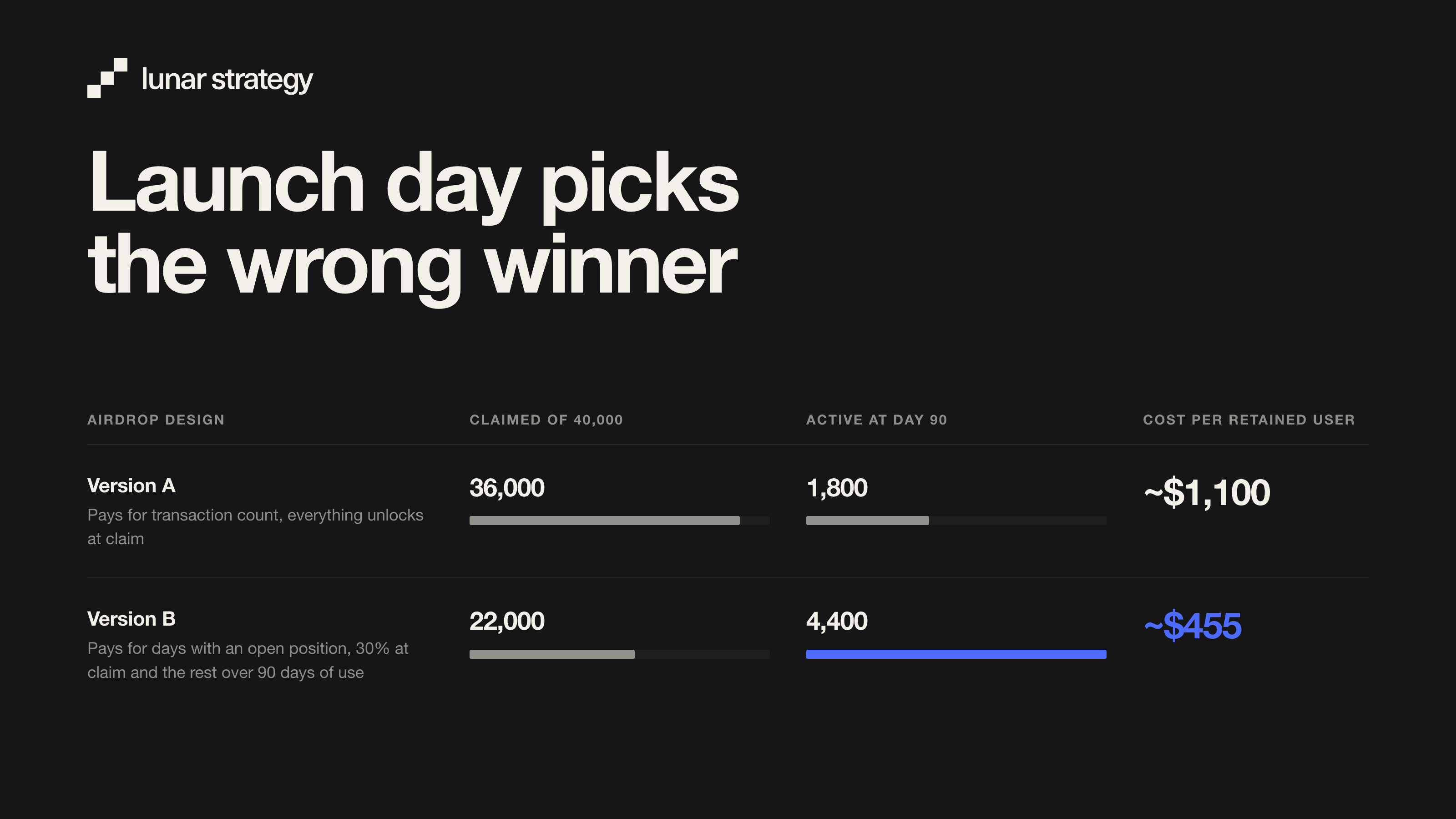
These numbers are made up to show the math, not a benchmark. The point is that Version B looks worse on launch day and better on the only number that lasts. A team that reports claim counts will pick Version A every time, so agree on cost per retained user as the headline before launch.
How Lunar reviews an airdrop before launch
We've worked with more than 300 crypto projects since 2019, and in our go-to-market work the airdrop is reviewed as part of the launch, not as a separate giveaway. The token side of that work includes a points mechanic audit, an airdrop mechanic audit, sell pressure management and buy pressure recommendations. It sits next to the launch narrative, KOL and PR strategy and rollout plan that bring the right people to the product in the first place.
- What we review: your eligibility rules, filters, reward weights, unlock terms and claim flow, against the goal the airdrop is meant to serve.
- What you get: recommendations on each Keep Loop stage and a launch calendar that keeps marketing pushes away from heavy selling windows.
Get your airdrop reviewed with Lunar →
Share your token plan and launch timeline, and we'll tell you which decisions we'd revisit first.
Frequently Asked Questions
What is the biggest crypto airdrop ever?
By dollar value, Uniswap still holds the record. Its 2020 airdrop distributed UNI worth $6.43 billion, according to CoinGecko figures cited by Cointelegraph in December 2025. Rankings move with token prices, so lists that value tokens at their all-time high can order the top ten differently.
How much of the token supply should go to an airdrop?
There is no standard share. Uniswap made 15% of UNI claimable by past users in 2020, while Hyperliquid's community share was about twice that. The better question is what the allocation has to buy and how much selling the market can absorb. A large community share works only when real demand exists to meet it.
How long should an airdrop claim window be?
Long enough for real users to notice, short enough to keep attention. Recent launches ranged from about three weeks at Monad to 90 days at Linea. A shorter window concentrates selling but also news; a longer one spreads both out. Whatever you choose, say up front what happens to unclaimed tokens, and don't leave them in a contract nobody watches.
Should you tell users an airdrop is coming?
Only once you know what you're paying for. A vague hint invites people to guess, and they guess with volume and extra wallets, the activity that's cheapest to fake. When you announce, publish the behavior that counts and how tokens unlock after the claim, so the people who show up are willing to do what you need.
When should you start planning an airdrop?
About four months before the token launches for a full design: a month for the goal and legal review, a month for eligibility and filters, a month for the claim flow and dashboard, and the last month for the snapshot and appeals. Teams that start at the snapshot usually skip the parts that decide retention.
What's the difference between an airdrop and a points program?
An airdrop is the distribution itself: tokens sent or made claimable to a list of wallets. A points program is one way to build that list, by scoring actions over a season before the token exists. Points usually convert into tokens at launch, so the points rules end up deciding who gets the airdrop.