




.png)














TL;DR:
- When someone searches a well-known company, Google often shows a Knowledge Panel, the box beside the results with its description, logo, founders and official links. Google builds it on its own from its Knowledge Graph, a database of facts about people, companies and things, so you can't apply or pay for one.
- The catch is that fame in crypto doesn't earn one. When we searched 10 well-known crypto projects on Google in October 2026, only 2 showed a panel, and names like Aave and Ethena competed with a dialect and an unrelated company for the same search.
- What gets you there is becoming an entity, meaning one distinct thing Google can tell apart from everything else with the same name. You publish one official page with your key facts, label it with Organization and Person structured data, and get independent sources to describe you the same way.
- Those outside sources carry the most weight, because they confirm what your own site claims. A Wikipedia article helps less than you'd expect: Aave, Pump.fun and Chainlink co-founder Sergey Nazarov all have one and showed no panel in our test.
- Once a panel appears, claim it with an official profile such as YouTube, Search Console or X, and add a second owner. Until then, search your project and each founder in a private window every month to see the work land.
Search your project's name on Google. Big brands get a box on the right with their logo, founder and official links. Most crypto projects get a list of links, or an answer about something else. When we searched "Aave" in October 2026, Google's AI Overview opened with a dialect of English before it reached the lending protocol, even though Aave has an official site, a Wikipedia article and years of press coverage. The answer ended by asking which Aave you meant.
That matters because your name is where users check you're real, and where scammers wait. In July 2026, the co-founder of the crypto exchange Coinstash told B&T, an Australian marketing and media trade publication, what happened when ads impersonating the exchange showed up on Google:
"People were reaching out saying they'd seen what looked like Coinstash links and ads on Google, but something felt off."
Mena Theodorou, Co-founder, Coinstash, to B&T, July 2026
A panel won't remove scam ads, but it gives searchers one box that lists your real site and profiles, and Google shows it once it can tell which project and which founders a name refers to. This guide is for crypto founders and marketers who want Google to recognize their project and the people behind it, and it follows the order of the work: what Google is looking for, why most crypto projects fall short, the four layers that fix it and how to claim and correct the panel once it appears.
How to get a Google Knowledge Panel: become an entity Google can't confuse
A Knowledge Panel is created by Google's systems, never by request, so the only way to get one is to become easy to identify. Publish your official facts on one page, label them with Organization structured data and earn independent sources that describe you the same way. Once the panel appears, you can claim it and suggest fixes.
Google's Knowledge Panel Help states that its current policy "doesn't manually create or delete Knowledge Panels", so nobody can sell you a "guaranteed" panel. Two panels matter in crypto: one for the project (an organization) and one for each founder (a person), and founders often get theirs first, as our test below shows. A physical shop or office needs a Google Business Profile instead. Four terms come up throughout this guide:
- Knowledge Panel: the box Google shows "when you search for entities (people, places, organizations, things) that are in the Knowledge Graph," in Google's own definition of knowledge panels.
- Entity: a person, organization or thing that Google understands as one distinct object, not just a string of letters. Aave the protocol and AAVE the dialect are two entities that share a name.
- Knowledge Graph: Google's database of "billions of facts about people, places, and things." Google says those facts come from public sources, licensed data and content owners, and that panels appear when there is enough information on the open web.
- Structured data: code on a web page, usually in a format called JSON-LD, that labels facts like your name, logo and official profiles so search engines don't have to guess.
"Enough information" is the part crypto projects underestimate, and our own test shows why.
Being well known in crypto doesn't get you a panel
A big following on X tells Google very little: it needs a name it can separate from everything that shares it, and enough independent pages to be sure. To see how often crypto clears that bar, we searched the names of 10 well-known crypto projects and 5 founders on Google (US, English, desktop) through the DataForSEO SERP API on October 4, 2026, then re-ran every search on October 5.
| Search | Knowledge Panel | What Google showed |
|---|---|---|
| Uniswap | YesNot on every search | Subtitle "Chain"; description from Wikipedia; founder Hayden Adams, founded 2018 |
| Chainlink | YesNot on every search | Subtitle "Blockchain oracle"; description from Wikipedia |
| Aave | No | AI Overview opens with the AAVE dialect; the project has a Wikipedia article |
| Pump.fun | No | The project has a Wikipedia article |
| Ethena | No | First organic result is an unrelated AI compliance company with the same name |
| Phantom wallet | No | A fake "Official Site" page on Google Sites appears on the first page |
| EigenLayer | No | AI Overview mentions the rebrand to EigenCloud |
| Arbitrum | No | Official site ranks first |
| Hyperliquid | No | Official app ranks first |
| Jupiter exchange | No | AI Overview links the official site |
| Hayden Adams | Yes | Subtitle "CEO of Uniswap"; no Wikipedia article of his own |
| Sreeram Kannan | Yes | Subtitle "Researcher", with h-index and Google Scholar profile |
| Sergey Nazarov | No | His Wikipedia article ranks second |
| Stani Kulechov | No | AI Overview describes him as Aave's founder |
| Jeff YanSearched with "Hyperliquid" | No | Common name, so we added the project name |
Only 2 of the 10 projects (Uniswap and Chainlink) and 2 of the 5 founders (Hayden Adams and Sreeram Kannan) showed a Google Knowledge Panel. Even those 2 project panels were unstable: on October 5, Uniswap and Chainlink each returned no panel on one search and a panel on the next, so a panel you see today is not one you can count on tomorrow. Four patterns stand out, and each one points to a layer of the work you can fix:
- A Wikipedia article is not a switch. Aave, Pump.fun and Chainlink co-founder Sergey Nazarov all have English Wikipedia articles and showed no panel. Hayden Adams has no Wikipedia article of his own (his name redirects to Uniswap's) and does have a panel.
- Shared names split the signal. "Aave" competes with a dialect. For "Ethena," the first organic result was goethena.com, an AI compliance company, and the "Ethena" LinkedIn page on the same results page belongs to that company too.
- Panels can show the wrong side of you. Uniswap's panel calls it a "Chain," which is not how the project describes itself. Sreeram Kannan's panel calls him a "Researcher," while most results on the same page present him as the founder of EigenLayer: Google picked his academic identity.
- Clones fill the gap. A search for "Phantom wallet" showed no panel, and on both days a free Google Sites page titled "Phantom Wallet | Extension Download | Official Site" appeared on the first page. Phantom doesn't run it, so we're not linking it.
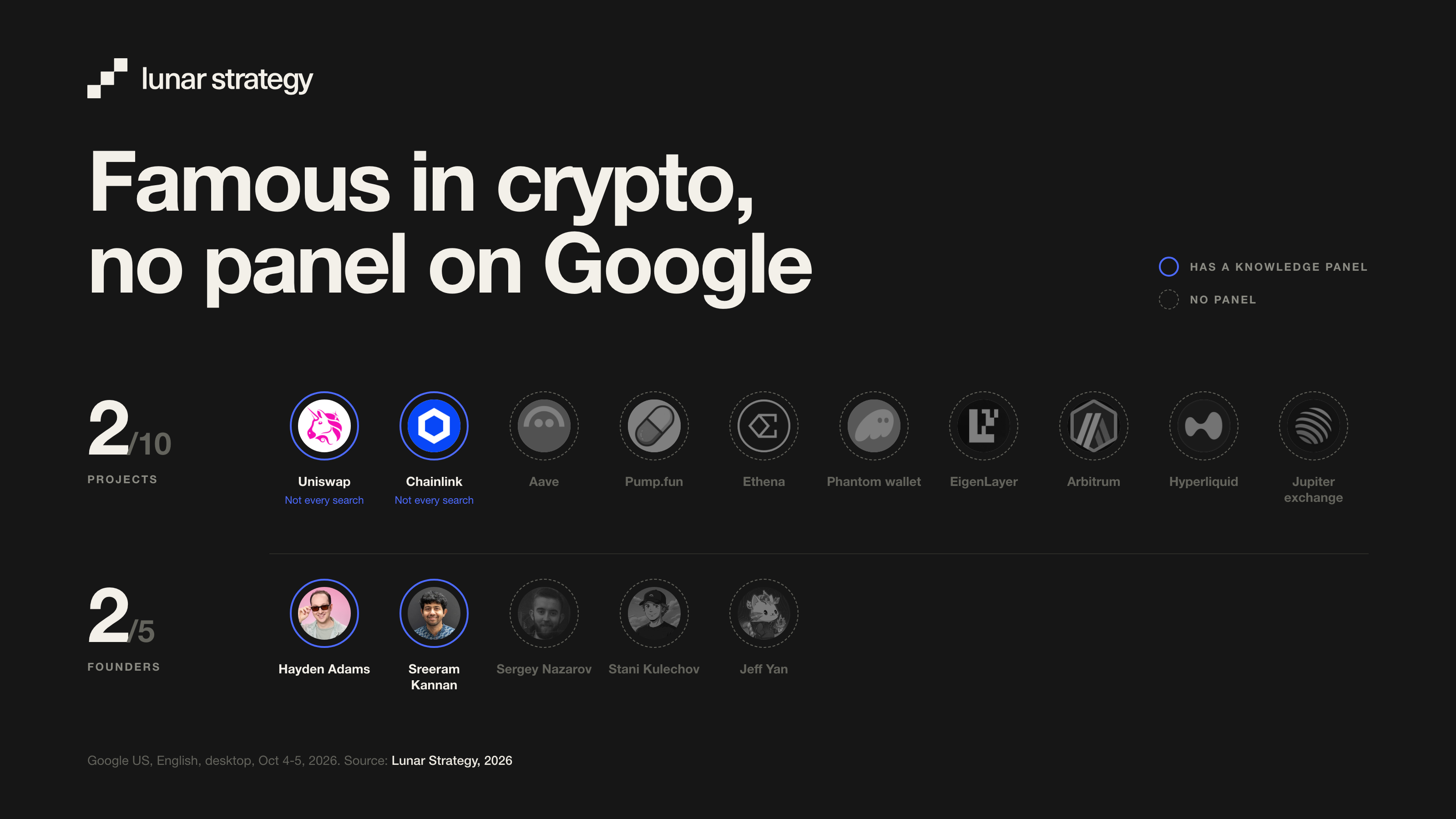
Keep the limits in mind: a small sample, 2 days, one country, desktop only, and panels detected by the API's parser, so read this as a snapshot. Run the same check on your own names before you change anything: search your project and each founder in a private window, and write down whether a panel shows, its subtitle, where its description comes from and which links it lists.
That snapshot is your baseline, and the four patterns tell you where to build.
The entity stack: four layers that make you easy to recognize
The patterns in our test map onto four layers, built from the bottom up: one official page, markup that labels it, outside sources that confirm it and a claim once the panel exists. After working with more than 300 crypto projects, we treat it as two jobs done together: SEO builds the entity home, the structured data and a site Google can read, and PR earns the coverage that confirms it. Skip a layer and the one above has nothing to stand on.
01 · Home: "Which page is the official source?"
- Move: one entity home with your names, description, founders and official links.
- Trap: a different description in every place, so Google has several answers to weigh.
- Done when: your X bio, CoinGecko description and press kit match it word for word.
02 · Markup: "Which name, logo and profiles are yours?"
- Move: Organization and Person structured data, with every official profile in
sameAs. - Trap: stopping at schema. Markup labels facts; independent sources confirm them.
- Done when: the markup validates on the entity home and on every founder's page.
03 · Proof: "Do outside sources say the same thing?"
- Move: press coverage, consistent data sites and a referenced Wikidata item.
- Trap: writing your own Wikipedia article, which breaks Wikipedia's conflict of interest rules and is likely to be removed.
- Done when: the 10 most visible pages you don't control match your name, category and founders.
04 · Claim: "Who speaks for this panel?"
- Move: claim it with an official profile, then suggest fixes.
- Trap: leaving the claim with one login. People leave, and recovery takes days.
- Done when: 2 people hold access and someone checks your names every month.
The first layer is the cheapest, and every other layer points back to it.
One official page beats a dozen inconsistent profiles
For most projects, the About page or an official links page is the right candidate for what SEOs call the entity home: the page Google can treat as the source of truth for who you are, which everything else points back to. If your homepage says "liquidity layer," your X bio says "DeFi super app" and your CoinGecko listing says "lending protocol," Google sees three answers instead of one, so pick one sentence and use it word for word everywhere.
The same page protects you against clones like the fake Phantom page by listing your real domains and contract addresses. Our crypto SEO guide walks through the 10-minute brand search audit and the official links page, so run that audit first and then use this checklist to fill the page:
- Names: official name, short name and ticker (for example "Example Protocol," "Example" and EXMPL).
- One-sentence description, identical to your X bio, CoinGecko and CoinMarketCap listings and press kit.
- Disambiguation, if your name collides with something else: "Example Protocol is not affiliated with Example Inc."
- Launch date and the company, foundation or labs entity behind the project, with one line on how they relate.
- Founders and core team: names, roles and links to their own pages and profiles.
- Official links: website, docs, X, GitHub, Discord and Telegram.
- Contract addresses for each chain.
- Listings: CoinGecko, CoinMarketCap and DefiLlama.
- Press contact and a media kit with logo files.
- A visible "last updated" date.
Separate your entities on purpose. The protocol, the token, the labs company, the foundation and the founder can each be a distinct entity. Blur them into one and Google can't tell them apart; keep them unlinked, three names that never reference each other, and it can't connect them. Spell out the relationship in one place: "Example Labs builds Example Protocol. The EXMPL token governs it. The Example Foundation funds ecosystem grants."
Give each founder a page of their own (for example /team/jane-doe) with role, short bio and current links. If a founder uses a pseudonym, pick one name and use it everywhere, because a real name on LinkedIn and a handle on X look like two people to Google. If your founder is the public face of the project, our founder-led marketing guide covers how to build that presence.
Once the page exists, the next job is telling Google, in its own format, which facts on it matter.
Structured data labels your facts so Google doesn't have to guess
Google Search Central, the company's official documentation for site owners, says Organization markup "can help Google better understand your organization's administrative details and disambiguate your organization in search results," including which logo shows in your knowledge panel. Disambiguation is exactly the Aave and Ethena problem, but the markup doesn't create a panel on its own: it labels facts that outside sources still have to confirm.
The key property is sameAs, a list of URLs for your profiles on other websites. It tells Google "this X account, this GitHub and this CoinGecko page are the same entity as this website," and Google accepts multiple sameAs URLs. Copy this template, replace the example values and add it to your entity home inside a <script type="application/ld+json"> tag:
{
  "@context": "https://schema.org",
  "@graph": [
    {
      "@type": "Organization",
      "@id": "https://example.xyz/#organization",
      "name": "Example Protocol",
      "alternateName": ["Example", "EXMPL"],
      "url": "https://example.xyz/",
      "logo": "https://example.xyz/logo-512.png",
      "description": "Example Protocol is a lending protocol on [chain].",
      "foundingDate": "2024-03-01",
      "founder": { "@id": "https://example.xyz/team/jane-doe#person" },
      "sameAs": [
        "https://x.com/exampleprotocol",
        "https://github.com/example-protocol",
        "https://www.linkedin.com/company/example-protocol",
        "https://www.coingecko.com/en/coins/example",
        "https://coinmarketcap.com/currencies/example/",
        "https://defillama.com/protocol/example"
      ]
    },
    {
      "@type": "Person",
      "@id": "https://example.xyz/team/jane-doe#person",
      "name": "Jane Doe",
      "jobTitle": "Co-founder and CEO",
      "url": "https://example.xyz/team/jane-doe",
      "worksFor": { "@id": "https://example.xyz/#organization" },
      "sameAs": [
        "https://x.com/janedoe",
        "https://www.linkedin.com/in/janedoe",
        "https://github.com/janedoe"
      ]
    }
  ]
}
Two notes on the template: founder, worksFor and jobTitle are valid schema.org properties that aren't on Google's list for Organization, used here to connect project and founder. Add your Wikidata URL to sameAs only once you have an item (covered in the next section). Beyond that, Google's documentation adds a few rules worth following:
- Placement: put it on your home page or "a single page that describes your organization, for example the about us page."
- No required properties: add every property that's true and relevant.
- Logo: at least 112x112 px, at a URL Google can crawl and index.
- Names: use the same
nameandalternateNameyou use for your site name in Google. - No guarantees: Google says it "does not guarantee that features that consume structured data will show up in search results."
Validate the page with Google's Rich Results Test after publishing, then run the same test on every founder page that carries a Person block. To see whether Google already knows you as an entity, developers can query the Knowledge Graph Search API, which needs an API key and returns the entities Google matches to a name.
Other people's pages carry more weight than yours
Press coverage in recognized crypto and business media is the strongest outside signal most projects can earn, because it's written by people with no reason to repeat your pitch. The goal is several credible sources that use the same name, category and founders. Give every journalist the one-sentence description, the correct name and your founders' titles, and correct errors quickly. Our guide to PR for crypto and Web3 projects covers how to earn that coverage.
Data sites and founder sources come next. CoinGecko, CoinMarketCap, DefiLlama, GitHub and conference speaker pages are crawled constantly, so keep every one of them identical to your entity home, including the founder list. Interviews and speaker bios should state each founder's current role: Sreeram Kannan's "Researcher" label shows what happens when older academic profiles outweigh recent ones.
Wikipedia, with care. Wikipedia's own notability guideline presumes a company notable when it has "significant coverage in multiple reliable secondary sources that are independent of the subject." Don't write your own article: Wikipedia strongly discourages editing with a conflict of interest, as we explain in how to get your crypto project cited by ChatGPT and Perplexity. And as the Aave and Pump.fun results show, an article doesn't guarantee a panel.
Wikidata is the more realistic step. Wikidata is a free, public database of structured facts, run by the same Wikimedia community as Wikipedia. Its notability policy accepts an item that "refers to an instance of a clearly identifiable conceptual or material entity that can be described using serious and publicly available references." Back each statement with a reference to an independent source, because an item without references is easy to challenge. For a crypto project, the useful Wikidata properties are:
- P856: official website
- P2002: X (Twitter) username
- P2037: GitHub account
- P5777: CoinMarketCap cryptocurrency ID
- P5810: cryptocurrency code (your ticker)
With the three layers in place, the panel may appear, and that's when the last layer starts.
Claim the panel the day it appears, then fix it at the source
Verification doesn't make Google show a panel, which is why the three layers above come first, but it turns your feedback into something Google says it "can prioritize" and reviews "within a few days," and it lets you decide who else can speak for the panel. Google's verification steps are short:
- Sign in to a Google Account.
- Search for your project or your name and find the panel.
- At the bottom of the panel, click "Claim this knowledge panel" (on mobile, it's in the menu).
- Review the details, then sign in to one of the official sites or profiles Google lists: YouTube, Search Console, Twitter (X) or Facebook.
If Google can't find a site associated with the entity, it asks for more information to verify you. Not every panel is claimable yet; Google says to check back for the button and use Feedback meanwhile. Once verified, add a second person: you can add users as Owner, Manager (can suggest changes and add or remove users) or Contributor (can suggest changes). Don't leave the claim with one employee or one agency login.
If someone else already claimed it, for example a former team member, use account recovery: Google emails the current owner and waits 3 business days, and if they don't respond, the panel becomes claimable again. If the panel mixes you up with someone else, contact Google support through the same help page. Google lists "mixed with another of the same or similar name" and "showing the wrong websites or profiles" as reasons to do so, which covers most name collisions like Ethena's.
Even verified, you can't rewrite everything Google shows:
| Panel element | Can you change it? | What Google says to do |
|---|---|---|
| Description | Not directly | Descriptions "can't be edited"; ask the source (often Wikipedia) to correct it |
| Title | Rarely | Changes need feedback with "substantial evidence" |
| SubtitleFor example "Chain" or "Researcher" | No custom subtitles | Google "doesn't accept or create custom subtitles"; send feedback if it's wrong |
| Image | Only if one exists | If there's no image, Google "can't add an image by request" |
| Social profile links | Yes, once verified | Google can make some corrections directly, like links to social profiles |
| Mixed-up entities or wrong websites | Yes, through support | Contact Google support from the verification help page |
The details come from Google's guide to editing panels. In practice, Uniswap couldn't type in a subtitle to replace "Chain," and Sreeram Kannan couldn't swap "Researcher" for "founder of EigenLayer." The fix is upstream: consistent sources that call each of them what they are.
Where to start, and why the same work carries into AI search
None of this needs a budget to begin, only an order: check what Google shows today, then build from the bottom of the stack up. The payoff also reaches beyond the panel. In March 2025, Google wrote on its official blog that AI Mode can "tap into fresh, real-time sources like the Knowledge Graph," and the Aave AI Overview in our test split its answer between two entities with the same name.
Google doesn't say a panel gets you into AI answers, and we won't claim it either: its Search Central guide to AI features lists "no additional technical requirements" beyond being indexed and eligible to show a snippet. What the two share is the input: one name, one description and consistent sources, which also keep an AI summary from mixing you up with someone else. In practice, that's four steps:
- This week: run the private-window check on your project and each founder, and save the results as your baseline.
- This month: publish or update your entity home, make every bio match its one-sentence description, then ship and validate the Organization and Person markup.
- This quarter: fix the outside pages you can edit, starting with CoinGecko, CoinMarketCap and DefiLlama, and pitch coverage that uses your exact name and your founders' titles.
- When a panel appears: claim it the same day, add a second Owner and keep the monthly check going.
Crypto SEO that covers your entity, not just your rankings
A panel sits where SEO and PR meet, so the work needs both sides at once. Our crypto SEO team can audit your entity signals with you and do the work. The service also covers AI search (often called GEO or AEO, generative or answer engine optimization), so the same effort shapes how AI tools describe your project, not just where it ranks.
- Entity home and markup: one official page, one description, validated Organization and Person structured data.
- Outside sources: coverage and data-site listings that repeat your name, category and founders.
- The panel itself: claiming, a second Owner and the monthly name check.
Bring a screenshot of your brand search, and we'll start from what Google shows today.
Frequently Asked Questions
How much does a Google Knowledge Panel cost?
Nothing. Google charges no fee to show a panel or to claim one. What costs time and money is the work behind it: your entity home, structured data and press coverage. Treat any offer of a "guaranteed" panel as a red flag, because Google says it doesn't create panels manually.
How long does it take to get a Knowledge Panel?
Google doesn't publish a timeline. A panel appears when its systems find enough consistent information, which can take months for a new project. Claiming an existing panel is quick once the "Claim this knowledge panel" button appears. The slow part is the outside coverage, so start the entity home early.
Why did my Knowledge Panel disappear?
Google decides automatically when a query shows a panel. Its help page says this "happens automatically and isn't something we can or would influence." Check whether a rebrand, a name collision or conflicting new sources changed the picture, then fix the sources. Check from a private window more than once before you act.
Can a protocol, its token and its foundation each have a panel?
They can be separate entities if sources treat them separately. Wikidata, for example, has one item for Uniswap and another for Uniswap Labs. Make the relationship explicit on your entity home so Google doesn't merge them or confuse them, and give each entity its own consistent description.
Do I need a crypto PR agency to get a panel?
No, but you need the independent coverage a good PR program produces. Some teams earn it in-house through founder interviews and research. If you're weighing outside help, our explainer on what a crypto PR agency does and whether you need one breaks down the trade-offs.