







.png)


















TL;DR
- More and more people research crypto projects by asking AI tools like ChatGPT and Perplexity. When those tools answer, they usually link to the websites they used. Being one of those links is called being cited.
- Nobody can buy or guarantee a citation. OpenAI says plainly that placement in ChatGPT search "is not guaranteed". What you can do is make your project easy for these tools to find, read and trust.
- That comes down to five steps: let the AI tools read your site, publish clear answers to the questions people ask, get mentioned on sites the AI tools already trust, keep your facts the same everywhere, and check the results every month.
- A 2024 study by researchers at Princeton and IIT Delhi found that adding quotes, statistics and sources to a page raised its visibility in AI answers by up to 40%. Stuffing in extra keywords didn't help.
- You can measure this for free. ChatGPT tags the visitors it sends you, Bing shows how often Microsoft's AI cites your pages, and a simple monthly list of test questions shows where you stand.
You Asked an AI About Your Own Market. Your Project Wasn't in the Answer.
Picture this. You run a project, say a lending app on a newer blockchain. One evening you open ChatGPT and type the kind of question a new user might ask: "What are the best lending apps on this chain?"
The answer names three of your competitors. It explains how each one works and links to their websites. Your project isn't mentioned.
So you ask Perplexity directly about your project. This time it knows your name, but the answer describes the token details from your first version, before you changed them. The source it links to is a blog post from over a year ago that you'd forgotten existed.
You didn't do anything wrong. You built a good product, you post on X, and your community is active. But somewhere between your work and the AI's answer, your project got lost.
This is happening to a lot of teams, and it's fixable. This article explains, step by step, how AI tools choose what to cite, why projects so often get left out, and what you can do about it, starting this week.
Why AI Answers Matter for Crypto Projects Now
A few years ago, if someone heard about a new crypto project, they'd search Google, click a few links and read. Many still do. But a growing number now ask an AI tool first.
The scale is impossible to ignore. ChatGPT reached 900 million weekly users in February 2026. Google now shows AI-written summaries at the top of many searches, and those summaries change how people click. A Pew Research Center study of real browsing data found that when a Google search showed an AI summary, people clicked on a regular result 8% of the time, compared with 15% when there was no summary.
What that means for you: the AI's answer is often the first thing a potential user reads about your market. If your project is named in it, and your site is linked as a source, you're part of the conversation from the start. If you're missing, many people won't scroll further to find you.
This doesn't replace your other marketing. Google search, X, KOLs, events and your community all still matter. AI answers are one more place where people now discover projects, and one that most crypto teams haven't looked at yet.
To show up there, it helps to understand how these tools actually build an answer.
How ChatGPT and Perplexity Decide What to Cite
First, two words that sound similar but mean different things:
- A mention is when the AI names your project in its answer.
- A citation is when the AI links to a web page as the source of what it said. That page could be yours, or someone else's page about you.
Both are valuable. A citation is usually worth more, because it sends people to a source they can click on, and it shows the AI considers that page reliable.
When you ask one of these tools a question that needs current information, it does roughly what a person would do, only faster:
- It searches the web. It turns your question into one or more search queries.
- It reads a handful of pages. It picks the results that look most relevant and useful.
- It writes an answer. It summarizes what it found in plain language.
- It links its sources. It adds citations to the pages it relied on.
The AI can also answer from what it learned during training, the process where it read a huge amount of text before it was released. But training knowledge can be months or years old, and it usually doesn't come with links. Citations mostly come from the live search in steps 1 to 4. That's good news, because live search is something you can influence.
Each tool finds pages in its own way:
A crawler (also called a bot) is a program that visits websites automatically and reads their pages, so a search tool knows what's on them. If a crawler can't get into your site, the tool can't cite it. It's that simple.
OpenAI also says that ChatGPT ranks results "using multiple factors intended to help users find relevant, reliable information". In practice, the tools are looking for the same three things: a page they can read, that directly answers the question, from a source that looks trustworthy.
With that in mind, it becomes easier to see why so many crypto projects get skipped.
Why Crypto Projects Often Get Left Out
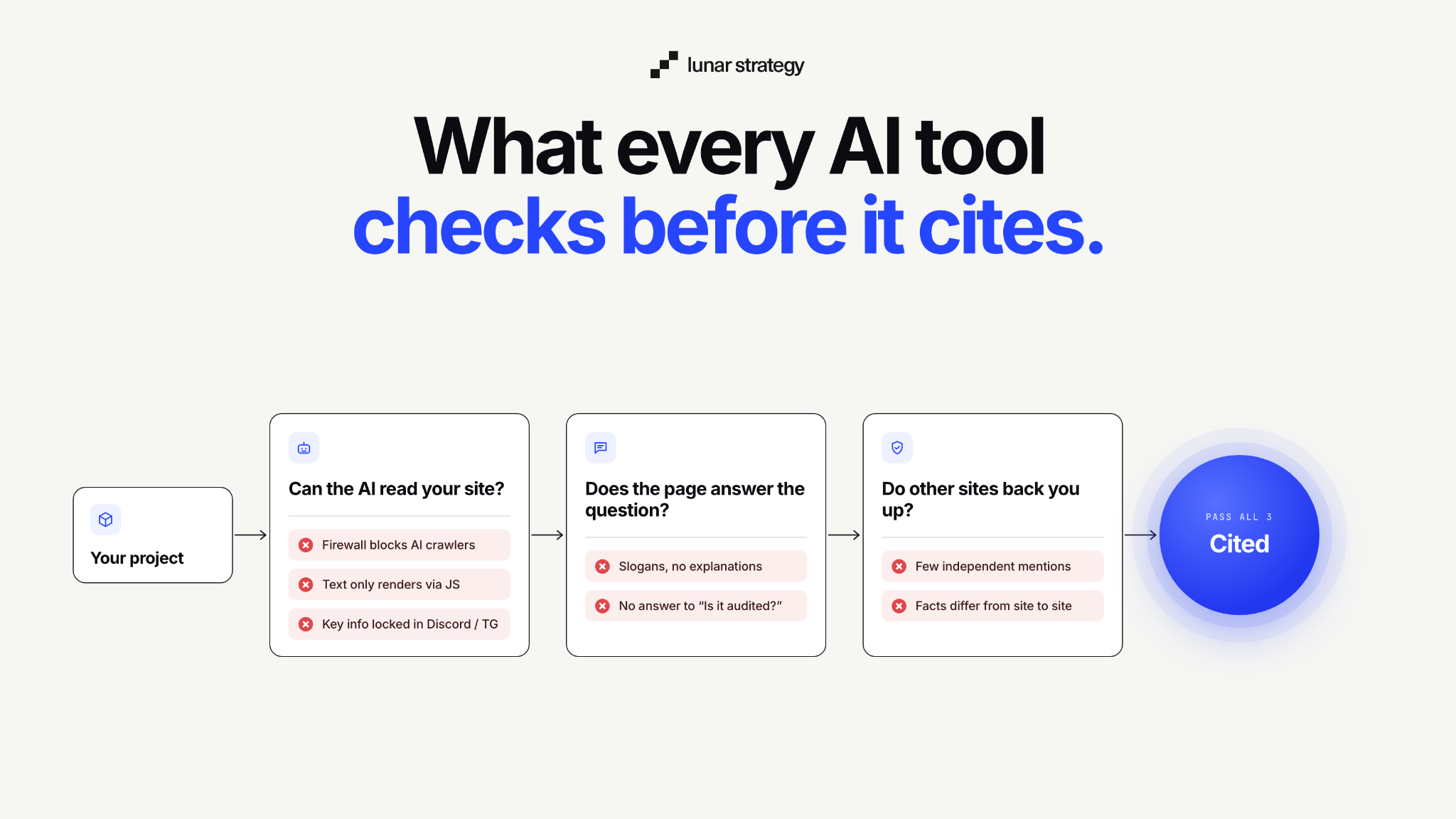
Most crypto teams put real effort into their product and community. The problem is usually that the information AI tools need is missing, hidden, or hard to read. These are the causes we see most often.
The AI's crawler can't get in. Many crypto sites sit behind security services that block automated traffic to stop attacks. That's sensible, but it can also block the crawlers of AI search tools. OpenAI notes that your website host or content delivery network (the service that speeds up and protects your site) must allow traffic from its search crawler. Perplexity gives similar instructions for website firewalls. Many teams never check.
The site shows very little text to a crawler. A lot of websites are built with tools that load the content with code after the page opens. A person sees a full page. A crawler that reads only the first version of the page may see almost nothing. The section on Step 1 below shows a quick way to check.
The useful information lives in places search can't reach. Teams often share their most important updates in Discord servers and Telegram groups. Those are great for your community, but they usually require joining or logging in, so search tools can't read them.
If the only place your new token details are explained is a pinned Discord message, AI tools won't find it.
The website sells, but doesn't explain. Many project homepages are short slogans and a "Launch App" button. That works for people who already know you. It gives an AI tool nothing to quote when someone asks "How does this work?" or "Is it audited?"
Few independent sites talk about you. AI tools lean on outside sources to judge trust, just like people do. If the only site describing your project is your own, there's little to back it up.
The facts are different in different places. Your website says one thing, your old blog post says another, and a listing site shows last year's numbers. An AI tool reading all three may repeat the wrong one, as in the example at the start.
Nobody on the team checks. Most teams track followers and website visits, but few ever ask an AI tool about their own project. You can't fix what you haven't seen.
Each of these has a fix, and they build on each other. The first one is the most basic: making sure the AI tools can read your site at all.
Step 1: Let the AI Tools Read Your Site
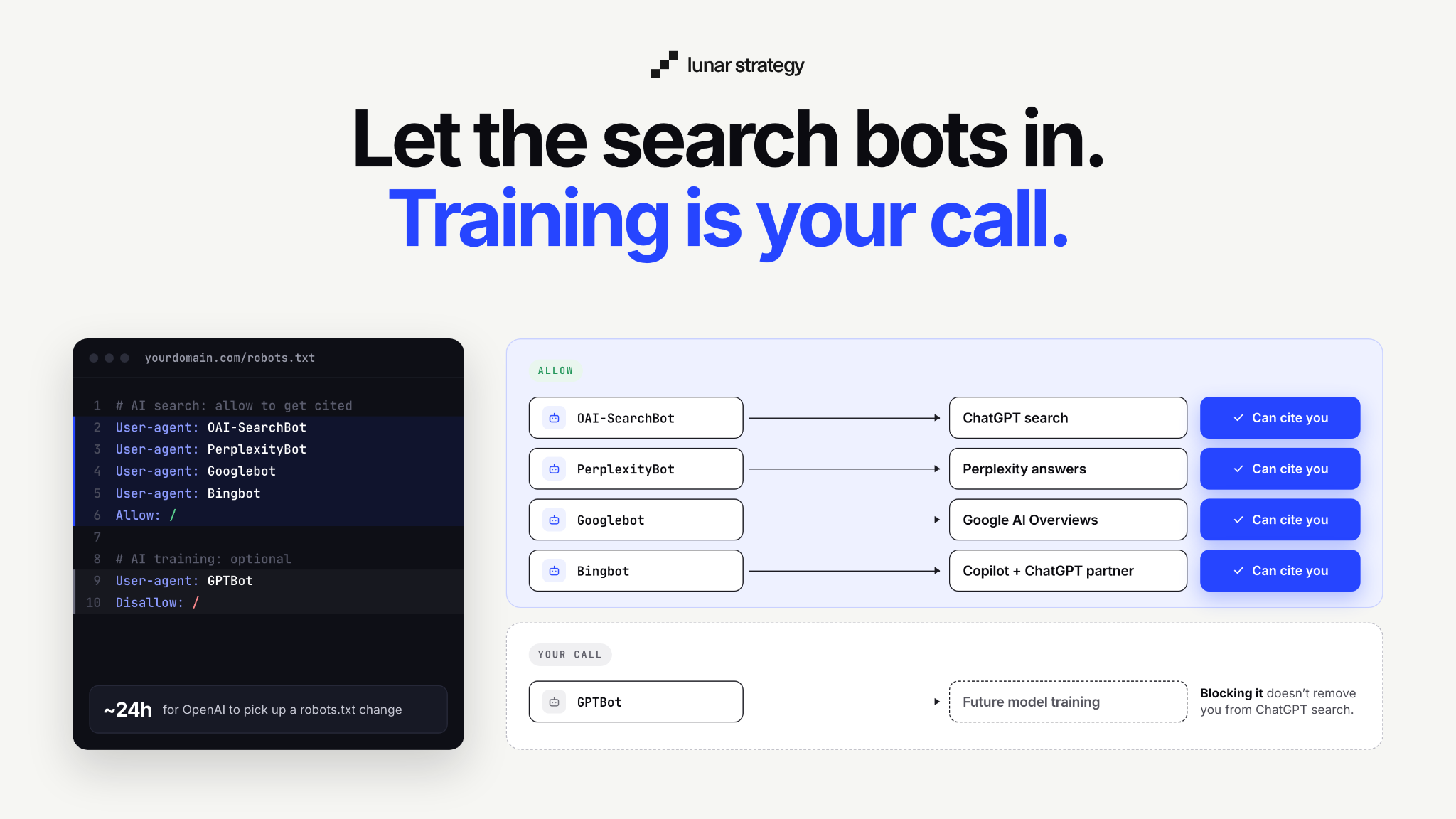
Every website has a small public file called robots.txt. It sits at yourdomain.com/robots.txt and tells crawlers which parts of the site they're allowed to visit. Open yours in a browser. It takes seconds.
Here are the crawlers that matter for AI search, and what each one does:
Two things to know from this table.
Search and training are separate choices. You can allow OAI-SearchBot, so ChatGPT can cite you, and still block GPTBot if you'd rather your content not be used for training. OpenAI treats each setting independently. If your goal is to be cited, the search crawlers are the ones that must be allowed.
Changes are quick. OpenAI says it takes about 24 hours for its systems to pick up a change to your robots.txt.
Then run three more checks:
- Ask whoever manages your website security whether AI crawlers are being blocked. OpenAI and Perplexity both publish the addresses their crawlers use, so these can be allowed specifically.
- Check what a crawler sees. Open one of your key pages, right-click and choose "View page source." If you can find your main text in there, crawlers can read it. If the source is mostly code with very little readable text, ask your developers about "server-side rendering," which means sending the finished page to visitors instead of building it in their browser.
- Register your site with Bing and Google. Both Bing Webmaster Tools and Google Search Console are free. Submitting your sitemap (a list of all your pages) helps both find new pages faster.
You may have heard of a file called llms.txt, a proposed way to give AI tools a summary of your site. It's harmless to add, but don't count on it. Google says you don't need any special AI files or markup to appear in its AI features. Treat it as optional, and spend your time on the steps in this article first.
Once the tools can read your site, the next question is whether they'll find anything worth citing there.
Step 2: Publish Clear Answers to the Questions People Ask
AI tools cite pages that answer the question in front of them. So the most useful thing you can do is write down the answers to the questions people actually ask about your project and your market.
Start with a list of questions. Think like a new user who has never heard of you. For most crypto projects, the list looks something like this:
- What is [project], and what does it do?
- How does it work, step by step?
- Who is it for?
- Is it audited, and by whom?
- What are the fees?
- How is it different from [a well-known competitor]?
- How do I get started?
- What is the token used for, and how is it distributed?
- What are the risks?
Ask your community team which questions come up again and again in Discord and Telegram. Those are gold, because they're exactly what people type into AI tools too.
Give each important question a clear answer on a public page. That might be a detailed FAQ, a "How it works" page, a comparison page, or a docs section. A few things make these pages much easier for AI tools to use:
- Put the answer first. Start with two or three sentences that answer the question directly, then add the detail. AI tools, like busy readers, look for the answer near the top.
- Use the question as the heading. A heading like "Is [project] audited?" tells both people and AI tools exactly what the section covers.
- Be specific. Name the blockchain, the audit firm, the launch date, the fee. Vague phrases like "industry-leading security" give an AI tool nothing to repeat.
- Show the date. Add "Last updated" to pages with facts that change. In crypto, a lot changes quickly, and a clear date shows the information is current.
Back up your claims. This is where the research is clearest. A 2024 study called GEO: Generative Engine Optimization, by researchers at Princeton University and IIT Delhi and presented at the KDD 2024 conference, tested what makes content show up more in AI answers. Adding quotations from credible sources, adding statistics, and citing sources each raised visibility by roughly 30% to 40%. Adding extra keywords, an old SEO habit, did not help and in their test did slightly worse than doing nothing.
One finding from that study is especially encouraging for newer projects. Websites that ranked lower in normal search gained the most. Pages in fifth place that added citations saw their visibility in AI answers rise by 115%. You don't need to be the biggest name in your market to be quoted. You need to be the clearest and best supported.
Create one official "key facts" page. Put the basics in one place: project name, token name and ticker, which blockchains you're on, official contract addresses, launch date, audits with links, team or company details, and official links to your X account, docs and community. Keep it current and dated. This page becomes the reference point that other sites, and AI tools, can rely on.
Clear pages on your own site are the foundation. But when an AI tool decides whether to trust a source, it doesn't only look at what you say about yourself.
Step 3: Get Mentioned on Sites AI Tools Already Trust
Think about how you'd check a project you'd never heard of. You'd look at its website, but you'd also want to see what other people say about it. AI tools do something similar.
Mentions matter, especially on Google. The SEO software company Ahrefs studied 75,000 brands and found that how often a brand is mentioned across the web was the factor most closely linked with appearing in Google's AI Overviews. The link was 0.664, compared with 0.218 for backlinks (links from other sites to yours) on a scale where 1 would be a perfect match. A second Ahrefs study found this link was weaker for ChatGPT and Perplexity, and Ahrefs itself points out that a link between two things doesn't prove one causes the other. So mentions aren't a magic switch, but they're one of the clearest signals available.
Each AI tool trusts different sites. The SEO software company Semrush tracked 100 million AI citations over three months in 2025. Reddit and Wikipedia were ChatGPT's most cited sites, while Perplexity leaned on Reddit, LinkedIn and research sources such as the US National Institutes of Health. The top sites also shifted a lot over just a few weeks. The takeaway: don't bet everything on one site. Aim to be described accurately in several places.
For a crypto project, the places worth working on usually include:
- Crypto news and research coverage. An article in a respected crypto publication, or a mention in a research report, is exactly the kind of independent source AI tools look for. Share real news (a launch, a partnership, a milestone, original data) rather than asking for a feature.
- Data and listing sites. Many people check token details on sites like CoinGecko, CoinMarketCap and DefiLlama. Make sure your project's page on each is complete and correct, with the same description and links as your own site.
- Reddit and forums. Take part in the discussions where your users already are. Answer questions honestly, and say you're on the team. A helpful, open answer on a popular thread can be read by people and AI tools for a long time.
- YouTube and podcasts. Explainer videos and interviews create lasting public mentions that people keep finding long after they're published.
- KOLs and creators. When trusted crypto creators write threads or articles explaining your project, that adds to the mentions people and AI tools find. We explain how to work with them in How to Brief a KOL.
- Wikipedia, carefully. Wikipedia is heavily used by AI tools, but it has strict rules. Its guidelines say you should not write an article about your own company. A project earns a Wikipedia page when enough independent sources have written about it. If a page already exists and has errors, you can suggest corrections on its "Talk" page and say who you are.
As these mentions build up, one detail becomes more important than it looks: all of them need to say the same thing.
Step 4: Keep Your Facts the Same Everywhere
When an AI tool reads five sources about your project and they disagree, it has to guess which is right. Sometimes it guesses wrong, and your project gets described with old numbers or a feature you removed.
The fix is simple, but it takes discipline:
- Write one short official description of your project, two or three sentences, and use it everywhere: your website, X bio, listing sites, press kit and docs.
- When something changes, update every place. Keep a short list of all the pages that mention your key facts (token details, supported blockchains, fees, audits), and work through it after every change.
- Fix or update old content. If an old blog post describes a version of your product that no longer exists, update it with a note at the top, or redirect it to the current page.
- Use your key facts page as the source. Point everyone, including journalists, partners and creators, to that one page, so the correct version spreads.
Once your site is readable, your answers are clear, and your facts line up, you need a way to see whether it's working.
Step 5: Check Where You Stand Every Month
You don't need expensive tools to start. You need a list of questions, a spreadsheet, and half an hour a month.
Build a test list of 20 to 30 questions. Include a mix:
- Questions about your market, where you'd want to be named ("What are the best [type of app] on [blockchain]?")
- Questions about your project by name ("What is [project]?", "Is [project] safe?")
- Comparison questions ("[Project] vs [competitor]")
- How-to questions ("How do I [thing your product does]?")
Ask each question once a month in ChatGPT, Perplexity and Google, and write down what you see:
This is an example of what the sheet might look like, not real data. AI answers change from one day to the next, so look at the trend over several months rather than any single answer. The "which sources" column is often the most useful: it shows you exactly which sites the AI trusts on your topic, and those are the places to be mentioned next.
Then add the numbers these platforms give you for free:
- ChatGPT visitors. OpenAI says ChatGPT adds utm_source=chatgpt.com to the links it sends people through. A "UTM" is a small tag at the end of a web address that tells your analytics tool where a visitor came from. In Google Analytics, you can filter by that tag to see how many people ChatGPT sends you and what they do next.
- Perplexity visitors. In your analytics, look for visits referred from perplexity.ai.
- Bing and Microsoft Copilot. Since February 2026, Bing Webmaster Tools includes an AI Performance report that shows how often your pages are cited in Copilot, Bing's AI summaries and some partner services, and which pages get cited most.
- Google. Visits from Google's AI features are counted inside your normal search traffic in Search Console. They aren't shown separately, so watch your overall trend.
Put together, these tell you whether you're being named, whether you're being linked, whether the AI has the facts right, and whether any of it brings real visitors.
What to Expect, and What No One Can Promise
It's worth being clear about what's realistic, because this area is new and full of bold claims.
No one controls AI answers except the companies that run them. OpenAI says placement in ChatGPT search is not guaranteed, and the same is true for every other AI tool. Anyone who promises a specific citation is promising something they don't control.
Some changes work fast, others take time. Allowing a blocked crawler can take effect within a day or so, according to OpenAI. New pages need to be found and read. Independent mentions take the longest, because they depend on other people choosing to write about you. In our experience, the full effect builds over several months, not days.
The results move around. AI answers change as the tools update and as the web changes. A month where you disappear from one answer isn't a failure. Look at the trend across your whole question list.
The work helps beyond AI. Clear answer pages, accurate listings and independent coverage also help your normal Google rankings, your community's understanding, and anyone doing research before they buy. Very little of this effort is wasted, even when a specific AI answer doesn't change.
Common Mistakes to Avoid
Before you start, it helps to know where teams most often trip up:
- Blocking AI crawlers by accident, through robots.txt or security settings nobody has looked at in years.
- Relying on content crawlers can't read, like text that only appears after code runs, or updates that only exist in Discord.
- Writing hype instead of answers. "The future of finance" can't be quoted as an answer to anything.
- Stuffing pages with keywords. The GEO study found this didn't help in AI answers.
- Letting facts drift apart between your site, docs, listings and old posts.
- Writing your own Wikipedia page, which goes against Wikipedia's rules and is usually removed.
- Checking once and stopping. AI answers change, so treat this as a monthly habit.
How We Approach This at Lunar
We've worked with more than 300 crypto projects, and AI search is now part of how we think about getting projects found. We treat it as one connected job rather than a set of tricks: making sure search and AI tools can read the site, writing pages that answer real user questions, building independent mentions through PR, creators and community, and measuring what changes every month.
We don't promise specific citations, because no one can. What we can do is make sure that when someone asks an AI tool about your market, your project has the best possible chance of being found, understood and trusted.
Putting It All Together
AI tools are becoming one of the first places people learn about crypto projects. When they answer, they cite pages they can read, that answer the question clearly, and that come from sources they trust.
Most crypto projects get left out for fixable reasons: their site blocks or confuses the crawlers, their best information sits in Discord, their pages sell instead of explain, few independent sites mention them, or their facts don't match from place to place.
So work through it in order. Let the AI tools in. Write clear, dated answers to the questions people actually ask, and back them up with sources. Get mentioned in the places AI tools already trust. Keep your facts the same everywhere. Then check every month, and let what you see guide the next step.
Do that, and the next time someone asks an AI tool about your market, your project has a real chance of being part of the answer.
Frequently Asked Questions
What does it mean to be "cited" by ChatGPT or Perplexity?
It means the AI tool links to a web page as a source for its answer. Being "mentioned" means your project is named in the answer. A citation is usually more valuable, because it sends readers to a page they can visit.
Can I pay to be cited by ChatGPT or Perplexity?
No. Citations in their answers aren't for sale. OpenAI says placement in ChatGPT search is not guaranteed and depends on factors meant to help users find relevant, reliable information.
How do I know if AI crawlers can access my site?
Open yourdomain.com/robots.txt and check that OAI-SearchBot and PerplexityBot aren't blocked. Then ask whoever manages your website security whether automated traffic from these crawlers is being stopped.
If I block GPTBot, will I disappear from ChatGPT?
Not from search. GPTBot collects content for training AI models. ChatGPT search uses a different crawler, OAI-SearchBot. You can allow one and block the other.
Do I need an llms.txt file?
It isn't required. Google says you don't need any special AI files or markup to appear in its AI features. It's harmless to add, but treat it as optional.
How long does it take to start being cited?
There's no fixed timeline. Fixing crawler access can take effect within about a day. New content and independent mentions take longer, often several months, and results vary from question to question.
What's the fastest thing I can do this week?
Check your robots.txt, ask your team what questions users keep asking in Discord and Telegram, and publish clear, dated answers to the top five on a public page.
How do I measure results?
Keep a list of 20 to 30 test questions and check them monthly in ChatGPT, Perplexity and Google. Track visits tagged utm_source=chatgpt.com in Google Analytics, visits from perplexity.ai, and the AI Performance report in Bing Webmaster Tools.
Let's Talk Strategy
AI tools are already answering questions about your market. Make sure your project is easy for them to find, read and trust, and check every month how they describe you.
You explain what you're building and we'll explain how we'd support it.