







.png)

















TL;DR
- Crypto SEO is the work of getting your project's website, docs and product pages to rank on Google and show up in AI answers. The rules are the same as any SEO, but Google holds money-related topics to a higher trust bar.
- Start with your own name. If a copycat site, a "scam?" thread or a negative autocomplete shows up before your site, fix that first: impersonation scams grew 1,400% in 2025.
- Make sure Google can read your site. Many dApps show Google an empty page, so keep your homepage, docs and token pages as plain HTML that loads without a wallet.
- Build the pages your type of project needs (docs, token page, security, comparisons), then earn links with research and PR instead of buying them.
- Track three things: clicks on your name vs. clicks on everything else, impressions in AI Overviews, and how many visitors connect a wallet. Expect results in months, not weeks.
What Is Crypto SEO?
Crypto SEO is the practice of getting a crypto project's website, docs and product pages to rank on Google and appear in AI answers. To rank a project in 2026, you own the results for your own name, make your site readable without a wallet, build pages for your project type and earn trust with sources.
Try this before reading further. Search your project's name on Google. If your own site isn't the first result, something else is introducing you to your next user: a copycat claim page, a "scam?" thread, or an autocomplete that says your chain is dead.
That last one isn't hypothetical. In August 2025, a member of the Polkadot community noticed that "'Polkadot is D3ad' is the first Google Search Term that appears in the search bar." SEO starts with your own name.
The basics are the same as in any industry: Google has to find your pages, understand them and trust them. What changes is how hard each of those steps is.
The rest of this guide covers each row, in the order we'd fix them.
Why Crypto Projects Can't Skip SEO in 2026
Most industries can buy their way onto the first page of Google while their SEO matures. Crypto mostly can't.
Google Ads does not allow ads for initial coin offerings, DeFi trading protocols or "the purchase, sale, or trade of cryptocurrencies," regardless of location. Exchanges and wallets can advertise only in approved countries, with Google certification and a local license. Meta asks for a recognized license and written permission before it runs ads for crypto trading, swapping or staking.
That leaves organic search as one of the few discovery channels a crypto project can build and own. It also feeds the newer one. Google says a page must be indexed and eligible to show a snippet before it can appear in AI Overviews or AI Mode, so the pages that rank are the pages AI search can quote.
Now what? If your plan assumes paid search will carry growth, check the ad policy for your product and country first. For most tokens and DeFi protocols, organic search, X and your community are the channels left. Our crypto marketing playbook shows how they fit together.
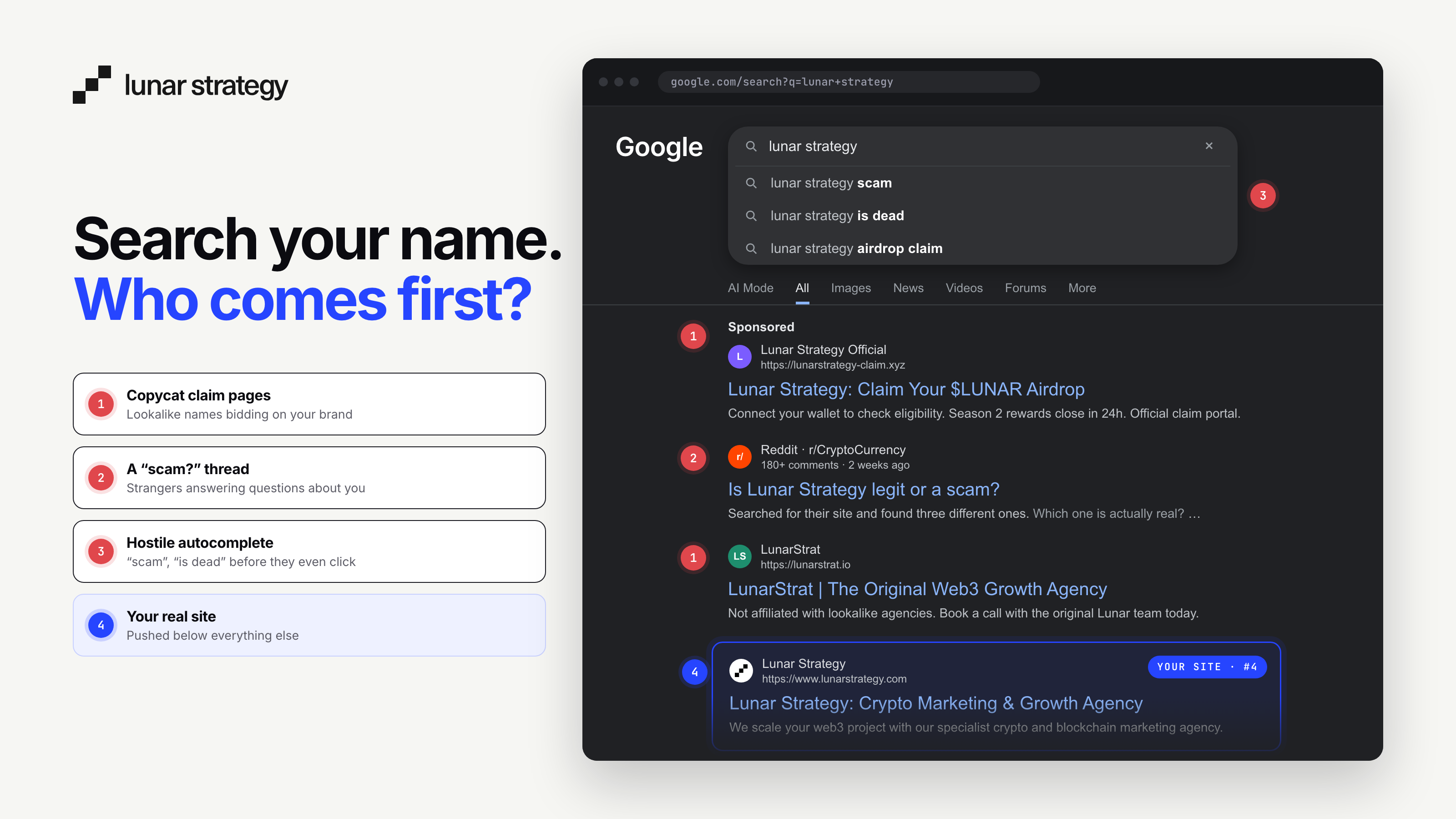
Step 1: Own the Search Results for Your Own Name
Your first SEO goal is that every search for your project's name leads to you. That search, also called your brand SERP (the search engine results page for your name), is where new users, investors and journalists check whether you're real.
It's also where attackers wait. Chainalysis estimates that crypto scams received at least $14 billion on-chain in 2025, and that impersonation scams grew 1,400% year over year. In February 2026, Uniswap founder Hayden Adams wrote that "Scam ads keep returning despite years of reporting." If a clone sits above your site, some of your users will connect a wallet to it.
The 10-minute brand SERP audit
Run these searches in a private browser window, on desktop and on mobile:
- Your project name. Is your site first? Do your X, docs, GitHub and CoinGecko or CoinMarketCap pages follow?
- Your name + "scam", "legit", "review" and "airdrop". Who answers these questions? If it isn't you, someone else is.
- Your token ticker. Tickers are shared across chains, so check that your token page shows up and not an unrelated asset.
- The autocomplete. Type your name slowly and note every suggestion, good or bad.
- Your name in Perplexity and ChatGPT. Check whether the facts are current (contract address, chain, token details).
What to fix first
- Publish an official links page. One page on your domain lists your contract addresses, official domains, social accounts and claim or airdrop URLs. Link it from your homepage footer and your X bio.
- Answer the trust questions yourself. A security page with audits, a "how to verify our official links" section and a plain FAQ give Google something to rank for "is [name] legit."
- Tell Google who you are. Organization structured data (code that labels your company details for search engines) can help Google disambiguate your organization. Add your logo and list your official profiles in
sameAs. - Report clones. Pages built to imitate yours can be reported to Google Safe Browsing. Keep a shared doc of reported URLs so the community can help.
Worked example. Picture a lending protocol on a newer L2. A search for its name shows the right homepage, but "[name] airdrop" returns two lookalike claim sites and a Telegram group the team doesn't run. The fix takes a week: an official links page, a dated "airdrop status" page that says clearly whether an airdrop exists, Safe Browsing reports for both clones, and a pinned X post linking to the official page.
Now what? Run the audit today and save screenshots. Repeat it every month and before every major announcement, because a TGE or an airdrop is exactly when clones appear.
Step 2: Make Sure Google Can Read Your Site
A page that Google can't read can't rank, and many crypto sites show Google almost nothing. The cause is usually a dApp (a decentralized application) built as a single-page JavaScript app, where all the content loads in the browser after the page opens.
In 2022, the team behind the Swapr exchange found that "there is no page content in div with id="root", so bots aren't indexing our page correctly." Their app worked for users. To Google, it looked empty.
Google can process JavaScript, in three phases: crawling, rendering and indexing. But its own JavaScript SEO guide says server-side or pre-rendering "is still a great idea" because "not all bots can run JavaScript." Server-side rendering (SSR) means the server sends finished HTML instead of an empty shell.
The view-source test
- Open your homepage and your most important page (docs or token page).
- Right-click and choose "View page source" (not "Inspect").
- Search the source for your main headline and one sentence of body text.
If you can't find them, a crawler may not either. Fix it with SSR or static pages for everything that should rank.
Rules for crypto sites
- Split the site from the app. Keep your homepage, docs, blog and token pages on a server-rendered or static site, and the app on its own subdomain (for example
app.yourproject.com). - Never put rankable content behind a wallet. Googlebot doesn't log in, and Google says it won't crawl pages that require a log-in. A wallet connection works the same way. Fees, supported assets and risks should be readable without connecting.
- Check speed on mobile. Google's Core Web Vitals call a page "good" when the main content loads within 2.5 seconds, interactions respond within 200 milliseconds and layout shift stays at 0.1 or less.
- Set up Search Console on day one. It's free, it shows which pages are indexed and it reports errors before they cost you traffic.
Now what? Run the view-source test on your 5 most important URLs this week. If any fail, that's your first ticket for the dev team, ahead of any content work.
Step 3: Build the Pages Your Project Type Needs
Crypto SEO isn't blogging. The pages that rank and get quoted are usually docs, token pages, security pages and comparisons, because they answer the questions people actually search before they use a product.
Most sites have a homepage, a blog and a "launch app" button, with nothing in between. Use this table to see what's missing for your type of project.
A token page, for example, should hold real information: contract address, chain, supply, where it trades and links to the audit. Google's spam policies call out scaled content abuse, meaning many pages generated mainly to rank, "no matter how it's created." A thousand token pages with the same paragraph and a new name fit that description.
If your token launch is coming up, the "token before TGE" row belongs in your 90-day pre-TGE plan. Search results for a new name take time to settle, so publish these pages weeks before launch, not on the day.
Now what? Pick your row, list the pages you already have, and mark the gaps. The gaps are your content plan for the next quarter.
Step 4: Find Keywords When Nobody Searches Your Category Yet
Crypto keyword research starts from what people want to do, not from coin names. New categories often show zero search volume in keyword tools, because people don't search for a term before they learn it.
Group your keywords into 5 clusters:
- Brand: your name, ticker, "[name] docs", "[name] airdrop".
- Product: the category you compete in, such as "liquid staking" or "crypto lending".
- Problem: the task behind the category, such as "how to earn yield on stablecoins" or "how to bridge ETH".
- Education: the concepts a newcomer needs, such as "what is restaking".
- Comparison: "[you] vs [competitor]" and "best [category] for [chain]".
When volume is low, use other signals. Look at the questions in your Discord and Telegram (a well-run community is a free keyword tool), the "People also ask" box on Google, and the queries already showing in Search Console. If 20 community members asked the same question this month, that question deserves a page, whatever a keyword tool says.
One page per topic, not per keyword. "What is liquid staking", "liquid staking explained" and "liquid staking guide" are the same search intent, so they belong on one strong page.
Now what? Build a spreadsheet with the 5 clusters, add 10 queries to each, and map every query to an existing page or a page from your Step 3 gap list.
Step 5: Write Content That Passes Google's Trust Bar
Google applies a stricter standard to content that can affect people's money. Its guidance on helpful content says its systems give "even more weight" to strong E-E-A-T (experience, expertise, authoritativeness and trust) for topics that affect "financial stability," which it calls "Your Money or Your Life" topics. The same page says "trust is most important."
In practice, a crypto page earns trust with things a reader can check:
- Real authors. A name, a role and a short bio on every article.
- Dates. A publish date, and an "updated" date when you actually update.
- Sources. Link to the audit, the docs, the governance proposal or the on-chain data behind each claim.
- Risk disclosure. Say what can go wrong (smart contract risk, depeg risk, lockups) in plain words.
- No promises. Never imply guaranteed returns. It erodes trust with readers and with Google.
Google also separates "commodity" from "non-commodity" content. Its AI search guide describes commodity content as "based on common knowledge," and non-commodity content as "unique expert or experienced takes." Another "What is DeFi?" post is commodity. Your protocol's 12 months of liquidity data, or a breakdown of how your vaults behaved during a volatile week, is not.
Now what? Pick your 3 most important pages and add an author, a date, sources and a risk section to each. Then plan one piece built on data only your team has.
Step 6: Earn Links and Mentions Instead of Buying Them
Links from trusted sites still tell Google you're worth ranking, but bought links put you at risk. Google's spam policies list "Exchanging money for links, or posts that contain links" as link spam. Paid placements, including sponsored articles on crypto media, should carry rel="sponsored".
What earns links in crypto:
- Original data. On-chain dashboards, research reports and ecosystem stats that journalists and analysts can cite.
- Real news. Funding, launches, integrations and audits, pitched to the right reporters. A good crypto PR partner makes this repeatable.
- Developer assets. Open-source tools, SDKs and GitHub repos that other projects link from their docs.
- Ecosystem pages. Chain directories, partner pages and grant announcements usually link to the projects they list.
Mentions without links matter too, especially for AI search. Consistent coverage of your project on X and in your community (our X playbook covers this) makes your name easier to recognize and verify.
Now what? List the 3 assets your team could publish this quarter that a journalist or developer would want to link to. Plan the announcement before you build them.
Step 7: Show Up in AI Overviews and ChatGPT
For Google, ranking in AI answers is part of SEO, not a separate discipline. Google's guide states that optimizing for generative AI search "is optimizing for the search experience, and thus still SEO." It also says you can ignore tactics like "chunking" content or creating files such as llms.txt, because Google Search doesn't use them.
Everything in Steps 1 to 6 already does the work: indexable pages, clear answers, sources and trust. Two habits help on top:
- Answer first. Open each section with a one or two sentence answer that makes sense out of context, then explain.
- Keep facts identical everywhere. Your site, docs, X bio and CoinGecko page should state the same chain, supply and contract address.
ChatGPT and Perplexity use their own crawlers and rules, so they need a few extra checks. We cover them step by step in how to get your crypto project cited by ChatGPT and Perplexity.
Now what? Ask Google, ChatGPT and Perplexity the 5 questions a new user would ask about your category. Note who gets cited, and which of your pages should have been.
Step 8: Measure From Search to Wallet Connection
Rankings are a means, not the goal: measure how many search visitors become users. For a crypto project, that usually means a wallet connection, a deposit or a swap.
Set up 4 things:
- Brand vs. non-brand clicks. Search Console's branded queries filter, available to all eligible sites since March 2026, splits searches for your name from everything else. Non-brand growth shows that SEO is bringing in new people.
- AI search impressions. Since June 2026, Search Console shows impressions in AI Overviews and AI Mode, rolled out to all sites by August 31, 2026. It reports impressions, not clicks.
- Conversion events. In your analytics tool, track "connect wallet" and "first transaction" as events, and tag links from your site to your app so you can see which pages send users.
- A monthly brand SERP check. Repeat the Step 1 audit and log what changed.
How long it takes: technical fixes take effect once Google recrawls the affected pages. New content and links usually take a few months to move non-brand traffic. Plan in quarters, and judge SEO on the trend, not the first month.
If you work with an agency, ask for these numbers in every report. Our guide on how agencies measure ROI explains what a useful monthly report includes.
Now what? Turn on the branded filter and the AI report in Search Console, add the two conversion events, and save this month as your baseline.
The Crypto SEO Checklist
Copy this list into your team's tracker. It's ordered by priority.
- Search your name, ticker and "[name] scam / airdrop / legit". Screenshot the results.
- Publish an official links page with contract addresses, domains and socials.
- Report every clone to Google Safe Browsing and keep a shared log.
- Add Organization structured data with your logo and official profiles.
- Run the view-source test on your top 5 URLs.
- Move rankable content off the wallet-gated app onto server-rendered or static pages.
- Verify the site in Search Console and submit a sitemap.
- Check Core Web Vitals on mobile for your homepage and docs.
- Build the missing pages for your project type (Step 3 table).
- Map 50 queries across brand, product, problem, education and comparison.
- Add authors, dates, sources and risk sections to your key pages.
- Plan 3 linkable assets (data, research, open-source tools) for the quarter.
- Mark every paid placement with
rel="sponsored". - Track brand vs. non-brand clicks, AI impressions and wallet connections monthly.
Frequently Asked Questions
Can a crypto project run Google Ads instead of doing SEO?
Only some can. Google allows exchange and wallet ads in approved countries with certification and a local license, and bans ads for ICOs, DeFi trading protocols and token sales. Even when ads are allowed, they stop the day you stop paying, while SEO keeps working.
Can a small crypto team do SEO without an agency?
Yes, for the basics. The brand SERP audit, the view-source test, Search Console setup and the pages in Step 3 need a marketer and a few developer hours. Outside help pays off at scale: technical migrations, programmatic token pages and consistent PR. Our guide to what a Web3 marketing agency actually does shows where the line usually falls.
Should a token have a website before TGE?
Yes, ideally several weeks before. Google needs time to find and trust a new domain, and clones target the days around launch. Publish the official links page, tokenomics and airdrop status first.
Does crypto SEO work for projects without a token?
Yes. Infrastructure, wallets, security firms and developer tools often get more value from SEO than tokens do, because their buyers search for solutions. Docs, use-case pages and comparisons do most of the work.
Is it safe to use AI to write crypto SEO content?
It's safe to use AI for research, outlines and editing. It's risky to publish AI text at scale without adding anything new, because Google treats mass-produced pages with little value as spam. Every page still needs a real author, checked facts and something your team actually knows.
Start With Your Own Name
Crypto SEO comes down to a simple order: own your name, make your site readable, build the pages your project type needs, earn trust and links, and measure what converts. Do the first two this week. Everything else compounds on top of them.
After working with more than 300 crypto projects, we see the same pattern: the teams that win search fixed the basics early, before the launch noise started. If you want a second pair of eyes on your site, our crypto SEO team can run the audit with you. Book a call and bring your brand SERP screenshots.