
























TL;DR:
- Most crypto startups raise money before their token launches, so the seed round sells investors a right to an asset delivered later. Three contracts do it: a SAFT (future tokens), a SAFE (future equity) and a SAFE plus a token warrant (equity now, the right to tokens later).
- The SAFT was built for crypto in 2017, and in 2020 courts ruled that the token presales of Kik and Telegram were part of public securities offerings. The market moved to SAFE plus token warrant, and in March 2026 the SEC published an interpretation that names the SAFT and says when delivered tokens stop being part of an investment contract.
- Whichever you sign, the contract decides who holds tokens on launch day, how many, and when they can sell. That makes it a launch question as much as a legal one.
- The wording matters more than the name. Plasma alleges in a 2025 lawsuit that a single phrase in a $100,000 token warrant let one fund claim tokens worth about $273 million.
- The Seed-to-TGE Map below shows the situations each instrument is typically used in, and the six terms table lists the clauses that decide how much a deal moves on launch day.
A token's first owners are decided in the seed round, and how that deal is written can cost more than any launch campaign. When the SEC stopped Telegram's token in 2020, the company agreed to return more than $1.2 billion to investors and pay an $18.5 million penalty, because a court found its presale and the token's public trading were one securities offering. Telegram's mistake wasn't exotic: it sold investors the right to tokens delivered at launch, which is how most seed rounds in crypto still work.
The contract you sign at seed decides who sells at your TGE. This guide, updated for the SEC's March 2026 interpretation, is for founders and their teams raising before their token launches. It explains the three instruments, what changed in 2026 in the US and how the EU and Dubai treat the same sale, the terms that shape your launch, and it ends with a map of where each one is typically used. It compares the options without recommending one, and it isn't legal advice: the final structure is a question for counsel.
Three ways to give seed investors a stake before your token launches
A SAFT (simple agreement for future tokens) is a crypto fundraising contract in which investors pay today for tokens delivered later, usually at the token generation event (TGE), the day the token is created and first distributed. A SAFE (simple agreement for future equity) buys future shares in the company instead. A token warrant is a separate right to buy tokens if they are ever issued, usually signed next to a SAFE or a priced equity round.
All three exist for the same reason: early investors fund the company before anyone can price what they are buying. They differ in what the investor ends up holding, which is what the rest of this guide is about. The SAFE came first, created at Y Combinator in 2013, and it isn't debt: it carries no interest and no maturity date and only becomes stock when it converts in a priced round.
| SAFT | SAFE | SAFE + token warrant | |
|---|---|---|---|
| Investor gets | Tokens, delivered at or after the TGE | Shares, when the SAFE converts | Shares, plus the right to buy tokens |
| If no token ever launches | Depends on the contract's terms | Nothing changes: the investor holds equity | The warrant expires; the equity stays |
| Main risk in 2026 | The sale is a securities transaction from the day it's signed | No token upside, so token-focused funds may pass | A loosely defined token pool or formula |
| Commonly used by | A token-first project with a clear launch plan | A company that may never issue a token | Most seed rounds that expect a token |
The third column has become common in seed rounds. The reason starts with what happened to the first.
The SAFT was built for 2017, and the courts tested it in 2020
The SAFT was designed during the ICO boom to make token presales legal in the US. Its whitepaper, published in October 2017 by Marco Santori, then head of Cooley's fintech practice, with Juan Batiz-Benet and Jesse Clayburgh of Protocol Labs, split the deal in two: the SAFT itself is a security sold to accredited investors, while the tokens delivered once the network works "need not be securities". Sell the contract under securities law, deliver a working token, and the token would trade freely.
Two of the biggest presales of that era found the limits of that logic in court. Kik raised nearly $100 million in 2017, about $49 million of it through SAFTs sold to investment funds and wealthy investors, then the rest in a public sale. In September 2020 a federal court ruled that the private and public sales were a single securities offering, and Kik paid a $5 million penalty. Telegram, which had sold 2.9 billion Grams to 171 initial purchasers according to the SEC, had lost the same argument in March 2020.
"Telegram's sale of Grams to the Initial Purchasers, who will function as statutory underwriters, is the first step in an ongoing public distribution of securities."
Judge P. Kevin Castel, U.S. District Court for the Southern District of New York, SEC v. Telegram (2020)
The problem wasn't the paper itself. Both courts looked at the whole plan, and the plan was for presale buyers to resell into the public market at launch.
In 2026, the SEC wrote down how a SAFT works
On March 17, 2026, the SEC, joined by the CFTC, issued a formal interpretation of how securities law applies to crypto assets (SEC Release No. 33-11412). It sorts tokens into categories (digital commodities, collectibles, tools and stablecoins issued under the GENIUS Act are not securities; tokenized securities are) and names the SAFT directly. For founders, three points matter:
- The sale happens when you sign. Under a SAFT, the tokens become subject to an investment contract the day the agreement is signed, whenever they're delivered. The raise needs a registration or an exemption, as in 2017.
- Delivery can end the investment contract. When the tokens arrive, they leave it if buyers can no longer reasonably expect profits from the team's work, for example because the issuer has publicly disclosed that it finished the work it promised.
- You define "done." Whether the network is functional is judged by how the issuer itself described functionality, not by a general market view.
That is close to the 2017 thesis, with one condition the original paper didn't have: a public record of what you promised and when you delivered it. Congress hasn't settled the rest. The CLARITY Act, which would set a federal market-structure framework, passed the House in July 2025 but stalled in the Senate in September 2026.
Outside the US, the rules follow the token sale, not the seed contract
US law starts from the seed contract and asks whether it's a security. The EU and Dubai mostly regulate the moment a token is offered to the public, so for teams launching there the pressure point is the TGE, not the round. Two of the most developed regimes work like this:
- European Union (MiCA): Since December 30, 2024, anyone making a public offer of a token in the EU must be a legal entity and publish a white paper notified to their national regulator, under the Markets in Crypto-Assets Regulation. No white paper is needed for offers to fewer than 150 people per EU country, offers under €1 million over 12 months, or offers made only to qualified investors, so a private round can stay outside that duty. For a utility token whose service isn't running yet, the public offer can last at most 12 months. Tokens that qualify as financial instruments fall outside MiCA and under EU securities law.
- Dubai (VARA): The Virtual Asset Issuance Rulebook of Dubai's Virtual Assets Regulatory Authority covers entities issuing tokens in the emirate. A typical utility or governance token falls in Category 2: no VARA license, but placement and distribution must go through a licensed distributor, and the issuer must publish a whitepaper and a separate risk disclosure statement before any offer or marketing.
In both places, the white paper becomes a launch document with legal weight, and MiCA also sets rules for the marketing communications around the offer. That ties it to the launch narrative: every claim in the campaign has to match what the white paper says.
Why SAFE plus token warrant became a common seed deal
Between the court losses and the years of uncertainty, investors and founders moved to a structure that separates the two bets. The investor buys equity in the development company through a SAFE or a priced round and signs a token warrant alongside it. Norton Rose Fulbright, an international law firm, wrote in March 2026 that warrants "have gained increasing market prevalence" because of the uncertainty around SAFTs, and that the holder gets "the right, but typically not the obligation" to buy tokens before a set expiration date.
The appeal is flexibility. If the project never issues a token, the investor still owns part of a company. If it does, the warrant decides how many tokens they can buy, usually at a nominal price. Orrick, a law firm with a large crypto practice, described the moving parts in a 2023 guide to token warrants, and they're the same today:
- Scope: which tokens the warrant covers, usually any future token from the company, its affiliates or whoever acquires its technology.
- Pool: what the investor's share is measured against, either total supply or only the allocation reserved for insiders.
- Formula: how the share is calculated, most often from the investor's fully diluted ownership of the company.
- Measurement date: when that ownership is counted (at signing, at the token launch or when the warrant is exercised).
- Lockup: how long the tokens can't be sold after delivery.
Each of those lines can move millions of tokens, which is why the next section matters more than the choice of instrument.
The contract you sign at seed decides who sells at your TGE
Every instrument ends up as a line on your unlock calendar, the public schedule of when each group can sell. Here is what each one puts there:
- SAFT holder: receives tokens at or after the TGE, so when they can sell depends entirely on the lockup they negotiated.
- SAFE holder: receives no tokens unless another agreement gives them some.
- Warrant holder: can buy tokens for almost nothing once the token launches, so a seed investor can hold liquid supply as soon as the lockup ends.
That's why a16z crypto, one of the largest crypto investors and so a party with a stake in these terms, argues that lockups should be the same for investors, founders and employees, and that investors focused only on tokens "tend to have shorter investment timelines" and push teams to launch early. The argument is that a contract paying investors only in tokens gives them a reason to want the TGE before the product is ready.
The biggest launches publish these terms in advance. Arbitrum's official documentation shows investors held 17.53% of the ARB supply at its March 2023 launch, and that all investor and team tokens were locked for four years, with the first unlock one year after launch and monthly releases after that. Holders could read that schedule before they bought a single token.
When we plan a launch with a team, the investor unlock dates are among the first entries on the marketing calendar, because big announcements land differently in an unlock week. Our guide to tokenomics for founders shows how those dates move price, and our TGE guide covers the decisions to close before launch day.
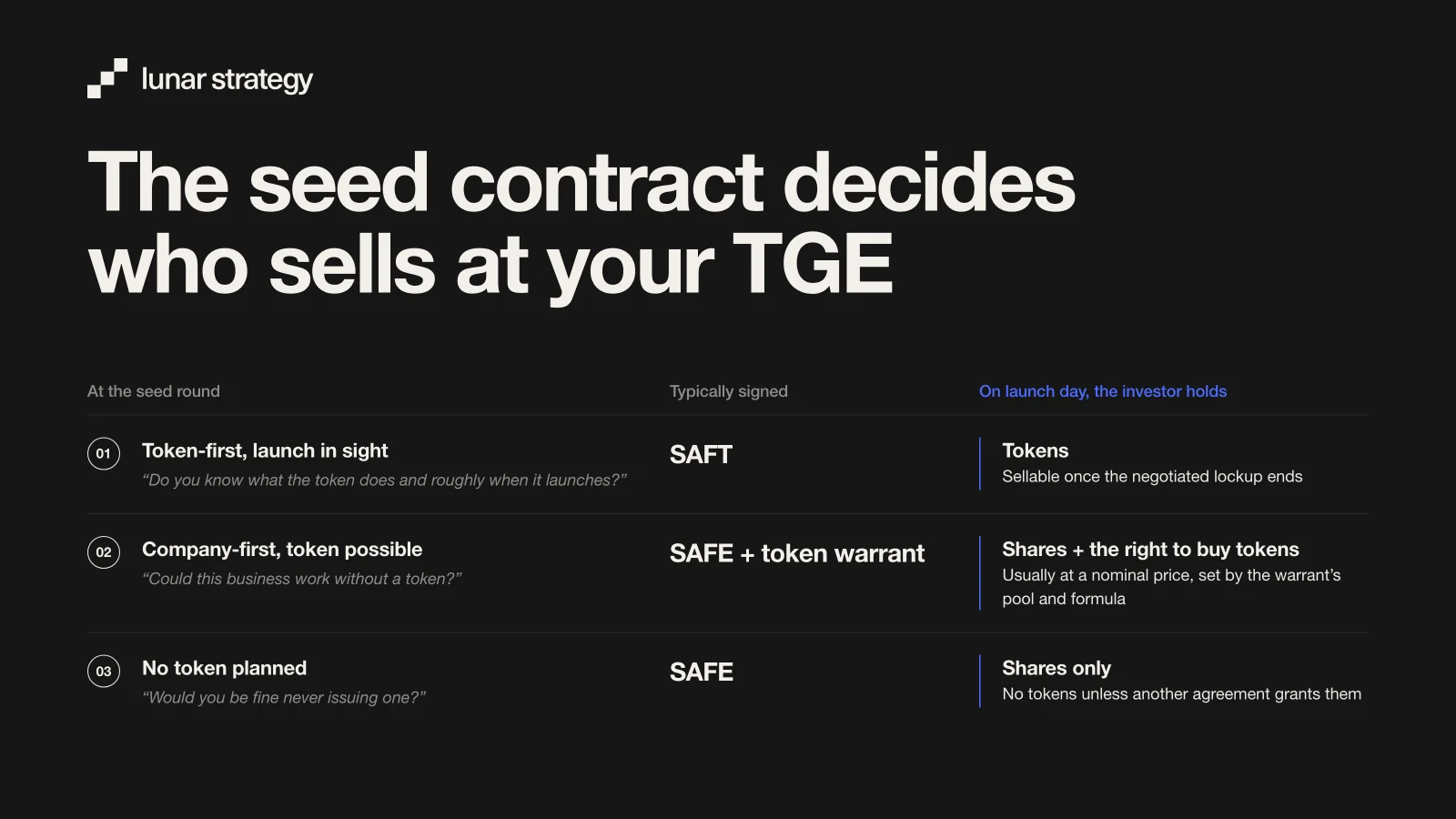
The Seed-to-TGE Map: where each instrument is typically used
The Seed-to-TGE Map describes three common situations at the time of a raise and the instrument usually found in each. It's a description, not a recommendation: every situation has the same three labels, covering what's typically used, the points lawyers tend to check, and what investors usually ask.
01 · Token-first, launch in sight: "Do you know what the token does and roughly when it launches?"
- Typically used: a SAFT, sold under a securities exemption, with a public record of what the team says it will deliver.
- Points to check: under the 2026 interpretation, the issuer's own description of "functional" is the test for when tokens leave the investment contract.
- Investors usually ask: the delivery date, the lockup and what happens if the launch slips.
02 · Company-first, token possible: "Could this business work without a token?"
- Typically used: a SAFE plus a token warrant, with the token pool and formula set in the warrant.
- Points to check: how the pool is defined (total supply or the insider allocation), since the same percentage can mean very different amounts.
- Investors usually ask: their share of supply, the measurement date and whether lockups match the team's.
03 · No token planned: "Would you be fine never issuing one?"
- Typically used: a plain SAFE or a priced round. For another way to fund a network, see node sales.
- Points to check: token-focused funds may not invest without token rights, and informal promises of "future allocations" can create the same obligations a warrant would.
- Investors usually ask: whether a token is truly off the table, and whether that's in writing.
Plans often change between the seed round and the launch, and the instruments handle that differently: a warrant can deliver tokens later if a token launches, while a SAFT can't easily be turned back into equity.
Six terms that decide what a token deal is worth
Most of the cost sits in the wording, not the instrument. In October 2025, Plasma, a blockchain built for stablecoins, sued an early investor in Delaware federal court. According to Plasma's complaint, Mercury Fund invested $100,000 through a SAFE and a token warrant in September 2024, and the warrant was drafted to count each holder's total equity in Plasma instead of their SAFE investment.
- What Plasma says the deal was: tokens tied to the $100,000 SAFE, the metric it used for about 100 other warrant holders, at a strike price of fractions of a penny.
- What the warrant said: tokens based on total equity holdings, which Plasma calls a drafting error it later corrected by amendment.
- What was at stake: Plasma alleges the fund claimed about 291 million XPL tokens, worth roughly $273 million.
These are allegations, not a court's findings. But nobody in the filing argues about the instrument, which the complaint calls "common". The fight is over one definition in one clause, the kind of line a founder skims while a round is closing. These six terms are where most of that value is decided:
| Term | The question it answers | Why it matters |
|---|---|---|
| Token pool | "Is the investor's share measured against total supply or the insider allocation?" | The same percentage can mean very different token amounts |
| Allocation formula | "Is the share fixed, or tied to equity ownership and diluted with it?" | a16z crypto calls fixed token allocations "predatory" because they make later rounds harder to raise |
| Super pro rata | "Is the investor's multiple above 1x?" | Orrick cites 1.25x or 1.5x of ownership as a point investors negotiate |
| Measurement date | "Is ownership counted at signing, at launch or at exercise?" | Later rounds dilute equity, so the date changes the count |
| Lockup | "Is the investor lockup at least as long as the team's?" | Equal lockups keep any one group from selling first |
| Launch rights | "Can investors approve or block when we issue a token?" | a16z says investors "should generally not have approval rights" over timing |
Each answer eventually becomes public, on the unlock calendar the community reads.
From the contract to the launch calendar
Whichever instrument a team signs, its terms end up as an unlock calendar: who can sell, how much, and in which month after launch. That calendar is where the legal side of a raise meets the launch plan. For readers still mapping investors, our list of strategic crypto VC funds covers who invests at this stage, and our guide to KOL investor rounds covers a round that uses the same contracts. Once the date is set, our 90-day pre-TGE playbook takes it from there.
The calendar is also where launches go wrong. We've worked with more than 300 crypto projects since 2019, including layer-1 teams like Supra, which came to us before its TGE to bring creators into its product launch (Lunar Strategy, 2025). Our go-to-market team builds the narrative and rollout plan around the dates your contracts set.
Plan your token launch with Lunar →
Send us your raise structure and launch window, and we'll say which dates to plan around first.
Frequently Asked Questions
Is a SAFE the same as a SAFT?
No, but one was copied from the other. The 2017 SAFT whitepaper says the SAFT is based on Y Combinator's SAFE: both trade money today for something of value later. The SAFE delivers shares in the company and the SAFT delivers tokens on the network, and that single difference changes how each is regulated, taxed and unlocked.
Is a SAFT a loan?
No. A SAFT is a prepaid purchase of tokens, not debt: it has no interest rate and no repayment schedule. Norton Rose Fulbright's comparison of funding structures lists neither SAFTs nor token warrants as repayable. The money comes back only in narrow cases, such as the company winding down, and only if the agreement says so.
What happens if you can't deliver the tokens on time?
Under the original SAFT form, nothing happens automatically. That template sets no launch deadline: the contract ends only when the tokens are issued or, if the company winds down, when investors are paid back their purchase amount. A delay simply leaves investors waiting, so a delivery deadline, a refund right or a switch to equity exists only if the contract includes one.
What happens to a token warrant if the token never launches?
A token warrant has an expiration date. If no token has launched by then, the warrant lapses and the investor keeps only what they bought through the SAFE or equity round. That is one reason investors accept warrants: their downside is a normal startup investment, not a promise you can't keep.
Do SAFT investors get their tokens on launch day?
Delivery and selling are different things. Tokens may be delivered at the TGE but stay under a lockup, a period when they can't be transferred. In Orrick's 2023 example, a warrant lockup blocks all transfers for one year after exercise, then releases half, with the rest released monthly over two to four years.
Can employees receive token warrants?
Usually not. Orrick advises companies to limit token warrants to investors, because US tax rules on deferred compensation make warrants a poor fit for paying staff. Teams normally reward employees through a separate token plan with its own vesting, and that plan also appears on the unlock calendar alongside investors.
What does "super pro rata" mean in a token warrant?
It means the investor's token share is a multiple of their ownership, not equal to it. An investor with 2% of the company and a 1.5x super pro rata right would receive tokens as if they owned 3%. Every multiple above 1x comes out of someone else's share.
How are SAFTs taxed in the US?
A SAFT is commonly structured as a prepaid forward contract to buy tokens, a sale of property rather than stock. A panel at San José State University's 2026 Blockchain Tax Conference, including a Fenwick partner, said receiving the tokens isn't taxable for the investor, whose cost basis is the SAFT price; tax comes when the tokens are sold or swapped. When the company owes tax is less settled, so confirm it with a tax adviser.