




















TL;DR:
- A Web3 ambassador program turns your most active community members into a small team that represents the project in other languages, at local meetups, in developer circles and on crypto Twitter. In most online communities only about 1% of users contribute most of the activity, and the program is how you find and keep them.
- Most programs fail for the same reasons: they attract farmers, run without structure, never measure outcomes and burn out their best people. In a December 2024 review of Celo's regional program, one hub lead admitted results were confirmed through "trust and minimal documentation."
- The fix is a clear journey (discovery, application, onboarding, activation, growth, retention) and five build steps: set objectives, pick KPIs, build a portal, onboard properly and reward proven work through earned tiers.
- Finding the right creators is the slowest part, and platforms like Creator Wire now handle it: any project can use it to source vetted creators, approve their work and pay them in one place.
- Measure contributors who stay active and the users they bring in, not posts. Ambassadors who are paid must disclose it, and a first season works best with 5 to 10 people in one role.
On January 15, 2026, X's head of product, Nikita Bier, announced that the platform would "no longer allow apps that reward users for posting on X," blaming them for "a tremendous amount of AI slop & reply spam." The token of Kaito, the best-known of those apps, fell more than 15% within 30 minutes (Decrypt), and Kaito said the same day it would shut down its Yaps leaderboard (CoinDesk).
Plenty of crypto ambassador programs ran on the same logic: open the doors, reward anyone who posts, count the points. That model lost its main channel overnight, and it was failing long before the ban. Programs built that way tend to break in four places: they attract airdrop hunters, they lack structure, they don't measure outcomes, and they burn out the few contributors who actually care.
The programs that work look less like a campaign and more like a small team: chosen people with clear jobs, briefed work, rewards for impact that has already happened, and payment they disclose. This guide walks through how to build one, from the phases of the ambassador journey to the step-by-step setup, the metrics, real examples and the mistakes to avoid.
Why ambassador programs work in Web3
In crypto, an ambassador program is a structured group of community members who represent a project outside its core team, in return for rewards, access or recognition. It works because every community already has a small group doing this for free. Jakob Nielsen's participation inequality research (2006) found that in most online communities 90% of users only watch, 9% contribute now and then, and 1% "participate a lot and account for most contributions." A program finds that 1%, gives them a clear job and keeps them.
Web3 users also expect to take part, not just consume. They hold the token, vote in governance and test the product before anyone else, so the step from user to ambassador is short. Good ambassadors usually play one of four parts:
- Brand evangelists: explain the project in threads, videos and guides, often in a language the team doesn't speak.
- Local operators: run meetups, Spaces and university events in their city or region.
- Content multipliers: turn every announcement into explainers, translations and tutorials that reach new people.
- Community leads: welcome newcomers, answer questions in Discord and Telegram and flag problems before they spread.
The word "ambassador" also gets stretched to cover jobs that aren't ambassador work at all, and mixing them up is where budgets leak.
| Role | What they do | How they're paid | Time horizon |
|---|---|---|---|
| Ambassador | Represents the project in a region, language or niche: content, events, onboarding | Stipend, bounties or tokens tied to agreed work | Seasons of 3-6 months, renewable |
| KOL | Reaches an existing audience with sponsored content | Fee per campaign or post | One campaign |
| Moderator | Keeps Discord or Telegram safe and answers questions | Salary or contracted hours | Ongoing |
| Quest participant | Completes one-off tasks for points | Points, XP or airdrop eligibility | Days to weeks |
If you need reach next month, brief a KOL (see what a KOL is in crypto and our KOL brief template). If you need someone still explaining your project in a year, you need an ambassador.
The six phases of a Web3 ambassador journey
Every ambassador moves through the same path, from first hearing about the program to becoming part of its core. Mapping it before launch shows where people will drop off and what each phase needs from your team. Most programs only design the first two phases, which is why so many fill up fast and go quiet within a season.
| Phase | What happens | Outcome |
|---|---|---|
| Discovery | Members hear about the program in Discord, on X or from another ambassador | The right people know the program exists and what it's for |
| Application | They apply through a portal and complete a short paid trial task | You choose from finished work, not promises |
| Onboarding | New ambassadors get the kit, the private channel and a named contact | Everyone can explain the product and its risks accurately |
| Activation | Monthly briefs tied to real moments: launches, listings, votes | Verified deliverables that reach new users |
| Growth | The best contributors take on bigger roles and lead others | Leads who came up from inside the program |
| Retention | Season reviews, promotions and rotation out | A team that stays active and keeps improving |
Each phase has an owner on your side, and each one feeds the next. Discovery depends on the reputation the program builds in Retention, and Activation only works if Onboarding was done properly.
How to build a Web3 ambassador program, step by step
Step 1 · Define your objectives. "What do we need ambassadors to achieve?" Tie the program to one or two business goals, not to "awareness." A good objective names a result, a place and a deadline: "grow monthly active users in Brazil by 2,000 before our mainnet launch in March," or "get our SDK taught at five developer meetups this quarter." Objectives decide which roles you need (a regional lead for the first, a developer educator for the second) and stop the program from drifting into posting for the sake of posting.
Step 2 · Set clear KPIs. "How will we know it's working?" Pick 3 to 5 numbers per objective before launch, so the season review is a reading of numbers rather than a debate:
- Qualified applications: applicants who pass the trial task, not total sign-ups.
- Verified deliverables: meetups held, guides published, calls hosted, checked by a team lead.
- Community metrics: new members who stay active after 30 days.
- Onchain metrics: new active wallets through ambassador referral links or event attendance badges.
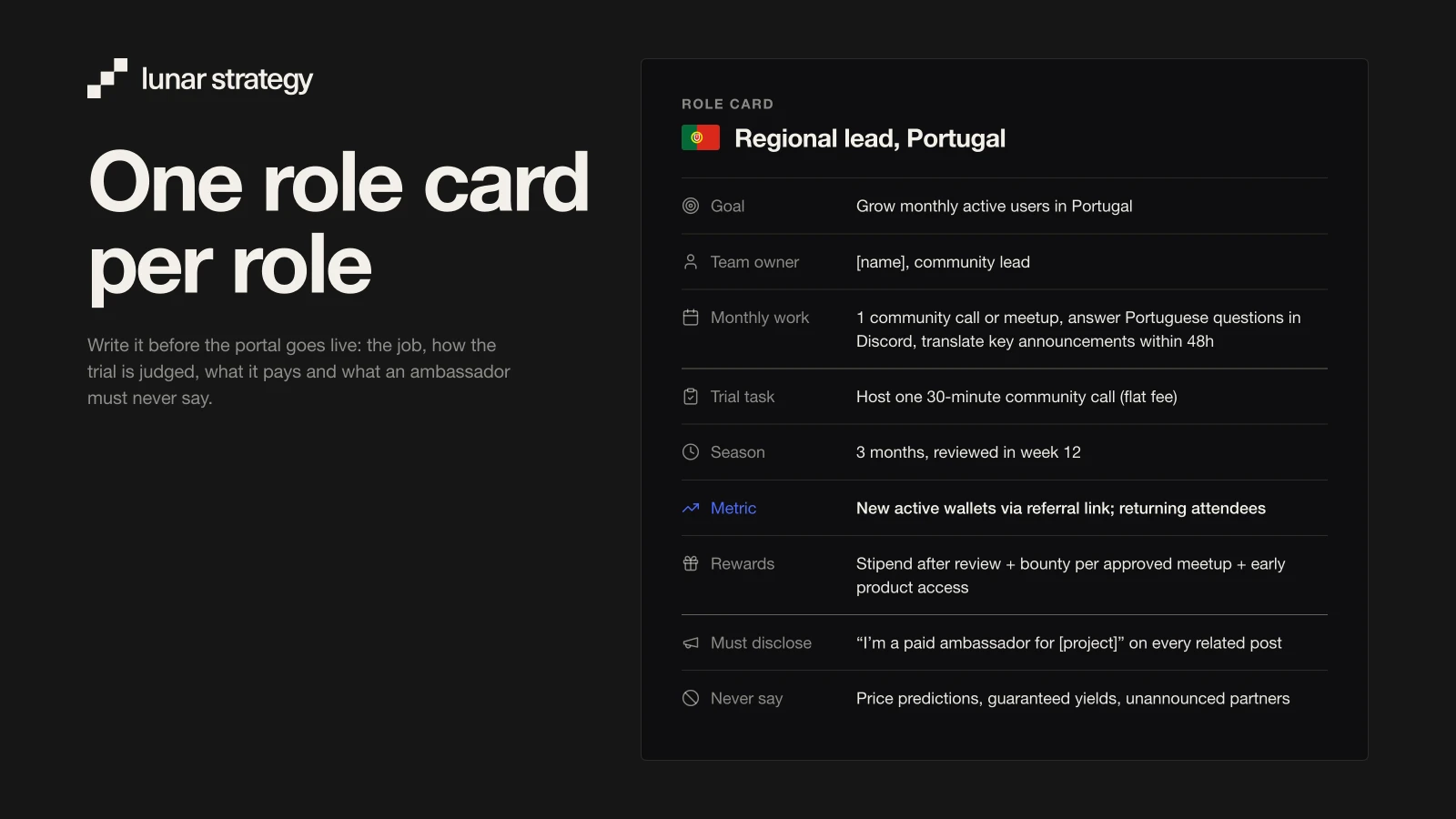
Step 3 · Build an ambassador portal. "Where do people learn about the program and apply?" A simple public page in Notion or on your site is enough: the mission, the roles, who's eligible, the tiers, what each tier earns and a short application form. Promote it in your Discord and pinned posts on X, but start with the people already answering questions in your community; open applications come last. Before you publish, write one role card per role:
Step 4 · Build the onboarding system. "Do they know enough to represent us?" Selected ambassadors need more than an invite to a group chat. Give them a welcome pack (positioning, approved claims, FAQ, brand assets), a code of conduct, examples of good contributions, a live onboarding call and a named contact on the team, usually your community manager. The kit also has to cover disclosure, because regulators read a paid ambassador's post as an ad. In the US, the FTC tells influencers to "disclose when you have any financial, employment, personal, or family relationship with a brand" (FTC).
| Market | Rule | What it means for your program |
|---|---|---|
| United States | FTC Endorsement Guides (updated June 2023) | Ambassadors disclose payment, tokens or free products in every relevant post |
| United Kingdom | FCA cryptoasset promotion rules (since October 8, 2023) and finfluencer guidance FG24/1 (March 2024) | Promotions to UK consumers must be clear, fair and not misleading, with risk warnings; "refer a friend" bonuses are banned |
| European Union | MiCA Article 7 | Marketing must be clearly identifiable, fair, clear and not misleading, and consistent with the white paper |
The UK rules "apply to firms wherever they are based globally" when they target UK consumers (FCA). This is a summary, not legal advice, so confirm the details with counsel for each market.
Step 5 · Reward and recognize effectively. "What do they get, and when?" Pay for impact that has already happened. Optimism's Retro Funding follows "the principle that positive impact to the Collective should be rewarded with profit to the individual" (Optimism), and the same logic keeps farmers out: before its airdrop, Linea flagged about 516,960 of 1,297,203 eligible addresses, roughly 40%, as Sybils (The Block). Anything paid per action gets farmed, so rewards follow review and tiers have to be earned:
| Tier | How you get there | Rewards |
|---|---|---|
| Contributor | Pass the paid trial task | Bounties per approved deliverable, role badge, POAP (proof of attendance protocol) for events |
| Advocate | Complete one full season with verified work | Monthly stipend after review, early product access, team calls |
| Core | Nominated by Core members after two or more seasons | Monthly retainer, vested tokens, travel to events, a say in the next season's roles |
Pay in stablecoins where you can: token rewards that unlock instantly tend to get sold the day they land. Recognition matters as much as money, so add public shout-outs, a leaderboard of verified work (not posts) and retroactive bonuses at the end of each season. Our airdrop marketing guide covers how to keep farmers out of token rewards.
Finding the right creators with Creator Wire
For content roles, sourcing is the hardest part of Step 3. Follower counts are easy to inflate, so a big account can reach fewer of the right people than a small one followed by builders and traders. Then come the operations: briefs, approvals and payments spread across spreadsheets, group chats and screenshots. That's the work Creator Wire was built to take off your desk.
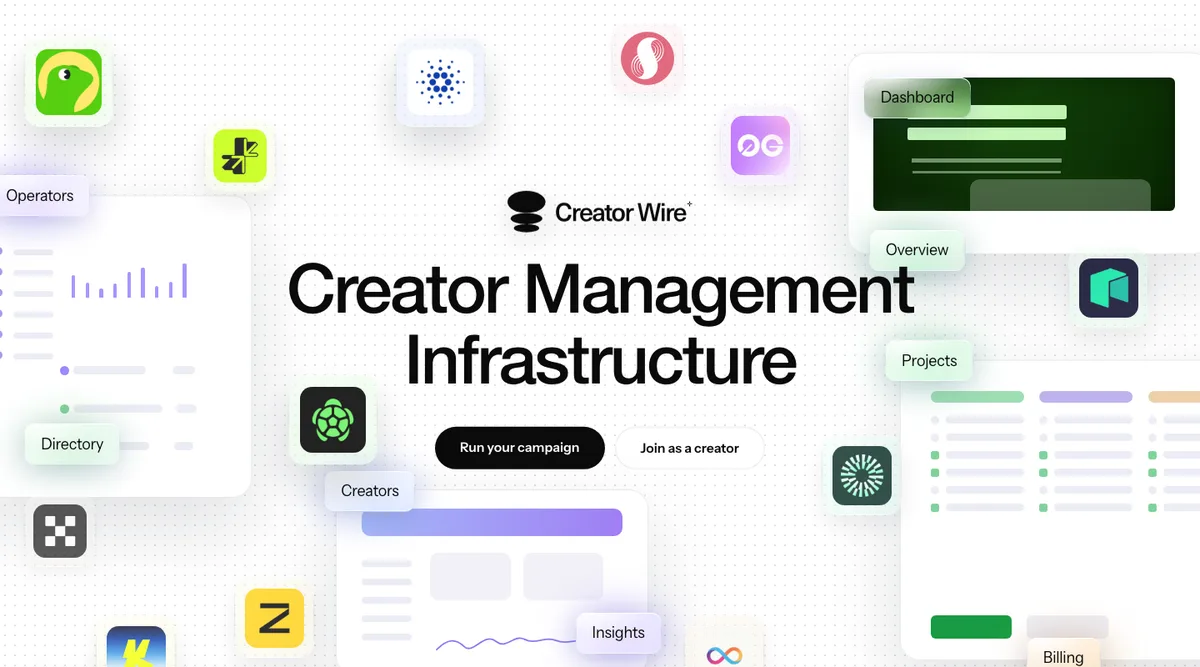
Creator Wire is a creator management platform, built by the Lunar team, that any project or agency can use to run creator work for its program:
- Source vetted creators: browse a network of verified crypto creators, benchmarked on real engagement and the quality of their audience rather than raw follower counts.
- Shortlist and share: build a shortlist and share it with your team as one link before anyone is booked.
- Brief and approve: send briefs, collect deliverables and approve them in one workspace, with the budget updating as you go.
- Track: follow every post's performance from one dashboard, so the season review reads numbers instead of screenshots.
- Pay: pay every creator onchain in one flow once the work is approved.
Creators can join too: they get briefs, approvals and payouts in their own app. The split with Lunar is simple: Creator Wire finds and manages the creators, and Lunar handles the strategy and the program itself, from objectives and roles to briefs, community and season reviews.
How to measure performance
A healthy program shows up in product data, not only in social data: new users who arrived through an ambassador, contributors still active after a season, and work the community actually uses. Review these monthly and agree on them before launch.
| Metric | What it tells you | Phase to fix |
|---|---|---|
| Activation rate (ambassadors who complete a first brief within 30 days) | Whether onboarding prepared people to act | Onboarding |
| Retention at 30, 60 and 90 days | Whether you picked the right people | Application |
| Verified deliverables per ambassador | Whether the work happened | Activation |
| New active users or wallets from ambassador links and events | Whether the work reached new people | Activation |
| Leads promoted from inside | Whether people can grow in the program | Growth |
| Off-message or undisclosed posts | Whether the kit covered claims and disclosure | Onboarding |
The tool stack can stay small: Discord or Telegram for the private channel, X for most of the public work, a Notion page for role cards and the kit, quest platforms for one-off community tasks and Creator Wire for creator roles. If one person with ten wallets can hit a metric, it doesn't belong on the dashboard.
Real examples from Web3 projects
Avalanche Team1. Avalanche's community program counts "450+ members across 40+ countries," with regional leads who "provide direct guidance and ecosystem connections" and event funding for members. It states that "full-time Web3 experience is not a prerequisite," which keeps the door open to people who show initiative rather than credentials (Avalanche).
Solana Superteam. Superteam, which calls itself "the Talent Layer of Solana," runs 25 local chapters (Superteam). Each chapter works like a regional ambassador team: local leads, local events and paid work for local builders, which is the Growth phase done at ecosystem scale.
Injective. Injective's ambassador program rewards its top 100 contributors from a monthly pool of up to 2,500 INJ and reviews each mission before awarding points (Injective). Review before reward is what keeps a points system from turning into a farm.
Celo Regional DAOs. Celo's regional program shows what happens without shared KPIs, and how to fix it. In 2024, seven regional DAOs received budgets from $2,000 to $311,200, and two hubs took over 70% of the total (Celo Forum). The public retrospective that followed is worth reading in full.
"We often rely on trust and minimal documentation to confirm that parties have met their commitments."
Niko da Costa Gomez, co-lead of Celo Europe, in Celo's 2024 Regional DAOs retrospective, December 2024
The January 2025 proposal replaced open budgets with earned tiers: a new hub starts with 3 months and $2,500 to $10,000, and only a "proven track record" unlocks up to $50,000 for 6 months, with standardized KPIs and onchain checks for individual ambassadors (Celo Forum). Celo deserves credit for doing this in public; most projects make the same mistakes in private.
Common mistakes to avoid
Smaller programs fail more quietly. In February 2025, a proposal on the Minswap DAO forum asked for $24,000 to keep three ambassadors for six months. A token holder answered that the program "has had no quantifiable positive impact on Minswap or MIN holders. TVL is down. Price is down. Activity in Discord is down" (Minswap forum). The same mistakes show up again and again:
| Mistake | What it looks like | Fix |
|---|---|---|
| No tier system | Everyone gets the same title and the same pay | Earned tiers with clear criteria to move up |
| Pay before proof | Stipends for holding a title | Paid trial task first, rewards after review |
| No communication channel | Ambassadors learn news from public posts | Private channel and a named team contact |
| Vanity metrics | Views and post counts in every update | Active users, retention and verified work |
| Unclear or overpromised rewards | Vague "token allocation" that never arrives | Written reward rules per tier, paid on schedule |
| No offboarding | The list only grows, inactive members keep perks | Season review that rotates people out |
Final thoughts: start small and build a team, not a campaign
Start smaller than feels right. A first season with 5 to 10 people in one role, chosen from your own community, will teach you more than a public form with 500 entries. Write the role card in week 1, run paid trial tasks in weeks 2 and 3, run the season with monthly briefs until week 12, then review, promote and rotate before adding a second role. If your program already exists, use the same plan as an audit: freeze new titles, write the missing role cards and move rewards to after-review payment.
We've worked with more than 300 crypto projects since 2019, and ambassador programs are one of the growth initiatives inside our community management service. Lunar sets the objectives, designs the roles and tiers, writes the briefs and runs the community and the season reviews. When Theoriq ran its sale on the Kaito Capital Launchpad, our team coordinated members through the commitment period, and the sale closed 40x oversubscribed with $78M in commitments (Lunar Strategy, 2025). For creator roles, Creator Wire handles sourcing, approvals and payouts. If a launch is coming, our 90-day pre-TGE playbook shows where ambassadors fit, and our crypto community management guide covers the wider setup.
Plan your ambassador program with Lunar →
Tell us who's already helping in your community, and we'll show you which role to start with and which creators to bring in.
Frequently Asked Questions
Are ambassador programs worth it for crypto projects?
Yes, when the program has a narrow job and pays for verified work. Ambassadors reach places a core team can't: local languages, university groups, developer meetups and other communities. They're not worth it as a cheap substitute for marketing reach, because programs that pay for volume attract farmers and leave the project with posts nobody reads.
How much do crypto ambassadors get paid?
There is no standard rate. Programs pay through a mix of monthly stipends, bounties for specific deliverables, token rewards and access, such as early features or event tickets. A practical rule: set pay from the hours a role really needs, pay new members per task, and keep stipends for people who have already completed a season.
What's the difference between an ambassador and an affiliate?
An affiliate earns a commission on the sales or sign-ups they refer, so the relationship is purely transactional. An ambassador represents the project more broadly, through events, education, support and feedback, and is rewarded for that work. Some programs add referral rewards on top, but check local marketing rules before you do.
Do you need a large following to be a crypto ambassador?
No. Audience size matters for KOLs, not for ambassadors. A good ambassador is trusted inside a specific group: a city, a language, a developer niche or a Discord server. Even for creator roles, who follows you matters more than how many, which is why good vetting looks at audience quality rather than raw counts.