




























TL;DR:
- A neobank is a financial company that offers accounts, cards and payments only through an app, with no branches. Many US neobanks are technology companies that keep your money at a partner bank, so the word "bank" in their marketing deserves a closer look.
- The model works at scale. Revolut ended 2025 with 68.3 million retail customers and Nubank reached 139 million customers by mid-2026, won over by low fees, fast sign-up and an app that replaces the branch.
- The catch is protection. FDIC insurance only covers money that actually sits in an insured bank with records showing it is yours, and the 2024 collapse of Synapse left customers $60-90 million short.
- The line between neobank and bank is blurring. Nubank and Revolut both won conditional approval for US national bank charters in 2026, and crypto neobanks now add stablecoin balances and cards on top.
- Before opening an account, check which bank holds your money, how it is insured and what happens if the app shuts down. Teams building a neobank should answer those three questions on their own site before a customer has to ask.
Revolut added 16 million retail customers in 2025 alone and finished the year with 68.3 million, according to its 2025 annual report. Neobanks have grown from a niche for people tired of overdraft fees into the main account for tens of millions, and in 2026 two of the largest took formal steps toward becoming US banks.
The word itself still causes confusion. A neobank can be a fully licensed bank in one country and an app built on someone else's bank in another, and that difference decides what happens to your money when something breaks. This guide explains what a neobank is, how it works behind the app, how safe your money is and where crypto neobanks fit, so you can judge any of them in a few minutes.
What is a neobank?
A neobank is a financial company that offers banking services such as checking accounts, debit cards, savings and payments entirely through a mobile app or website, with no physical branches. Many, especially in the US, are technology companies that keep your money at a partner bank. The Basel Committee on Banking Supervision, which sets global banking standards, defines neobanks as "digital-only banks" that offer banking services "predominantly through smartphone applications or internet-based platforms."
The label covers two very different kinds of company. Some neobanks hold their own banking license, as Nubank does in Brazil and Revolut now does in the UK. Others partner with a licensed bank, which holds the deposits and issues the cards. Chime says so in its own footer: "Chime is a financial technology company, not a bank." The Basel Committee notes the same split, with some countries using "neobank" for fully regulated banks and others for firms "which may not themselves be insured deposit-taking institutions."
You will also see neobanks called digital banks, challenger banks or fintech banks. The terms overlap, and this is how they are usually used:
| Term | What it usually means | Example |
|---|---|---|
| Neobank | App-only financial company, licensed itself or working through a partner bank | Chime, Revolut, Nubank |
| Digital bank | A bank that operates mainly online, often used for licensed ones | Varo Bank |
| Challenger bank | UK and European term for newer banks competing with the incumbents | Monzo, Revolut |
Why are neobanks popular?
Neobanks grew by fixing the parts of banking people complain about most. Opening an account takes minutes on a phone, monthly and overdraft fees are low or zero, and features such as early paychecks, instant spending alerts and cheap currency exchange come built in. The appeal is strongest with younger customers and with people traditional banks served poorly, such as freelancers, immigrants sending money home and anyone tired of overdraft fees.
The three largest neobanks alone serve more than 210 million customers:
| Neobank | Customers | Main markets | License status |
|---|---|---|---|
| Nubank | 139 million Q2 2026 | Brazil, Mexico, Colombia | Licensed in Brazil; US national bank charter conditionally approved in January 2026 |
| Revolut | 68.3 million retail End of 2025 | UK and Europe | Full UK banking license since March 2026; US charter conditionally approved in September 2026 |
| Chime | 10.4 million active members Q2 2026 | United States | Technology company; banking services by The Bancorp Bank and Stride Bank |
Growth has turned into profit for the leaders. Revolut reported £1.7 billion in pre-tax profit for 2025, up 57%, and Chime posted $670 million of revenue in the second quarter of 2026, up 27% (Chime). That profitability is recent, and many smaller neobanks still lose money.
How do neobanks work?
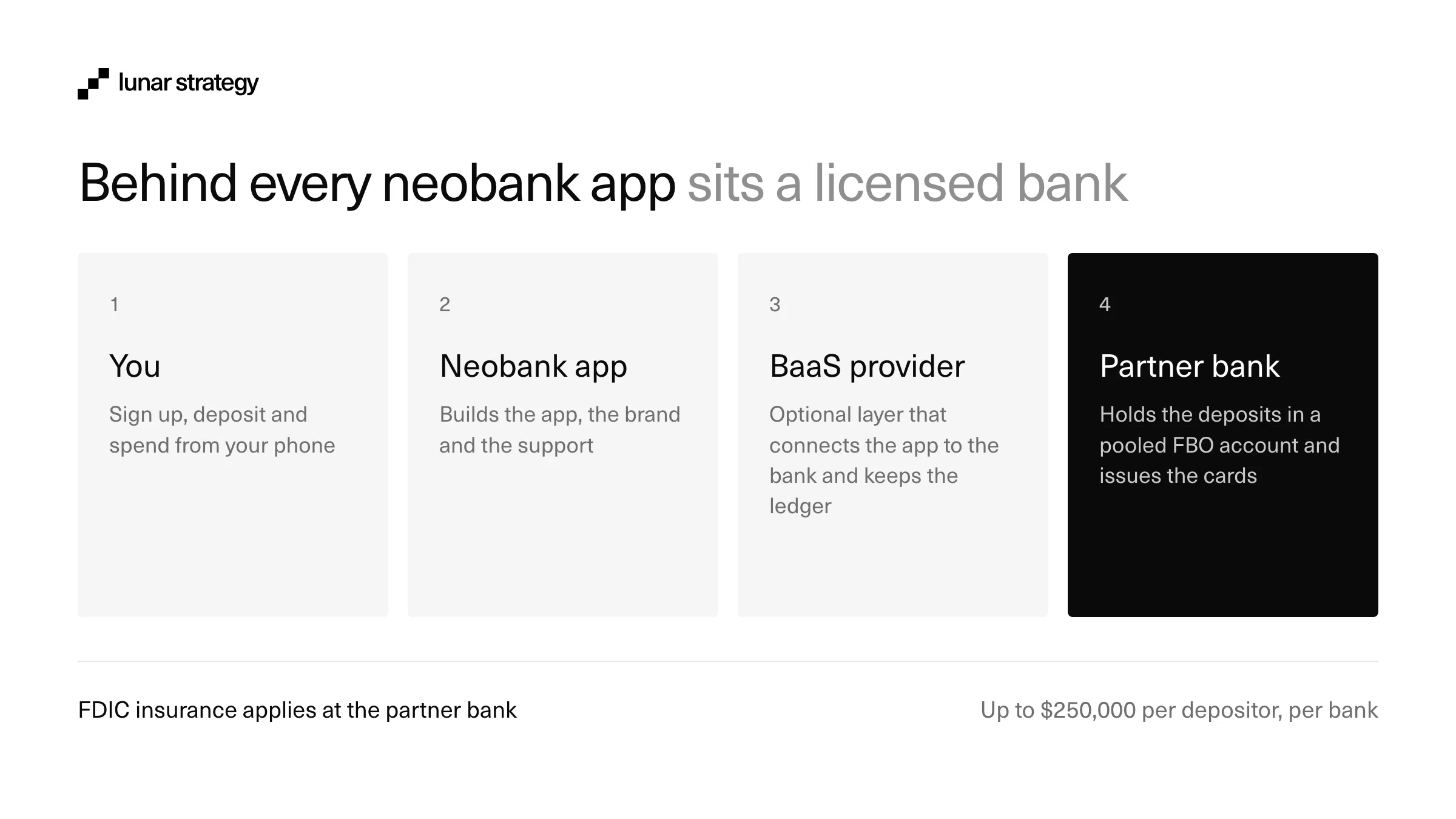
Behind every neobank app sits a licensed institution. A neobank either holds a banking license itself, or it partners with a licensed bank that holds customer deposits, issues the debit cards and connects to the payment networks, while the neobank builds the app, the brand and the customer experience. Most of what a customer sees is the neobank. Most of what protects their money is the bank.
In the US, the partner model often adds a third layer: a banking-as-a-service (BaaS) company, software that connects the app to the bank's systems and keeps the ledger of who owns what. Customer money usually sits in a pooled account at the partner bank, called a for-benefit-of (FBO) account, and the neobank or its BaaS provider records each person's share. When something goes wrong, that record decides who gets paid back.
There are three main ways a neobank gets licensed:
| Model | Who holds the money | Examples | Trade-off |
|---|---|---|---|
| Partner (sponsor) bank | A licensed bank; the neobank runs the app | Chime, through The Bancorp Bank and Stride Bank | Fast to launch, but the neobank depends on its partner and on accurate records |
| Own bank charter | The neobank itself, as a licensed bank | Varo Bank (US), Nubank (Brazil) | Full control and direct deposit insurance, but a long approval process and heavy capital |
| E-money or payment license | The company, which must safeguard funds | A common first step for European fintechs | Easier to obtain; customer funds must be kept separate from the company's own money and can't be lent out, but there is no deposit insurance |
The partner route is why most US neobanks run on a sponsor bank, which lets a team launch in months. A charter takes far longer and serious capital: the OCC's conditional approval for Revolut's US bank sets a minimum of $95 million.
Are neobanks FDIC insured?
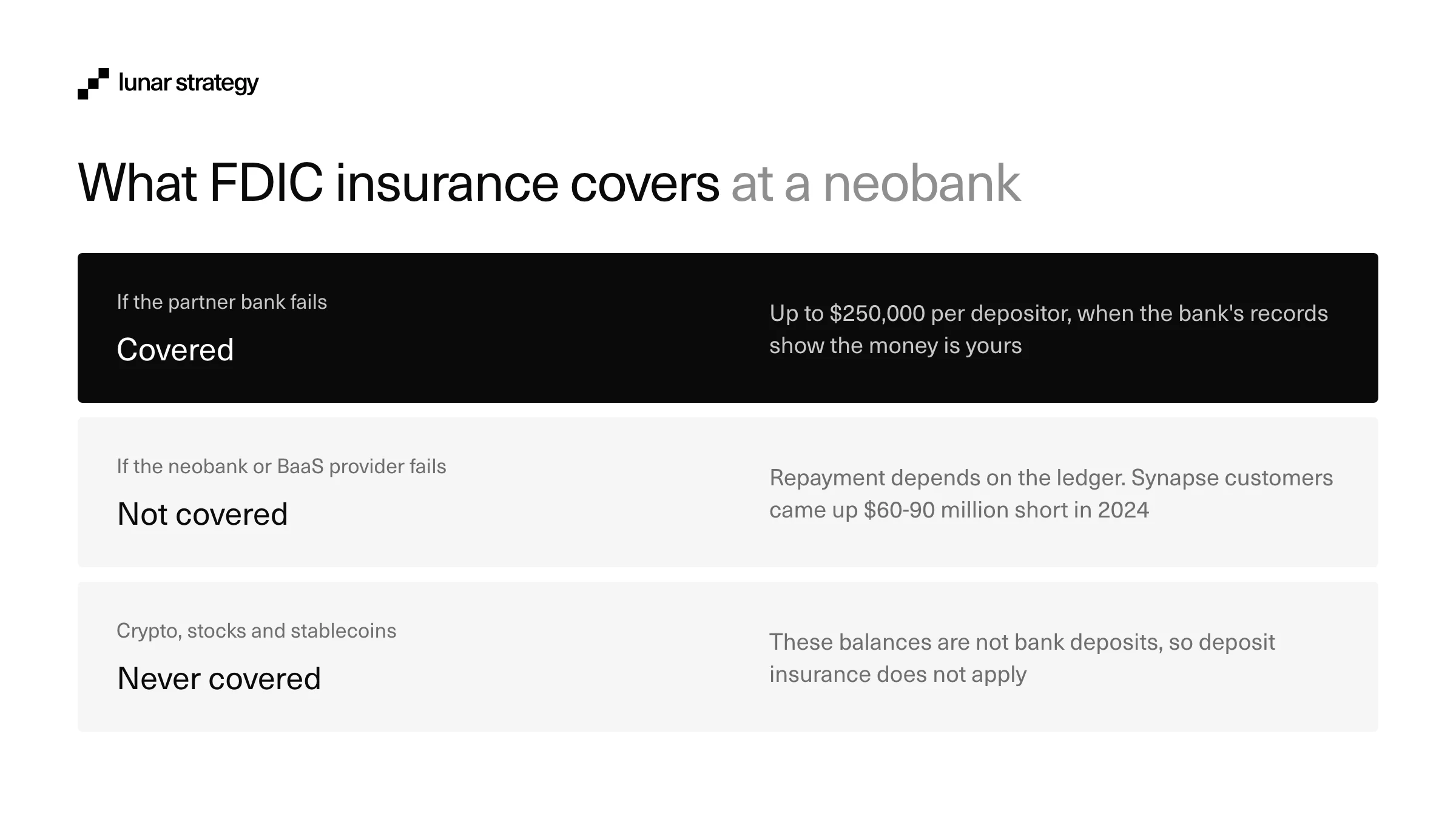
Your money at a neobank can be FDIC insured, but only through the bank that actually holds it, and only when the records are right. The Federal Deposit Insurance Corporation (FDIC), which insures US bank deposits up to $250,000 per depositor, per bank, per ownership category, is blunt about it: "nonbank companies themselves are never FDIC-insured."
When a neobank uses a partner bank, coverage works on a pass-through basis. Your funds are not eligible until the neobank deposits them at an insured bank, and the bank's records must show that the money belongs to you. Insurance protects you if the partner bank fails. It does not protect you if the neobank or its BaaS provider fails, or if nobody can prove which dollars are yours.
That gap became real in 2024. Synapse, a BaaS company that connected fintech apps to partner banks, went bankrupt and customers of the apps built on it lost access to their money. The partner banks found that the funds they held were $60 million to $90 million less than Synapse's records showed (CFPB). The Consumer Financial Protection Bureau sued Synapse in August 2025 and allocated about $46.2 million from its Civil Penalty Fund to victims in November 2025, plus about $9 million in May 2026.
The safety of your money comes down to details most apps print in small type, so check five things before moving your paycheck:
- Which bank holds the money: the app should name it, and you can confirm its status on the FDIC's BankFind tool.
- How coverage applies: look for the words "pass-through" and check whether savings, investment or crypto balances are excluded.
- What happens if the app shuts down: whether you can claim your funds directly from the bank.
- Who regulates the company: a bank charter, a money transmitter license and an e-money license each give different protection.
- What is not covered at all: crypto, stocks and stablecoin balances are not bank deposits, so deposit insurance does not apply to them.
How do neobanks make money?
Neobanks earn from the same places card-heavy banks do, without the cost of branches. Card interchange, a small fee paid on the merchant's side of every card payment, is a major source of income, especially for neobanks that don't lend much. Paid subscription plans, interest on loans and deposits, foreign exchange and investing products fill out the rest. Revolut's 2025 revenue mix shows how diversified a mature neobank becomes:
| Revenue stream | Share of Revolut's 2025 revenue | How it works |
|---|---|---|
| Card payments | 22.2% | Interchange on every card purchase |
| Interest income | 21.6% | Interest earned on deposits and loans |
| Subscriptions | 15.7% | Monthly plans with extra features and limits |
| Wealth | 14.7% | Trading, savings and investment products |
| FX | 13.4% | Margins on currency exchange |
Other income makes up the remaining 12.4%. Source: Revolut Annual Report 2025.
Interchange alone is a thin margin, which is why neobanks push credit, premium plans and investing once they have users. Each stream, and the reasons most neobanks still struggle to make a profit, is covered in our neobank business model guide.
Neobanks vs traditional banks vs online banks
The real difference is who holds the license, and that decides how your deposit is insured and how far the products go:
| Neobank | Online bank | Traditional bank | |
|---|---|---|---|
| Branches | None | None | Yes |
| License | Own license, or a partner bank's | Own banking license | Own banking license |
| Deposit insurance | Through whoever holds the license; pass-through if partnered | Direct | Direct |
| Fees | Usually low or none | Low | Often higher monthly and overdraft fees |
| Products | Accounts, cards, transfers; lending growing | Accounts, savings, some loans | Full range, including mortgages and business banking |
| Support | In-app chat | Phone and chat | Branch, phone and chat |
| Best for | Daily spending, travel, fast setup | High-yield savings | Complex needs and in-person service |
Many people now use two of them at once: a neobank for daily spending and transfers, and a traditional bank for mortgages, larger savings and anything that needs a person across a desk. Neobanks are closing that gap by adding credit and savings, and the newest ones start with digital assets, which is where crypto neobanks come in.
What is a crypto neobank?
A crypto neobank adds digital assets to the neobank model: accounts that hold stablecoins (tokens pegged to a currency such as the US dollar), cards that spend crypto or stablecoins at any card merchant, and transfers that settle on a blockchain in minutes. Some are crypto exchanges or wallets that added cards and bank details. Others are new apps built on stablecoin rails from day one.
Card networks show the demand most clearly. Visa says it has more than 160 stablecoin-linked card programs live as of September 2026. Crypto card spending reached $1.04 billion in July 2026, more than triple a year earlier, according to Paymentscan data reported by CoinDesk.
| Regular neobank | Crypto neobank | |
|---|---|---|
| Main balance | Dollars or local currency in a bank account | Stablecoins or crypto, sometimes next to a bank account |
| Card spending | Debit card from the partner bank | Card that converts crypto or stablecoins at checkout |
| Protection | Deposit insurance through the license holder | Depends on the stablecoin issuer and custody; no deposit insurance on crypto |
| Transfers | Bank rails and card networks | On-chain transfers plus bank rails |
The protection questions above matter even more here. In the US, the GENIUS Act, signed in July 2025, sets reserve rules for payment stablecoins, and the EU regulates them under MiCA, its crypto-asset rulebook. For a team building a crypto neobank, that moves the marketing job from features to trust: who holds the funds, how they are backed and what a user can recover if something fails. Our comparison of the best crypto banks shows how the leaders explain it.
Latin America is where much of this demand is being tested. In July 2026 we hosted a Lunar Live on go-to-market for neobanks in Latin America, a live conversation on what it takes to launch a neobank or crypto card across Brazil, Argentina and Mexico, from licensing to user education.
Education matters as much as the product. The takeaway from that session was that cards, yield and cashback bring users in and clear explanations keep them, because crypto in the region has moved from being seen as a scam to a regulated product faster than most users' understanding of it.
From challengers to banks: the US charter wave
Two of the three largest neobanks now hold conditional approval for a US national bank charter. On January 29, 2026, the Office of the Comptroller of the Currency (OCC), which charters US national banks, granted preliminary conditional approval to Nubank, National Association, in McLean, Virginia. On September 2, 2026, it did the same for Revolut Bank US in Stamford, Connecticut, leaving out Revolut's proposed retail foreign exchange business. Each must raise its capital within 12 months and open within 18, or the approval expires.
The other milestones so far:
- July 2020: the OCC presents Varo Bank with its full-service national bank charter, a first for a US consumer fintech by Varo's account.
- December 2025: PayPal applies to open PayPal Bank, a Utah industrial bank.
- March 2026: the UK's Prudential Regulation Authority lifts the mobilization restrictions on Revolut's UK banking license.
For customers, a charter means deposits insured directly by the bank they signed up with. For the rest of the market, it raises the bar. A neobank on a sponsor bank now competes with rivals that can say "we are the bank," so it has to explain its own setup more clearly to earn the same trust.
How Lunar Strategy approaches neobank marketing
A neobank sells trust before it sells features. In that same Lunar Live, the point that came up most was that a financial product's launch starts with compliance: check what the license allows in each country, build around those limits, then explain the product in words nobody can misread. Brazil, Argentina and Mexico run on different payment rails and different user habits, so a Latin American launch starts by choosing one of them.
After working with more than 300 crypto projects, we've seen financial products grow fastest when they answer the safety question before the customer asks it: who holds the money, how it is protected and what happens if something breaks. For a crypto neobank, add one more answer: how the stablecoin balance is backed.
Our go-to-market strategy work turns those answers into positioning and a launch plan, crypto PR puts them in front of the press your users read, and crypto SEO makes sure the app shows up when people ask Google or AI tools which neobank to trust.
Our Revolut marketing teardown and neobank growth channels guide show how the leaders scaled, and our guide to choosing a neobank marketing agency lists what a partner should deliver.
Plan your neobank go-to-market →
We'll map your audience, your trust story and your launch channels for 2027.
FAQ
Is Revolut a neobank?
Yes, and one of the largest. Revolut started as an app and has since become a licensed bank in the UK, where its full banking license took effect in March 2026. Its planned US bank has conditional approval from the OCC but has not opened yet.
Is Chime a bank?
No. Chime describes itself as a financial technology company, not a bank. Its accounts are held at The Bancorp Bank and Stride Bank, both FDIC members, so deposits are insured through those banks on a pass-through basis. Chime itself is not an insured institution.
Is PayPal a neobank?
Not in the usual sense. PayPal is a payments company that holds customer balances and offers cards through partner banks. In December 2025 it applied to open PayPal Bank, a Utah industrial bank focused on small-business lending and savings. Deposits there would be FDIC insured only once the bank is approved and open.
Why is it called a neobank?
"Neo" means new. The name marks these companies as a newer generation of banking built for phones instead of branches. In the UK and Europe the same companies are often called challenger banks, because they set out to challenge the large incumbent banks.