



























TL;DR
- Revolut grew from zero to 50 million customers in roughly a decade by stacking five reinforcing pillars: referrals, performance marketing as a profit center, geographic expansion as marketing, product-led growth, and an irreverent challenger brand voice.
- The referral loop was engineered before the brand - that order matters and is the single biggest takeaway for any neobank or crypto neobank.
- Subscription tiers (Standard → Plus → Premium → Metal → Ultra) transformed Revolut's unit economics and made aggressive CAC sustainable.
- Every country launch is staged as a local marketing event with local pain points, local creative, and local PR - not a translated global pitch.
- The Revolut playbook informs the paid and lifecycle side of crypto neobank growth, but the community and KOL layer comes from a separate Web3-native toolkit.
Revolut by the numbers
- Founded in 2015 by Nik Storonsky and Vlad Yatsenko
- 50 million+ retail customers globally as of 2025
- $48 billion valuation in 2024 secondary share sale
- 500,000+ business customers
- UK banking license granted 2024 after a multi-year application
- Profitable since 2021, with reported pre-tax profit above $1 billion in 2024
- Active in 38+ countries across Europe, Americas, Asia-Pacific
The 5 pillars of Revolut's marketing strategy
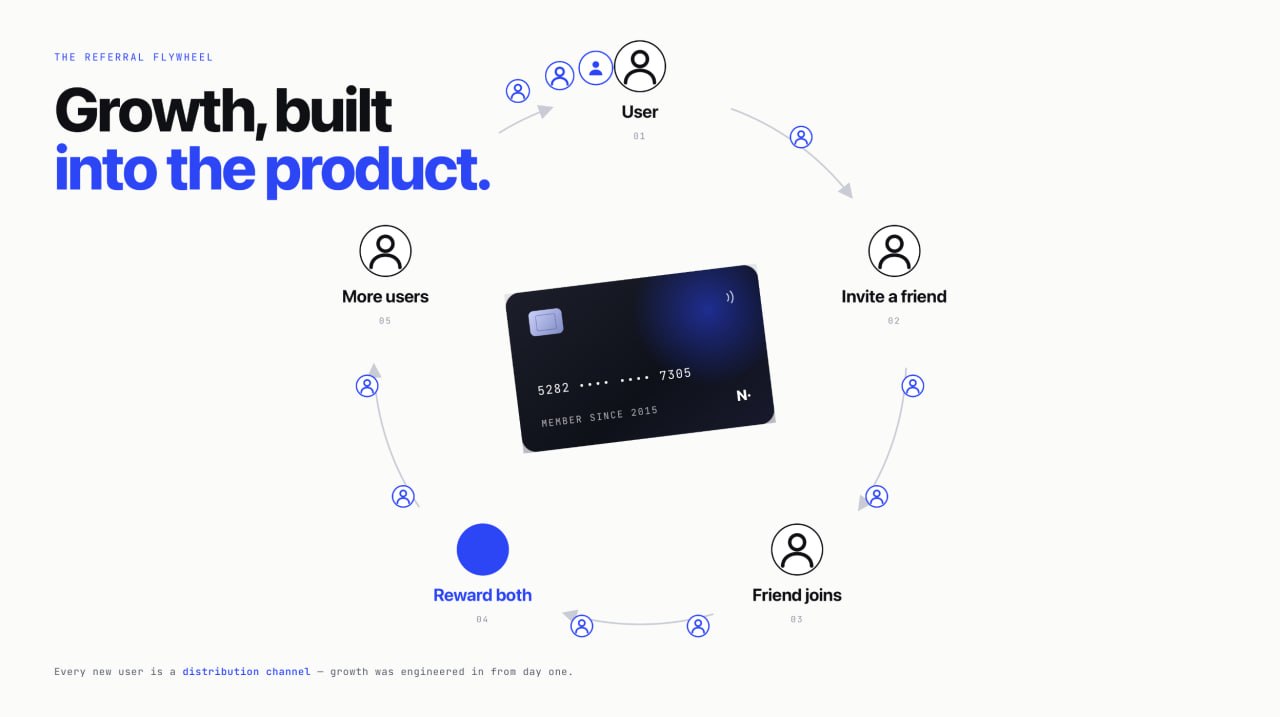
Pillar 1: A referral loop engineered from day one
Revolut's first growth lever was a referral program built into the core app experience. Refer a friend, both sides earn a benefit. Nothing novel about the mechanic. What was different was the engineering discipline behind it: low-friction sharing, real-time tracking, payout reliability, and aggressive optimization of every step in the loop.
By 2019, Revolut publicly attributed a large share of new signups to referrals. The lesson for any neobank: build the loop before you build the brand. A working referral engine compounds CAC down month after month. A brand without a referral loop has to pay for every customer twice - once for the install, once for the trust.
Pillar 2: Performance marketing as a profit center
Revolut runs one of the most sophisticated paid acquisition operations in European fintech. The team produces hundreds of creative variants per month across Meta, Google, TikTok, Apple Search Ads, and emerging channels. Every campaign is tied to a CAC target, every cohort tracked to LTV.
The unusual choice is the operating philosophy. Revolut treats marketing as a P&L. The marketing team is held to acquisition cost and contribution margin, not vanity metrics. This forces creative volume, ruthless channel exit when CAC slips, and reinvestment when payback periods shorten. This is the discipline a specialist neobank marketing agency should bring from day one.
Pillar 3: Geographic expansion as a marketing event
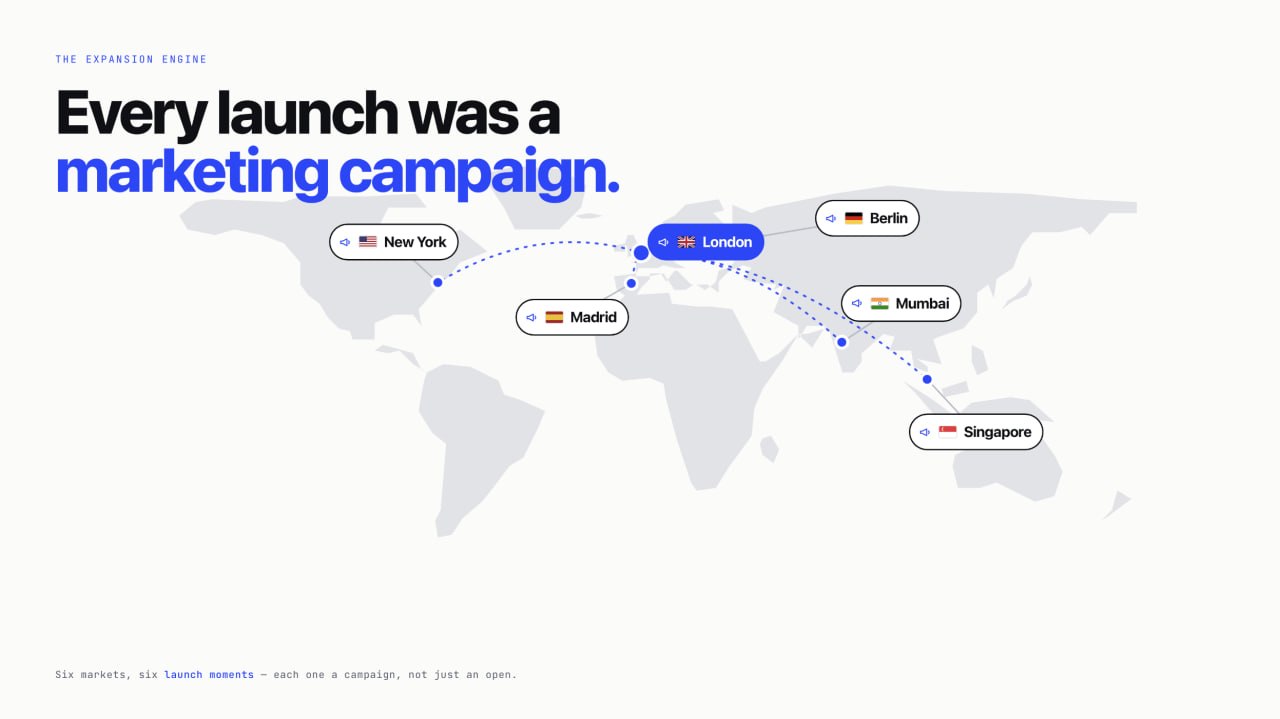
Every Revolut country launch is staged as a marketing moment. Local PR, local influencer partnerships, local product positioning, local referral incentives. The Spain launch leaned on currency conversion for travelers. The US launch leaned on the wire-transfer fee story. The India launch leaned on remittance. Same product, different headline per market.
This is a meaningful contrast with banks that translate one global pitch into thirty languages. Revolut's approach is to find the local pain point and lead with it. Geographic expansion becomes both a growth strategy and a perpetual launch cadence that keeps the brand in the news - the same discipline behind a strong PR practice.
Pillar 4: Product as the primary marketing channel
Revolut ships product features at a cadence that most banks find impossible. Cryptocurrency in 2017, commodities, stocks, junior accounts, insurance, savings, business banking, premium tiers, eSIM, AI features. Each launch is a marketing moment. Each marketing moment drives organic press and social attention. Each cycle of attention drives signups that the product then converts to higher-tier subscribers.
The result is a self-reinforcing loop. The product team feeds the marketing function. The marketing function drives signups that justify more product investment. This is the canonical product-led growth model applied to consumer banking.
Pillar 5: Brand voice that breaks fintech rules
Revolut's brand voice is irreverent, fast, and often confrontational with traditional banks. Outdoor campaigns lean into the contrast: "Old banks. Old you." or "Money for those who get more out of life." The voice would be unthinkable at HSBC. It is exactly the wedge a challenger needs.
The CMO has spoken publicly about treating Revolut as a product-led business where marketing's job is amplification, not creation. The implication: brand voice has to ride on real product differentiation. Without the product gap, the voice would be empty.
The growth tactics behind the strategy
The viral signup mechanics
Revolut's early growth came from a tightly engineered viral loop. Users could see exactly how many referrals they were away from a perk. The app surfaced sharing prompts at high-intent moments. Payouts were instant. Each design decision was tested.
The compound effect across years was decisive. Revolut publicly cited referrals as responsible for a meaningful share of its growth through the early scaling years, and the program remains active today as a CAC dampener.
The premium tier ladder
Standard, Plus, Premium, Metal, Ultra. Revolut built a subscription ladder that converts free users to paying subscribers and then upsells them to higher tiers. Subscription revenue is high margin, predictable, and fundamentally changes the unit economics of a low-ARPU consumer bank.
The marketing implication is large. Once a free user converts to Premium, CAC is recovered fast. This unlocks aggressive acquisition spend that pure interchange-driven banks cannot match.
Targeted campaigns for verticals
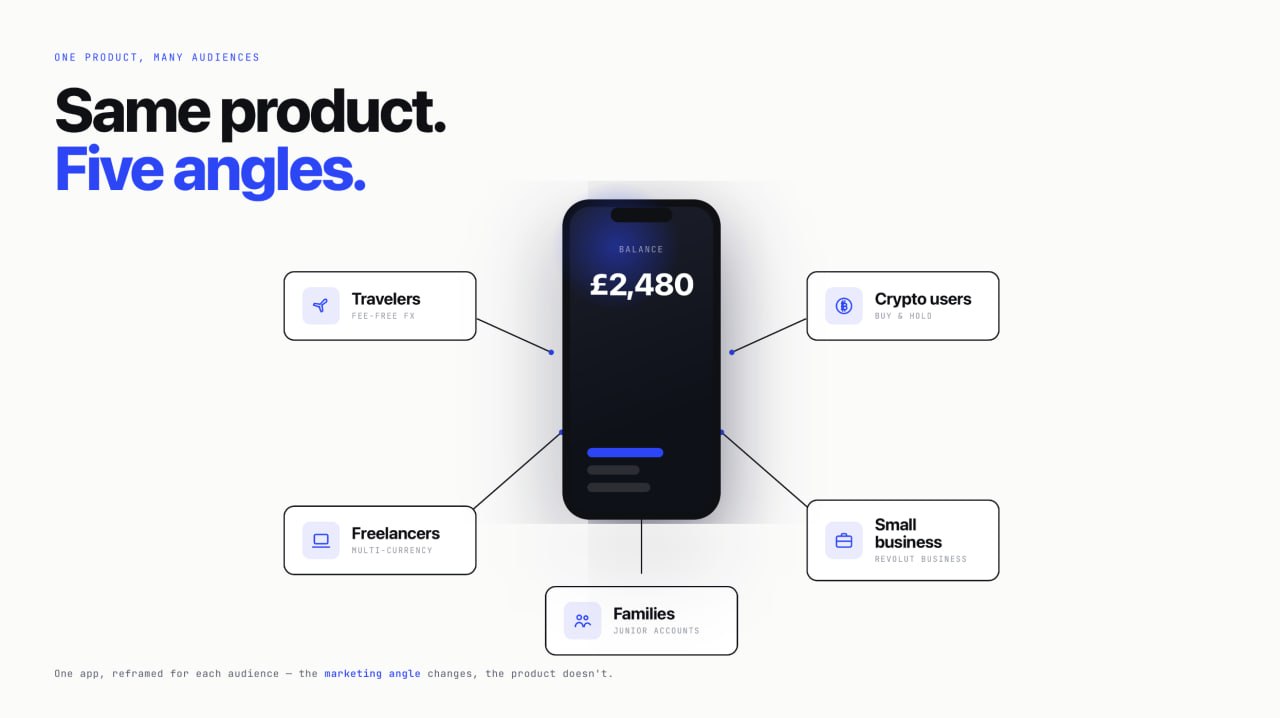
Revolut runs vertical-specific campaigns for travelers, freelancers, crypto users, junior customers, and small businesses. Each vertical gets its own creative, messaging, and landing page. This is the opposite of horizontal mass marketing. It is segment-by-segment optimization at scale.
Crypto as a customer acquisition lever
Revolut added crypto trading in 2017, years before most retail banks. The product brought in a younger, higher-engagement audience and gave Revolut a marketing wedge against traditional banks during the 2021 bull cycle. The 2024-2025 push into stablecoins and tokenization signals continued category attention - and places Revolut squarely in the same conversation as the leading crypto banks of 2026.
PR as a feedback loop
Every funding round, every country launch, every regulatory milestone is staged as PR. Revolut treats earned media as a structured channel, not an opportunistic one. Founder commentary, data drops, and product launches feed a constant rhythm of fintech press coverage.
What Revolut got wrong and learned from
The Revolut story is not all wins. Three meaningful stumbles offer lessons.
- Workplace culture controversies. 2018 press reports about internal culture forced a multi-year HR and brand repair. The lesson: an irreverent external brand needs a credible internal culture, or the brand collapses.
- UK banking license delays. The application took years longer than expected. Revolut continued operating, but the messaging discipline during the wait was a case study in how to communicate trust without overpromising.
- US market entry friction. The US launch underperformed early expectations. The lesson for any neobank entering the US: state-by-state regulation, established competitors, and high CAC make the US the hardest market in the world. Plan accordingly.
What crypto neobanks should steal from the Revolut playbook
- Engineer the referral loop before the brand campaign. CAC compounding starts with the loop. Brand spend without a loop is throwing money at a leaky bucket.
- Run marketing as a P&L. Every channel needs a CAC target and a payback period. No exceptions for crypto media buys or KOL programs.
- Treat each launch as a marketing event. New country, new product, new tier - each one is a press cycle, an ad creative refresh, and a community activation.
- Build the subscription ladder. Free users are great. Paying users are durable. A premium tier transforms unit economics.
- Pick a wedge audience first. Revolut started with FX-heavy travelers and freelancers. Pick yours. Avoid the broad-market trap.
- Use product as marketing. Ship features at a cadence the incumbent cannot match. Every ship is an attention event.
- Build founder content. Storonsky's founder voice on X and in press shapes the Revolut narrative. Crypto neobank founders should do the same - see Lunar's crypto social media practice.
Where the Revolut playbook does not apply
Two contexts where the Revolut model breaks down:
- B2B and institutional crypto banking. Sygnum, Anchorage, and AMINA serve institutions where trust is built on regulatory positioning and named partnerships, not viral loops. Different audience, different playbook.
- Pure Web3-native banking. Stablecoin-first neobanks like Karsa or Bleap rely heavily on community velocity and on-chain attribution. The Revolut playbook informs the paid and lifecycle side, but the community and KOL layer comes from the Web3 marketing toolkit - which is exactly where community design and KOL strategy matter.
The 2026 question for Revolut
Revolut now sits at the intersection of three fights. It must defend the European consumer base against new entrants. It must scale meaningfully in the US. And it must decide how aggressively to embrace stablecoins and tokenization without alienating its mainstream customer base.
The marketing decisions of the next 24 months will shape whether Revolut becomes the global digital bank or remains a European champion. Either way, the playbook so far is the most replicated growth model in fintech.
FAQ
What is Revolut's marketing strategy?
Revolut's marketing strategy combines a referral-driven viral loop, disciplined performance marketing run as a profit center, geographic expansion as a constant launch cadence, product-led growth, and an irreverent challenger-brand voice. The five pillars compound to produce one of the lowest CAC-to-LTV ratios in consumer banking.
How did Revolut grow so fast?
Three reinforcing engines: a referral loop engineered from launch, an aggressive product release cadence that fed continuous PR cycles, and a performance marketing operation that treats CAC and payback period as the primary success metrics. Together they enabled compound growth from zero to 50 million customers in roughly a decade.
What can a new neobank learn from Revolut?
Build the referral loop before the brand campaign. Run marketing as a P&L. Pick a wedge audience instead of going horizontal. Build a subscription ladder to transform free users into paying ones. Treat every product launch and every new country as a marketing event.
What is Revolut's brand voice?
Irreverent, challenger-oriented, fast, and willing to contrast directly with traditional banks. The voice is supported by genuine product differentiation, which keeps it from feeling hollow. Crypto neobanks can learn from the discipline: brand voice has to ride on real product gaps.
Is Revolut a bank?
Revolut received a UK banking license in 2024 and operates under various banking and electronic money licenses across other jurisdictions. The depth of regulatory protection varies by country and product, which Revolut now leans into as a marketing asset rather than a constraint.
Working with Lunar Strategy
Lunar Strategy has built marketing engines for 250+ crypto and Web3 projects since 2019, including Polkadot, ICP, and OKX. Our team brings the Web3-native acquisition capabilities - KOL and influencer networks, community infrastructure, crypto-native PR, crypto social media marketing, and end-to-end go-to-market strategy - that the new generation of crypto neobanks, stablecoin banks, and Web3-native banking products need to scale.
If you are launching or scaling a crypto neobank or Web3-native banking product, book a free consultation with our team.
Explore all Lunar services or browse our case studies.