

























TL;DR
- Crypto ecosystem growth in 2026 is systems-driven, not campaign-driven. Hype cycles and isolated marketing no longer convert into durable adoption.
- Winning projects align four layers: KOL distribution, PR narrative control, X-based coordination, and community participation, all reinforcing each other.
- AI changes both discovery and execution. Projects must optimize for AI search visibility while using AI to scale community operations and sentiment monitoring.
- Participation beats reach. Governance activity, builder engagement, and on-chain behavior matter more than followers, impressions, or short-term buzz.
- The new growth advantage is attribution. Teams that track how narratives, KOLs, PR, and communities drive on-chain outcomes scale faster and waste less capital.
Bottom line: The teams that win in 2026 think in growth systems, not marketing tactics, and optimize for ecosystem health over vanity metrics.
Why Crypto Ecosystem Growth Is Harder in 2026 (And Why Most Projects Still Fail)
The attention economy in crypto has fragmented to the point of near-invisibility. Users now split their time across dozens of chains, hundreds of protocols, and thousands of content sources. What worked during the 2021 bull run, viral threads, celebrity endorsements, and airdrop farming, no longer convert attention into sustainable growth. Most projects still fail because they mistake noise for signal.
AI-powered discovery tools like ChatGPT, Perplexity, and Google AI Overviews have changed how people find and evaluate projects. Users research through conversational queries, not keyword searches. They expect immediate proof of value, not promises of future utility. Traditional crypto SEO tactics miss these AI-driven touchpoints entirely, leaving projects invisible to a growing segment of sophisticated users.
The decline of pure hype cycles means projects face a new reality: users demand working products, transparent governance, and measurable impact before they commit capital or attention. Marketing without substance fails faster and more publicly than ever. This environment rewards teams that build genuine ecosystems, not those optimizing for short-term token pumps.
The 2026 Ecosystem Growth Stack (From Awareness to Participation)
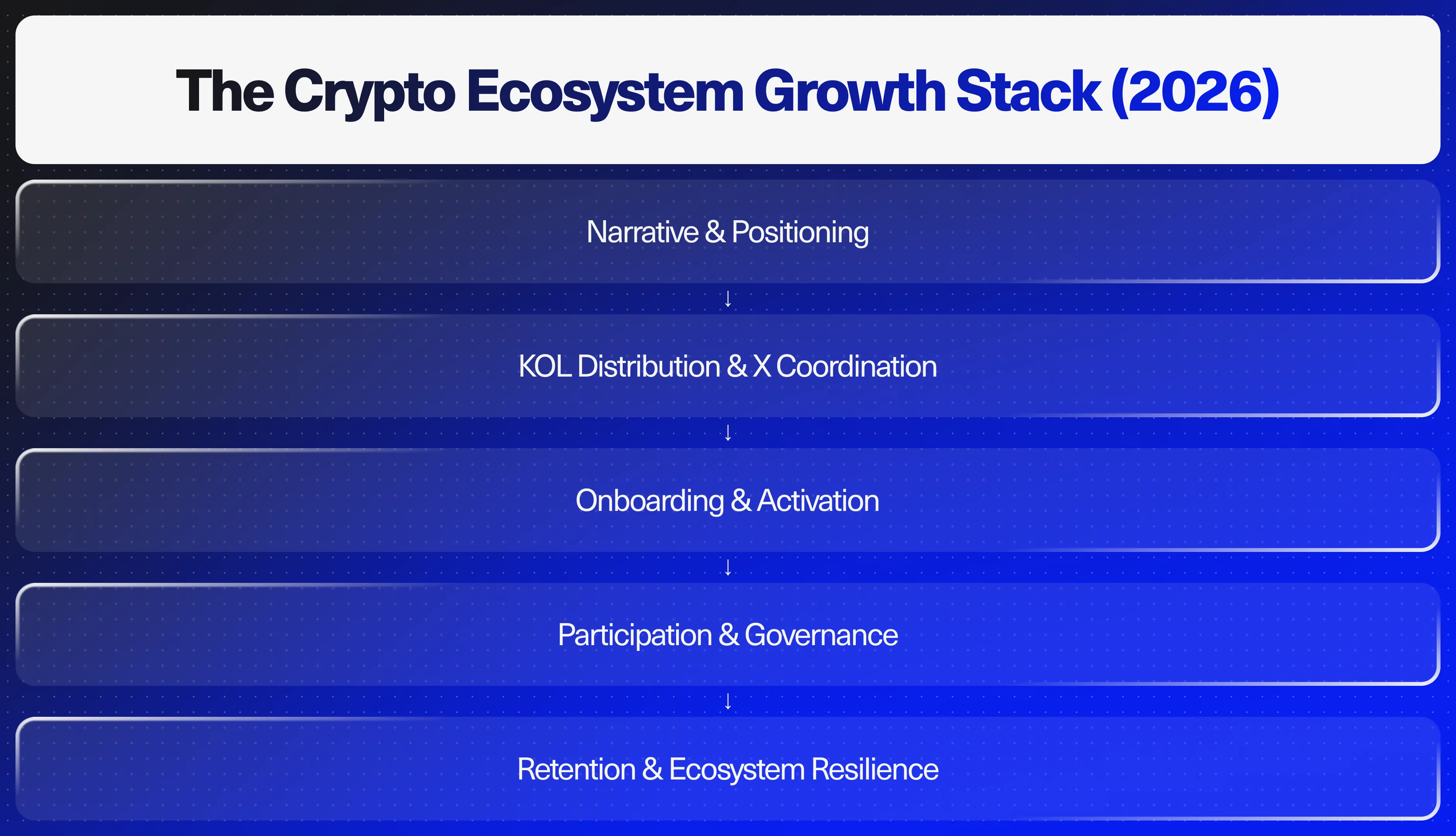
Web3 growth strategy in 2026 operates as a stack, not a collection of tactics. The foundation starts with narrative and positioning, the story that explains why your ecosystem exists and what problem it solves better than alternatives. Without this clarity, every subsequent layer fails to compound.
Distribution sits on top of narrative. This includes KOLs who educate their audiences, X accounts that maintain real-time presence, and communities that self-organize around shared goals. Distribution channels must align with your core message; otherwise, they create confusion rather than momentum. Activation follows distribution; this is where onboarding, education, and first-use experiences determine whether attention converts into participation.
The top two layers that differentiate winning ecosystems from others are participation and retention. Participation means users engage with governance, contribute to discussions, build on your platform, or stake assets long-term. Retention requires consistent value delivery, transparent communication during crises, and regular updates that prove the ecosystem evolves based on user feedback. Projects that optimize only the bottom layers have not achieved sustainable crypto marketing strategy outcomes as of 2026.
KOL Marketing Evolves: From Endorsements to Distribution Infrastructure
The pay-to-shill model died because audiences learned to recognize when influencers promote projects they don't understand or use. In 2026, KOLs function as distribution infrastructure—they educate their communities about technical concepts, amplify genuine innovations, and bridge different ecosystem tribes. The best KOL partnerships last for months or years, not single-tweet threads.
Audience quality matters more than follower count. A KOL with 10,000 engaged builders in a specific niche delivers better crypto ecosystem growth outcomes than someone with 500,000 passive followers. Teams should evaluate KOLs and shape their influencer strategy based on audience overlap with target users, content depth, and historical alignment with similar projects. Surface-level metrics like engagement rates miss the actual impact.
On-chain impact tracking has become table stakes. Platforms now attribute user acquisition, wallet creation, and transaction volume to specific KOL campaigns. This data informs which partnerships to extend and which to end. The shift from vanity metrics to performance data makes KOL marketing accountable in ways that traditional influencer spend never was. Projects that can't measure attribution waste budget on relationships that look good in reports but don't drive results.
PR in 2026: Narrative Control, Not Just Media Coverage
PR has evolved from chasing TechCrunch mentions to controlling your narrative across fragmented information channels. Media coverage still matters, but only when it reinforces a story you already own. Projects that let journalists define their positioning often result in coverage that confuses their community and attracts the wrong users or investors.
Legitimacy signals matter as much as reach. A feature in a respected industry publication signals to potential partners, exchanges, and institutional investors that your project meets basic credibility thresholds. Crypto PR also builds visibility in AI search tools; ChatGPT and Perplexity pull information from published articles, press releases, and thought leadership content. If your narrative doesn't exist in these sources, AI tools can't recommend your project when users ask relevant questions.
Crisis response separates competent teams from amateurs. When exploits happen, when markets crash, or when community conflicts emerge, PR infrastructure determines whether you control the story or get defined by Twitter speculation. The best teams prepare response frameworks before crises hit, maintain direct channels to key journalists, and communicate transparently with their communities. Thought leadership and founder visibility compound these efforts; CEOs and technical leads who regularly publish insights build trust that protects reputation during difficult periods.
X as the Control Layer of Crypto Ecosystems
X functions as the real-time sentiment engine for crypto. Price movements, partnership announcements, technical milestones, and community debates all unfold on the platform before reaching other channels. Projects that treat X as just another social network or crypto social media channel miss how it coordinates attention, shapes narratives, and filters signals from noise across the entire ecosystem.
Advanced strategies focus on the reply layer, not just the main tweets. The most engaged communities live in comment threads where users debate technical details, share use cases, and onboard newcomers. Teams should optimize for reply visibility by asking questions that spark discussion, highlighting user contributions, and participating in community-initiated conversations. This creates feedback loops where community voices amplify official messaging.
Narrative reinforcement happens through consistent presence, not viral moments. Projects that post daily, respond to mentions quickly, and maintain distinct voices build recognition that compounds over months. Community-led amplification matters more than official account reach; when users share your updates with their own context and commentary, it signals genuine ecosystem engagement rather than coordinated marketing. The teams winning on X in 2026 enable their communities to tell the story, not just broadcast it themselves.
Community Participation Is the New Growth KPI
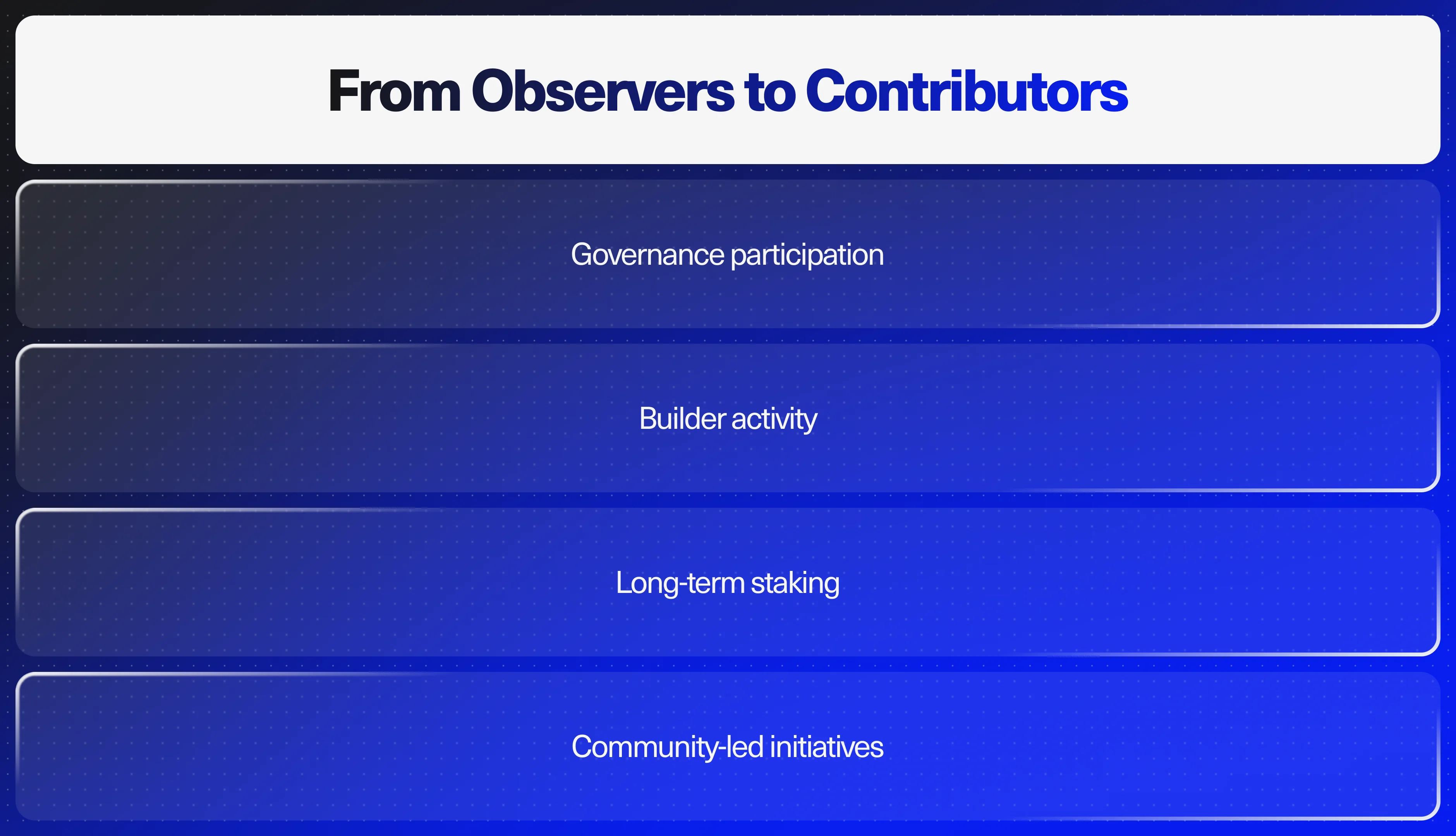
The shift from followers to contributors represents the biggest change in how teams measure success in scaling the blockchain ecosystem. A protocol with 5,000 Discord members where 500 actively participate in governance votes, submit improvement proposals, or build integrations outperforms one with 50,000 lurkers. Participation predicts longevity because it signals that users derive real value from the ecosystem.
Governance engagement and builder activity create measurable growth signals. On-chain data shows who votes on proposals, stakes tokens long-term, provides liquidity consistently, or deploys smart contracts on your platform. Off-chain signals include GitHub contributions, forum discussions, educational content creation, and community-organized events. Projects should track these metrics as closely as they monitor token price or social follower growth.
Feedback loops between core teams and active participants strengthen ecosystems faster than top-down roadmaps. When developers see which features users request most, when governance reveals user priorities, and when community-built tools gain traction, teams can allocate resources based on actual demand rather than assumptions. This participation-driven development creates products that users want because users literally told you what to build.
Data, AI, and Feedback Loops: The Real Growth Advantage
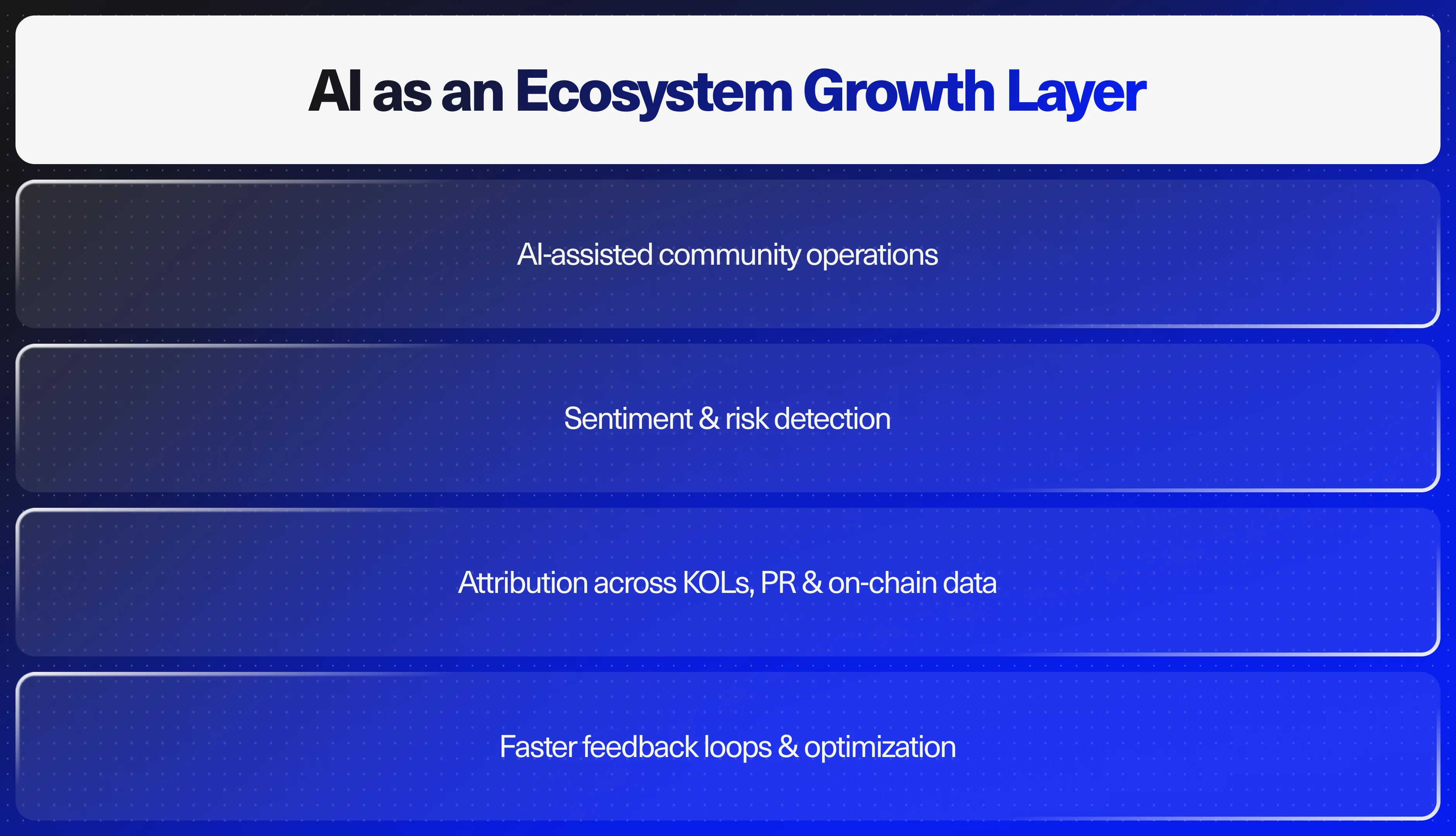
AI-assisted community operations now handle repetitive tasks that once required full-time staff. Chatbots answer common questions in Discord, automated systems surface trending topics for community management teams to address, and sentiment analysis tools identify emerging concerns before they become crises. This technology doesn't replace human judgment; it frees teams to focus on strategic decisions and relationship building.
Attribution across content, KOLs, PR, and on-chain behavior closes the loop between marketing spend and actual results. Teams can now see which article drove exchange listings, which KOL partnership brought in developers, which PR placement attracted institutional attention, and which community initiative increased governance participation. This visibility transforms the ecosystem crypto growth fund from a budget line item into a performance system with clear ROI.
Real-time optimization becomes possible when data flows between different growth functions. If X engagement spikes after a specific type of content, double down on that format. If users who join through a particular KOL show higher retention, expand that partnership. If governance participation increases when proposals are explained in simple terms, adjust your communication style. The teams that build these feedback loops learn faster and waste less budget on tactics that don't compound.
What the Best Crypto Ecosystems Do Differently (2026 Patterns)
Patterns from top-performing projects reveal a consistent approach to Web3 growth strategy. They launch fewer products but tell stronger stories about each one. They resist the urge to chase every narrative trend and instead build deeper trust through consistent execution. Their audiences may be smaller than those of hype-driven competitors, but participation rates are five to ten times higher.
These ecosystems work with fewer influencers but maintain better alignment through long-term partnerships, equity stakes, or governance roles. They view KOLs as advisors and distribution partners, not hired promotion channels. This selectivity means every voice speaking for the project actually understands and believes in its mission.
The best teams also share a systems mindset; they understand that PR reinforces X strategy, X feeds into community engagement, community participation generates on-chain signals, and on-chain data informs future PR narratives. Nothing operates in isolation. This integrated approach to crypto marketing strategy 2026 creates compound effects that isolated tactics never achieve. They measure success in years, not quarters, and optimize for sustainable ecosystem health over token price volatility.
Final Takeaway: Growth Is a System, Not a Campaign
The projects that master crypto ecosystem growth in 2026 think in systems, not campaigns. They understand that one viral moment means nothing without infrastructure to convert attention into participation. They build trust through transparency, align incentives across all stakeholders, and measure what matters instead of what looks impressive in pitch decks.
Sustainable scaling of a blockchain ecosystem requires patience that most teams lack. It means investing in community tools before they show ROI, maintaining consistent communication during bear markets, and prioritizing governance development even when token price dominates every conversation. The payoff comes in ecosystems that survive multiple cycles, attract top talent without excessive spending, and maintain loyal communities that defend the project during attacks or downturns.
For teams serious about building ecosystem growth as a system, execution matters as much as strategy. At this stage, the difference is rarely in ideas; it’s the ability to align KOL distribution, PR narrative control, X coordination, community participation, and data attribution into a single operating model.
This is the approach we take at Lunar Strategy. We work with Web3 teams that want to move beyond campaigns and build growth systems designed to compound across cycles.
If you’re exploring how to operationalize this framework for your own ecosystem, you can review our approach or book a conversation to see whether it’s a fit.
Frequently Asked Questions
What is crypto ecosystem growth?
Crypto ecosystem growth refers to the strategic expansion of a blockchain project's user base, developer community, governance participants, and on-chain activity through coordinated marketing, product development, and community engagement. Unlike traditional growth marketing, it emphasizes participation and long-term value creation over short-term user acquisition.
How has Web3's growth strategy changed in 2026?
Web3 growth strategy in 2026 shifted from campaign-driven tactics to systems-driven approaches. Teams now integrate KOL partnerships, PR narrative control, X-based coordination, AI-assisted operations, and data attribution into unified frameworks. Success depends on participation metrics and governance engagement, not follower counts or social impressions.
Why do most crypto marketing campaigns fail?
Most crypto marketing campaigns fail because they optimize for attention without building the infrastructure to convert that attention into participation. They chase viral moments, pay for endorsements that don't align with product value, and measure vanity metrics instead of on-chain behavior. Without systems to retain users and facilitate genuine engagement, growth proves unsustainable.
What role do KOLs play in scaling the modern blockchain ecosystem?
KOLs in 2026 function as distribution infrastructure and educators rather than paid promoters. The most effective partnerships involve long-term alignment, audience quality over size, and on-chain attribution to measure actual impact. Projects that treat KOLs as advisors and community bridges see better retention and higher participation rates than those using transactional endorsement models.
How do AI tools affect the growth of the crypto ecosystem?
AI tools impact crypto ecosystem growth through three main channels: discovery (ChatGPT and Perplexity surface projects when users ask relevant questions), operations (automated community management and sentiment analysis), and attribution (tracking which growth activities drive on-chain behavior). Teams that optimize for AI visibility and use AI for operational efficiency gain significant advantages over competitors still using 2021 playbooks.