






















TL;DR
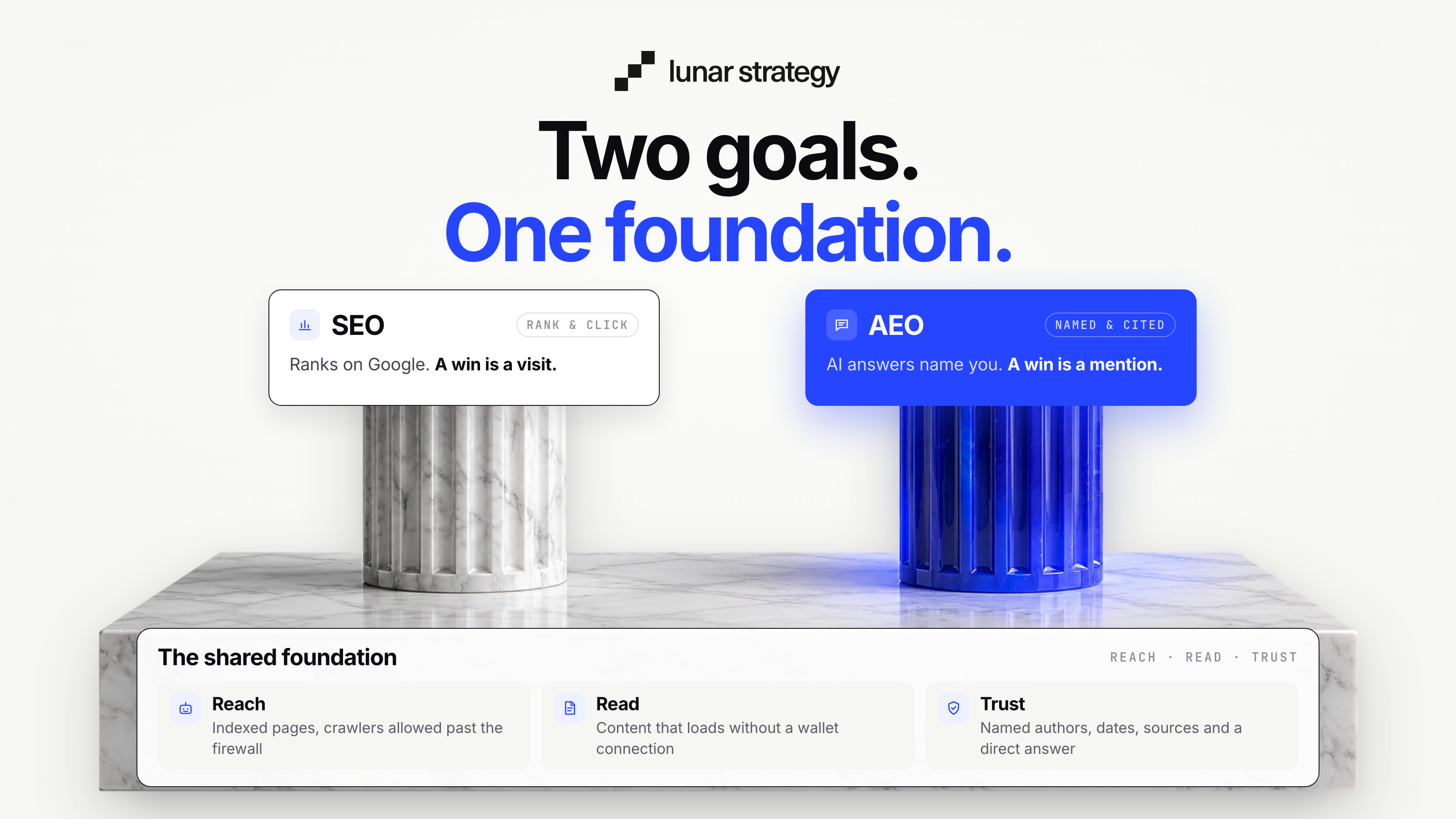
- AEO (answer engine optimization) is the work of getting your project named and cited inside the answers that ChatGPT, Perplexity and Google's AI Overviews write. SEO (search engine optimization) is the work of ranking your pages in search results. Most of the groundwork is the same.
- What doesn't change: AI tools still need to reach, read and trust your site. Google says optimizing for its AI features is "still SEO," so docs that load without a wallet, clear answers and real sources work for both.
- What changes: ranking on Google doesn't carry over to ChatGPT. When we tested 28 crypto questions in October 2026, only 6 of the 108 sources ChatGPT cited were on Google's first page for the same question.
- Crypto widens the gap. AI tools answer "is it safe?" questions with independent sources, can repeat outdated facts about your token, and each one leans on different sites. Paid placements barely show up as sources.
- Don't split your budget by a fixed formula. Do the shared work first, then move effort toward AEO only when your own data (AI impressions in Search Console, ChatGPT referrals, a monthly prompt check) shows you're missing from the answers.
AEO vs SEO: What's the Difference for a Crypto Project?
AEO vs SEO comes down to where you want to show up. SEO gets your pages ranked in Google's results so people click through. AEO gets your project named and cited inside the answers that ChatGPT, Perplexity and Google's AI Overviews write. For a crypto project, most of the groundwork is shared.
Your project ranks on Google's first page for its category. So you ask ChatGPT the same question a new user would.
It names two competitors, a project that left in 2024 and one that has been dead for over a year. Yours isn't on the list.
That gap between ranking and being recommended is what this article is about. Most of the work behind both is the same. A few parts are genuinely new, and you can measure which ones you're missing.
Here is how the two compare. If you need the SEO basics first, start with our crypto SEO guide.
What Doesn't Change: The Shared Foundation
Most of what makes a crypto site rank also makes it citable. Google's guide to optimizing for generative AI search says that this work "is optimizing for the search experience, and thus still SEO." In May 2026, Google added a section that busts common "AEO/GEO" misconceptions and calls SEO best practices "foundational."
Three things carry over in full:
- AI tools have to reach your pages. To appear in AI Overviews or AI Mode, a page must be indexed and eligible to show a snippet, and Google now also requires the site to be included in its generative AI features in Search Console. ChatGPT and Perplexity use their own crawlers (bots that read web pages): sites that block OAI-SearchBot aren't shown in ChatGPT search answers, and PerplexityBot is the crawler that surfaces and links sites in Perplexity.
- AI tools have to read them. A dApp (decentralized application) that loads its content only after a wallet connects can show crawlers an almost empty page. That costs you the ranking and the citation at the same time.
- AI tools have to trust them. Named authors, dates, linked sources and a direct answer at the top help a page rank. They're also what makes a passage safe for an AI tool to quote.
Now what? If your site already passes a solid SEO audit, most of your AEO groundwork is done. The extra steps for AI tools are in our guide to getting your crypto project cited by ChatGPT and Perplexity.
What Changes: 4 Differences That Matter
Ranking on Google doesn't carry over to ChatGPT, and that's the biggest change. The other three follow from it: you compete for a mention instead of a position, third-party sites weigh more, and you measure different numbers.
1. You compete for a mention, not just a click
Ahrefs found that an AI Overview correlates with a 58% lower average click-through rate for the top-ranking page (December 2025 data, 300,000 keywords). When the answer sits above the results, being named inside it becomes part of the win.
2. AI tools cite pages outside Google's first page
In our test, ChatGPT almost never cited what Google ranked. In October 2026 we ran 28 crypto questions (brand safety, discovery, how-to, comparison and definition) once each on Google (US, desktop), ChatGPT with web search on and Perplexity's API, then compared the sources each one used.
Only 6 of the 108 sources ChatGPT cited (6%) were on Google's first page for the same question, and for 19 of the 28 questions ChatGPT shared no domain at all with page one (Lunar Strategy, 2026). Perplexity did slightly better: 31 of its 280 cited sources (11%) were on Google's first page.
Even Google's own AI feature reaches past page one. Of the 87 sources cited in the 11 crypto AI Overviews we could analyze, only 20 (23%) appeared in the first-page organic results (Lunar Strategy, 2026).
Our sample is small (one run per platform, one country), so read it as a snapshot. Larger studies point the same way: across 15,000 prompts, Ahrefs found that only 12% of links cited by ChatGPT, Gemini and Copilot ranked in Google's top 10 for the same prompt, with Perplexity closer to 1 in 3. For AI Overviews, 38% of cited pages ranked in the top 10 in March 2026.
3. Third-party sites weigh more, and each AI tool picks different ones
For the same 28 questions, ChatGPT and Perplexity shared just 16 of 273 cited domains (6%), and in half of them (14 of 28) they had no domain in common (Lunar Strategy, 2026).
What other sites say about you also counts. Ahrefs found that brand web mentions correlate with AI Overview visibility far more strongly than backlinks (0.664 vs. 0.218). That's a correlation, not proof, but it explains why a site that ranks well can still be missing from the answer.
4. You measure different numbers
SEO reports clicks and positions. AEO reports how often you're named and cited, platform by platform, and many of those mentions never produce a click. The free sources for both are in the measurement section below.
Now what? Ask ChatGPT and Perplexity the 5 questions that matter most in your category. Compare the pages they cite with the pages you rank with on Google.
AEO vs GEO: Same Thing, Different Name?
For practical purposes, yes. AEO, GEO (generative engine optimization), AIO (AI optimization) and LLMO (large language model optimization) are labels for the same goal: being used and cited in AI-written answers. Google's mythbusting section treats all of it as SEO.
GEO doesn't mean "Google Engine Optimization." The term comes from a 2023 research paper that introduced generative engine optimization as a way to raise a page's visibility in AI answers. Pick one term inside your team, and judge any vendor by what they measure, not by the acronym they sell.
Why the Gap Is Wider for Crypto Projects
Crypto is a money topic, so AI tools lean harder on independent sources and can repeat outdated facts for longer. Five things widen the gap between ranking and being cited.
- A higher trust bar. Google gives even more weight to strong E-E-A-T (experience, expertise, authoritativeness and trust) on topics that affect people's financial stability, and money topics include crypto. Finance questions also trigger AI Overviews often: BrightEdge saw them on 91% of educational finance queries in December 2025, vs. 7% for tickers and live prices.
- Safety verdicts come from others. When we checked Google's AI Overview for "is hyperliquid safe," it cited the project's own site for technical facts and third parties, such as the wallet maker Ledger, for the safety verdict.
- Old facts stick. The founder behind our opening scene also found Perplexity citing a 2023 listicle with pricing the team had changed twice. Models lag too: OpenAI's newest model, released on September 29, 2026, has an April 30, 2026 knowledge cutoff, so a token launched in between exists only in what the AI tool finds by searching.
- Paid reach barely counts. Google Ads doesn't allow ads for ICOs, DeFi trading protocols or crypto trading, except for certified exchanges and wallets in select countries. Bought articles don't buy citations either: Muck Rack found that paid and advertorial content made up 0.3% of AI citations, while about 84% came from earned media. That's where crypto PR feeds AEO.
- Each AI tool reads different sources. In our test, the mix of cited sources looked like this (Lunar Strategy, 2026):
Your own docs do the most work in ChatGPT, while exchange academies and crypto media carry Perplexity. Community content matters on Google, not in the other two: Reddit was on Google's first page for 23 of 28 questions and YouTube was cited in 9 of 11 AI Overviews, yet ChatGPT and Perplexity cited neither in any of the 28.
One more pattern: AI tools cite whoever publishes most on a topic. When we asked Perplexity this article's own question, at least 14 of its 24 sources were crypto marketing agencies or lists of them, and none was official documentation from Google, OpenAI or Perplexity. If your category has no sourced answers, someone else's sales page will fill the gap.
Now what? If you have a launch coming, publish your token facts weeks ahead as part of your pre-TGE marketing plan, so search-based answers can find them on day one.
How to Split Your Effort: The Shared-First Method
Don't split your budget by a fixed percentage: do the shared work first, then follow your own data. When we asked ChatGPT this article's question in October 2026, it recommended "60% SEO / authority building, 25% AEO / AI visibility, 15% measurement + experimentation" while citing 3 sources, none of which contained a budget split. A precise-sounding number isn't a plan.
The data that does exist argues for patience, not panic. Conductor found AI referrals were 1.08% of website traffic across 13,770 enterprise domains (US, May-September 2025), with organic search still driving most discovery. Semrush estimates the average AI search visitor is worth 4.4 times an organic visitor, based on conversion rate: small volume, high intent.
The shared-first split sorts every task into one of three buckets:
3 triggers that move effort toward AEO
- AI impressions grow on your key pages in Search Console's AI report.
- AI referrals grow: sessions tagged utm_source=chatgpt.com in GA4, or citations in Bing's AI report.
- Your prompt check shows a gap: across about 20 fixed category questions, competitors get named and you don't.
If the prompt check shows a gap while AI impressions or referrals grow, shift effort into the AEO-only bucket. If Google still brings most of your visits and conversions, keep the weight on shared work and SEO.
Worked example: one staking page, two jobs
Take a hypothetical lending app that publishes "How staking works on [app]." For SEO, it targets "how to stake [token]," writes a clear title tag and gets linked from its docs and partners. Crawlable HTML, an author, a date and sources serve both sides.
Two changes serve AI tools specifically: confirm that OAI-SearchBot and PerplexityBot can fetch the page past the firewall, and make sure the lockup period and fees match on the exchange academy pages that Perplexity and AI Overviews cite. Neither moves a Google ranking, but both decide whether the answer about staking on the app is right.
The founder from our opening scene fits the same table. A ChatGPT list with dead projects and a Perplexity answer built on a 2023 listicle are AEO-only problems: outdated third-party sources, not a broken website. The fix is to get those pages corrected or replaced, earn recent coverage, and recheck the same questions every month.
How to Measure Both Without New Tools
Four free sources cover both disciplines: Search Console, your analytics, Bing Webmaster Tools and a monthly prompt check.
- Search Console. Since June 2026 it reports impressions in AI Overviews and AI Mode, rolled out to all sites by August 31, 2026. It shows impressions, not clicks, so read it next to your regular click data.
- Analytics. ChatGPT adds utm_source=chatgpt.com to the links it sends, so you can filter those sessions in GA4.
- Bing Webmaster Tools. The AI Performance report, in public preview since February 2026, shows how often your content is cited in Microsoft Copilot and Bing's AI summaries.
- A prompt check. Ask the same questions every month in ChatGPT, Perplexity and Google, and log who gets cited per platform. Answers vary: in our test, two ChatGPT runs of "is hyperliquid safe" a few minutes apart cited 3 and 8 sources with no URL in common, so judge the trend, not one run.
Report each platform separately instead of one blended "AI visibility" score. If an agency reports to you, these lines belong next to the SEO numbers in a monthly report that measures real ROI.
How We Approach This at Lunar
We run SEO and AI search as one plan, because most of the work is shared. After working with more than 300 crypto projects, we build the shared foundation first, then add the AEO-only work (crawler access, prompt tracking per platform, third-party fact fixes) where the data shows a gap.
The results we can show publicly are Google results, which is the shared foundation at work. A Web3 security platform whose pages weren't indexed properly, with incomplete metadata and no internal linking, went from 1.28K to 1.61K clicks (+26%) and grew impressions 74% in three months (Lunar Strategy, 2026). For a crypto wallet security SaaS with no organic traffic, two of four new educational posts generated 2.4K+ clicks and 67K+ impressions in their first year (Lunar Strategy, 2026).
Frequently Asked Questions
Is SEO dead now that AI answers come first?
No. In July 2026, Google said AI Mode passed 1 billion monthly users and, like AI Overviews, is driving an incremental increase in Search queries overall. People still search; what changed is how much of the answer they read before they click.
Do I need a separate AEO agency or budget?
Usually not. Ask your current SEO team whether the AEO-only items are covered: crawler access for OAI-SearchBot and PerplexityBot, a monthly prompt check per platform, and fixing outdated facts on third-party sites. Be wary of anyone who promises citations: OpenAI says placement in ChatGPT search "is not guaranteed." Our guide to what a Web3 marketing agency actually does helps you check the scope.
Does an llms.txt file help with AEO?
Not on Google. Google says Search doesn't use llms.txt or other "special" AI files, and that you don't need to break your content into tiny chunks. For other AI tools it's harmless to add, but it doesn't replace crawler access or clear, sourced pages.
How long does AEO take to show results compared with SEO?
Crawler fixes count from the next crawl, so they're the fastest win. Earned mentions and corrected third-party pages take months, much like links in SEO. Answers that come from a model's memory instead of a live search lag the longest, because they only change when a newer model is trained.
Putting It All Together
AEO doesn't replace SEO: it's SEO plus a short list of new jobs. Build the shared foundation, keep the SEO work that still brings your visits, and add AEO-only work when your data shows you're missing from the answers.
Three things to do this week:
- Ask ChatGPT, Perplexity and Google 20 questions from your category and log who gets cited.
- Check robots.txt and your firewall for OAI-SearchBot and PerplexityBot.
- Open the AI report in Search Console and add a utm_source=chatgpt.com filter in GA4.
To see where AI search fits in the rest of your growth plan, read our crypto marketing playbook. If you want help, our crypto SEO team runs Google and AI search as one plan. Book a call and bring your prompt-check results.