




















TL;DR:
- Prediction markets are one of the fastest-growing products in crypto and finance: combined monthly volume on Kalshi and Polymarket went from under $5 billion to about $24 billion in seven months. The leaders got there with distribution deals, sports and big events and thousands of paid creators.
- Marketing one is harder than marketing a normal app, because you have to explain the category, build liquidity (enough orders on both sides for a trade to happen at a fair price) and work inside the rules at the same time. Skip liquidity and the sign-ups you paid for place one trade and leave.
- The growth work runs in order: seed deep markets, build a core of active traders, publish content people search for, reward only the behavior you want, then ride events with creators who actually trade.
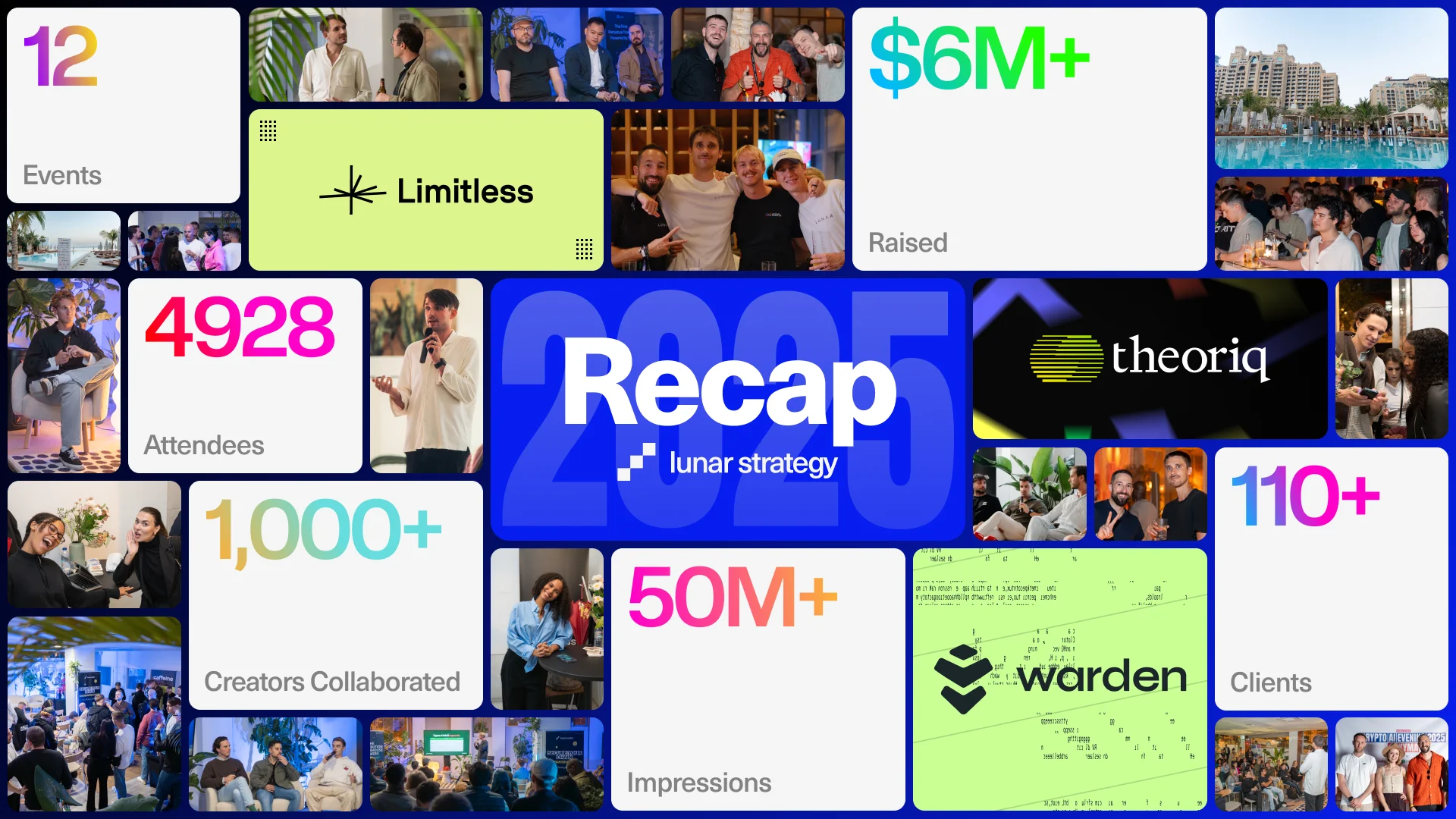
- It works when every activation ends in a trade. Limitless, a prediction market on Base we've worked with since July 2025, reached $1.97 billion in all-time volume and 213,000 unique users, third in the sector by users.
- Judge the work by funded traders (people who deposited and traded) and by who is still trading on days with no big event, not by impressions or headline volume.
Prediction markets have never had more attention. In May 2026, the Pew Research Center reported that combined monthly trading volume on Kalshi and Polymarket rose from less than $5 billion in September 2025 to about $24 billion in April 2026. That money brought a wave of new platforms on Base, Solana, Hyperliquid and other chains, and almost all of them now face the same question: how do you get traders to a market when two brands already own the category?
This playbook answers it in the order the work happens: the three problems every platform has to solve (education, liquidity and regulation), the growth work from seeding markets to referrals, the acquisition channels that convert, what Polymarket, Kalshi and Limitless did, and a six-month plan with the metrics to judge it. It is written for founders and growth leads of prediction markets.
Why prediction market marketing matters now
Prediction market marketing is the work of getting people to deposit money and trade on the outcome of real events, then trade again when the next event arrives. It matters now because demand has proven itself and the leaders have pulled far ahead, so every challenger is competing for the same traders with less money and thinner markets.
The numbers show how fast the gap opened. Kalshi reached a $22 billion valuation in May 2026 and, according to The Block, now accounts for more than 90% of US prediction market activity. During the 2026 World Cup alone, Kalshi told CNBC it brought in 3 million new users. Across the whole sector, growth was large but uneven:
| Signal | Figure | Source |
|---|---|---|
| Monthly volume, Kalshi + Polymarket | Under $5B (Sep 2025) to about $24B (Apr 2026) | Pew Research Center, May 2026 |
| Sector volume | $15.8B (2024) to about $63.5B (2025) | CertiK, via Decrypt |
| Kalshi share of US activity | More than 90% | The Block, May 2026 |
| New Kalshi users during the World Cup | 3 million | CNBC, July 2026 |
CNBC noted the catch in the same story: volume on days without matches was significantly lower. Keeping people trading after the moment passes starts with three problems most apps never face.
Category education
Most people who see a prediction market for the first time file it under something they already know: sports betting, stock trading or a poll. Each label brings expectations, and the wrong one sets up the wrong first trade: a bettor expects bonuses, a trader expects charts and depth. Your marketing decides which label sticks, so choose it on purpose.
The leaders show that the frame follows the business model. Kalshi presents itself as a regulated exchange and reaches users through brokers, so "trading" fits. Polymarket leans on odds that news and social media quote, so "information" fits. A challenger usually picks between four:
- Trading: event contracts as a new asset, next to options and futures.
- Information: prices as the crowd's best forecast, made for media and data content.
- Entertainment: skin in the game during a match or an election.
- A betting alternative: better prices than a sportsbook. Easy to sell, and the frame regulators look at hardest.
Pick one and build the homepage, onboarding and creator briefs around it. A frame that changes with every campaign leaves new users unsure what they signed up for.
The liquidity problem
A trader who arrives from an ad and finds a wide gap between the buy and sell price, or no orders at all, rarely comes back to check whether it improved. This is why prediction market growth runs in a different order from most consumer apps: market depth first, distribution second, brand third.
The problem is old and well described. In a 2024 essay for Works in Progress, Nick Whitaker and J. Zachary Mazlish argued that prediction markets attract neither savers nor ordinary gamblers easily, and that "without savers or gamblers, only sharps would remain." Sharps (skilled traders who profit from mistakes in pricing) need less skilled traders to take money from, so a market of only sharps goes quiet. Vitalik Buterin, co-founder of Ethereum, put the same point plainly:
"Many have even argued that without subsidies such markets won't work at all because on all but the most large and sensational questions, there are not enough naive traders for sophisticated traders to take profit from."
Vitalik Buterin, co-founder of Ethereum, in "From prediction markets to info finance", 2024
The leaders escaped this with sports and big news events, which bring in people who trade for fun or conviction rather than pure edge. Pew found that sports made up 80% of Kalshi's volume and 39% of Polymarket's since July 2024. A challenger usually has the reverse problem: a small base of sophisticated traders and not enough casual flow to keep them busy. Marketing has to bring the casual side, and the liquidity program has to make sure they find a price when they arrive.
Regulatory positioning
Where a platform sits legally decides which channels it can use, so regulation is a marketing input, not only a legal one. Two broad positions exist today:
| Regulated US exchange (e.g. Kalshi) | Crypto-native platform (most challengers) | |
|---|---|---|
| How it is regulated | CFTC-designated contract market for event contracts | Varies by jurisdiction; often not available to US users |
| Typical framing | Trading and information | Information, entertainment, on-chain ownership |
| Channels it opens | Brokers, mainstream media partners, Google Ads after certification | Crypto creators, wallets, chain ecosystems, on-chain rewards |
| Channels it limits | State challenges to sports contracts, scrutiny of influencer ads | Most paid search and social ads, mainstream broker distribution |
Paid search is the clearest example. Since January 21, 2026, Google allows prediction market ads in the US only from CFTC-authorized designated contract markets and brokerages registered with the National Futures Association, and advertisers must apply for certification (Search Engine Land). Most crypto-native platforms don't qualify, which is one reason creators, communities and organic search carry their acquisition.
Even the regulated side is contested. New York sued Kalshi in July 2026, calling it an "illegal gambling operation," and 44 state attorneys general told the CFTC it has no right to regulate sports event contracts (CNBC). Either way, get legal review of where and to whom you can market before any campaign.
Market creation and seed liquidity
Every campaign lands on a market, so the first growth decision is which markets to list and how deep to make them. Pick topics people already argue about (elections, a league, crypto prices, earnings, commodities) and seed a short list you can keep deep, rather than hundreds that look empty.
Seeding costs real money, and it is a marketing decision as much as a trading one. The Block reported in June 2026 that Limitless was rebating 100% of its revenue to market makers (firms or bots that post buy and sell orders so others can trade instantly) to prioritize growth, a choice that puts liquidity ahead of short-term income. Whatever your terms, decide them before the first paid campaign.
Before any paid traffic goes live, have these in place:
- A short list of markets with depth you can sustain at the hours your audience is online
- Market maker terms (fee rebates, revenue share) and API access with documentation for professional traders
- A dashboard tracking spread and order size on your top 20 markets
- The follow-on markets a user will see after their first trade, so the second visit has somewhere to go
Community and power users
A small group of traders does most of the trading on any prediction market. The Block's June 2026 report on Limitless notes that the top 5% to 10% of users generate the vast majority of volume, and a single account can be a trading desk with dozens of people behind it. Those traders arrive through an API and liquidity terms, not a creator post, so treat them as partners: a direct channel to the team, early access to new markets and a say in what gets listed.
CJ Hetherington, CEO of Limitless, described how concentrated that group is across the whole sector:
"We already know some of the largest traders on other platforms are also the largest traders on our platform."
CJ Hetherington, CEO, Limitless, reported by The Block, June 2026
Community work earns its budget on the long tail around them: real people who deposit, trade a few times a month and bring friends. Build it on X for real-time takes and on Discord or Telegram around specific markets, and give members something to do there, like market suggestions and team competitions. On Limitless, that mix of creators, competitions and an ambassador program grew the X account from 28,000 to 57,600 followers (+106%) with more than 6,500 campaign participants (Lunar Strategy, 2026). Our crypto community management guide covers the day-to-day.
Content and SEO
Search is one of the few channels where a challenger competes on equal terms with the leaders. When we analyzed the Google results for "prediction market marketing" in October 2026, the top results were explainers from universities, personal finance sites and the platforms themselves, with only a handful of practical playbooks. With paid search closed to most crypto-native platforms, organic traffic is often the cheapest new trader you will find.
The content that works falls into a few types:
| Content type | Example | What it does |
|---|---|---|
| Definitions and explainers | "How prediction market odds work" | Captures newcomers and sets your frame |
| Market analysis | Why a price moved after a debate or a match | Brings traders back when news breaks |
| Accuracy and resolution reports | How often your markets' favorites won | Builds trust in the "information" frame |
| Comparisons | Your platform vs Kalshi or Polymarket on fees, markets, access | Catches people already deciding |
| Data posts | Volume and user curves from public Dune dashboards | Gets shared by data creators and cited by media |
The same pages feed AI search: ChatGPT, Perplexity and Google's AI Overviews quote pages with clear definitions and sourced numbers. Our guides to crypto SEO and to getting cited by ChatGPT and Perplexity cover how to build those pages.
Viral and referral mechanics
Prediction markets have a built-in reason to share: a position is a public opinion with money behind it. Shareable position cards, public trader records and leaderboards turn users into distribution, and embeds do it at scale: when X named Polymarket its official prediction market partner in June 2025, its odds started appearing where news is read.
Referrals and points need more care, because rewarding raw volume invites wash trading (one person trading with themselves to create fake activity). In November 2025, a Columbia University study found that about 25% of all trading volume on Polymarket may be wash trading, and one of the authors, Allen Sirolly, told Decrypt the motive was "possibly related to airdrop farming." The expectation of a token drives it: Polymarket's CMO, Matthew Modabber, confirmed in October 2025 that "there will be a token, there will be an airdrop" (The Block).
Pay only for behavior you want:
| Mechanic | Reward it for | Check before you scale it |
|---|---|---|
| Referrals | Referred users who trade in their second month | Share of referrals from linked wallets |
| Points | Holding positions, trading across several days, providing liquidity | Organic volume share (no reward running) |
| Leaderboards and competitions | Profit or accuracy over a period, not volume | Self-trades between the top accounts |
| Shareable positions | Nothing; the post is the reward | Clicks to a market that has depth |
If you run points ahead of a token, filter self-trades and follow the same design rules covered in our guide to airdrop marketing.
Event-driven acquisition
Sports and news events are the category's acquisition engine. During the 2026 World Cup, Kalshi and Polymarket raised their month-over-month digital ad spending by 104% and 286% respectively, according to Sensor Tower data reported by Marketing Dive, and Polymarket offered up to $2 million for a perfect knockout bracket. The moment lasts days, and the platform with a deep market and a post ready when the news breaks wins most of the sign-ups.
Speed is cheaper than it used to be. Kalshi's AI-generated ad for the 2025 NBA Finals cost under $2,000 to produce, according to the company, and passed 3 million views on X within a week (NPR). For a challenger, the lesson isn't to outspend the leaders around the Super Bowl, where the NFL kept its ban on prediction market ads in 2026. It is to own a narrower calendar and be fastest inside it.
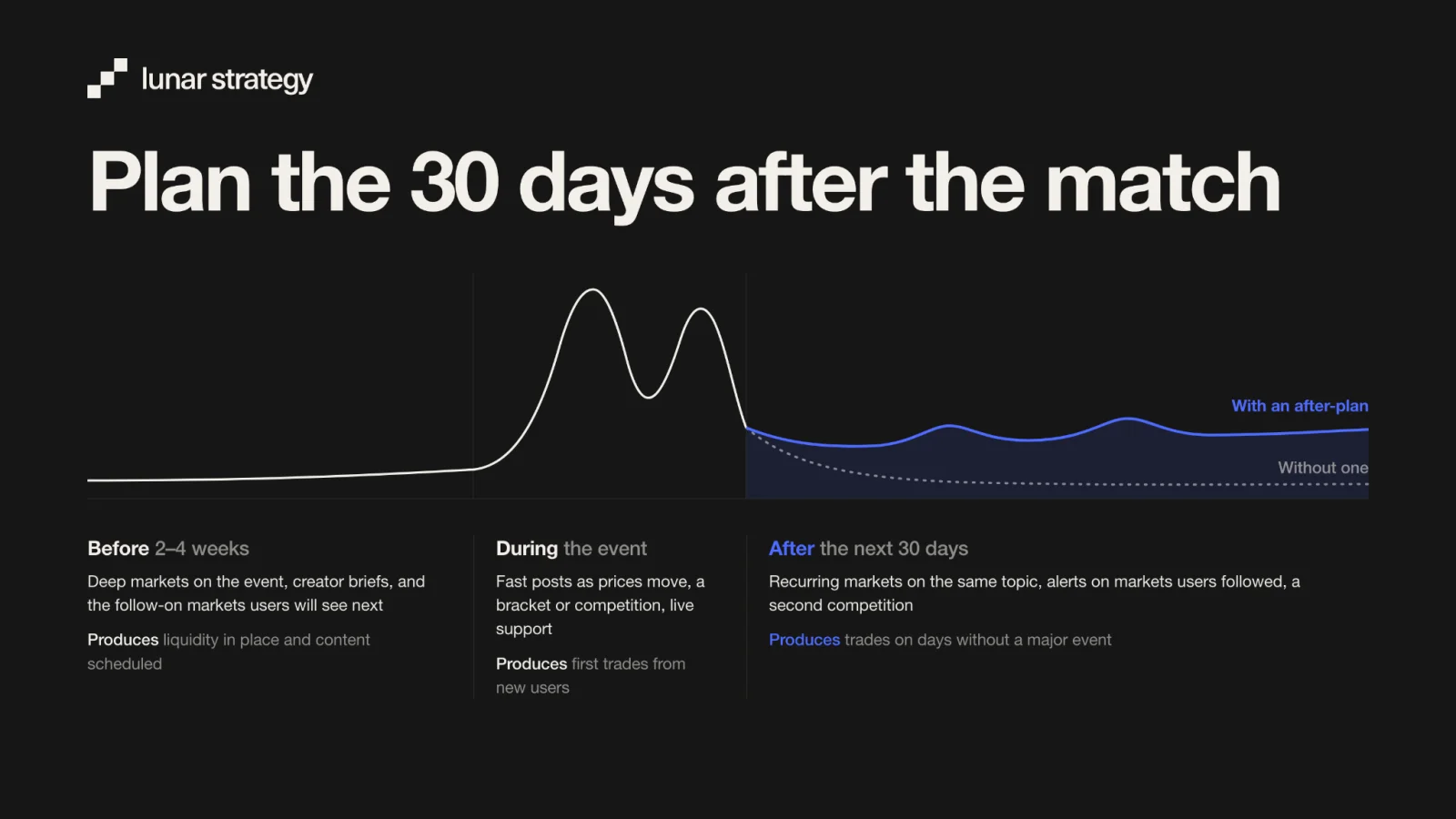
Plan each event before, during and after, and give the after the most work:
| When | What you prepare | What it should produce |
|---|---|---|
| Before (2-4 weeks) | Deep markets on the event, creator briefs, the follow-on markets users will see next | Liquidity in place, content scheduled |
| During (the event) | Fast posts and clips as prices move, a trading competition or bracket, live support | First trades from new users |
| After (the next 30 days) | Recurring markets on the same topic, alerts on markets users followed, a second competition | Trades on days without a major event |
Most teams stop at "during." Even the leaders find the after the hard part, as the quieter days between World Cup matches showed.
We talked through prediction markets and World Cup campaigns in a Lunar Live on X on June 12, 2026, the day after the tournament kicked off:
KOL and creator partnerships
Creators are where most challengers spend their budget, and where it is most often wasted. The channel works because prediction markets need explaining, and the leaders buy it at volume. Polymarket sponsored at least 101 YouTube videos and Kalshi at least 140 in 90 days, per Gospel Stats data reported by Tubefilter in February 2026.
A challenger can't match that count, so it has to win on fit: creators whose audience already has a view to trade, and who trade on the platform themselves. Three types do most of the converting:
- Vertical experts: sports analysts, commodity traders, political data writers, whose audience arrives with an opinion ready to price.
- Data creators: accounts that chart volumes and users from public on-chain data.
- Builders: developers who build on the API and bring professional traders with them.
Paying for reposts from general crypto accounts whose audiences never trade is the most common waste in the category. Count first trades from each creator's link or code within 7 days, and keep the creators who produce them. We cover how to choose and brief creators in our guides to the KOL in crypto and the KOL brief.
Disclosure is not optional. NPR reported in June 2026 that Kalshi and Polymarket had offered creators as much as $500 per post, and the same month the advertising watchdog BBB National Programs referred Kalshi to the FTC and state attorneys general after it declined to take part in a review of its influencer posts. Mark every paid post, and keep creators away from promising returns.
Crypto-native and TradFi distribution
The fastest way to reach traders is inside an app they already use, because nobody leaves it without a reason. The leaders built most of their reach this way, on both the finance side and the crypto side:
| Channel | What the leaders did | What it bought |
|---|---|---|
| Brokers and apps | Robinhood offers Kalshi contracts in its app, and its prediction market revenue passed its crypto and equities revenue in Q2 2026. Interactive Brokers and Clear Street added Kalshi contracts in May 2026 | Funded users who never had to download a new app |
| Media | CNN made Kalshi its prediction markets partner in December 2025 | Odds shown where news is read, with the brand attached |
| Sports rights | The NHL gave both platforms rights to its marks and in-broadcast signage; UFC made Polymarket its exclusive prediction market partner | Reach inside the events people already trade on |
A challenger rarely gets a Robinhood deal, but the same logic works at its size. On the crypto side, that means wallet and chain integrations and a place in your chain's ecosystem campaigns. On the finance side, it means newsletters and communities of options and futures traders, where event contracts read as a new instrument rather than a bet. Judge each partner by the funded traders it sends.
Case studies: Polymarket, Kalshi and Limitless
The three platforms below grew with different tools, and each one shows a lesson a challenger can use at a smaller scale:
| Platform | What it did | Lesson |
|---|---|---|
| Polymarket | Became X's official prediction market partner, signed UFC, paid creators at volume and ran a $2M World Cup bracket | Put your odds where people already argue about the news |
| Kalshi | Built on CFTC regulation, reached users through Robinhood and other brokers, partnered with CNN and the NHL, made fast low-cost ads | Compliance can be a distribution channel, not only a cost |
| Limitless | Paired crypto and commodity creators, ran team trading competitions and an ambassador program, and rebated revenue to market makers | Tie every activation to a trade, and make creators traders |
Limitless is the case we know from the inside. Since July 2025 we have run campaigns like "Crypto vs. Commodity," which paired creators from both trading worlds and drove trading through the matching markets, while data creators used public Dune dashboards and developers built on the API. Before the token launch, a team trading competition turned creator audiences into volume, and because points ran alongside creator rewards, many creators kept posting after the paid scope ended as organic ambassadors (Lunar Strategy, 2026).
Launch plan for a new prediction market
The order matters more than the budget. A short list of deep markets, clear market maker terms and a dashboard that tracks funded traders will make every later dollar work harder than a bigger first push. Here is how the work above fits into six months:
| Period | Focus | Move on when |
|---|---|---|
| Months 1-2 | Deep markets on a short list, market maker terms, API docs, funded-trader dashboard, a core community of early traders | Spreads hold at your audience's peak hours |
| Months 3-4 | One vertical you can own, two or three distribution partners, the first creator cohort, the explainer and comparison pages, the first event campaign with an after-plan | New users trade within 7 days at a steady rate |
| Months 5-6 | Referrals and points with self-trade filters, embeds and integrations, a second creator cohort chosen by funded traders | Non-event-day activity is growing |
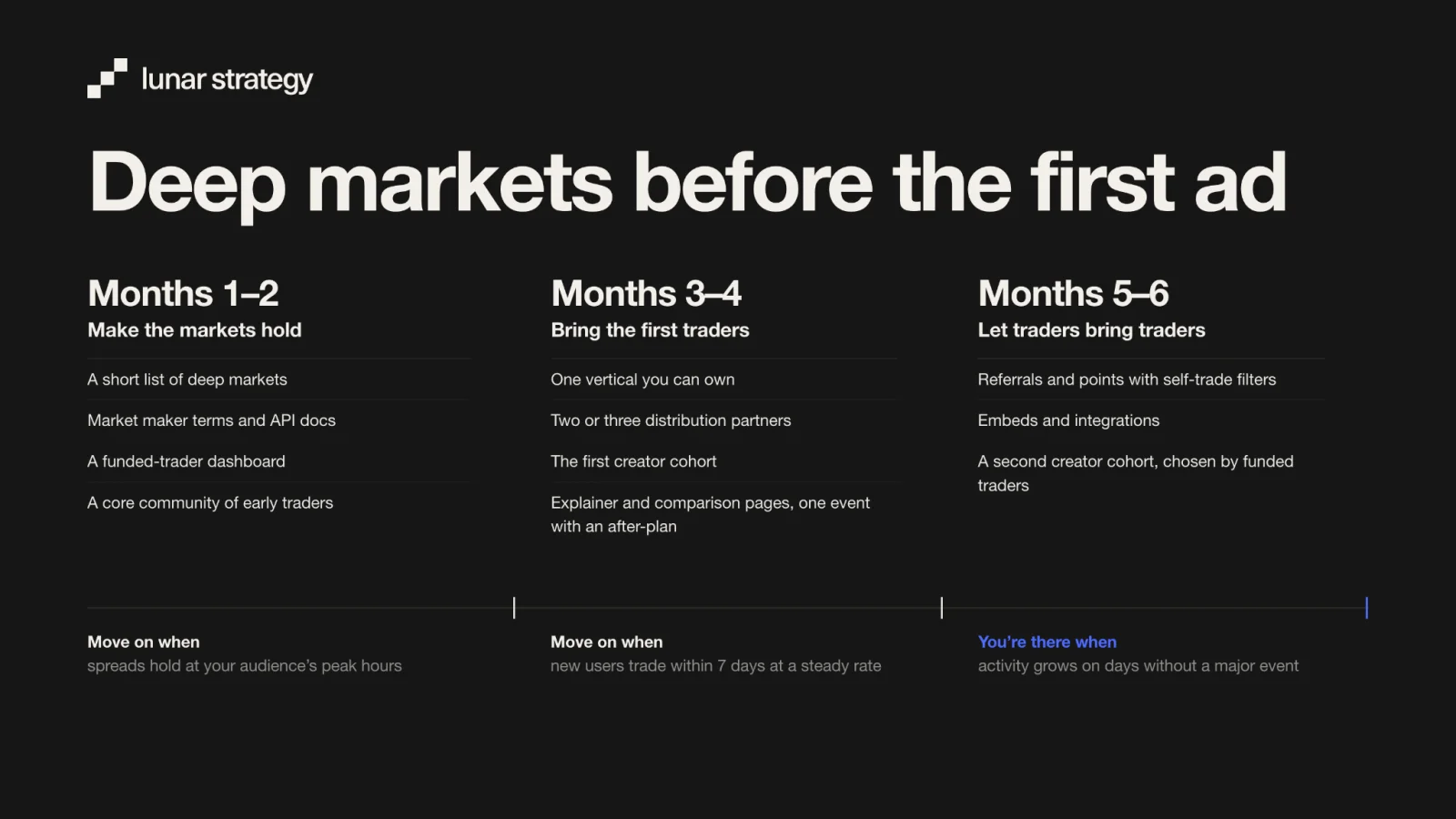
The most common mistake is to start in month 3, with a launch campaign before the markets can hold the traffic. Teams launching a token alongside the product can map this plan to our 90-day pre-TGE playbook, and our report on the state of prediction markets in 2026 covers who leads each category and where challengers are building.
Measuring prediction market marketing
Impressions tell you how many people saw a campaign, not whether a single person traded. Our rule with prediction market clients is that every activation ties to an on-chain outcome: trading volume, deposits, new wallets or competition participation (Lunar Strategy, 2026). That lets you compare a creator, a partnership and an event on one sheet:
| Metric | What it tells you |
|---|---|
| Funded traders | People who deposited and placed at least one trade. The base unit of acquisition |
| Time to first trade | Share of sign-ups that trade within 7 days. A low number points to empty markets or a hard deposit flow |
| Cost per funded trader | Campaign spend divided by funded traders it produced. Our CAC guide covers attribution |
| Active on non-event days | Traders who trade when no major match or election is running. The best sign of real retention |
| Organic volume share | Volume from wallets with no reward running, after removing self-trades |
| Depth on top markets | Spread and order size on the markets your campaigns send people to |
A worked example with made-up numbers: Campaign A pays general crypto accounts $40,000 for reposts and gets 2 million impressions, 1,200 funded traders and 150 still trading a month later, about $267 per retained trader. Campaign B spends the same on 15 vertical creators with a team competition: 400,000 impressions, 1,500 funded traders, 600 still active, about $67 each. A wins every reach report and loses on the one number that lasts.
How Lunar Strategy approaches prediction market marketing
We've worked with more than 300 crypto projects since 2019, and we have been embedded with prediction market teams for over a year, running creator campaigns, social operations and on-chain growth programs. Our flagship engagement is Limitless, the largest prediction market on Base, where we have worked since July 2025 across the pre-token phase, the community sale and the ambassador program that followed (Lunar Strategy, 2026):
- Scale: $1.97 billion in all-time volume and 68,874 monthly active traders at the all-time high.
- Users: 213,000 unique users, third in the sector, while sixth by volume.
- Community sale: 32,686 participants pledged $201 million against a $1 million target, 200 times oversubscribed, with allocation priority rewarding on-chain activity on Limitless.
We also work with Outcome, which is building the first prediction market on Hyperliquid, where a testnet trading competition drew more than 3,000 sign-ups before mainnet.
See how we market prediction markets →
Book a discovery call and tell us which markets you're launching; we'll show you what we'd fix first.
Frequently Asked Questions
How is a prediction market different from sports betting?
On a sportsbook, the operator sets the odds and takes the other side of your bet. On a prediction market, users trade contracts with each other and the price moves with supply and demand. Whether that makes it gambling in law is what US states and the CFTC are disputing in 2026.
Do most prediction market traders make money?
No. A Bloomberg News analysis of every Polymarket wallet active since the start of 2025 found that more than 100,000 accounts lost at least $1,000, almost twice the number that made that much (Bloomberg). For marketers, that is a reason to sell the experience of trading a view, never easy profits.
What's the difference between Kalshi and Polymarket?
Kalshi is a CFTC-designated contract market, a regulated US exchange for event contracts, and reaches many users through brokers such as Robinhood. Polymarket started as a crypto platform: it runs on Polygon and settles in USDC, a dollar stablecoin. Together they handled most of the sector's 2025 volume, as our 2026 prediction markets report details.
What does a market maker do on a prediction market?
A market maker posts buy and sell orders on a market at the same time, so anyone who arrives can trade instantly at a fair price. It earns the small gap between the two prices, plus any fee rebates the platform offers. Without one, new markets show empty order books.