























TL;DR:
- AEO (answer engine optimization) is the work of making your pages the source that AI tools quote when they answer a question. The answer engines that matter are Google's AI Overviews and AI Mode, ChatGPT, Perplexity and Microsoft Copilot.
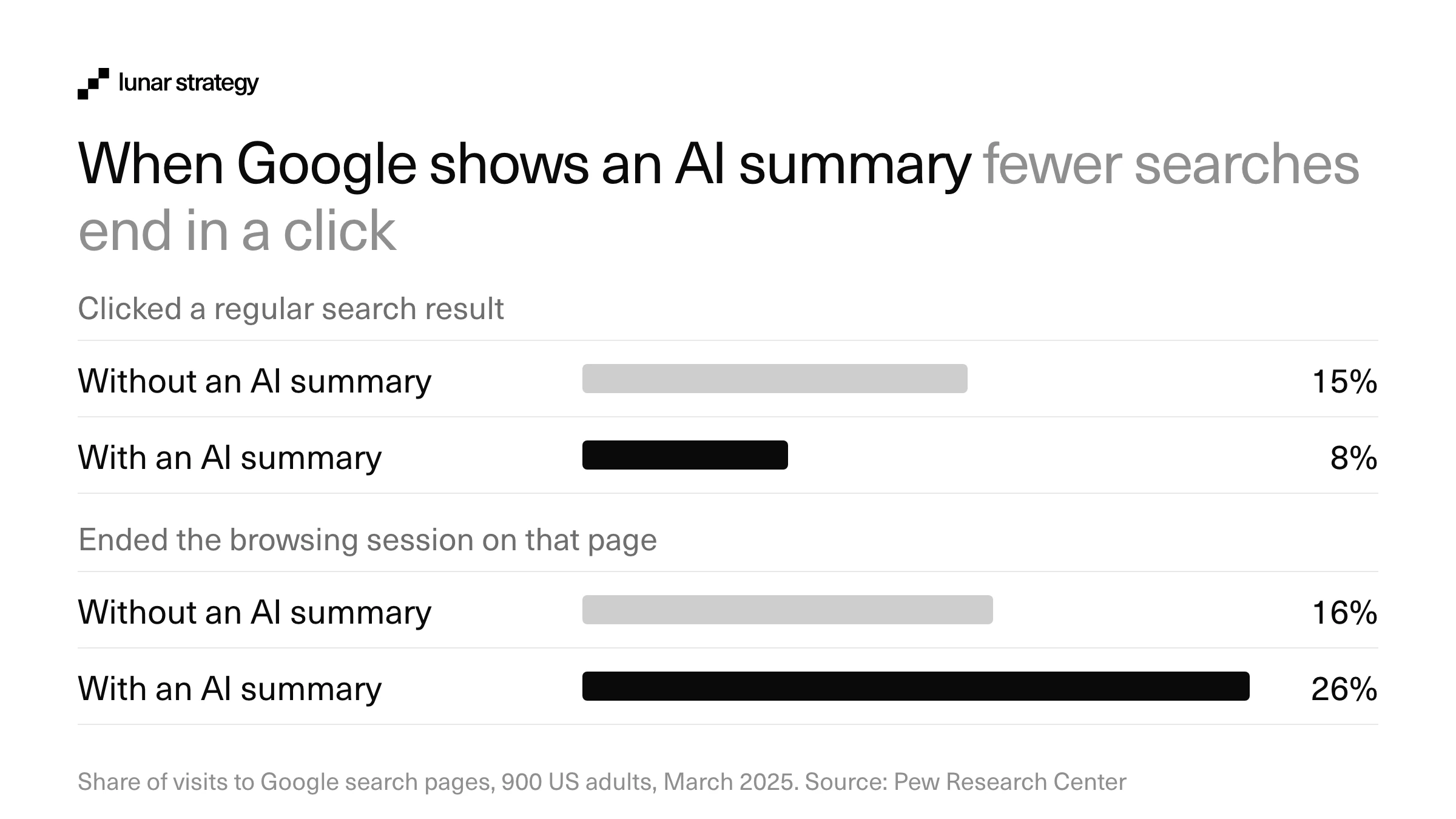
- The answer is now where many searches end. In a Pew Research Center study, people clicked a regular result in 8% of visits to Google pages with an AI summary, against 15% without one.
- AEO is part of SEO, and Google says so in its own guide. What changes is how you write (answer first, in passages that stand alone), where your facts live (including the sites that write about you) and how you measure (citations as well as rankings).
- Most "AEO hacks" sold online don't move anything. Google says structured data isn't required for its AI answers and that many suggested tricks "aren't effective"; the pages that get quoted are indexed, clear and trusted.
- Start with free tools: Search Console, Bing's AI Performance report and a fixed list of 20 questions you check every month in Google, ChatGPT and Perplexity.
Google's AI Overviews reached more than 2 billion monthly users in July 2025, and by October 2026 the questions people typed into AI Mode were, on average, three times longer than a traditional search. People now ask full questions and read a written answer before they decide whether to click anything. For a brand, the page that answer quotes gets the attention, and often the only click.
AEO, short for answer engine optimization, is the name for the work of becoming that quoted page. The term is everywhere in 2026, usually sold as a new discipline with its own audit and its own budget. AEO is SEO written for a results page where the answer comes first: the same foundations, plus a different way of writing, a wider view of where your facts live and a new set of numbers to watch.
This guide explains what AEO means, where it came from, why clicks moved into the answer, how answer engines choose what to quote, what makes a page quotable, and how to measure and start it with free tools.
What is AEO (answer engine optimization)?
Answer engine optimization is the practice of structuring your content and your presence across the web so that answer engines pick your page as the source of a direct answer, quote it accurately and link to it. An answer engine is any tool that replies to a question with a written answer instead of a list of links, such as Google's AI Overviews, ChatGPT search or Perplexity.
The term has official recognition. Google's guide to AI features in Search, last updated in July 2026, has a section titled "What about AEO and GEO?". It groups AEO with GEO (generative engine optimization) as names for work focused on visibility in AI search, and then answers the question most people are really asking: for Google, that work is still SEO.
These are the answer engines it applies to in 2027:
- Google AI Overviews: the AI summary at the top of a Google results page, built from Google's own index.
- Google AI Mode: Google's chat-style search tab, which passed 1 billion monthly users in July 2026, according to Alphabet.
- ChatGPT search: OpenAI's assistant when it browses the web, using OpenAI's crawler and search partners.
- Perplexity: an AI search engine that shows numbered sources next to every answer.
- Microsoft Copilot and Bing: AI answers built on Bing's index, which Microsoft now reports on in Bing Webmaster Tools.
- Voice assistants: Siri, Alexa and Google Assistant, which read one answer aloud.
The practical difference shows up in what you compete for. In SEO, you compete for a position in a list of links, and the reader picks which one to click. In an answer engine there is no list: the AI reads dozens of sources, writes one answer and decides which brands to name. The work carries over, though. A site that already ranks with useful, well-structured content tends to be mentioned in AI answers before it does anything AEO-specific, because the engines pull from the same pages search already trusts.
That's also why AI search is unlikely to replace SEO outright. New channels usually grow alongside old ones: when app stores took off around 2010, many predicted the end of the web, and the web kept growing. AI search looks set to follow the same pattern, and Google still handles billions of searches a day, so the sensible plan is to work on both.
AEO started with featured snippets, long before ChatGPT
The idea behind AEO is older than generative AI. In January 2014, Google introduced featured snippets, the boxed answer above the regular results. Danny Sullivan, Google's public liaison for Search, later explained that featured snippets "reverse the usual format": Google shows the answer first and the source second. Marketers who wanted that box started writing short, direct answers under question headings, and that habit is the core of AEO today.
Voice assistants raised the stakes. A speaker or a phone reading an answer aloud picks one source and skips everyone else, so being second stopped counting. Then, from 2024, AI Overviews, ChatGPT search and Perplexity began writing full answers from several sources at once. The format grew from one box to a whole paragraph with citations, and the goal stayed the same: be the clearest, most trusted answer to the question.
One rule from the featured-snippet era still holds. Google's documentation on featured snippets asks "How can I mark my page as a featured snippet?" and answers in two words: "You can't." Google's systems decide. The same is true of AI answers, which is why AEO is about earning the pick.
| Era | What the answer looked like | What won it |
|---|---|---|
| Featured snippets (2014 onward) | One boxed excerpt above the results | A short, direct answer under a matching question |
| Voice answers (late 2010s) | One answer read aloud | Concise, conversational wording; one clear fact |
| AI answers (2024 onward) | A written paragraph built from several sources, with citations | Passages that stand alone, sourced facts, trust across the web |
The questions changed shape along the way. In Alphabet's October 2026 earnings remarks, Google said that queries in AI Mode are on average three times longer than traditional searches and that one in five AI Mode searches globally use voice, images or documents. People ask the way they talk now, and the page that matches the question as asked gets used.
Being cited in the answer is the new position one
The strongest reason to care about AEO is what happens to clicks when an answer appears. Three independent data sets point the same way, and they measure different things, so it helps to read them side by side.
| Study | What it measured | Finding |
|---|---|---|
| Pew Research Center, July 2025 | Browsing of 900 US adults in March 2025 | Users clicked a regular result in 8% of visits with an AI summary vs 15% without; 1% clicked a link inside the summary |
| Ahrefs, February 2026 | 300,000 keywords, December 2023 vs December 2025 | An AI Overview correlates with a 58% lower average click-through rate for the top-ranking page |
| Seer Interactive, November 2025 | 3,119 queries across 42 organizations | Organic CTR on queries with AI Overviews fell from 1.76% to 0.61%; brands cited in the AI Overview got 35% more organic clicks than when not cited |
Pew also tracked what people did next. After a Google search that showed an AI summary, people stopped browsing altogether 26% of the time, against 16% when there was no summary. That’s about 1 in 4 searches ending without a visit to any website. If your brand is named in the summary, it still reached them. If it isn’t, they never saw you, even if your page ranked high in the results below.
Google tells the other side. Its AI features documentation says that when people click from results pages with AI Overviews, "these clicks are higher quality", meaning visitors spend more time on the site. That's Google's own claim and it isn't independently measured, but it fits Seer's finding about cited brands: fewer clicks in total, and better clicks for the sources the answer names.
Conversion data points the same way. In a July 2025 study, Semrush found that the average visitor arriving from AI search tools such as ChatGPT was worth 4.4 times the average traditional organic visitor, based on conversion rate. Semrush sells AI visibility software, so it has a stake in that finding, and the figure covers non-Google AI referrers only. Still, it fits the pattern: AI answers send fewer people, and the people they send arrive further along in their decision.
How answer engines pick the answer they quote
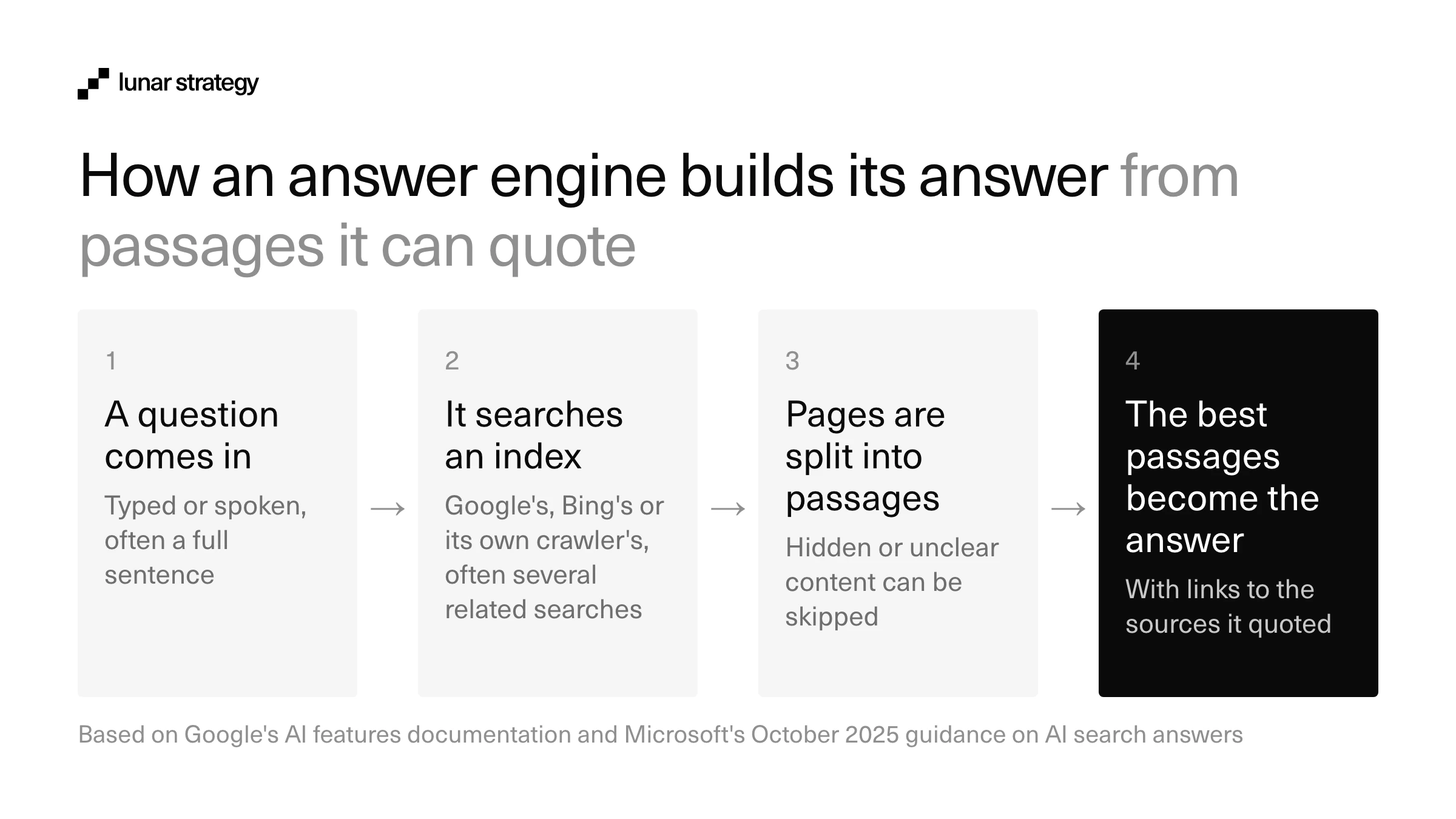
When answer engines reply to a search, they run a search of their own, pull candidate pages from an index, split those pages into passages and assemble an answer from the passages that best fit the question. Every AEO tactic follows from that process: your page has to be in the index, readable in pieces, and the clearest fit for at least one passage of the answer.
Each engine has its own entry rules. Google says a page must be "indexed and eligible to be shown in Google Search with a snippet" to appear in AI Overviews or AI Mode, and that controls like nosnippet and max-snippet limit what its AI features can show. OpenAI says sites that block its OAI-SearchBot crawler won't appear in ChatGPT search answers.
Microsoft is the most open about what happens next. In an October 2025 post on optimizing content for AI search answers, Krishna Madhavan of Microsoft explains that AI systems break content into smaller pieces (a process called parsing), look for "clear meaning, consistent context, and clean formatting", and may skip content hidden behind tabs or accordions. The same post sums up the whole field in one line:
"While there's no secret sauce that guarantees selection in AI answers, there are clear practices that improve eligibility."
Krishna Madhavan, Microsoft
Ranking well doesn't guarantee a place in the answer. Google's documentation explains why: AI Overviews and AI Mode may use a "query fan-out" technique, running several related searches across subtopics, so the answer often quotes a page that covers one piece of the question better than the page ranking first for the whole of it.
AEO, SEO and GEO are one job with three names
AEO, SEO and GEO describe overlapping work, and the differences are mostly about where you want to appear.
- SEO aims to rank pages in the list of results.
- AEO aims to be the direct answer, in a snippet, a voice reply or an AI summary.
- GEO aims to be cited inside answers written by generative AI tools.
In practice, the same pages and the same habits serve all three.
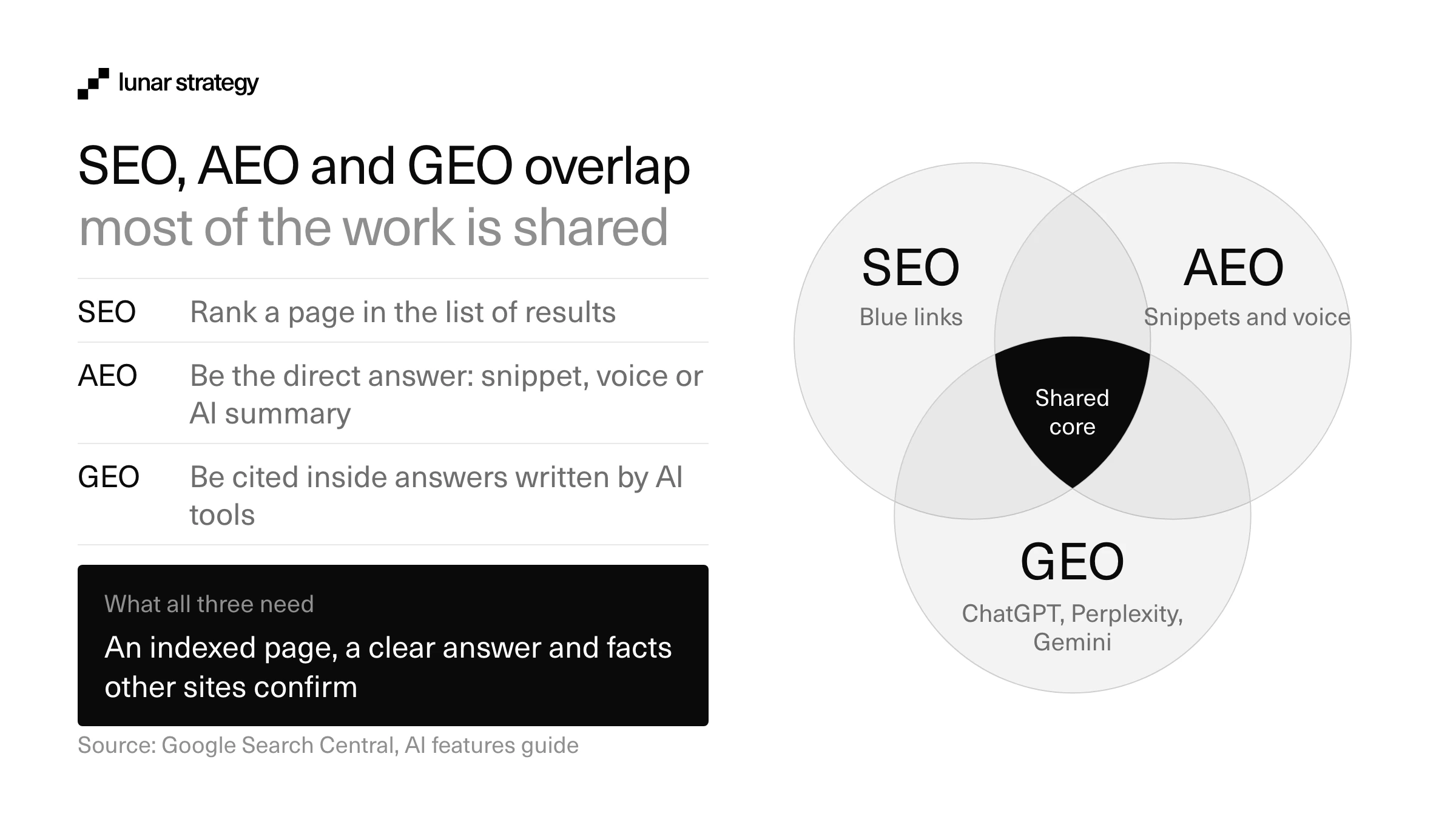
Some guides treat GEO as a subset of AEO, because AEO also covers featured snippets and voice answers that no language model writes. The labels matter less than the work behind them: an indexed page, a clear answer and facts that other sites confirm.
Google's position is that none of this needs a separate playbook. Its guide says many suggested AEO and GEO "hacks" "aren't effective or supported by how Google Search actually works". Danny Sullivan made the same point at WordCamp US in August 2025, telling the audience that good SEO is good GEO, as reported by Search Engine Roundtable.
| SEO | AEO | GEO | |
|---|---|---|---|
| Goal | Rank a page in the results list | Be the direct answer | Be quoted and linked inside AI-written answers |
| Where you show up | Blue links | Featured snippets, voice answers, AI Overviews, chat answers | ChatGPT, Perplexity, Gemini, Copilot, AI Overviews |
| Unit of success | Position and clicks | Selected as the answer, citations | Mentions, citations, how you're described |
| Main lever | Your pages and links to them | Answer-first passages that stand alone | Your pages plus what other sites say about you |
If you want the comparison in depth, our article on AEO vs SEO for crypto projects breaks down where budgets and teams should split. We also wrote a short version for founders on X:
What makes a page easy for answer engines to quote
A quotable page answers the question in its first two sentences, under a heading that matches how people ask it. The answer is short enough to lift (about 40-60 words, which is also what Google's own AI Overview recommends for AEO), it names the subject instead of saying "it", and it carries one specific fact with its source. Detail, context and caveats come after. An engine that splits the page into passages can then take that opening and use it without the rest.
Headings work best as the reader's real questions. People Also Ask boxes, your support inbox and the questions in your community chat are the best sources, because they're phrased the way people type and speak. Each section should make sense if it's the only part an engine reads, so avoid "as we saw above" and repeat the subject's name where a human writer would use a pronoun. Keep dates visible on time-sensitive facts, because answer engines favor information they can tell is current.
Coverage matters as much as the opening. Because Google's AI runs related searches across subtopics while it writes, a page that also answers the obvious follow-up questions (how much it costs, how long it takes, what can go wrong) gives the engine more passages to pick from.
Original material helps most of all: first-party data, a calculator, a test you ran yourself. An answer engine can only summarize what's already published, so a page with numbers nobody else has becomes the source for them.
A passage that answer engines can quote usually has these parts:
- The question as a heading, in the words people use when they ask it.
- A 40-60 word answer first, with the subject named and one fact with its source and date.
- Detail after the answer: how it works, who it's for and the main caveat.
- A table or list when the reader is comparing options.
Structured data deserves a straight answer, because it's the tactic most AEO advice leads with. Google says "structured data isn't required for generative AI search, and there's no special schema.org markup you need to add." Microsoft says schema helps search engines and AI systems understand content. Both are true: markup that matches the visible page keeps your facts consistent and machine-readable, which is good practice. It won't get a weak answer quoted, and an FAQ block added only for AEO does nothing a clear paragraph doesn't already do.
The same goes for hidden content. Key facts inside tabs, accordions, sliders or images with no text alternative risk being skipped by the systems that parse the page, as Microsoft's guidance warns. Put the facts people ask about in plain text on the page.
In crypto, other sites write the answer about you
When someone asks an answer engine whether a project is safe, legit or worth using, the engine leans on what other sites say about it: review sites, exchange learning centers, data aggregators and news coverage. A project can have perfectly answer-first pages and still be described by a third party's outdated review.
The off-site layer counts for every brand, in crypto or not. In a May 2025 study of about 75,000 brands, Ahrefs found that branded web mentions correlated with visibility in AI Overviews at 0.664, against 0.218 for the number of backlinks. Correlation isn't proof of cause, as the author notes, but the direction is clear: being talked about on trusted sites predicts being named in the answer better than links alone.
Each type of source does a different job in the answer:
- Review and research sites: trusted for the safety and "is it legit" verdict; keep your facts current with them and correct errors quickly.
- Exchange learning centers and listings: trusted for definitions and token basics; make sure your listing data (supply, contract address, audits) is accurate.
- Data aggregators: trusted for numbers such as TVL, volume and fees; your figures should match theirs.
- News coverage: trusted for events, funding and partnerships; this is where digital PR earns mentions.
- Your own docs and blog: trusted for how the product works; this is where answer-first writing pays off most.
That's why AEO for a crypto project includes PR and partnership work, and why your brand facts need to agree everywhere they appear. Our guide to a Google knowledge panel for crypto projects covers how to get Google's entity data right, which feeds the same answers.
How to measure AEO with free tools
You can measure AEO without a paid tool, by combining what the platforms report with a simple, repeated check of the answers themselves. Google counts traffic from AI Overviews and AI Mode inside your overall Search Console data, and since August 31, 2026, Search Console's generative AI performance insights are available to every site. Bing Webmaster Tools added an AI Performance report in February 2026 that shows citations in Copilot and Bing's AI summaries.
The rest is a habit. Write down 20 questions your buyers really ask, run them in Google, ChatGPT and Perplexity on the same day each month, and record who gets cited and how your project is described. Answers change between runs, so look at the trend over three months. Because many AI answers send no click, also watch the signals that come later: searches for your brand name and what new users say when you ask how they found you.
| Metric | Free tool | What it tells you |
|---|---|---|
| Clicks and impressions incl. AI features | Google Search Console (Performance + generative AI insights) | Whether Google's AI surfaces send you visits |
| Citations in Copilot and Bing AI answers | Bing Webmaster Tools, AI Performance | How often Microsoft's AI quotes your pages |
| Share of voice in answers | A fixed list of 20 questions, checked monthly | Your citations divided by all citations across the list (8 of 40 = 20%), per engine, over time |
| How you're described | The same monthly check | Whether the facts in the answer are right and current |
| Referral visits from AI tools | Google Analytics 4 (referrals from chatgpt.com, perplexity.ai) | Which AI answers send real visitors |
| Branded searches | Google Search Console (queries containing your brand name) | Whether people who saw you in an answer search for you later |
| Self-reported attribution | A "How did you hear about us?" field with AI tools as an option | Influence that never shows up as a click |
When you outgrow the spreadsheet, our roundup of AI visibility tools for crypto compares the paid trackers.
Where to start
Start with access, because nothing else matters if engines can't read you: confirm your key pages are indexed, that no nosnippet or max-snippet setting blocks them, and that OAI-SearchBot, PerplexityBot, Googlebot and Bingbot are allowed in robots.txt and your CDN. Then pick the 10 pages that answer your buyers' most important questions and rewrite their openings answer-first. Next, fix your facts across the web, starting with the review sites and aggregators that keep appearing in answers. Finally, set up your monthly 20-question check, with questions from each stage of the decision (what is it, how do I choose, is this project safe), plus the Search Console and Bing reports, and judge progress after a quarter.
A checklist for the first month:
- Key pages indexed and eligible for snippets (no accidental nosnippet or max-snippet)
- OAI-SearchBot, PerplexityBot, Googlebot and Bingbot allowed in robots.txt and the CDN
- Answer-first opening (40-60 words) on your 10 most important pages
- Headings phrased as the questions people ask (from People Also Ask and your support inbox)
- Key facts in plain text, not hidden in tabs, accordions or images
- One sourced, dated fact in each section of your key pages
- Structured data that matches what's visible on the page
- Brand and token facts identical across docs, listings, aggregators and review sites
- 20 buyer questions saved across the learning, comparing and deciding stages, with the first results recorded per engine
- Search Console and Bing AI Performance checked monthly
For the Google side in depth, see how to rank in AI Overviews; for ChatGPT and Perplexity, see how to get your crypto project cited by ChatGPT and Perplexity.
How Lunar Strategy approaches AEO
Lunar's crypto SEO service runs Google and AI search as one program, so AEO sits inside the same plan as rankings. It starts with an audit of crawlability, indexation, site architecture, metadata and backlinks, then moves to answer-first rewrites of the pages that matter, new content for the questions buyers ask, and off-site work on the sites answer engines trust, with monthly reporting from Search Console and GA4 plus a fixed set of AI prompts.
Book a call about AEO for your project →
Bring five questions your users ask AI tools; we'll show you who gets quoted today and what it would take to be the answer.
Frequently Asked Questions
What does AEO stand for?
In marketing, AEO stands for answer engine optimization: optimizing content so that AI tools, voice assistants and answer boxes use it as a direct answer. In international trade, AEO means Authorized Economic Operator, a customs certification for trusted companies. The two are unrelated, so check the context when you see the acronym.
Is AEO replacing SEO?
No. AEO depends on SEO, because answer engines pull their sources from search indexes, and Google says optimizing for its AI features is still SEO. What AEO adds is a focus on being the quoted answer, which changes how pages open, how facts are formatted and which numbers you track besides rankings.
What is AEO in digital marketing?
In digital marketing, AEO is the part of a search strategy aimed at AI answers: making a brand's pages, docs and third-party mentions the sources an answer engine trusts and quotes. It usually sits with the SEO or content team and connects to PR, because coverage on trusted sites shapes how answer engines describe a brand.
What do LLMO and AIO mean?
LLMO (large language model optimization) and AIO (AI optimization) are other names for the same goal: getting a brand used and cited in AI-generated answers. LLMO focuses on chat tools built on language models, such as ChatGPT, while AIO is an umbrella term for every AI surface. Most teams run AEO, GEO, LLMO and AIO as one workstream.
Do I need FAQ schema or an llms.txt file for AEO?
Neither is required for Google. Google says there's no special schema needed for its AI features and that its Search doesn't use llms.txt. FAQ markup can still help keep facts machine-readable when it matches the visible page. Clear, answer-first text and correct facts across the web matter far more than either file.
How long does AEO take to show results?
Technical fixes, such as unblocking crawlers or removing snippet restrictions, can show up within weeks, once engines recrawl your pages. Rewriting key pages answer-first usually shows in a month or two. Changing what third-party sites say about you takes longer. Because AI answers vary between runs, judge AEO over three to six months of monthly checks.
Can a small brand win AEO against big sites?
Yes, on specific questions. Answer engines pick passages from individual pages, so a small brand with the clearest, best-sourced answer to a narrow question can be quoted ahead of larger sites. Because Google's AI runs several related searches for one question, a focused page that answers one part well has a real chance.