







.png)

















TL;DR:
- More and more people ask AI tools like ChatGPT and Perplexity which crypto projects to use and whether a token is safe. AI visibility tools show you what those answers say: they ask the same questions on a schedule and report how often your project is named and which websites the answers rely on.
- Those answers are often wrong. When we asked ChatGPT and Perplexity which of these tools to use, both got the prices wrong, and an AI that misquotes a public price can misquote your token supply or your chain too.
- For a crypto project, a good tool does three things: it covers Perplexity (and Grok, if your community is on X), it lets you track your own questions with your project and token names, and it shows the full answer, so you can catch wrong facts.
- You can start for free with Google Search Console, Bing Webmaster Tools and Ahrefs' free checker. After that, most early-stage projects need just one paid tool under $100 a month, such as Otterly.AI ($29), LLMrefs ($79) or Peec AI ($95).
- Expect the numbers to jump. In our own October 2026 test, two ChatGPT answers to "is hyperliquid safe," asked minutes apart, cited 3 and 8 sources with no link in common, so read the trend over several weeks. When it's low, the fix isn't in the tool but in the sites the AI trusts: your own pages, media coverage and mentions.
On October 4, 2026, we asked ChatGPT and Perplexity which AI visibility tools a crypto project should use. Both answered with confidence, and both got prices wrong. Perplexity said Profound starts at $99 a month, but Profound's own pricing page shows only a free trial and custom enterprise plans. ChatGPT said Otterly.AI and Peec AI don't publish their prices. They do: $29 and $95 a month.
If AI assistants get a price on a public page wrong, they can get your token supply, your audits or your chain wrong too, and more of your future users are asking them. In an August 2026 survey by the UK's Financial Conduct Authority, 4 in 5 less experienced investors aged 18-40 said they had used AI for help with investing, and more of them trust AI tools (56%) than TV and radio (47%) or the press (46%). None of those answers show up in your analytics. An AI visibility tool is how you see them.
After working with more than 300 crypto projects, we've learned that the numbers only move when the sources move.
Lunar Strategy
This guide is for crypto founders and marketers deciding whether to pay for one of these tools, and which one. It follows the order you'll need it in: what the tools measure, what a crypto project should look for, the 8 worth considering (prices checked in October 2026), how to set one up, how to read the results and what to do when they're low.
What an AI visibility tool actually measures
An AI visibility tool sends a fixed list of questions to ChatGPT, Perplexity, Google AI Overviews and other AI assistants every day or week, saves every answer and checks each one for your project, your competitors and your website. Your report is built from those saved answers, and almost every tool on the market works this way.
Dashboards look different from vendor to vendor, but they come down to three things you'll actually use:
- How often you're named. Tools call it visibility or mention rate: the share of saved answers that include your project. Share of voice puts that number next to your competitors'.
- Which pages the answers relied on. These are the citations. They're the most useful part of the report, because they show which sites shape what AI says about your category.
- What the answers actually say. The full text is where you catch an old supply figure, the wrong chain or a "possible scam" label.
Most tools also show your position in lists and a sentiment score. Treat both as rough signals: answers reshuffle from one run to the next, and a "positive" label won't tell you the AI put your token on the wrong chain. Citations also connect AI visibility to the rest of your search work, because every page an AI assistant cites is a page you can improve or earn coverage on. Our crypto SEO guide covers that groundwork.
The third item, what the answers say, is where crypto differs from almost every other category.
Projects need accuracy, not just mentions
A software brand left out of an AI answer loses a lead. A token described with an old supply figure, the wrong chain or a "possible scam" label loses trust, which is much harder to win back. And wrong answers are common. In a study led by the European Broadcasting Union and the BBC, journalists from 22 public broadcasters reviewed more than 3,000 answers from ChatGPT, Copilot, Gemini and Perplexity, and 20% had significant accuracy issues. That study covered news questions in October 2025, not crypto, but token facts such as supply, vesting dates and contract addresses change often, which gives AI assistants more chances to repeat old ones.
Trust questions are where it hurts most. In October 2026 we asked ChatGPT, Perplexity and Google 8 brand-safety questions, such as "is aave safe" and "is phantom wallet safe." ChatGPT cited the project's own website in all 8 answers, Perplexity in 4, and Google's AI Overview in 1 of the 3 that loaded. Each time, the project's site was cited for features, docs, audits or terms, never for the verdict itself.
Your site supplies the facts, and someone else supplies the judgment.
Lunar Strategy
That shapes what you should demand from a tool. Before you compare prices, check three things:
- It covers the AI assistants your users ask. ChatGPT, Perplexity and Google AI Overviews at a minimum. Add Grok if your community lives on X: it's built into X, and only some tools track it. Our X growth playbook covers that side.
- You can write your own questions with your project name, ticker and chain. Tools call these prompts, and generic ones won't tell you much about a token.
- It saves the full answer and its citations, so you can check token facts and see whether the AI relied on CoinGecko, your docs, an exchange or a news site.
Those three criteria, plus a price an early-stage team can afford, are how we chose the tools below.
The 8 AI visibility tools worth considering
We started from the tools that Google's AI Overview and the top-ranking guides name, added the ones ChatGPT and Perplexity recommended, and kept the 8 that best meet the three criteria above with public pricing and a trial or free plan. We left out tools that are mainly content writers with tracking added, and smaller vendors whose "best tools for crypto" lists rank their own product first. Lunar Strategy doesn't sell an AI visibility tool, so nothing here is ranked first because we built it.
We checked every price on the vendor's official pricing page on October 5, 2026. Prices in this category change often, so confirm on the vendor's page before you buy. For most crypto teams, the deciding columns are Perplexity, Grok and the number of prompts on the entry plan:
| Tool | Entry price | Prompts on entry plan | Perplexity | Grok | Free option |
|---|---|---|---|---|---|
| Otterly.AI | $29/monthLite plan | 15 | Yes | No | Free trial |
| LLMrefs | $79/monthLimited-time price | 500 | Yes | Yes | 7-day trial |
| Rankscale | $99/monthPro plan; Essentials from $17/month, billed yearly only | 1,200 creditsAbout 0.25 credit per AI query | Yes | Yes | 7-day Pro trial |
| Peec AI | $95/monthStarter plan | 50On 3 models | Add-on | Enterprise only | None listed |
| Semrush AI Visibility Toolkit | $99/monthPer domain | 25 | Yes | No | No toolkit trial |
| Ahrefs Brand Radar | $50/monthCustom prompts; AI Visibility Index from $199/month | 5 includedWith a paid Ahrefs Lite plan | Yes | No | Free checker |
| AthenaHQ | FreeStarter plan $295/month | 300 creditsFree plan; 3,600 on Starter | Yes | Starter and up | Free plan |
| Profound | CustomEnterprise plan | 50 during the trial | Enterprise | Not confirmed | 7-day free trial |
Each review below covers the price, the AI assistants included and the crypto fit, then the same two lines: the main limit and who should pick it.
1. Otterly.AI: the cheapest way to start
Otterly.AI's Lite plan costs $29 a month ($25 billed yearly) for 15 prompts tracked on ChatGPT, Google AI Overviews, Perplexity and Microsoft Copilot, with a free trial. Claude, Google AI Mode and Gemini are paid add-ons. Perplexity is included from day one, and Lite tracks 50+ countries, which matters when most of your users aren't in the US.
- Limit: 15 prompts is enough for your name, your token and a few trust questions, not your whole category. There's no Grok.
- Best for: a pre-TGE or early-stage team that wants a first baseline before spending more.
2. LLMrefs: the most prompts per dollar
LLMrefs' All in One plan costs $79 a month, marked "limited time only," and tracks 500 prompts across ChatGPT, Google AI Overviews, AI Mode, Gemini, Perplexity, Claude, Grok, Copilot, Meta AI and DeepSeek. Geo-targeting covers 50+ countries and 20+ languages, and it shows fan-out queries (the follow-up searches an AI assistant runs behind your question).
- Limit: reports are weekly, not daily, and the promotional price may not last. Check the page before you commit to a yearly plan.
- Best for: teams that want broad category coverage, many prompts and Grok on a small budget.
3. Rankscale: flexible credits and Grok
Rankscale's Pro plan costs $99 a month for 1,200 credits, with a 7-day free trial. An Essentials plan starts at $17 a month, billed yearly only. One AI query typically uses a quarter of a credit, and the engines include ChatGPT, Gemini, Perplexity, Claude, DeepSeek, Mistral, Grok and Copilot in all regions. You can schedule checks from hourly to monthly, which suits launch weeks, when you may want daily checks for a short window.
- Limit: credits take some math. Work out prompts × AI assistants × runs per month before you pick a plan.
- Best for: teams that want Grok and control over how often each prompt runs.
4. Peec AI: daily tracking with fact-checking
Peec AI's Starter plan costs $95 a month for 50 prompts tracked daily on 3 models of your choice, with unlimited users. Its docs describe "prompts fact-checked": answers checked for claims about your brand "against the facts you set." That's the closest thing on this list to measuring accuracy, the feature crypto needs most, so confirm which plan includes it during onboarding.
- Limit: Perplexity isn't one of Starter's standard models (ChatGPT, AI Mode, AI Overviews, Copilot, Gemini and Naver). It's sold as an add-on, and Grok is Enterprise only.
- Best for: teams that care about how they're described, not just whether they're named.
5. Semrush AI Visibility Toolkit: for teams already on Semrush
Semrush's AI Visibility Toolkit costs $99 a month per domain and includes 25 tracked prompts, with mentions from ChatGPT, Google AI, Gemini and Perplexity. Its advantage is location: it sits next to your keyword and backlink data, so you can compare Google rankings with AI mentions in one place. It also includes a site audit for AI readiness.
- Limit: 25 prompts on the base plan, no Grok, and no free trial for the toolkit.
- Best for: teams already paying for Semrush who want AI data in the same reports.
6. Ahrefs Brand Radar: a ready-made prompt index
Ahrefs Brand Radar offers two products. Custom prompt tracking starts at $50 a month, refreshed daily, and paid Ahrefs plans include a few custom prompts at no extra cost (5 on Lite). The AI Visibility Index, built from hundreds of millions of prompts, starts at $199 a month per AI platform, or $699 a month for all of them. It covers AI Overviews, AI Mode, ChatGPT, Perplexity, Gemini and Copilot, plus YouTube and Reddit, both of which show up in Google's AI answers about crypto.
- Limit: Ahrefs says the index works best "once your brand already appears in AI search," so a new token will find little there. There's no Grok.
- Best for: established projects, and teams already on Ahrefs who can start with the included prompts.
7. AthenaHQ: a free plan and 11 models
AthenaHQ's Essential plan is free, not a trial, with 300 credits (1 credit = 1 AI response) across ChatGPT, Perplexity, AI Overviews, Gemini and Copilot. That's enough to test your trust questions at no cost. Starter costs $295 a month ($245 billed yearly) for 3,600 credits across 11 models, including Grok, and Enterprise adds features AthenaHQ calls "claim review" and "discrepancy detection," aimed at answers that don't match your own facts.
- Limit: 300 credits run out fast if you track daily, and the accuracy features are Enterprise only.
- Best for: teams that want to try before paying, and larger projects that need Grok plus accuracy checks.
8. Profound: the enterprise option
Profound's pricing page shows two options: a free 7-day trial (50 prompts run daily on ChatGPT, Gemini and Google AI Overviews) and an Enterprise plan with tailored pricing that tracks up to 9 AI assistants, including Perplexity, AI Mode, Copilot, Claude and DeepSeek. Enterprise adds dedicated support and SSO, which can matter for an exchange or a large layer 1. The company announced a $180 million Series D in September 2026.
- Limit: no public paid price, and the trial skips Perplexity. Grok isn't on the pricing page's engine list, so ask on a demo if you need it.
- Best for: large exchanges, foundations and protocols with an enterprise budget.
Also considered: SE Visible (Basic $99 a month for 200 prompts on ChatGPT, Gemini, AI Mode, Perplexity and AI Overviews, 10-day free trial, no Grok) and Scrunch (Core $250 a month for 125 prompts on ChatGPT, Perplexity, AI Overviews and Copilot, Grok on Enterprise only). Both are solid; neither beat the 8 above on price or crypto fit.
Which one to pick: start free, then pay for one tool
You don't need to pay anything on day one. No free option tracks your own questions over time, but four free reports cover the basics, and the two from Google and Bing build a history you can't recreate later. Turn them on before you choose a paid tool:
- Ahrefs' AI Visibility Checker checks ChatGPT, Gemini, Perplexity, Copilot and Google AI Overviews with no signup. Ahrefs calls it a "limited preview," so treat it as a snapshot.
- Google Search Console shows impressions in AI Overviews and AI Mode for every site since August 31, 2026, by page, country, device and date. It doesn't show clicks or the queries that triggered them.
- Bing Webmaster Tools has an AI Performance report with citations in Microsoft Copilot and Bing's AI summaries, plus grounding queries (the phrases the AI used to find your page). A June 2026 update adds your citation share per query, in preview.
- Google Analytics can isolate visits from ChatGPT, because ChatGPT adds utm_source=chatgpt.com to the links it sends.
Add one manual habit: once a month, ask your top 20-30 questions in ChatGPT and Perplexity and log the answers in a sheet. Step 5 of our guide to getting cited by ChatGPT and Perplexity has the full method. When you're ready to pay, match the tool to your stage: free and manual before launch, one paid tool under $100 after it, enterprise only at scale. The table assumes monthly billing.
| Budget | Best picks | What you get | Who it suits |
|---|---|---|---|
| $0 | Ahrefs checker, Search Console, Bing Webmaster Tools, Google Analytics, AthenaHQ free plan | Snapshots, first-party AI reports, 300 free AI responses | Pre-launch teams setting a baseline |
| Under $100 | Otterly.AI ($29), Ahrefs custom prompts ($50), LLMrefs ($79), Peec AI ($95), Rankscale ($99), Semrush ($99) | 15 to 500 prompts, daily or weekly, on 3 or more AI assistants | Most early-stage and post-TGE projects |
| $100-300 | Rankscale Pro+ ($229), Peec AI Pro ($245), Scrunch ($250), AthenaHQ Starter ($295) | More prompts, more models, Grok on some plans | Growing projects tracking a full category |
| Custom | Profound, Peec AI Enterprise, Ahrefs index for all platforms ($699) | Dedicated support, all models, SSO | Exchanges, foundations, large layer 1s |
If you're planning a launch, set up the free layer at least a month before TGE so you have a baseline to compare against; our 90-day pre-TGE playbook shows where this fits. And whatever your budget, pay for one tool, not three. Each tool samples answers its own way, so two tools give you two different numbers and no clearer picture.
Once you've picked one, what you load into it matters more than which one it is.
Set it up with the questions your users actually ask
A tool can only report on the questions you give it, so the prompt list decides what your numbers mean. Split it into 4 groups, because each group tells you something different: category questions show whether you're recommended, brand questions whether you're described correctly, trust questions whether you're called safe, and comparison questions whether you beat a competitor head to head. Replace the brackets and paste these into any tool:
CATEGORY (are we recommended?)
1. What are the best [category] on [chain]?
2. Which [category] have the lowest fees in 2026?
3. What is the safest way to [use case] on [chain]?
4. Which [category] do experienced crypto users recommend?
5. What are the most popular [category] right now?
6. Where can I [use case] without a centralized exchange?
BRAND (are we described correctly?)
7. What is [project]?
8. What is the [token] token used for?
9. Who founded [project]?
10. What chain is [token] on?
11. What is the total supply of [token]?
12. How does [project] make money?
TRUST (are we called safe?)
13. Is [project] legit?
14. Is [project] safe to use?
15. Has [project] been audited?
16. Is [token] a scam?
17. Has [project] ever been hacked?
18. What are the risks of using [project]?
COMPARISON (do we win head to head?)
19. [project] vs [competitor]
20. Is [project] better than [competitor]?
21. Alternatives to [competitor]
22. [project] or [competitor] for [use case]?
23. Which is cheaper, [project] or [competitor]?
24. Why would someone choose [project] over [competitor]?
Then add a few questions specific to your type of project, and write down the facts every answer must get right. These are the facts that cost you trust when an answer gets them wrong:
| Project type | Extra prompts to add | Facts to check in every answer |
|---|---|---|
| DeFi protocol | "[project] TVL", "best yield for [asset] on [chain]" | Supported chains, audit firms, fee model |
| Layer 1 / layer 2 | "how fast is [chain]", "best dApps on [chain]" | Consensus, fees, token used for gas |
| Wallet | "is [wallet] safe", "which chains does [wallet] support" | Custody model, supported chains, security incidents |
| Exchange | "is [exchange] licensed in [country]", "[exchange] fees" | Licenses, proof of reserves, fee schedule |
| Memecoin / community token | "where to buy [token]", "is [token] a rug pull" | Contract address, chain, official links |
Worked example (illustrative). Picture a lending protocol on a layer 2 that tracks these 24 prompts plus 6 for its project type on 3 AI assistants every day. That's 30 × 3 × 30 = 2,700 answers a month. If the protocol appears in 216 of them, its visibility is 8%, and the citation list shows exactly which pages the other 2,484 answers relied on. Add a "fact to check" column to the sheet, because those 2,700 answers are also 2,700 chances to get the token wrong. One wrong supply figure deserves more of your attention than a 2-point visibility change.
Read the numbers as a trend, not a ranking
The first thing you'll notice after setup is that your numbers jump from week to week, even when nothing changed on your side. That's expected. Each run, the tool saves one answer per question per AI assistant, and none of the 10 tools we reviewed documents asking the same question several times in one cycle (our reading of their public docs, October 2026). Peec AI's pricing FAQ shows the usual scale: 25 prompts on 3 models for 30 days is 2,250 answers. That's a sample, and a small one.
Small samples matter because AI answers move. Rand Fishkin, co-founder of Moz, measured this at his company SparkToro together with Gumshoe, a vendor of AI tracking: 600 volunteers ran 12 prompts through ChatGPT, Claude and Google's AI 2,961 times. ChatGPT and Google's AI gave the same list of brands less than once in 100 runs, and the authors suggest asking "at least 60-100X" before you trust what an AI recommends. A 2026 paper on arXiv reaches the same conclusion: one-off checks are unreliable, so visibility should be read as a distribution, not a single number.
Our own test showed how far apart the AI assistants are. In October 2026, we ran 28 English crypto questions (brand safety, discovery, how-to, comparison and definition) once each through ChatGPT with web search, Perplexity and Google (US), and logged every source they cited. ChatGPT and Perplexity shared just 16 of the 273 domains they cited (6%), and in half the questions (14 of 28) they had no domain in common.
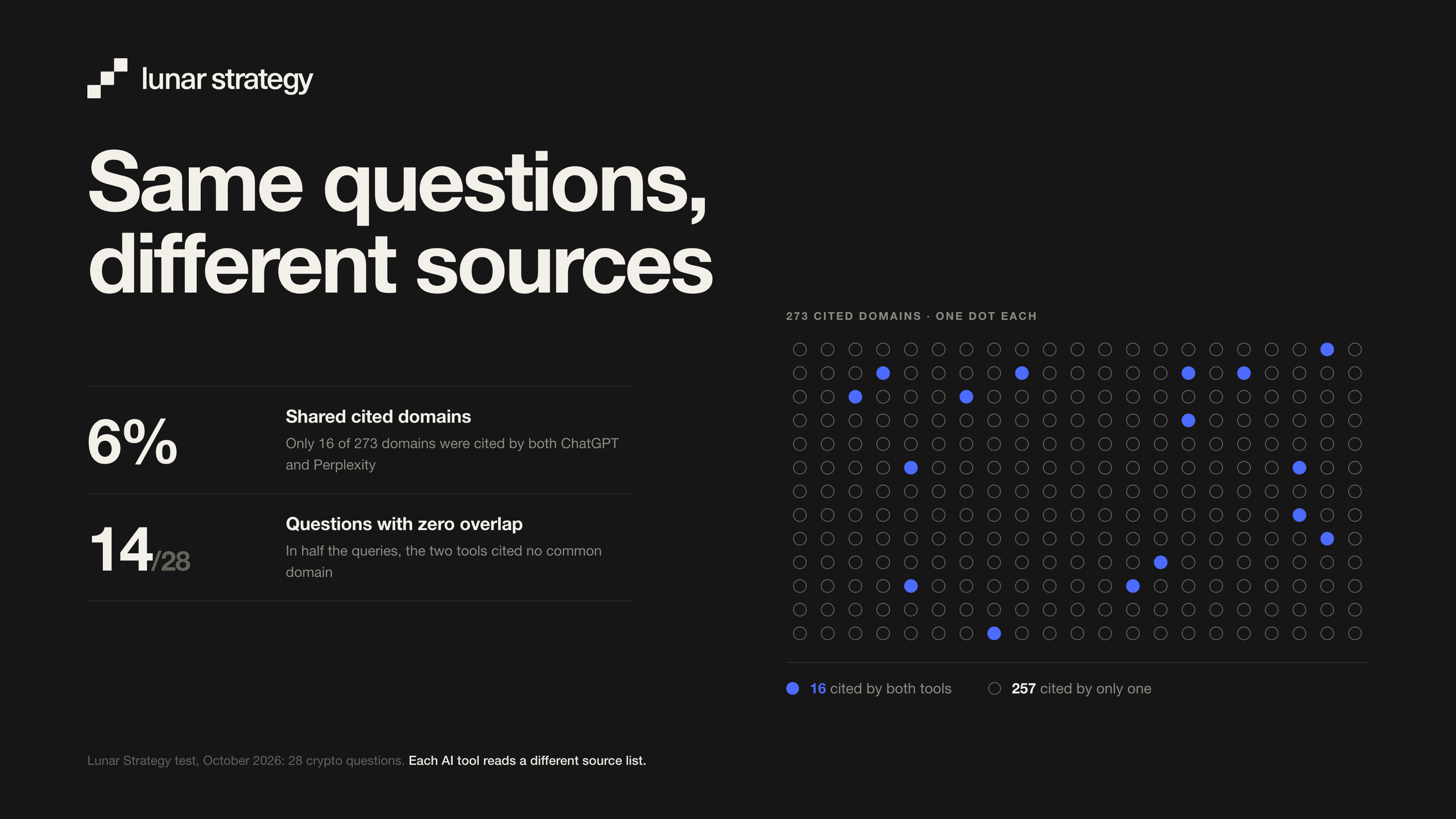
The same assistant can disagree with itself, too. Two ChatGPT runs of "is hyperliquid safe," minutes apart, cited 3 and 8 sources with no URL in common and only 1 shared domain, while Perplexity and the AI Overview stayed stable across our repeat calls.
None of this makes the tools useless. It means you read them with a few rules:
- Look at 4 or more weeks, never one run. A single jump is usually noise.
- Compare like with like: same tool, same prompts, same AI assistants. Numbers from two tools don't mix.
- Benchmark 3 to 5 competitors. A 12% visibility means little alone; 12% when the category leader has 40% is a plan.
- Read the citation list, not just the score. It's your outreach and PR list.
- Open the full answers to your trust prompts and check the facts.
If your budget is fixed, spend it on more prompts and more days before you add more AI assistants, because a bigger sample makes every number more reliable. When you report results to your team, treat AI visibility like any other channel; our guide to how agencies measure ROI shows what belongs in a monthly report.
Low numbers are fixed at the source, not in the tool
A tool tells you where you stand; it doesn't change anything on its own. AI assistants can only repeat what credible pages say about you, so when your numbers are low, start with the citation list: it shows which pages each AI assistant trusts for your category. In our October 2026 test of 28 crypto questions, each AI assistant leaned on a different kind of source. 45% of ChatGPT's citations pointed to the project's own sites and docs, while exchanges were the top source type for Perplexity (23% of citations) and Google's AI Overviews (20%).
The rest of the mix points to different work for each one. Crypto media and review sites made up 15% of Perplexity's citations, while YouTube made up 13% of AI Overview citations and Reddit, forums and social posts another 7%. So match the fix to the AI assistant where you're weakest:
- Weak in ChatGPT? Fix your own pages first: docs, a token page and a FAQ that state your facts plainly and identically.
- Weak in Perplexity? Earn coverage in crypto media, review sites and exchange learning hubs. A crypto PR agency is built for that.
- Weak in AI Overviews? Show up where Google's AI looks: YouTube explainers and forum threads. Our list of crypto subreddits is a starting point.
- Weak everywhere? Give independent voices something to say. A clear KOL brief and an active community program create the third-party mentions AI assistants cite.
Where to start
You now have the full path: a free baseline, one paid tool that covers Perplexity, a prompt list built for crypto, a month of trend data and a source plan for wherever you're weakest. In practice, that's four steps:
- Today: turn on the Search Console and Bing reports. They're free, and they build history you can't recreate later.
- This week: load the prompt set into one tool that covers Perplexity, with a "fact to check" column for every brand and trust prompt.
- This month: read 4 weeks of trend against 3 to 5 competitors, and open the full answers to your trust prompts.
- This quarter: pick the AI assistant where you're weakest, list its 10 most cited domains for your prompts, and plan one action per domain.
Lunar's crypto SEO team: the tracking and the fixes
Measuring is the easy half. Our crypto SEO team works on both sides of search, Google and AI: we set up the tracking, find the gaps and build what closes them.
- Your own pages: docs and token pages that state your facts identically.
- Coverage: placements in the crypto media AI assistants cite.
- Mentions: the KOL and community work that creates third-party mentions.
Bring your prompt list.
Frequently Asked Questions
Is Google visibility the same as AI visibility?
No. Ranking on Google helps, but AI assistants often cite other pages. Only 6 of the 108 sources ChatGPT cited across 28 crypto queries we tested in October 2026 (6%) appeared on Google's first page (US, English) for the same query; for Perplexity, it was 31 of 280 (11%) (Lunar Strategy, 2026).
Are free AI visibility checkers accurate?
They're accurate for a single moment, and that's the limit. A free checker runs your brand once, and answers change from run to run, so a good or bad result may not repeat tomorrow. Use free checkers to spot obvious gaps, and use a paid tool or a monthly log to see trends.
How many prompts should a crypto project track?
Start with 20-30 prompts across the 4 groups above, then add more as you learn which questions bring users. A project with one token and one chain rarely needs more than 50. Running fewer prompts every day beats running hundreds once a month.
Can you build your own AI visibility tracker?
Yes, if someone on your team can code. At its core, a tracker sends your prompts to each AI assistant's API on a schedule and saves the answers. The code is the easy part; the work is in the prompt design, the storage and someone who reads the results every week.
Do AI visibility tools work outside the US and in other languages?
Some do, on some plans. Otterly.AI's Lite plan includes 50+ countries, LLMrefs lists 50+ countries and 20+ languages, Rankscale includes all regions, and Peec AI adds multi-country tracking from its Advanced plan. If your users are in Asia or Europe, test a few prompts in their language during the trial.