
























TL;DR:
- More and more people meet a crypto project through Google's AI Overview, the AI-written answer above the regular results, which Google says has more than 2.5 billion monthly users. Being one of the links that answer cites is what ranking in AI Overviews means, and Google picks those links with its regular search systems, not a separate AI algorithm.
- The catch is that crypto is a "Your Money or Your Life" topic, where Google weighs trust above everything else. In our October 2026 test, the "is it safe" verdicts cited only third parties, and Hyperliquid's own site was cited just for how its protocol works.
- So the work comes in four layers: make sure Google is allowed to quote your pages, give one clear page to every question Google runs behind the scenes (a technique called query fan-out), state your facts in sentences it can lift, and get independent sources to repeat them.
- The most common problem is also the cheapest to fix. A stray
nosnippettag, facts that only load after a wallet connects, or the AI opt-out in Search Console can remove you without warning, while llms.txt files and special schema add nothing, because Google says it doesn't use them. - To measure it, run your 5 trust searches once a month and log who Google cites for the facts and who it cites for the verdict. It takes about 15 minutes and tells you which page to fix next and which third party to correct.
A new user asks Google whether your protocol is safe. Google answers with an AI Overview that cites 8 sources, and your website appears once, for a technical detail. The verdict comes from someone else. That's what we saw when we searched "is hyperliquid safe" on October 4, 2026, and for a crypto project that summary is often the first thing a potential user reads, before your homepage and before your docs.
It's also read at a scale no other channel matches. In May 2026, Google said AI Overviews has more than 2.5 billion monthly active users, and every one of the 28 crypto searches in our test showed one. You don't win that answer by holding the top spot for one keyword. You win it by being eligible to quote, by having the best page for each question Google asks behind the scenes, and by giving independent sources the facts they repeat when they deliver the verdict.
This guide is for crypto founders and marketers who want their project's pages to be the ones Google quotes. It follows the order you'll need: how Google picks its sources, why crypto plays by stricter rules, the 4 layers that get a page cited, the hacks to skip, and a 15-minute monthly audit to measure the result.
How to rank in AI Overviews: Google searches first, writes second
Ranking in an AI Overview means being one of the links it cites, and a page qualifies only if it's indexed, eligible for a snippet and among the most useful results for one of the searches Google runs behind the answer. Google grounds these answers in its core Search ranking systems, so there is no separate AI algorithm to game, only a different way of choosing among the pages it already ranks.
Google's guide to generative AI search explains that AI Overviews are built with retrieval-augmented generation (RAG): the model pulls relevant, current pages from the Search index, writes an answer and links to the pages that support it. In plain terms, Google searches first and writes second. What it finds in that first step decides who gets cited in the second.
The part most guides skip is query fan-out. Instead of running only the search you typed, the model issues several related searches at once, across subtopics, and picks sources from all of them. A question like "is [project] safe" could fan out into searches about the project's audits, its exploit history and its withdrawal rules, and each one has its own set of top pages.
That's why a first-page ranking for the main search doesn't guarantee a citation.
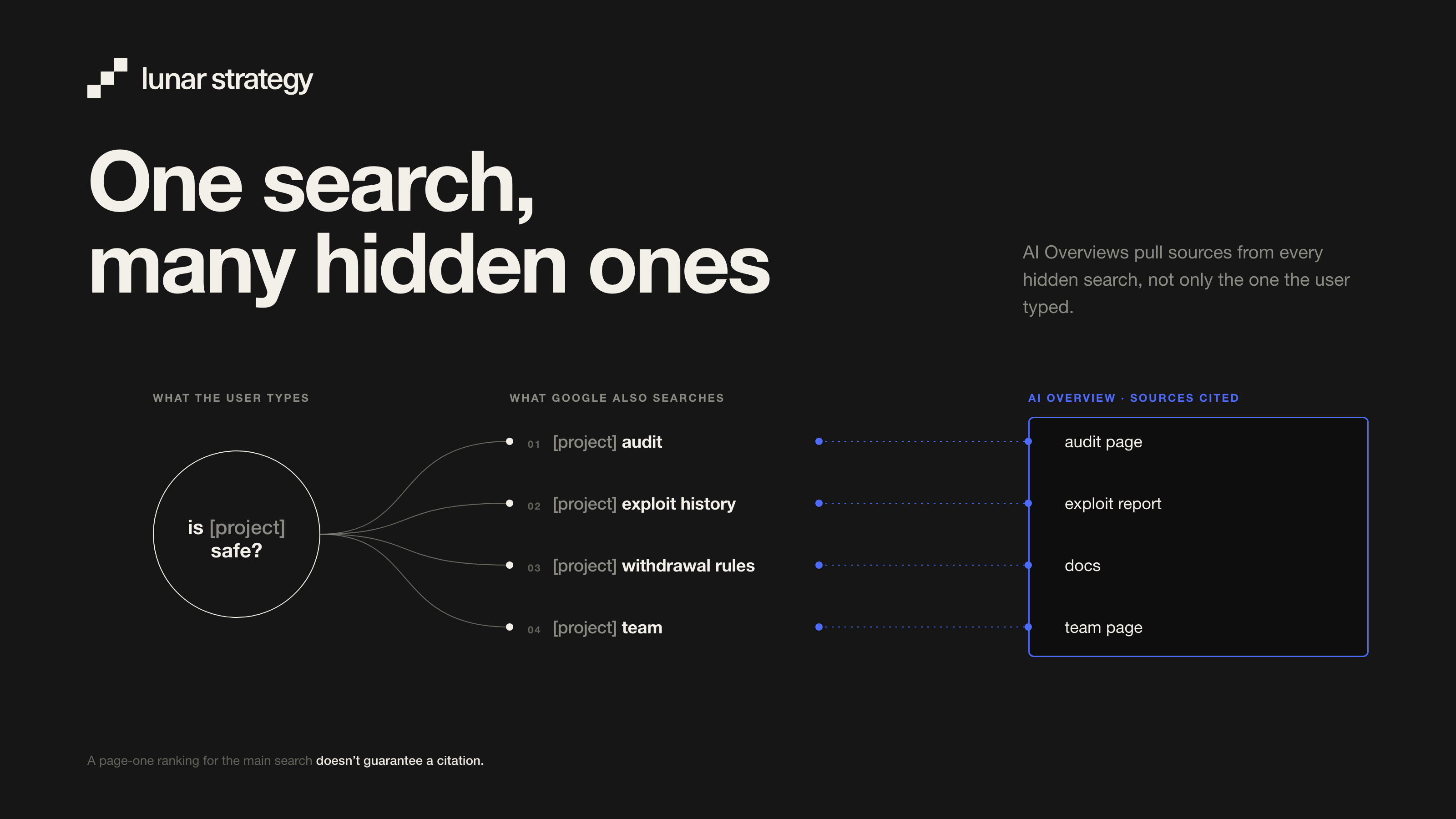
We measured how big that gap is. On October 4, 2026, we ran 28 English crypto searches on Google (US) through the DataForSEO API and logged every source each AI Overview cited next to the organic results. Of the 87 sources cited in the 11 AI Overviews we could fully read, only 20 (23%) also appeared on Google's first page for the same search, and in 8 of those 11 answers most cited pages weren't on page one at all (Lunar Strategy, 2026).
A much larger study points the same way. Ahrefs analyzed 863,000 keywords and found that only about 38% of pages cited in AI Overviews also appeared in the first 10 positions of the results page, down from about 76% in July 2025. Page-one rankings alone no longer tell you whether you're visible in AI answers.
The useful question is which related searches Google might run for your topic, and whether you have the best page for each one. ChatGPT and Perplexity pick sources in their own way, with their own crawlers, so they need their own plan, which we cover in how to get your crypto project cited by ChatGPT and Perplexity. This guide is about Google, and for crypto Google adds one more filter.
Your website wins the facts and third parties win the verdict
Google treats crypto as a "Your Money or Your Life" (YMYL) topic, its term for subjects that can affect people's finances, health or safety. Its guidance on helpful content says that among experience, expertise, authoritativeness and trust (E-E-A-T), "trust is most important," and for money topics it expects content to be highly accurate and in line with expert consensus. Google shows AI Overviews only when it decides they add something to the classic results, and for crypto it decides that often: all 28 searches in our test showed one, from "is aave safe" to "what is a TGE in crypto."
The higher bar shows most in the verdict. Our test included 8 "is [project] safe" and "is [project] legit" searches, and only 3 of those AI Overviews loaded fully enough to read their sources. In all 3, the opening verdict sentence cited only third parties.
| Search | Opening verdict (shortened) | Sources cited for the verdict | Project's own site cited? |
|---|---|---|---|
| is hyperliquid safe | "generally considered a secure, high-performance decentralized exchange (DEX), but it carries standard and unique financial risks" | Ledger, Whaleportal | Yes, for technical facts only |
| is phantom wallet safe | "generally safe and legitimate as a self-custody tool, but its security depends heavily on your own personal habits" | KuCoin, Binance | No |
| is pump.fun legit | "a real, functional website... but most of the tokens launched on it function like a high-risk casino or scam" | Webopedia, Reddit, TrustSwap, Binance | No, though pump.fun ranked on page one |
Hyperliquid is the clearest case. The project's own site, hyperliquid.xyz, was cited for how the protocol works, including its HyperBFT consensus and 7-day unstaking queue. The criticism of its centralization came from a YouTube video and a Motley Fool column titled "Here's Why I Wouldn't Touch Hyperliquid With a 10-Foot Pole". Across the 3 brand AI Overviews, project websites accounted for just 1 of 23 citations (4%).
It's a small sample from one day in one country, so treat it as a snapshot, not a law. But the logic holds, and it shapes everything that follows: you can't write your own verdict. What you can do is publish the facts the verdict depends on, so Google quotes them from you correctly, and give independent sources accurate information to work with. That takes 4 layers of work.
The citation stack: 4 layers between your project and the AI Overview
Getting cited is not one task, and each of the 4 layers fails on its own: Google has to be allowed to use your page, you need a page for every question it fans out to, that page has to say something quotable, and independent sources have to back the verdict. Skip a layer and the next one can't make up for it, so work through them in order, starting with the first, which is also the cheapest to fix.
01 · Eligible: "Is Google allowed to read and quote this page?"
- What Google needs: an indexed page, a snippet it may use, and key facts readable without connecting a wallet.
- Trap:
data-nosnippeton your risk section. Google will still answer risk questions, it will just quote someone else. - Check: the 5-point eligibility checklist below.
02 · Mapped: "Which questions will Google ask about this project behind the scenes?"
- What Google needs: one page for each angle of the fan-out: safety, legitimacy, how it works, token, risk, access and comparison.
- Trap: a page for every wording. "Is X safe", "is X secure" and "X safety" belong on one security page.
- Check: every row of the question map marked green.
03 · Quotable: "Can Google lift one sentence from this page and attribute it to you?"
- What Google needs: the claim, the number, the date and the proof in 1-2 sentences that make sense out of context.
- Trap: leaving your category term undefined, so Google has to guess what it means.
- Check: each fact page opens with its answer and shows a "last updated" date.
04 · Vouched for: "Who else confirms this, and are their facts right?"
- What Google needs: independent coverage, exchange and wallet education pages, creator videos and forum answers that repeat accurate facts.
- Trap: fake accounts and planted praise, which get spotted fast in crypto.
- Check: the third-party pages that rank or get cited for your 5 trust searches carry current facts.
One stray tag can keep you out of every AI Overview
Google's documentation on AI features lists no extra technical requirements for AI Overviews: the page has to be indexed and allowed to show a snippet, and that's it. On crypto sites, those two conditions usually break in 3 places: content Google can't render, snippet controls left in templates, and the AI control in Search Console.
Content Google can't render. Many crypto sites are dApps (decentralized applications) built in JavaScript, where content loads in the browser after the page opens. Google can process JavaScript as long as it isn't blocked, but its own guide admits that JavaScript sites make SEO "generally more complex." Anything that appears only after a wallet connects doesn't exist for Google, so fees, supported chains, audit results and risks should be readable in the page source. The view-source test in our crypto SEO guide takes 2 minutes per page.
Snippet controls left in templates. A snippet is the text Google shows from your page in results. Google's robots meta tag documentation says nosnippet also stops a page from being used as direct input for AI Overviews and AI Mode, and max-snippet limits how much of it can be used. These rules sometimes ship in a docs theme or CMS template and nobody notices. Audit reports are often PDFs, which take the same rules from the X-Robots-Tag HTTP header instead of a meta tag, so check both against this list:
<!-- 1. Each of these keeps a page out of AI Overviews. Remove them from pages you want cited. -->
<meta name="robots" content="nosnippet">       <!-- no snippet, no AI Overview input -->
<meta name="robots" content="max-snippet:0">   <!-- same effect as nosnippet -->
<meta name="robots" content="noindex">         <!-- removes the page from Search -->

<!-- 2. Safe setting for pages you want quoted: no length limit -->
<meta name="robots" content="max-snippet:-1">

<!-- 3. Keep one block out of snippets, not the whole page (works on div, span and section) -->
<div data-nosnippet>
  Cookie notice or boilerplate you don't want quoted.
</div>
The Search Console AI control. Search Console has a setting under Settings > Search generative AI that decides whether your site can appear in AI Overviews, AI Mode and AI features in Discover. Including your site is the default, so most projects have nothing to change. It's still worth a quick look, because if the site is excluded, Google stops linking it in these features within a few days, while content from other sites "may appear similar to yours."
Eligibility checklist:
- URL Inspection in Search Console shows your key pages as indexed.
- No
nosnippet,max-snippet:0ornoindexin the HTML or theX-Robots-Tagheader of pages you want cited. - Key facts are visible in the page source without a wallet connection.
- robots.txt allows Googlebot, and your firewall or CDN doesn't block it.
- The Search generative AI control is set to include your site.
Run the 5 checks on your homepage, docs, security page and tokenomics page this week. Fixing one stray tag can matter more than writing a new article.
Give every fan-out question one quotable page
Because of fan-out, a single question about your project can pull sources from security, tokenomics, how-to and comparison angles at once. If you have no page for one of those angles, someone else's page fills that slot, and it may be a competitor's comparison or a critic's column. The question map below lists the angles that come up most for crypto projects. Use it as the starting point for your own.
| Question type | Searches users run (and Google may fan out to) | Page on your site that should answer |
|---|---|---|
| Safety | "is [project] safe", "[project] audit", "[project] hack" | Security page: audits, bug bounty, incident history |
| Legitimacy | "is [project] legit", "[project] official site", "[project] team" | Official links page and team page |
| How it works | "how does [project] work", "[project] staking", "[project] fees" | Docs and a fees page |
| Token | "[project] tokenomics", "[project] unlock schedule", "[project] airdrop" | Tokenomics page and a dated airdrop status page |
| Risk | "[project] risks", "can I lose money on [project]" | A risks page in plain words |
| Access | "can I use [project] in the US" | Terms and availability page |
| Comparison | "[project] vs [competitor]", "best [category] on [chain]" | Comparison page with honest trade-offs |
To fill the table, collect questions from 4 places: the People Also Ask box for your 5 trust searches, the queries in Search Console, the questions your support team answers in Discord and Telegram, and the subtopics the current AI Overview already covers. If you're preparing a launch, build the token and legitimacy pages weeks before TGE (token generation event, when the token goes live); our 90-day pre-TGE playbook shows where they fit.
Keep it to one page per topic, not per wording. Google's guide says creating a page for every query variation or fan-out query, mainly to manipulate rankings or AI responses, violates its scaled content abuse policy. Then mark each row green (strong page exists), yellow (page exists but is thin) or red (no page). The red rows are your next content sprint.
Having the page is half the job; the other half is giving Google a sentence it can lift. A fact page should state its key answer in 1-2 sentences that make sense out of context: the claim, the number, the date and the proof. Vague pages get skipped for sources that are more specific. Compare two versions of the same security page:
- Weak: "Security is our top priority. Our contracts have been thoroughly audited by leading firms."
- Strong: "The v2 lending contracts were audited by [firm] in March 2026. The audit found 2 medium-severity issues, both fixed before launch. Read the full report (PDF)."
The strong version gives Google a quotable fact, a date and a source in three short sentences. If you don't have an audit yet, our overview of Web3 security audit firms explains how to choose one. The fact pages that matter most for crypto follow the same pattern:
- Security page: audits with dates and links, bug bounty, past incidents and how they were handled.
- Tokenomics page: supply, allocation, unlock schedule and contract addresses, with a "last updated" date.
- Risks page: smart contract, liquidation, depeg and lockup risks in plain words. In a YMYL topic, naming your risks builds trust.
- Definition pages: your core terms, explained with context.
That last item matters more than it seems. When we searched "what is restaking" in our test, Google's AI Overview answered as if the search were "restacking", about office moves and pallets, and cited dictionaries, even though the organic results below it were about crypto (Lunar Strategy, 2026). It's one case, but it shows the value of a page that defines your category term clearly, with context like "restaking on Ethereum."
Google's guide also favors original information over common knowledge. Your on-chain data, incident post-mortems and audit details are things no one else can publish, and the same pages drive classic SEO. For a crypto wallet security SaaS that started with zero organic traffic, 2 of the 4 educational posts we created generated more than 2,400 clicks and 67,000 impressions in their first year (Lunar Strategy, 2026). Start with your 3 most important red or yellow rows: write the 1-2 sentence answer first, add the date and the source, then build the page around it.
The verdict is earned off-site, and Google reads YouTube and Reddit
Google looks for the verdict in different places from the other AI tools. In our test, YouTube was cited in 9 of the 11 crypto AI Overviews we could read and Reddit in 5, yet ChatGPT and Perplexity cited neither in any of our 28 searches. Reddit also appeared on Google's first page for 23 of the 28 searches, and exchanges and wallet makers (Binance, KuCoin, Ledger) backed the verdict in all 3 brand AI Overviews in the table above (Lunar Strategy, 2026).
Google's guide confirms the pattern: its AI features can show what's being said across blogs, videos and forums, and seeking inauthentic mentions "isn't as helpful as it might seem." Your job is to give those sources accurate information and real reasons to cover you. If you also care about Perplexity, add review sites to the list: it cited Coin Bureau in 5 of our 8 brand-safety searches. Four places to focus for Google:
- Independent coverage. Funding news, audits, integrations and original data give journalists something to write about. A good crypto PR partner makes that coverage repeatable.
- Exchange and wallet education pages. If you're listed on an exchange or integrated into a wallet, ask whether their learn or academy team covers you, and send them current facts with sources.
- YouTube. Creator videos show up in AI Overviews far more than in ChatGPT or Perplexity. When you work with creators, a clear KOL brief keeps the facts in their videos correct.
- Reddit and forums. Answer questions in the open, under your team's real accounts, and keep the community informed so members can answer accurately too.
Then run your 5 trust searches and list the 10 third-party pages that rank or get cited. Check each one for outdated or wrong facts, and send corrections with a source.
Skip the AI Overview hacks Google has already ruled out
Even Google's own AI Overview for "how to rank in ai overviews" recommended adding FAQPage and HowTo schema when we checked on October 4, 2026, advice that Google's guide to generative AI search contradicts. That guide, updated in July 2026, rules out most of the tactics sold as AI Overview hacks. All five points below come from it, and they apply to Google only, since ChatGPT and Perplexity have their own crawlers and rules.
| Myth | What Google says | Do this instead |
|---|---|---|
| Add an llms.txt file | You don't need AI text files, markup or Markdown versions, because Google Search doesn't use them | Spend the time on pages people read |
| Break content into small chunks | There's no need to split content into tiny pieces, and no ideal page length | Give each section one question and the length it needs |
| Add special schema for AI | Structured data isn't required for AI search, and there's no special markup to add | Keep your Organization and Article schema for what it already does |
| Rewrite pages "for AI" | You don't need to write in a specific way for generative AI search | Write for the reader, answer first |
| Make a page for every question | Doing it to manipulate AI answers violates the scaled content abuse policy | One strong page per topic |
If anyone on your team is working on one of these five for Google, move that time back to the 4 layers of the citation stack. The last step is knowing whether that work is paying off.
Measure it with a 15-minute monthly audit
Rank trackers won't tell you who Google cites, so the most reliable measure is a short manual check. Once a month, run your project's 5 trust searches in a private browser window and log who Google cites for the facts and who it cites for the verdict. It takes about 15 minutes and shows you exactly which page to fix next. The 5 searches:
- [project]
- is [project] safe
- is [project] legit
- [project] review
- [project] vs [main competitor]
For each search, log:
- AI Overview? Yes or no, plus a dated screenshot.
- Cited for facts: which sources back the technical details.
- Cited for the verdict: which sources back the opening judgment.
- Your site: cited or not, and for what.
- Missing page: which of your pages should have been cited, and whether it passes the eligibility checklist.
- Errors: any wrong or outdated fact, and which source carries it.
- Lookalikes: any domain imitating yours in the AI Overview or the results below it.
Worked example. Run on Hyperliquid on October 4, 2026, search 2 would log: AI Overview yes; facts from hyperliquid.xyz; verdict from Ledger and Whaleportal; criticism from The Motley Fool and YouTube. The action would be to answer the centralization question directly on the project's own security or docs pages, and to make sure educators like Ledger have current facts.
Then pick one action per search: fix or create a page, send a correction to a third party, or report a clone. AI Overviews change by country and over time, so compare month to month, not one search to another, and save the first log as your baseline. For a wider view, Search Console now reports impressions in AI Overviews and AI Mode, though not clicks.
Where to start
After working with more than 300 crypto projects, we see the same pattern: the teams that show up well in AI answers fixed their basics and their reputation before they needed them. You now have both halves, the pages Google can quote and the sources that deliver the verdict. In practice, that's four steps:
- Today: run the eligibility checklist on your homepage, docs, security page and tokenomics page.
- This week: fill the question map and mark each row green, yellow or red.
- This month: write the quotable answer for your top 3 red or yellow rows, and run your first audit as a baseline.
- This quarter: correct the third-party pages that carry your verdict, and give journalists, educators and creators a reason to cover the facts you want repeated.
Lunar's crypto SEO team: the pages and the verdict
Ranking in AI Overviews takes on-page work and reputation work at the same time, and in crypto the reputation side decides the verdict. Our crypto SEO team works on both sides of search, Google and AI: we find the gaps in your trust searches and build what closes them.
- Your own pages: eligible, quotable fact pages for every fan-out question.
- Coverage: placements in the crypto media and education pages Google cites.
- Mentions: the KOL, YouTube and community work behind the verdict.
Bring your 5 trust searches to the call.
Frequently Asked Questions
If we block Google-Extended, will we disappear from AI Overviews?
No, Google says Google-Extended does not impact a site's inclusion in Google Search. Instead, it controls whether your content is used to train Gemini models and to ground answers in the Gemini app. The setting that covers AI Overviews is the Search Console AI control described above.
Do people actually click the links in an AI Overview?
Rarely, according to a Pew Research Center study of real browsing data: users clicked a link inside the AI summary in just 1% of visits to pages with one. Google says the clicks that do come from these pages are "higher quality", with people spending more time on the site. For a crypto project, the summary itself often matters more, because it shapes what users believe before they click anything.
What can we do if an AI Overview gets a fact about our project wrong?
Find the source first: open the cited links and see which page carries the error. If it's your page, fix it and update the date. If it's a third party, send them the correct fact with a link to your source, and make sure your own page states that fact in one clear sentence.
Can an AI Overview send users to a clone of our site?
Impostor content does reach AI answers. In December 2025, Gizmodo reported research from the security firm Aurascape showing scammers planting fake "customer support" numbers in content that Google's AI Overviews and Perplexity then surfaced as official. Keep an official links page with your domains and contract addresses, report clones to Google Safe Browsing, and check for lookalikes in your monthly audit.
How is AI Mode different from AI Overviews for a crypto project?
AI Mode is Google's conversational search for longer questions that need comparison or reasoning. Pages qualify the same way, but Google says the two may use different models, so the links they show will vary. Run your trust searches in both, since a comparison like "[project] vs [competitor]" fits AI Mode well.