
























TL;DR:
- Trading is concentrated: in September 2026, Binance alone held 28.5% of spot volume and the top three exchanges carried more than half of it. Every smaller exchange is asking traders to move money away from a venue they already trust.
- Most budgets buy sign-ups, and that is where they leak. Investment apps in Europe keep only 4% of new users by day 30, and sign-up bonuses mostly attract people who cash out and leave.
- Paid ads are a narrow door, because Google and Meta only accept licensed exchanges, country by country. The channels that keep paying are search content, niche creators, affiliates paid on trading fees and a community that answers the trust questions.
- Build them in order: ads and search first, community before launch, affiliates once onboarding works and creators for specific moments. Then judge every channel by cost per active trader, the spend divided by users still trading at day 90.
There are hundreds of crypto exchanges, but trading volume keeps flowing to the same few. In its September 2026 Exchange Review, CoinDesk Research found that Binance had extended its lead to 28.5% of spot market share and that the top three top-tier exchanges handled 53.8% of top-tier spot volume. The leaders also pay heavily to stay there: Coinbase spent $1.06 billion on sales and marketing in 2025, 62% more than the year before.
A smaller exchange can't outspend that, and it doesn't need to. The exchanges that grow put money where it brings traders who deposit and keep trading, not where it buys the most sign-ups. This guide goes through the channels in the order most growth teams meet them: where budgets leak, paid ads, search, creators, affiliates and community, then how to measure the mix and where to start.
Why most exchange marketing budgets leak
Crypto exchange marketing is the work of turning strangers into verified, funded traders who keep trading, because an exchange earns from fees on trades that keep happening. Most plans measure the first step, the sign-up, and stop there. Across 187 finance apps in the UK, France and Germany, AppsFlyer found that investment apps keep only 19% of users on day one and 4% by day 30. The leak usually sits in three places:
- The identity check: a stranger has to hand a passport to a company they don't know. Most teams treat it as compliance, so nobody in growth measures the drop-off.
- The first deposit: missing local payment methods, a high minimum or unclear withdrawal times stop people who already passed verification.
- No reason to come back: after the first trade, every user gets the same promotional calendar instead of alerts, recurring buys or products linked to what they hold.
Incentives make the leak worse when they pay for the wrong action. Pavel Zavadskii, CEO of the derivatives exchange Biqutex, described spending about $20,000 on a banner campaign for a bonus event and mostly getting people "who signed up for the bonuses, not the product" (HackerNoon, January 2025). A bonus for signing up buys sign-ups. A bonus paid after a verified deposit and a first trade buys traders, the same logic we covered in our guide to airdrop marketing.
Paid advertising
Paid ads are the fastest way to reach traders and also the most restricted. Google and Meta treat exchanges as a regulated category, so access depends on holding a license in each country you target, and a campaign approved in one market can be rejected in the next. Since July 1, 2026, serving EU clients without a MiCA license breaches EU law, which closes the region entirely to unlicensed venues.
Here is what the main platforms and markets allow as of October 2026:
| Platform or market | The rule | What it means for your plan |
|---|---|---|
| Google Ads | Only licensed, Google-certified providers may advertise exchanges, in select countries | Certify each market before you budget for search ads there |
| Meta (Facebook, Instagram) | Exchange ads need prior written permission and a recognized license or registration | Apply early; without approval, paid social is closed |
| European Union | Marketing must be "fair, clear and not misleading" and identified as marketing (MiCA, Article 66) | Every claim about fees or returns needs to hold up |
| United Kingdom | Promotions follow the FCA's rules: a risk warning and a 24-hour cooling-off period for first-time investors | Build a UK version of every landing page and campaign |
Where the big platforms are closed, crypto-native placements fill the gap: display and native ads on price trackers, block explorers and crypto news sites, plus sponsored articles in the publications your traders already read. They reach people who already trade, but the attention is rented, so give every placement its own tracking link and judge it on funded accounts, not clicks. The license itself also belongs in the ad, because in a market where many competitors can't advertise, being regulated is a reason to click.
SEO and AI search content
Search is the channel that keeps working after you stop paying. Traders research before they move money: they look up an exchange's fees, whether it's safe, how to buy a specific token and which venue is best for their country. More of those questions now go to ChatGPT, Perplexity and Google's AI Overviews, which answer by citing pages that state the facts clearly. A page written today can keep bringing traders for years at no cost per click.
Three page types do most of the work:
| Page type | The question it answers | What to put on it |
|---|---|---|
| Asset pages ("How to buy [token]") | How do I buy this token in my country? | Supported networks, deposit methods, fees and a guided first trade |
| Comparison pages | Is this exchange better than the one I use? | Fees, liquidity, licenses and assets side by side, written honestly |
| Trust and fee pages | Is it safe, and what will it cost me? | Licenses with the regulator and number, proof of reserves, withdrawal times, the full fee schedule |
Most exchange blogs fill up with daily price commentary that is out of date within a week. The pages that compound answer stable questions, get updated when fees or listings change and link to each other, so each new page strengthens the others. Our crypto SEO guide covers how to build them, and our crypto SEO service includes AI search visibility.
Influencer marketing
Traders trust other traders more than an exchange's ads, so creators work when the creator actually uses the platform. Smaller accounts whose followers trade the assets or products you're strongest in usually beat large generalist channels, because their audience is closer to a deposit. Our guide to what a KOL is in crypto covers how to vet them. The rules matter too: the FTC requires paid relationships to be disclosed clearly, and X banned apps that pay users to post in January 2026.
Every creator deal should include:
- A unique referral code per creator, so each placement is judged on its own traders instead of disappearing into a channel total.
- Payment tied to funded accounts: a fixed fee for the content plus a share of fees from the traders who deposit and trade.
- Real use of the product: a deposit, a trade or a withdrawal on camera, which answers the trust question better than any script.
- Disclosure written into the brief, with a version for each market's rules.
Affiliate and referral programs
Affiliates are creators, communities and websites paid for the traders they bring, and the payout model decides which traders those are. The leaders set the benchmark your partners will compare you to: Binance says its affiliates can earn up to a 50% sustained commission on spot and futures fees, and OKX's affiliate program starts at a 30% default commission. Both pay a share of fees over time, which ties the partner's income to how long the trader stays.
| Payout model | What it attracts | When to use it |
|---|---|---|
| Flat fee per sign-up | Volume, bonus hunters and low-intent traffic | Rarely, and only with a deposit requirement |
| Revenue share on trading fees | Partners whose audience actually trades | As the default for every affiliate |
| Higher share after 90 days | Partners who bring traders who stay | To reward your best partners |
Referral programs, which reward existing users for inviting friends, follow the same logic: reward the friend's first trade, not the sign-up. In the UK, refer-a-friend bonuses are banned for crypto, so plan a version without incentives there. A smaller exchange can't always match Binance's rate, so it competes on terms: payouts on fees, a share that lasts as long as the trader does and reporting partners can check.
Community
Fees can be copied in a week, but a community that trusts you can't. For an exchange, community is mostly a trust and retention channel: it's where traders ask whether withdrawals are working, where problems surface first and where your team proves it answers. That matters in a market where Chainalysis counted more than $3.4 billion stolen in crypto from January to early December 2025, with a single exchange breach accounting for $1.5 billion of it.
| Platform | Its job for an exchange |
|---|---|
| Telegram | Announcements and fast support in each language you serve |
| X | Listings, product news and real-time updates during incidents |
| Discord | A structured space for active traders, feedback and VIP channels |
| Where traders check your reputation before depositing: monitor and answer, don't advertise |
A community only builds trust when the evidence behind it is public. Publish proof of reserves on a fixed schedule, name your licenses with the regulator and number, and give frozen or flagged accounts a human route to support, the complaint that spreads fastest on forums. We run community management for crypto projects with 24/7 moderation and crisis response, because the first hour of an incident decides whether traders wait or withdraw.
How to measure exchange marketing
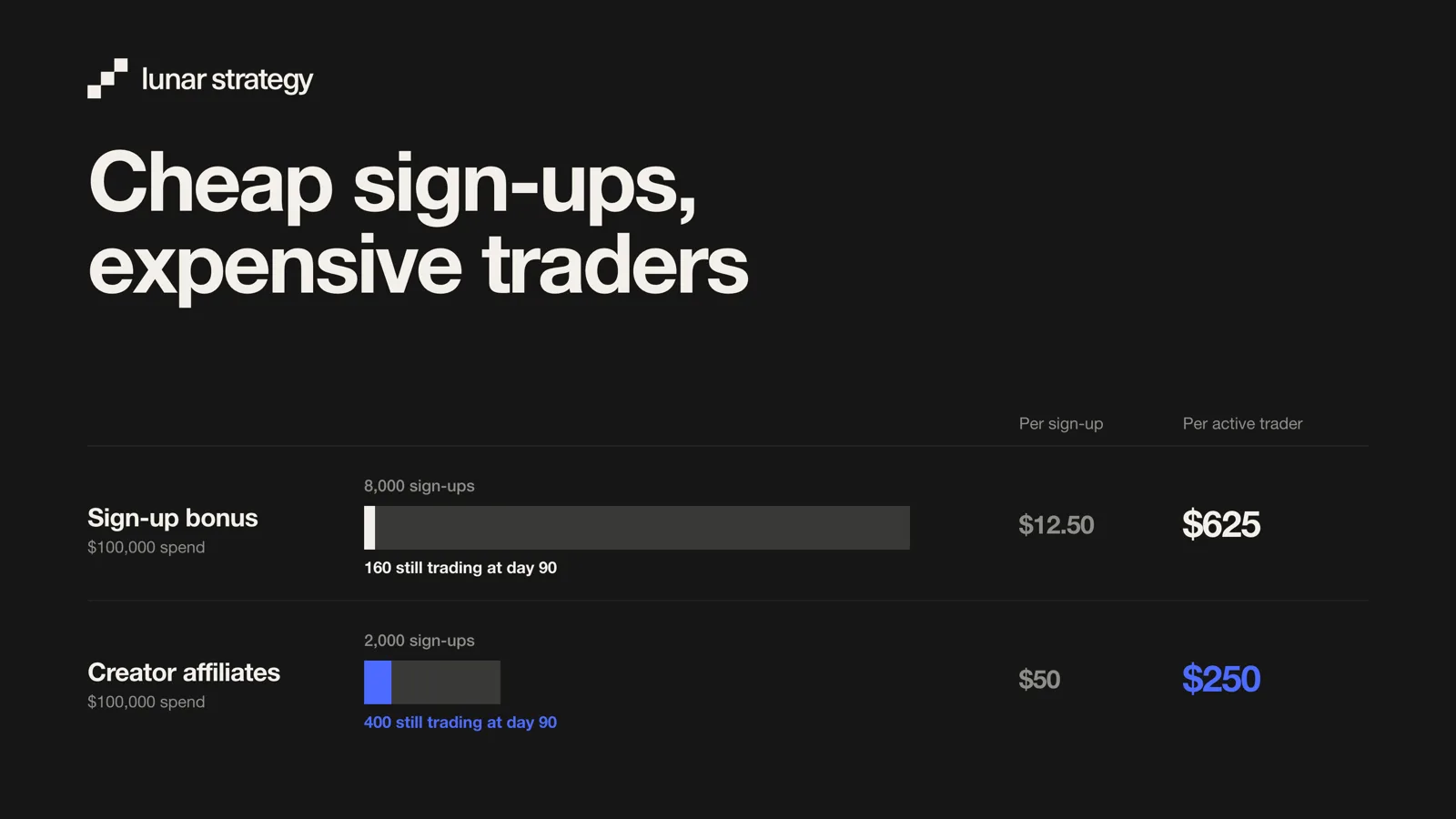
Cost per sign-up makes bonus campaigns look cheap because it stops counting before the leak. Follow each group of new users, by channel and month, through verification, deposit and trading, then divide what you spent by the traders still active at day 90. In a hypothetical example, a bonus campaign costs $100,000 and brings 8,000 sign-ups at $12.50 each, but only 160 still trade at day 90, or $625 per active trader. A creator affiliate program with the same spend brings 2,000 sign-ups at $50 each and 400 active traders, or $250 each.
| Metric | What it tells you |
|---|---|
| Verification rate | Share of sign-ups that pass identity checks; a low number points to friction or the wrong audience |
| Funded account rate | Share of verified users who deposit within 14 days |
| Active at day 30 and day 90 | Share of first-time traders still trading, the core number |
| Cost per active trader | Channel spend divided by traders still active at day 90 |
The bonus campaign wins every report that stops at sign-up. The affiliate program wins on the number that pays the bills.
Where to start
Most exchange teams already run several channels, and the fastest gains come from the order, not from adding more. This is the sequence we'd follow:
- Before launch: open Telegram, X and Discord, publish the trust page (licenses, proof of reserves, fees) and set up tracking by channel and cohort.
- First month: run crypto-native ads and licensed search ads for immediate traffic, and start asset and comparison pages in parallel.
- Once onboarding works: launch the affiliate program on fee share, after verification and first-deposit drop-off are measured and improved.
- For specific moments: bring in creators around listings, new products and rallies, each with their own referral code.
Scale paid spend with the market, not against it. Coinbase cut digital advertising by $65.2 million in the first half of 2026 "as a response to softer market conditions" (Coinbase 10-Q), and in a downturn the budget belongs in retention and community first. At day 90, rank every channel by cost per active trader and move money toward the top. For what an outside team should hand over in the same window, see what a crypto marketing agency should deliver in 90 days.
How Lunar Strategy approaches exchange marketing
We've worked with more than 300 crypto projects since 2019, and we don't sell an exchange-specific package; we combine the services each channel needs. For getting found, that means crypto SEO with AI search visibility, influencer strategy built on creators who fit your niche and PR that puts your licenses, security and launches in front of the right publications. For keeping traders, it means community management on Discord and Telegram, plus go-to-market strategy for new products and regions.
Talk to Lunar about your exchange's growth →
Tell us which markets you serve and where your funnel leaks, and we'll tell you which channel we'd fix first.
Frequently Asked Questions
What is proof of reserves?
Proof of reserves is a report, usually checked by a third party, showing that an exchange holds enough assets to cover what customers have deposited. Many exchanges started publishing them after FTX collapsed in November 2022. For marketing, it's one of the few trust claims a trader can check, so publish it on a fixed schedule and link it where people decide to deposit.
What is a monthly transacting user?
It's the metric Coinbase uses for active customers: a retail user who actively or passively transacts in at least one of its products during a rolling 28-day period. It counts accounts that generate revenue, not accounts that merely exist. For a growth team, a measure like this makes a better headline number than registered users, which only ever go up.
Do decentralized exchanges need the same marketing?
Partly. A decentralized exchange, or DEX, lets users trade from their own wallets, so there is no identity check or custody to explain, but liquidity and trust in the smart contracts still decide where traders go. DEXs reached 19.8% of spot trading in September 2026, according to CoinDesk Research. Most DEX growth runs through incentives, integrations and community rather than paid ads.
How much should an exchange spend on marketing?
There is no standard share, and published figures depend heavily on accounting. Coinbase's sales and marketing expense was 15% of net revenue in 2025, and that line includes rewards paid to users, not only advertising. A newer exchange that is still building liquidity and trust may need a larger share, so tie the budget to cost per active trader rather than to a fixed percentage.