























TL;DR:
- Real-world assets (RWAs) are things like Treasury bills, private credit or gold whose ownership is recorded as a token on a blockchain. About $39.1 billion of them sat onchain on October 27, 2026, across 5.4 million holders.
- The catch is that RWA marketing sells to institutions who judge the legal structure and to onchain users who judge yield and what they can do with the token. Most of these tokens are securities, so the law limits what you can say and to whom.
- So it runs differently from a token launch: pick your legal route before your channels, choose which buyer you lead with and speak that buyer's language, because a treasury desk hears "fund size" and "redemption terms", not "TVL" and "APY".
- The proof is BlackRock's BUIDL fund: 101 holders and $2.16 billion in value, grown less by ads than by being accepted as collateral on exchanges and as a reserve for a stablecoin.
- Measure what the market can see: holders, net inflows and live integrations. A year in, a healthy program has a public proof trail, a few integrations holding real supply and a steady pipeline of qualified meetings.
Tokenization has moved past the pilot stage. On October 27, 2026, the analytics platform RWA.xyz tracked about $39.1 billion in tokenized real-world assets distributed onchain, outside stablecoins, and 5.4 million holders across the assets it covers, up 11% in 30 days. Institutions are watching too: in a January 2026 survey of 351 institutional decision makers by EY-Parthenon and Coinbase, 63% said they were "very interested" in tokenized assets, up from 57% a year earlier (Coinbase co-sponsored the study).
Interest is not the same as buying, though. Many tokenized products still struggle to find holders, and the playbook that fills a token launch, with KOLs, quests and a big announcement, can put an RWA issuer in legal trouble. Distribution, not the technology, now decides which products raise capital.
This guide is for founders and growth leads at tokenization platforms, RWA protocols and asset managers bringing funds onchain. It covers the market, the buyers, the language institutions expect, the channels and content that work, the rules, real examples and what to measure. It starts with the asset itself.
What are real-world assets (RWAs)?
Real-world assets (RWAs) are traditional assets, such as government bonds, loans, gold, company shares or property, whose ownership or economic exposure is represented by a token on a blockchain. The asset itself stays offchain, held by a custodian or a legal entity, while the token records who owns a claim on it and lets that claim move, settle or serve as collateral onchain.
What the holder actually owns depends on the legal wrapper, and that wrapper is the first thing any serious buyer asks about. The most common forms on the market today:
- Tokenized fund shares: a share in a regulated fund, such as a money market fund holding Treasury bills, recorded onchain by a transfer agent.
- Tokenized notes and credit: a debt claim, often on a pool of loans or a private credit fund, with the yield paid to token holders.
- Commodity tokens: a claim on physical gold or other metals held in a vault.
- Tokenized stocks: exposure to a listed share, sometimes with shareholder rights and often without them.
- Real estate tokens: usually a share in the company or fund that owns a building, not the building itself.
For marketing, that list is a warning. Two tokens can track the same asset and still give holders very different rights, so the wrapper has to be explained before anything else.
What RWA marketing means
RWA marketing is the work of getting qualified investors and onchain users to hold a tokenized real-world asset, and keep holding it, by proving what the token represents, who stands behind it and what holders can do with it. The token is the wrapper. What you're really selling is a legal claim on an asset that sits offchain, usually to two very different audiences at once.
The first audience is institutional: funds, treasury desks and asset managers who decide slowly, in committee, after due diligence. The second is onchain: crypto-native firms, DeFi protocols and individuals who decide fast and care about what the token can do. Ondo Finance shows the split in its own product line. It offers OUSG to qualified purchasers and USDY for broader non-U.S. access, two products over similar Treasury exposure. On October 27, 2026, RWA.xyz counted 71 holders of OUSG and 17,900 holders of USDY. Same issuer, same asset class, two audiences that barely overlap.
So RWA marketing runs on two tracks: credibility for the slow buyer and distribution for the fast one. BlackRock CEO Larry Fink put the stage of the market in one line in his 2026 letter to shareholders:
"We believe that tokenization today may be roughly where the internet was in 1996."
Larry Fink, Chairman and CEO, BlackRock
Early, promising and still short on buyers who understand what they'd own. That gap is the marketing job.
How RWA marketing differs from crypto marketing
A typical token launch sells a story about the future, and the market prices the story. An RWA issuer sells a present-day asset with a known yield, so there is far less story to sell and far more to prove. Buyers ask who holds the underlying Treasury bills, what happens if the issuer fails and how fast they can get their money out, and they ask before anyone talks about upside.
Credibility comes before attention, and that reverses the usual launch order. A token launch builds hype, then explains. An RWA launch has to publish its structure, partners and proof first, because a burst of attention sends buyers to a page that can't answer their first question. The speed is different too: an institutional allocation can take weeks or months of due diligence, so a campaign judged on launch-week numbers will look like a failure even when it's working. The difference shows up at every step:
| Typical crypto token launch | RWA or tokenized fund launch | |
|---|---|---|
| What the buyer judges | Narrative, team, community momentum, token upside | Legal structure, custody, issuer reputation, yield, redemption terms |
| What you can say | Broad freedom, within advertising and endorsement rules | Limited by securities law: who you may address and what you may promise |
| Main channels | X, KOLs, quests, exchange listings, community | Direct sales, earned media, research, data dashboards, DeFi and exchange integrations |
| Speed of the buyer | Hours to days | Weeks to months, with due diligence |
| Success metric | Mindshare, holders, trading volume | Assets held, qualified holders, net inflows, live integrations |

If you're still shaping the story itself, our guide to DeFi marketing positioning covers how allocators read a pitch.
The RWA market in numbers (2026)
Most of the money sits in one place. Of the $39.1 billion distributed onchain on October 27, 2026, U.S. Treasury debt alone accounted for $14.6 billion, more than a third, according to RWA.xyz's asset class table. The asset class most often pitched in tokenization decks, real estate, didn't make the top 10. Where the capital already is tells you which buyers are active and which story they've already accepted:
| Asset class | Distributed onchain value (Oct 27, 2026) | What it means for marketing |
|---|---|---|
| U.S. Treasury debt | $14.6B | The most accepted product. Buyers compare you on yield, fees, redemption speed and where the token can be used |
| Credit (asset-backed, specialty and corporate) | $7.3B | Higher yield, harder questions. Lead with underwriting, default history and who services the loans |
| Commodities (mostly gold) | $5.2B | A familiar asset with a simple claim. Custody, audits and redemption into the physical metal carry the story |
| Active strategies | $4.3B | Closer to selling a fund manager. Track record and risk limits matter more than the token |
| Stocks | $3.6B | Thousands of tokens, small per-token value. Explain shareholder rights plainly, since many give exposure only |
| Private equity and venture capital | $2.2B | Few, large tickets. Mostly a private sale to qualified investors |
| Real estate | Under $0.8B (outside the top 10) | Heavily pitched, lightly held. Expect skeptical buyers and a long education job |
Check the live figures before you quote them, because they move every week. The pattern is what matters: where liquidity is concentrated, buyers already understand the product and compare on terms; where it isn't, you're selling the category before you sell yourself.
Who buys tokenized assets
Treating every buyer with one message is the most common mistake we see in finance projects. A page written for a treasury desk reads as dry and slow to a DeFi user, and a yield-first page reads as risky to a compliance officer. In practice, holders of tokenized assets fall into a few groups, each with its own first question and its own place to find you.
The institutional end is narrow and deep. BUIDL, BlackRock's tokenized money market fund, asks for an initial investment of at least $5 million, according to Fortune, and on October 27, 2026 it held $2.16 billion across 101 holders, roughly $21 million each. The onchain end is wide and shallow: USDY's 17,900 holders hold a similar amount in total. Your budget should follow ticket size and the stage of your product, not the size of the audience:
| Buyer | What they check first | Where they find you | What converts them |
|---|---|---|---|
| Institutional allocators (asset managers, banks, corporate treasuries, family offices) | Legal structure, custodian, auditor, issuer track record | Direct sales, conferences, trade press, research, custodian referrals | A meeting, a pilot allocation, a partner's endorsement |
| Crypto-native firms (funds, market makers, exchanges, DAO treasuries) | Redemption speed, collateral use, chain support, counterparty risk | Business development, X, research desks, industry events | A place to use the token as collateral or cash management |
| DeFi protocols and stablecoin issuers | Onchain data, attestations, legal enforceability, liquidity | Governance forums, risk curators, direct partnership talks | A governance vote or integration that puts the token to work |
| Onchain individuals (where they're eligible) | Yield, access, what they can do with the token | Crypto media, DeFi dashboards, wallets, data platforms | A clear buy flow they qualify for and a place to use the token |
The table also shows which channels you can skip. If your product is open only to qualified purchasers, most of the bottom row is noise, and money spent there is money not spent on the meetings that actually move capital.
Positioning: institution-first or onchain-first
Choose one buyer to lead with, based on where your first year of capital will realistically come from. A product with a $5 million minimum and a private placement structure is institution-first whatever the team's crypto roots; a token built to serve as DeFi collateral for non-U.S. users is onchain-first even if a bank sits behind it. Trying to sound like both on one page usually means neither buyer feels the page was written for them.
Mature issuers can serve both, but they do it with separate products, pages and vocabularies, as Ondo does with OUSG and USDY. Until you have the team and the legal structure to run two tracks properly, pick one, win it and let the other follow. These signals usually decide it:
| If this is true | Lead with | Why |
|---|---|---|
| The offering is a private placement or limited to qualified purchasers | Institution-first | You can't market broadly, and each holder is worth millions |
| The minimum ticket is high, or the asset needs due diligence to understand | Institution-first | The decision happens in a committee, not a wallet |
| The token is built to be used as collateral or in DeFi strategies | Onchain-first | Its value depends on integrations and onchain demand |
| Eligible buyers are mainly non-U.S. individuals and crypto-native firms | Onchain-first | Speed, access and utility drive the decision |
| You have separate legal products for each audience | Both, kept apart | Two pages, two messages, two sets of metrics |
Whichever you pick, write it down with the legal route that supports it. The rest of the plan, from vocabulary to channels, follows from that one decision.
Speaking to institutions: from crypto terms to TradFi terms
Institutions rarely reject a tokenized product because it's weak. They reject it because the pitch sounds like a token launch. Words that signal energy to a crypto audience, like "APY", "degen yield" or "community-owned", signal risk to a compliance officer, who has to explain the allocation to a committee in the language of funds, custody and liability.
The fix is a second vocabulary, not a watered-down one. Keep the crypto-native language for onchain users and build a parallel set of pages, decks and documents in institutional terms. The translations that matter most:
| Instead of (crypto-native) | Say (institutional) | Why it lands |
|---|---|---|
| APY, real yield | Net yield after fees, with the source of return named | Allocators compare against a benchmark and need to know where the yield comes from |
| TVL | Assets under management, fund size | It's the number their own reports use |
| Wallet | Account, custody arrangement | They need to know who holds what and who is liable |
| Mint and burn | Subscription and redemption, with settlement times | Matches the fund operations they already run |
| Permissionless | Eligibility and onboarding (KYC) process | They must confirm they're allowed to buy |
| Community governance | Oversight: who can change the terms, and how | Committees want named, accountable decision makers |
| Airdrops, points, incentives | Fee terms | Incentive language reads as an inducement or a gimmick |
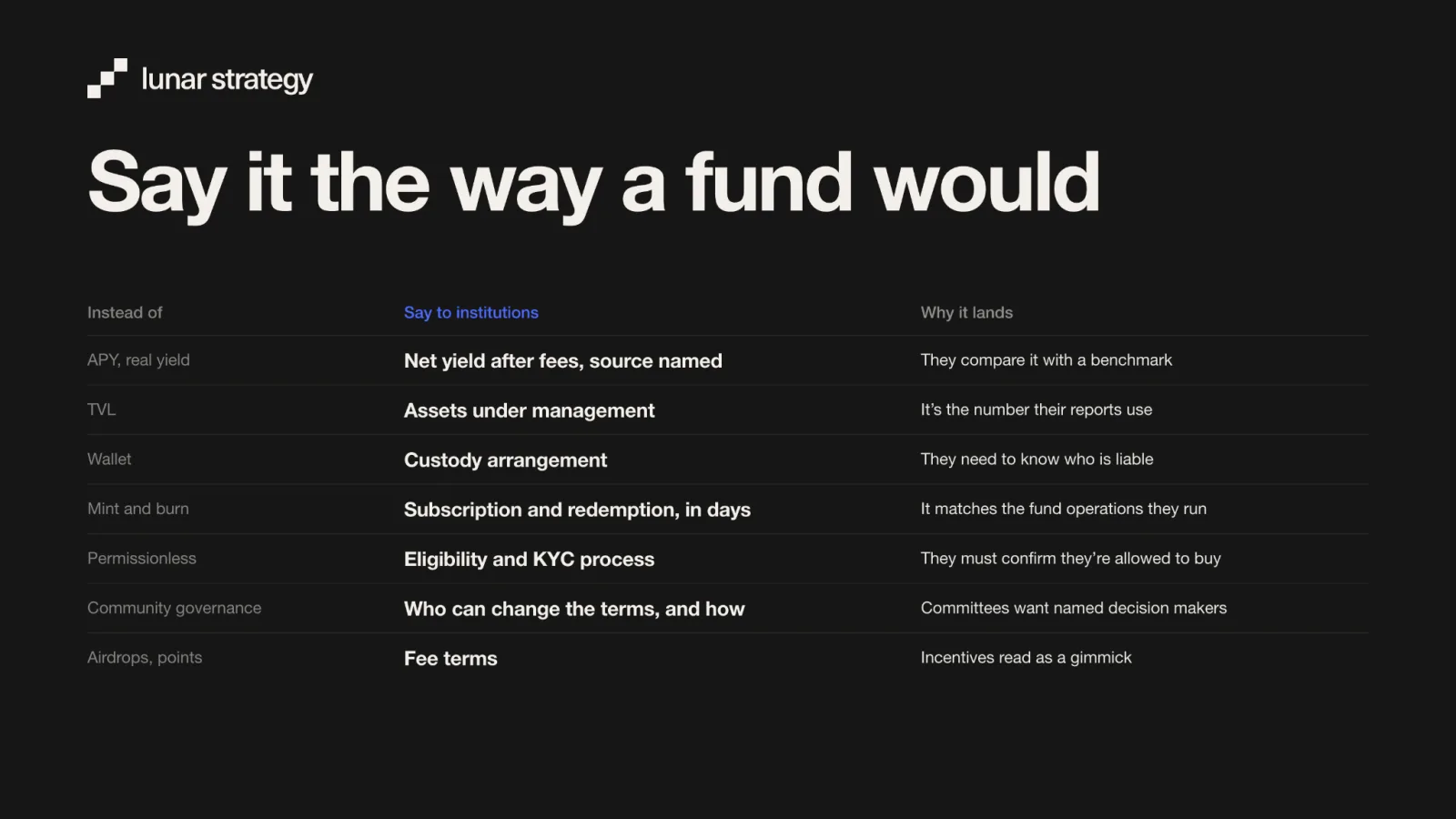
Run every institutional page through this list before it goes live. If a sentence would confuse a compliance officer reading it for the first time, rewrite it.
RWA marketing strategies that move allocations
The strategies that work for RWAs share one idea: make it easy to check you, then put the token where buyers already hold capital. Start by leading with proof. Publish the structure, the named custodian, administrator, auditor and transfer agent, regular attestations and complete data on dashboards like RWA.xyz before you spend on reach. A logo wall of "partners" with no stated role reads as padding to anyone who has done due diligence before.
Then earn distribution through integrations instead of buying attention. Many teams assume that putting an asset onchain makes it easy to trade, and that buyers will follow. The data says otherwise: in its November 2025 report on tokenization, IOSCO, the global body of securities regulators, found the impact on distribution and secondary trading "has been more limited" and still relies largely on conventional financial infrastructure and intermediaries. In October 2026, the IMF called tokenized markets "relatively illiquid", with trading fragmented across platforms. The CEO of the tokenization firm Securitize said it more bluntly to Decrypt in December 2025:
"An illiquid asset is illiquid whether you tokenize it or not."
Carlos Domingo, CEO, Securitize
A lending market listing, a collateral approval or a stablecoin reserve slot is therefore a distribution deal, and business development is the main marketing job. These deals take months, so start the conversations before launch, not after.
Recruit credibility, not reach. One explanation of your structure in a trade publication, a research note or a respected analyst's thread does more for a committee than a hundred paid posts. Make compliance visible: a clear eligibility checker, stated minimums and redemption terms in days and dollars tell buyers you're serious. Own the education layer with plain explainers of your asset class, since the buyers who learn the category from you tend to buy from you. And tie every dollar of spend to holders, inflows and qualified meetings, so you can stop what doesn't move capital.
The RWA funnel and channels
An RWA funnel moves from education to proof to a close, but the close looks different for each buyer. An institution closes in a meeting, after a pilot allocation and a partner's endorsement. An onchain user closes in a buy flow they're eligible for, followed by a place to use the token. Between those points, the channels that do the most work are the ones both buyers already trust:
- Earned media: coverage in trade publications and crypto outlets around real news (a new fund, a custodian, an integration). A crypto PR program built on milestones gives both buyers something to check; our explainer on what a crypto PR agency does shows what that involves.
- Research and data platforms: complete listings on dashboards like RWA.xyz and your own published reports put you where analysts already look.
- Search and AI search: buyers increasingly ask Google, ChatGPT or Perplexity which tokenization platforms are credible. Clear, sourced pages are what those tools cite; our guide to getting cited by ChatGPT and Perplexity covers how.
- Conferences and direct business development: still where most institutional pipelines start.
- KOLs and community, inside the rules: useful for explaining a product to onchain users, but only where your legal route allows public promotion, with paid relationships disclosed and never with yield promises.
What we'd cut first is the mass crypto KOL campaign. It reaches the wrong buyer for most RWA products and can breach the offering's rules. In our work with finance protocols, PR plus a small set of KOLs is the mix that builds trust before a launch. For Solv Protocol, a 35-day campaign of PR coverage and KOL marketing reached 4M+ impressions and put Solv in Kaito's top 10 pre-TGE arena with 9.3% mindshare (Lunar Strategy, 2025); the Avalon Labs campaign used the same mix. Neither is an RWA project, but the lesson carries over: a finance product earns trust by being explained well in credible places.
Building the RWA content engine
Content is where both buyers do their research before they ever talk to you, so it carries more weight in RWA marketing than in most of crypto. The structure that works is a hub on your asset class (tokenized Treasuries, private credit, gold) with pages that answer each question a buyer asks on the way to a decision, linked to each other and to your product pages.
Each page should open with a direct answer, cite its sources and show a date, because that is what both Google and AI tools lift into their answers. Refresh the numbers every quarter: in a market where values move weekly, a page with last year's figures tells a buyer you're not paying attention. The content types that matter most:
| Content type | Example | Who it serves |
|---|---|---|
| Explainers | "What is a tokenized money market fund?", "How does redemption work?" | Newcomers, search and AI tools |
| Structure pages | A one-page "what you own" summary with every partner and their role | Compliance officers, due diligence teams |
| Proof and reporting | Attestation archive, monthly holders and inflows report | Analysts, DeFi risk teams, journalists |
| Market commentary | Quarterly notes on yields, regulation and new integrations | Allocators, press, partners |
Our crypto SEO service builds this kind of hub, and the crypto SEO guide shows the method step by step.
Common mistakes that sink RWA launches
Most failed RWA launches don't fail on the product. They fail because the team ran a token launch playbook on an asset that needed a fund launch, and the first serious buyer couldn't find a clear answer to a basic question. The same handful of mistakes comes up again and again:
| Mistake | What to do instead |
|---|---|
| Marketing to everyone at once | Pick a lead buyer and build the first pages for them |
| Leading with yield | Lead with what the holder owns and who stands behind it; yield comes after |
| Treating compliance as a final review | Agree the legal route with counsel first and let it set the channels |
| Buying reach before proof | Publish structure, partners and attestations, then amplify |
| Driving traffic from people who can't legally buy | Target only eligible countries and investor types |
| Announcing integrations with no liquidity | Announce when the token is live and holding meaningful supply |
| Reporting followers and impressions | Report holders, net inflows, integrations and qualified meetings |
| Expecting launch-week results from institutions | Plan for a sales cycle measured in months |
Each row is cheap to fix before launch and expensive after. Audit your current pages and plan against the right-hand column before you spend on anything else.
Compliance and trust as marketing levers
Most RWA tokens are securities, and a blockchain doesn't change that. SEC Commissioner Hester Peirce made the point in a July 2025 statement, "tokenized securities are still securities", and the Commission confirmed it in March 2026 in an interpretation that also notes how an issuer "markets and promotes" an offering is relevant to whether it is selling a security (SEC Release 33-11412). In practice, the legal route chosen for the offering sets what marketing is allowed. For a U.S. audience, the common routes work like this:
- Rule 506(b) private placement: no general solicitation or advertising. Marketing means relationships and private meetings, with no public posts about the offering.
- Rule 506(c) offering: issuers may advertise broadly, but every buyer must be accredited and the issuer must take reasonable steps to verify it. In March 2025, SEC staff said a high minimum investment is a relevant factor in that check.
- Regulation S offering outside the U.S.: no "directed selling efforts" in the U.S., which can include ads in publications with general U.S. circulation, so geo-targeting becomes a marketing task.
- EU audience: tokens that qualify as financial instruments are outside MiCA, so existing EU securities rules, such as MiFID II, apply instead of the crypto marketing rules many teams know.
Regulators also watch the words. In September 2025, ESMA executive director Natasha Cazenave warned that tokenized stock products "typically do not confer shareholder rights", creating a specific risk of investor misunderstanding. Handled well, this becomes an advantage: a clear statement of what holders own, who can buy and how they exit is exactly the proof institutions look for. Our guide to crypto marketing regulations covers the rules by country. None of this is legal advice; bring counsel in before you write a single landing page.
RWA marketing examples
The products that grew fastest didn't win on ads. They won by becoming useful inside platforms where buyers already held capital, which turned one partnership into a steady source of demand. BUIDL is the clearest case: Ethena launched its USDtb stablecoin with BUIDL as more than 90% of its reserves in December 2024, and exchanges then accepted it as collateral. Four products show what each route teaches:
| Product | What happened | The marketing lesson |
|---|---|---|
| BlackRock BUIDL (tokenized money market fund) | Reserve asset for Ethena's USDtb; accepted as collateral by Deribit and Crypto.com in July 2025 and by Binance in November 2025 (Cointelegraph) | A trusted issuer plus collateral deals brought demand from trading firms without a retail campaign |
| Ondo OUSG and USDY (tokenized Treasuries) | Two products over similar exposure, one for qualified purchasers and one for non-U.S. access | Separate products let one issuer speak to both buyers without mixing messages |
| Apollo ACRED (tokenized private credit fund) | A leveraged yield strategy by Securitize and Gauntlet on Compound Blue, powered by Morpho (CoinDesk, April 2025) | Giving the token a job inside DeFi gave onchain capital a reason to hold it |
| Janus Henderson JAAA (tokenized CLO fund on Centrifuge) | Grove, a new protocol in the Sky ecosystem, started with a $1 billion allocation from Sky into JAAA (June 2025) | One allocator decision was worth more than any campaign, so treat large protocols as key accounts |
Read the table as a channel plan. None of these wins came from awareness alone, but every one depended on partners who had already heard of the issuer and trusted its structure.
Measuring RWA marketing performance
RWA projects have an advantage most crypto marketers don't: the results are public. Holder counts, value and transfers for most tokenized assets sit on public dashboards, so competitors, partners and journalists see the same numbers you do. Report on those first, treat follower growth and impressions as supporting signals, and add the one number no dashboard shows, the institutional pipeline:
| Metric | What it tells you |
|---|---|
| Distributed value (onchain assets) | Whether capital is arriving, the number partners will judge you by |
| Number of holders | Breadth of demand; low counts with high value mean you depend on a few allocators |
| Net inflows per month | Whether growth continues after the launch push |
| Value per holder | Which buyer you're really winning, institutional tickets or onchain users |
| Live integrations and share of supply in them | How much of your token is in use, not just held |
| Qualified meetings and conversion to allocation | The institutional pipeline |
| Cost per qualified meeting | Which channels are worth more budget |
| Average redemption time | A trust signal you can publish and improve |
One caution on onchain data: even experienced builders read it differently. Matthew Fisher, CEO of the DeFi chain Katana, who worked on bringing ACRED onchain, noted in an August 2026 CoinDesk opinion piece that estimates of how much tokenized RWA value is used in DeFi range from "under 1%" to "close to 20%". Pick one definition, write it down and keep it stable, so month-over-month changes mean something. A monthly report built this way fits on one page and tells the team exactly where the next dollar should go.
What good looks like at 12 months
A healthy RWA program looks quiet from the outside and busy underneath. The first 90 days go to the foundations, in order: agree the legal route with counsel and the channels it allows, pick your lead buyer, publish a one-page answer to their first question, shortlist the integrations that would put your token where that buyer already holds capital, and set up the metrics before launch. Our crypto go-to-market playbook covers the wider launch sequence.
By month 12, the result should be visible to anyone who checks:
- A public proof trail: structure page, named partners, attestation history and complete dashboard listings.
- Coverage in trade and crypto press tied to real milestones, not paid announcements.
- A few live integrations holding a meaningful share of supply.
- A content hub that ranks in search and gets cited by AI tools for your asset class.
- A repeatable pipeline of qualified institutional meetings, with conversion tracked.
- A second track, for the buyer you didn't lead with, ready to start.
If most of that list is missing after a year, the problem is rarely the budget. It's usually the order: reach was bought before proof existed.
How to choose an RWA marketing agency (and what it costs)
Many RWA teams come from finance or engineering and haven't run a crypto launch, while most crypto agencies have never sold to a compliance officer. The agency you want speaks both languages. Look for experience with finance products and institutional buyers, an instinct for what securities rules allow (an agency that pitches a mass KOL push for a 506(b) offering has answered the question for you), media relationships in both trade and crypto press, and a written plan with metrics agreed before work starts. Ask these questions in the first call:
| Ask the agency | A good answer sounds like |
|---|---|
| "Which legal route would change your plan, and how?" | Specific channels it would drop or add for 506(b), 506(c) or Regulation S |
| "Who would you lead with, and why?" | A choice tied to your minimum ticket and legal structure, not "both" |
| "What would you publish before any paid reach?" | Structure page, partners with roles, attestations, dashboard listings |
| "What will you report every month?" | Holders, inflows, integrations and qualified meetings, not impressions alone |
| "Show us finance-product work" | Named cases with public results |
On cost, agencies price by front rather than for "RWA marketing" as a whole. Clutch data from September 2026 shows most PR firms bill $100-$149 an hour and SEO agencies typically charge $2,000-$20,000 a month, across industries. Our breakdown of what a crypto marketing agency should deliver in 90 days shows what a realistic first quarter looks like.
How Lunar Strategy approaches RWA marketing
We've worked with more than 300 crypto projects since 2019, and our Web3 Consulting and GTM Strategy service is built for launches like this: positioning, audience segmentation, narrative and a rollout plan that ties product, brand and token strategy together. For Altura, that meant structuring a waitlist campaign and the timing of its mainnet launch; the results listed on our GTM page are about 80K users and followers from the waitlist, $1.2M in TVL in the first 4 weeks of mainnet and $4.25M raised (Lunar Strategy).
With RWA teams, we start where this guide does: the legal route and the lead buyer. From there we build positioning and a vocabulary for each buyer, review how clearly your pages answer the questions buyers ask first, plan channels that fit your offering's rules, and run PR and SEO and AI search around real milestones. You get a written plan your team can execute, with the metrics above agreed before launch.
Plan your RWA launch with Lunar →
Tell us what you're tokenizing and who it's for, and we'll show you where we'd start.
Frequently Asked Questions
What does RWA stand for in crypto?
In crypto, RWA stands for real-world assets: physical or traditional financial assets, such as Treasury bills, private credit, gold or real estate, whose ownership is represented by a token on a blockchain. Outside crypto the same letters mean other things, most often risk-weighted assets in banking, so check the context before reading any RWA statistic.
Is RWA tokenization legal?
Yes, tokenizing an asset is legal in most major markets, but the token usually keeps the legal status of the asset behind it. A tokenized fund share or bond is still a security, so the offering needs a registration or an exemption, and its marketing must follow the same securities rules as the traditional version.
Can you advertise a tokenized security on social media?
Only if your legal route allows public promotion. In the U.S., a Rule 506(c) offering may advertise broadly as long as every buyer is a verified accredited investor, while a 506(b) offering may not use general solicitation at all. Paid posts by influencers add disclosure duties, and promising returns is risky under any route.
What is the difference between tokenized Treasuries and stablecoins?
A stablecoin aims to hold a fixed value, usually one dollar, and is built for payments and trading. A tokenized Treasury fund holds short-term government debt and passes the yield to holders, either through a rising token price or as new tokens paid out. Tokenized Treasury funds are usually securities with eligibility limits; most stablecoins are not.
What yield do tokenized Treasury funds pay?
Roughly what short-term U.S. government debt pays, minus fees. On October 27, 2026, RWA.xyz showed a 7-day yield of 3.73% for BlackRock's BUIDL and 3.68% for Ondo's USDY. The figure moves with interest rates, so quote it with a date and compare net of the fund's management fee.
Which blockchain holds the most tokenized real-world assets?
Ethereum, by a wide margin. On October 27, 2026, RWA.xyz counted $15.9 billion of distributed real-world assets on Ethereum, about 40% of the total, followed by BNB Chain ($6.3 billion) and Solana ($4.9 billion). Many issuers launch on several chains to reach different buyers and integrations.
Do you need an agency to market an RWA project?
Not necessarily. The legal structure, issuer partnerships and integrations are the core work, and those sit with your team and counsel. An agency helps most with positioning for each buyer, PR around real milestones and a launch plan that fits your legal route, the parts most internal teams from finance or engineering haven't run before.