Crypto exchange listing: how to get your token listed
How to get your token listed on a crypto exchange: CEX vs DEX, how to prepare, what a listing really costs and the review process, step by step.
- Written by
- Shann HolmbergManaging Partner
- Published
- Reading time
- 14 minutes
- Topic
- Token launch

Contents
- 1What is a crypto exchange listing?
- 2Where should you list your token: CEX or DEX?
- 3How do you choose the right exchange?
- 4How do you prepare your token for an exchange listing?
- 5How much does it cost to list a token?
- 6The listing process, step by step
- 7What happens after your token is listed?
- 8Where to start, and how Lunar helps
- 9Frequently Asked Questions
There are far more tokens than any exchange will ever list. In October 2026, CoinMarketCap tracks the market data of more than 52 million crypto assets through its on-chain tools, while Kraken, a major US exchange, lists a little over 600 (Kraken). An exchange can say yes to only a tiny share of the projects that ask, and the ones it picks have usually prepared for months before anyone filled in a form.
This guide is for founders and marketing leads getting a token ready for its first or next exchange. It covers where to list, how to choose an exchange, how to prepare, what a listing costs beyond the fee, how the review works step by step and what to watch once trading starts. A listing is earned with preparation and demand, and kept the same way.
What is a crypto exchange listing?
A crypto exchange listing is an exchange's decision to let its users deposit, trade and withdraw your token. On a decentralized exchange it takes one transaction. On a centralized exchange it takes an application, a review of the project and its contracts, and a decision you can't buy, because the exchange carries the risk once its users hold your token.
That risk explains how exchanges behave. Their users put money into your token, their compliance team has to answer for what the token is, and their name sits next to your ticker for as long as the market stays open. Kraken says every listing has to meet its legal, compliance, engineering and commercial standards, and that its process is strictly merit based. A listing review feels closer to a credit check than a sales call.
Where should you list your token: CEX or DEX?
Most projects need both, in order. A DEX gives you a market on day one, and a CEX gives you access to millions of users who will never touch a wallet app. Data sites sit in between: they don't trade tokens, but CoinGecko and CoinMarketCap are where most investors look a token up first, and most exchanges check them.
| DEX (Uniswap, PancakeSwap, Raydium) | Data sites (CoinGecko, CoinMarketCap) | CEX (Binance, Coinbase, Kraken, Bybit) | |
|---|---|---|---|
| Who decides | Nobody: you create the pool yourself | The site's listing team | The exchange's listing and compliance teams |
| What it takes | Tokens and stablecoins to put in a pool | Trading on an exchange the site already tracks | An application, due diligence and KYC |
| Cost | Network fees plus the liquidity you lock | Free standard review; paid fast track optional | No listing fee at the majors; deposits and allocations may apply |
| What you get | A live price and on-chain trading history | A public page investors and exchanges check | Access to the exchange's users and order book |
| Main risk | A thin pool that one trade can swing | Rejection if supply data doesn't match the chain | Delisting if trading quality falls |
That order is what we call the Listing Ladder: a DEX pool first, then CoinGecko and CoinMarketCap, then a mid-size exchange or a pre-listing program, then a top exchange. Each step produces the evidence the next one checks. CoinGecko, for example, requires that your token already trades on an exchange it tracks, and offers a Preview Listing before launch if you show a confirmed launch date in official announcements.
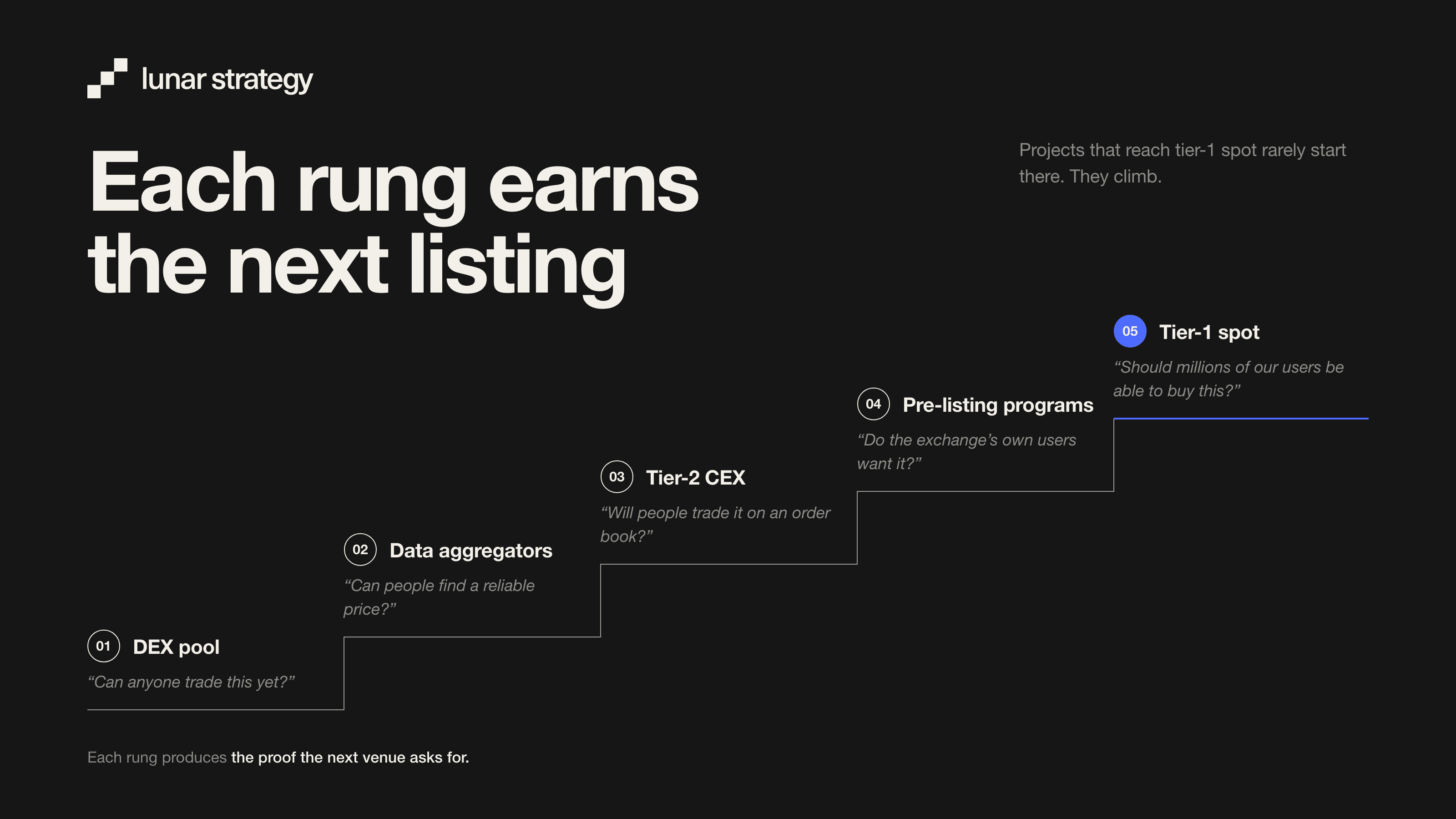
Binance has built the same ladder inside one company. It describes Binance Alpha as "a pre-listing token selection platform," and tokens move from Alpha to futures trading to spot trading based on how they perform at each stage.
How do you choose the right exchange?
The biggest exchange isn't always the right first one. Pick the venue where your users already trade and where your token can be supported without a long integration, because a listing nobody uses hurts the next application more than no listing at all. Five things decide the fit:
- Region: where your users live and whether the exchange serves them. Coinbase notes that a listed asset may still be unavailable in some regions.
- Chain support: Coinbase says it can support ERC-20 tokens on Base, Ethereum, Optimism, Arbitrum and Polygon, plus SPL and ARC-20 tokens, without heavy integration work, while native chains need more resources and wait longer.
- Users and liquidity: whether the exchange's traders want your kind of token, and whether you can keep its order book deep.
- Total cost: deposits, token allocations, liquidity and a market maker, priced against your runway.
- Reputation: a venue known for thin books and suspicious volume makes your trading data look worse to the next reviewer.
Start with one exchange that matches all five, then add venues as real trading volume justifies them.
How do you prepare your token for an exchange listing?
Exchanges publish what they check, and most of it can be prepared in advance. Binance lists product quality, real traction, utility, user metrics, the business model, tokenomics, the team, technical risk, compliance and user protection, and says the list is not exhaustive. Coinbase ranks the projects it reviews by trading volume, market value, number of token holders and expected liquidity, and also weighs social media sentiment, the history of the people behind the project and how tokens are spread across wallets.
Coinbase also publishes the red flags that lower its chances of listing a token. The list includes a project that markets the token as an investment, administrator keys that let one person change balances or pause transfers, a core team that controls enough supply to force governance votes, private or unverifiable source code, and no security audit from a reputable firm. Build the evidence pack below once, keep it current and send each venue the parts it asks for:
| What to prepare | What the reviewer checks it against |
|---|---|
| Working product and traction | Active users, retention and fees, in numbers an outsider can verify |
| Security audit | A published report from a reputable firm on the contracts that hold or release tokens |
| Contract control | Who holds admin keys, and whether privileged roles are limited or held under multi-signature control |
| Token contract and supply | The block explorer, which should show the same total and circulating supply you report |
| Allocation and unlock calendar | Who holds what, and when each group can sell |
| Top holders | The top 10 and top 100 wallets, with team, treasury and exchange wallets labeled |
| Markets and liquidity | Live trading pages, plus your market maker agreement if you have one |
| Community and coverage | Activity by channel and press links, which feed the sentiment Coinbase says it weighs |
| Team and legal | KYC for the applicants, beneficial owners, funding history and a lawyer's view on what the token is |
Read that list as a marketer and much of the work turns out to be yours. Holders who aren't three wallets, users who return, a community that talks about you unprompted: none of it can be bought from a listing agent, and all of it shows up in the data a reviewer checks. When founders argued in public over listing fees in November 2024, Binance's founder summed up the review in seven words:
"Work on the project, not the exchange."
Changpeng Zhao, founder, Binance, in Decrypt (November 2024)
If the unlock calendar is the weak part of your pack, our guide to tokenomics for founders explains what buyers and exchanges look for.
How much does it cost to list a token?
The largest exchanges say the listing itself is free. Kraken charges nothing, Coinbase writes that listing "is free, and always has been," and Binance says it charges no fee to evaluate a project. That doesn't make a listing free. In October 2025, CJ Hetherington, CEO of the prediction market Limitless, posted what he said was a Binance offer asking for about 8% of the project's token supply plus cash and token security deposits. Binance called the claim false and defamatory, and said deposits are typically refundable over a "1-2 years timeframe" (The Block).
Both sides can be telling the truth, and that is the useful part. A listing offer is a bundle, and the word "fee" names only one line of it. When an offer arrives, sort each line into one of these buckets before you react to the total:
| Component | What it is | Do you get it back? |
|---|---|---|
| Listing fee | Cash paid for the listing itself. Binance, Coinbase and Kraken say they don't charge one | No |
| Security deposit | Cash or tokens the exchange holds as a guarantee for its users | Often, after a set period |
| Token allocation | Tokens given to the exchange's users through airdrops or launch programs | No, they leave your treasury |
| Liquidity commitment | Tokens and stablecoins you keep available for trading | It stays yours, but it's tied up in the market |
| Market maker | A firm paid to keep buy and sell orders on the exchange so trading stays smooth | No, it's a service you pay for |
| Paid fast track | A faster review on a data site, such as CoinGecko Fast Pass or CMC Priority | No, and it buys speed, not approval |
Get the refund terms of every deposit in writing, check whether token allocations unlock gradually or land in users' wallets on day one, and price the liquidity commitment against your runway. Since March 2026, Binance requires projects to disclose their market maker's identity and contract terms, and it bans profit-sharing and guaranteed-return deals. Our comparison of market makers in crypto covers who fits a launch-stage project.
The listing process, step by step
Exchanges word it differently, but the review runs in the same order almost everywhere. Coinbase publishes its own sequence, from the request for review through due diligence, notification and listing, and Binance and Kraken describe the same shape. Each step below starts with the question the exchange is asking, followed by the same three labels: what happens, what they look for and the mistake that ends the review.
01 · Application: "Who is applying, and for what?"
- What happens: you fill in the exchange's official form, one per token. Binance asks that the founder or a key team member apply directly and provide KYC (identity checks).
- What they look for: a clear description of the product, the token's purpose, the technology and the team.
- Mistake: applying through an agent. Binance rejects the application and blacklists the project if it finds a third party involved, and Kraken says multiple applications or community campaigns only lower your chances.
02 · Initial review: "Does this meet our criteria at all?"
- What happens: a preliminary check against the exchange's business criteria. Coinbase says it can't respond to every submission and gets in touch only if it moves forward or needs more information.
- What they look for: demand, token holders, expected liquidity and whether the token runs on a chain they support.
- Mistake: chasing the team for an answer. Kraken asks applicants not to push their application or contact its staff to influence the review.
03 · Due diligence: "Is it safe for our users?"
- What happens: an in-depth review of the technology, use case, market demand and regulatory status. Coinbase says it runs this review without help from the project team.
- What they look for: the audit, admin keys, centralization, token distribution, beneficial owners and how the token was sold.
- Mistake: supply numbers, holder lists or claims that don't match what the reviewer finds on-chain.
04 · Decision and terms: "On what terms do we list it?"
- What happens: the exchange contacts the projects it chooses and agrees on the launch, including any deposits, user allocations and liquidity commitments.
- What they look for: a market that will stay deep and fair after day one.
- Mistake: signing a bundle you haven't priced against your runway.
05 · Listing: "Is the market ready to open?"
- What happens: deposits open first, and trading starts once liquidity is in place. Coinbase enables transfers and moves into trading mode "when liquidity conditions are met."
- What they look for: a market maker or enough liquidity on day one, and an announcement on the exchange's official channels.
- Mistake: announcing before the exchange does, which invites fake contract and deposit links.
Solv Protocol, a Bitcoin-focused DeFi project, shows what the end of the process looks like when demand comes first. We ran the campaign for Solv's TGE (token generation event, the day a token is created and starts trading), combining PR with KOL marketing, meaning paid work with crypto influencers. It put Solv in the top 10 of Kaito's pre-TGE arena with 9.3% mindshare during launch (Lunar Strategy, 2025).
Binance listed SOLV on January 17, 2025, as the first exchange to list the token, with 588 million SOLV set aside as rewards for its users through its Megadrop launch program, the token allocation line from the cost table in practice. The listing was Binance's decision; the visible demand was the part marketing could build.
What happens after your token is listed?
A listing gives you a market, and the exchange keeps grading it. Bybit says it regularly reviews every token it lists and may delist one that falls short of its requirements. If a delisted token can't be sold over the counter, directly between parties, once withdrawals close, Bybit's rules say its value becomes zero for users who didn't withdraw in time. The numbers behind that review are set in the first weeks of trading.
That's why the launch campaign shouldn't stop on listing day. Keep community and creator activity going after the first spike, plan the weeks around it the way our 90-day pre-TGE playbook lays out, and make sure liquidity lasts past the opening excitement. Then track what the exchange tracks, every week for the first month:
| Metric | What to watch | Why it matters |
|---|---|---|
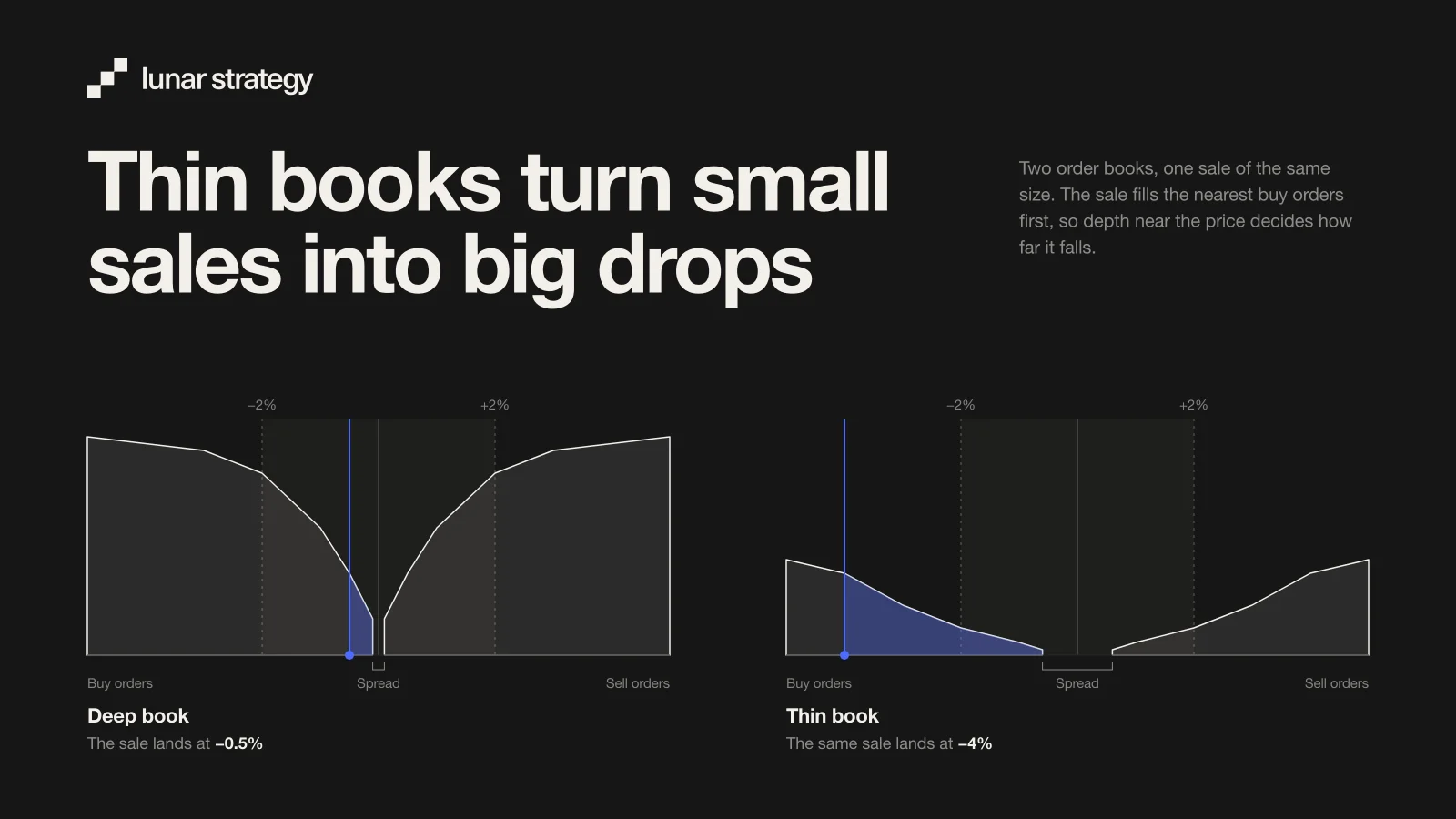
| Order book depth | How much can trade within 2% of the current price | Thin books turn small sales into big price drops |
| Spread | The gap between the best buy and sell price | A wide spread tells traders, and the exchange, that liquidity is weak |
| Real volume | Trading not driven by rewards or by your own market maker | Reviewers discount volume you created yourself |
| Holder spread | New holders, and the share held by the top wallets | Exchanges check how tokens are distributed |
| 30-day retention | Wallets still holding 30 days after buying | Shows whether the listing brought users or only short-term traders |
If depth and real volume fall while the holder count stalls, fix liquidity and give holders a reason to stay before the exchange's review finds the problem for you. Our guide on how to avoid a flopped TGE covers what usually breaks after day one.
Where to start, and how Lunar helps
Place your token on the Listing Ladder first, then work only on the proof for the next step. Write the evidence pack this week, before you apply anywhere, and fill its gaps with product, security and community work rather than a listing agent. When you do apply, use the official form, one venue at a time, and get every deposit and allocation in writing before you agree to anything.
- Not trading yet: set your launch date, announce it on official channels and request a CoinGecko Preview Listing.
- Trading on a DEX: get tracked on both data sites, with supply numbers that match the blockchain.
- Tracked and on a mid-size exchange: build the volume, holder and community data that a pre-listing program or a top exchange will check.
We've worked with more than 300 crypto projects since 2019, and many of them came to us around a token launch. We don't apply for listings on anyone's behalf, and Binance's rules make clear that no one should. Our part is the demand exchanges say they measure: our go-to-market team aligns product, brand and token story into one launch plan, then builds the community and attention that show up in a listing review.
Plan your token launch with Lunar →
Tell us which step of the ladder you're on, and we'll tell you what we'd build before your next application.
Frequently Asked Questions
What documents or audits are required for a token listing?
Requirements vary, but expect a KYC check on the applicants, details on the team, beneficial owners and funding, the token's supply and allocation, and a security audit. Coinbase says a token that never received an audit from a reputable firm is less likely to be listed, especially when the code is complex or new. A lawyer's view on what the token is helps in every review.
Do centralized and decentralized exchanges have different listing processes?
Yes. On a DEX there is no review: you create a liquidity pool and the token trades as soon as the pool exists. A CEX runs an application, a review and due diligence, then decides whether and on what terms to list. Many projects start on a DEX precisely to build the trading history a CEX will check.
How long does a crypto exchange listing take?
There is no standard timeline. CoinGecko's regular review takes up to five days, and CoinMarketCap says free reviews can take anywhere from days to months or years. Binance, Coinbase and Kraken publish no timelines and contact only the projects they move forward with, so plan your launch around the steps you control.
Is a CoinGecko or CoinMarketCap listing free?
The standard route is free at both. CoinGecko's paid Fast Pass speeds up the answer without guaranteeing approval, and CoinMarketCap sells a fast track called CMC Priority. Anyone else promising a guaranteed fast listing is not an official channel, and CoinGecko says community spam asking for a listing can get a token disqualified.
When can you announce an exchange listing?
Only after the exchange does. Kraken, for example, says a token on its listings roadmap is not guaranteed a listing, and that trading opens only after its official listings account on X confirms it. Announcing early invites scam contracts and fake deposit links, and it embarrasses you in public if the listing slips.
Tim, Jack or Luka



Free strategy call
20 min
Whether you need help with GTM or other marketing, we give you a first strategy and advice on a free 20-minute call.
Book a callRated 4.9/5 on Clutch