How much does crypto marketing cost in 2027?
What crypto marketing costs in 2027: prices by activity and channel, pricing models, in-house vs agency vs freelancers, and the costs most budgets miss.

- Written by
- Shann HolmbergManaging Partner
- Published
- Reading time
- 10 minutes
- Topic
- Strategy and growth

Contents
- 1What drives the cost of crypto marketing
- 2Costs most companies miss
- 3Average crypto marketing costs by activity
- 4What a token launch budget adds up to
- 5Crypto marketing channels compared
- 6Pricing models
- 7In-house team vs Agency vs Freelancers
- 8Where to start
- 9Get a budget for your project
- 10Frequently asked questions
Established companies size marketing as a share of revenue: 7.8% in 2026, according to the Gartner 2026 CMO Spend Survey of 401 marketing leaders, most at companies with more than $1 billion in revenue. A crypto project weeks away from its token launch has no revenue to take a share of, so it has to build the budget from what each piece of work costs.
That is what this guide does for teams planning their 2027 budget. It covers what drives the cost, the costs most budgets miss, what each activity and channel costs, how providers charge, and whether a team, an agency or freelancers should do the work. Every number comes from a provider's own price list, an official dataset or Lunar's published campaign figures, checked in October 2026.
What drives the cost of crypto marketing
Two projects can ask for "crypto marketing" and need budgets ten times apart, because the price is set by a handful of variables. After more than 300 crypto projects since 2019, these are the ones we see move a quote the most:
- Stage and launch date: a live product with users needs steady work; a project six weeks from its token generation event (TGE), the moment its token is created and starts trading, needs several channels peaking in the same few weeks.
- How many channels run at once: each channel adds its own fee and its own pass-through costs, and running KOLs, PR and community together also needs someone to keep them on one calendar.
- Market attention: creators price their posts by the attention they get, so the same push can cost more per 1,000 views in a busy week than in a quiet one.
- Regulation and platform rules: Google lets exchanges and software wallets advertise only after they are certified by Google and licensed in each country they target, and every market's rules add review time to copy.
- Community coverage: the hours a day someone answers in Discord or Telegram, and in how many languages, sets most of the community line.
You can settle most of these before you ask anyone for a price. Decide your launch date, your channels and your markets first, and every agency is pricing the same job, so you can compare the quotes side by side. Leave them open, and each agency fills the gaps with its own guesses, so the prices end up different for reasons that have nothing to do with the work.
Costs most companies miss
The lines that blow up a budget are rarely the big campaigns. They are the pieces of work that sit between campaigns, which no one prices because they don't look like marketing until they're missing.
| Hidden cost | Why it gets missed | What to do |
|---|---|---|
| Launch preparation | It happens before any campaign, so it looks like strategy, not spend | Fund positioning, a rollout plan and audits of token utility, points and airdrop mechanics first |
| Compliance review | Legal reads copy late, after creatives are made | Book review time for every market you target before the creatives are briefed |
| Community after launch | Teams staff up for launch week and stop | Keep coverage for at least the month after TGE |
| Creator vetting | Follower counts look like reach | Check views, audience quality and past results before paying any KOL |
| Pass-through costs | They get folded into one agency number | Ask for creator fees, platforms and wire packages on their own lines |
Community after launch is the one we see skipped most. Keep a line for community management in the budget once launch week is over, because engagement drops fastest in the weeks right after TGE. Exchange listing fees, legal work and market making belong on separate budgets, but they set the dates the marketing has to hit, so plan them on the same calendar.
Average crypto marketing costs by activity
These are the ranges a project can check for itself. Where no public price exists, the table says so instead of guessing; agency ranges come from Clutch, the B2B review platform, across all industries.
| Activity | Typical cost | Best for | Main risk |
|---|---|---|---|
| Strategy and launch preparation | Project fee, quoted per scope | Getting the narrative and token mechanics right before spend | Advice without anyone to execute it |
| Social media on X | Monthly fee, plus X's Premium Business plan at $200-$1,000 a month | Steady visibility with the crypto audience | Paying for followers instead of reach |
| KOL campaigns | About $5,000 test, $20,000 launch, $100,000 major pushLunar campaigns, about $20 CPM | Fast reach around a moment | Creators with inflated audiences |
| PR | $1,399-$10,799 per release (Chainwire, 8 to 100+ outlets); PR firms $100-$149 an hour | Credibility and announcements | Counting wire pickups as coverage |
| SEO and content | $2,000-$20,000 a monthClutch, Sep 2026 | Search and AI visibility that compounds | Slow results; no launch-week effect |
| Community management | Monthly fee, quoted on coverage hours and languages | Turning visitors into members who stay | Going quiet after launch |
| Paid ads | Media spend you set, plus platform approval | Testing messages at scale | Certification and policy delays |
| Full-service agency | $5,000-$50,000 a monthClutch, Sep 2026, all industries | Several channels on one plan | Fees that hide pass-through costs |
The KOL line is usually the largest, which is why the unit matters. A KOL, or key opinion leader, is a crypto creator whose audience trusts their take; dividing a creator's fee by the views a post gets turns any quote into a CPM you can compare across creators of any size. Our guide to KOL campaign costs shows the full math.
What a token launch budget adds up to
Here is how those prices stack up for a hypothetical DeFi project eight weeks from its TGE. It needs a KOL push, two announcements and a verified presence on X.
| Line item | Unit | Hypothetical amount |
|---|---|---|
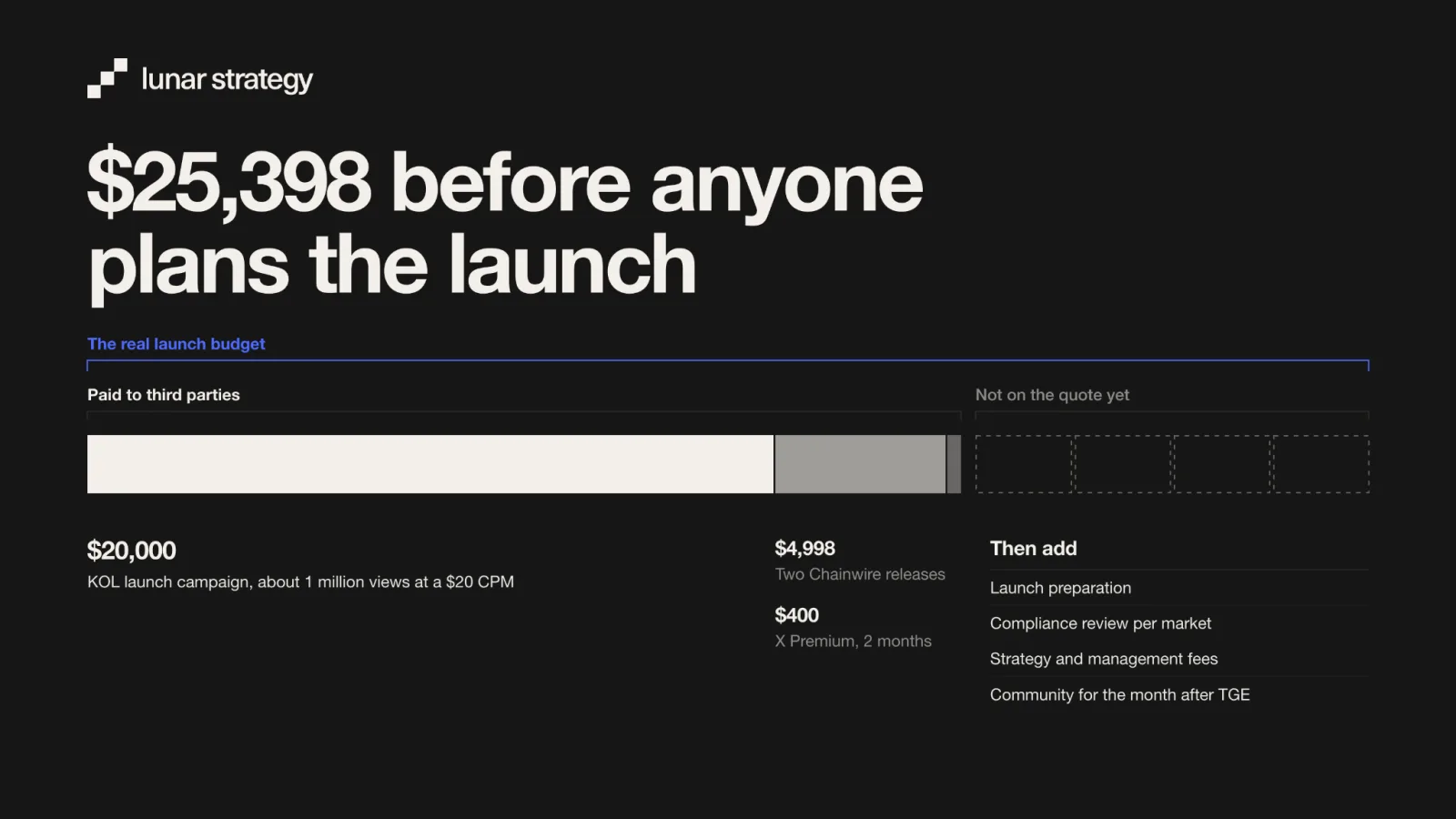
| KOL launch campaign | About 1 million views at a $20 CPM | $20,000 |
| Two announcements | Chainwire Standard, 20 outlets, $2,499 each | $4,998 |
| X verification | Premium Business Basic, 2 months at $200 | $400 |
| Pass-through total | Before strategy and management fees | $25,398 |
These numbers are made up to show the math. So, roughly $25,000 goes to third parties before anyone plans the narrative, briefs the creators or answers the community, and that planning is what decides whether the creator fees reach the right people. Add the hidden costs from the table above, and the real launch budget is the pass-through total plus fees, preparation and at least a month of community after launch.
Crypto marketing channels compared
Cost alone says little about a channel; what matters is what each one does for the money and where it stops working. This is how the main channels compare.
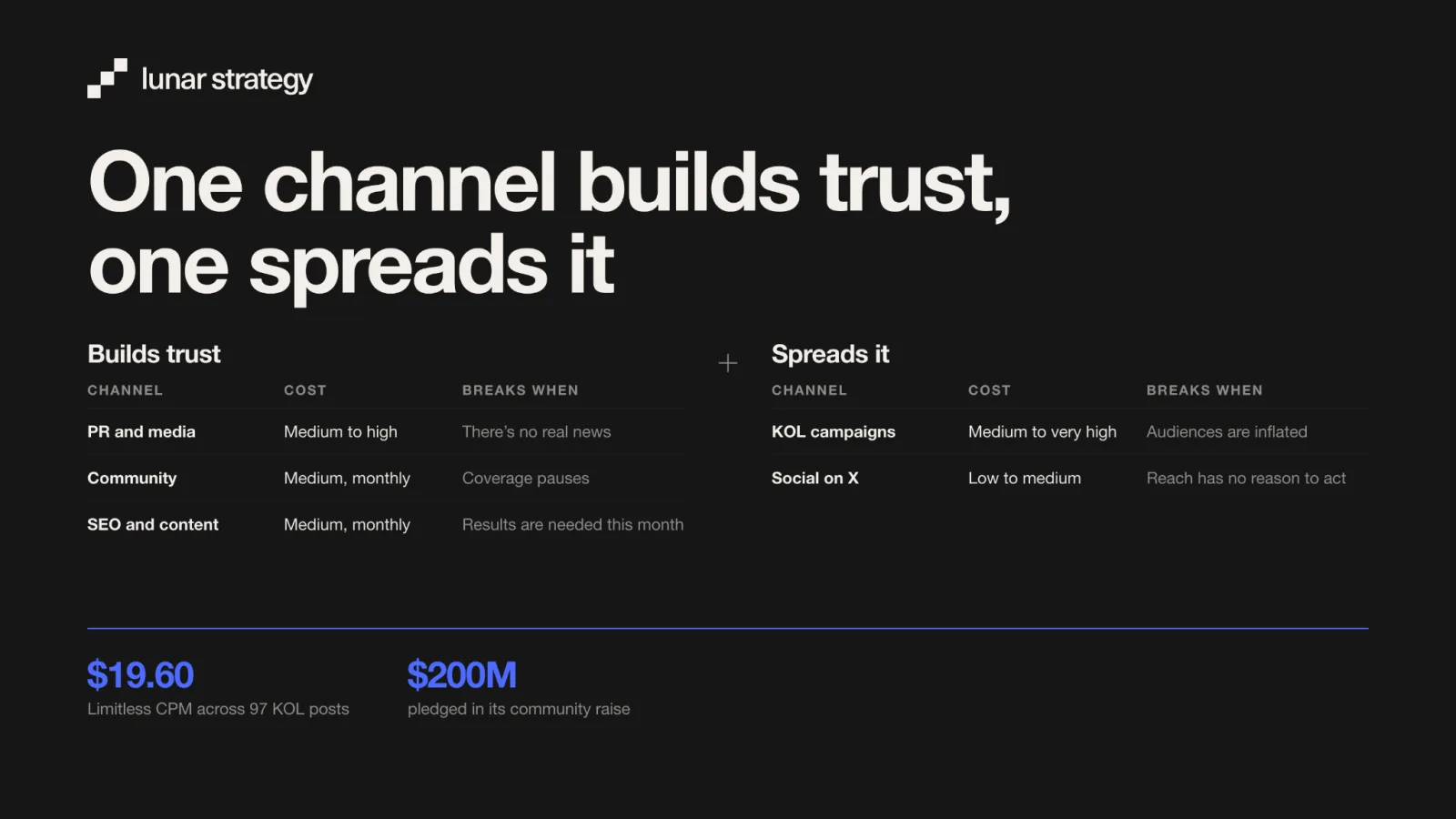
| Channel | Cost level | What it does best | Where it breaks |
|---|---|---|---|
| SEO and content | Medium, monthly | Durable education and search demand | Takes months to show |
| Community management | Medium, monthly | Answers doubts and keeps members | Daily work that can't pause |
| KOL campaigns | Medium to very high | Fast discovery around a moment | Audience quality varies |
| PR and media | Medium to high | Credibility with investors and partners | Shallow coverage if there's no news |
| Social media on X | Low to medium | Daily presence where crypto talks | Reach without a reason to act |
| Paid ads | High, plus approvals | Scaling a message that already works | Policy limits and mixed traffic |
The budgets that work usually pair one channel that builds trust (PR, community, SEO) with one that spreads it (KOLs, social), instead of spreading money thin across all of them.
Pricing models
Most quotes that feel impossible to compare are mixing pricing models in one number. Splitting a quote by model is the fastest way to see what you're actually paying for.
| Pricing model | Typical use | Main advantage | Main limitation |
|---|---|---|---|
| Hourly rate | Audits, advisory, PR firms | Pay only for the time you use | No one owns execution |
| Monthly retainer | Social, community, SEO, ongoing management | A steady team that learns your project | Needs work every month to justify it |
| Campaign or project fee | Token launches, listings, announcements | Clear scope and end date | Momentum can stop with the campaign |
| Price per 1,000 views (CPM) | KOL campaigns, paid social | Lets you compare reach across creators | Views aren't users |
| Performance-linked fee | Acquisition or engagement targets | Pays for results | Hard to attribute in crypto |
Most launch budgets mix two of these: a retainer for the work that compounds, such as community and SEO, and campaign fees for the spikes around a TGE, a raise or a mainnet. Be careful with performance-linked fees. In crypto, a user can see a KOL post, read a press article and sign up through a search result in the same week, so tie any bonus to numbers both sides can see and the provider can actually influence.
In-house team vs Agency vs Freelancers
Who does the work changes the bill. Each model hides a different cost, so compare them on the same scope.
| Model | What it costs | Hidden cost | How it scales |
|---|---|---|---|
| In-house team | Median marketing manager salary $166,790 a yearBLS, May 2025, about $13,900 a month before benefits | Hiring time, tools and idle months between launches | Slow to resize |
| Agency | $5,000-$50,000 a month | Scope creep if the brief isn't fixed | Fast to scale up or down |
| Freelancers | Social media managers $14-$35, PR specialists $18-$60 an hour. | Founder time spent managing and connecting them | Fragile when one person leaves |
One hire rarely covers KOLs, PR, community and SEO at once, so many teams pair an in-house lead with an agency or specialists. Every project that contacts us picks one of three ranges on our contact form: $15,000-$25,000, $25,000-$50,000, or $50,000 and above. The range is the fastest way for us to learn how many channels can run together and for how long.
Where to start
The right budget depends on your stage and on how much trust you still have to earn, not on what a competitor spent. Start small and specific, then scale what works:
- Pick one goal: reach, real users or coverage. Each one points to a different channel.
- Fund one channel first and test it for 2-4 weeks. A test-size KOL campaign tells you which creators bring users before you scale.
- Agree the metric before you spend: cost per real user and retention at day 30, set before launch, because nobody can rebuild a baseline afterwards.
- Keep a reserve for listing dates that move and creators who reprice in a busy week.
- Add something that compounds, like SEO and content, because paid reach stops the day the budget does. Our crypto SEO guide shows where to start, and our guide to calculating customer acquisition cost in crypto shows how to count real users.
Get a budget for your project
We map scope and budget together with every project before we quote. On a first call we go through your launch date, the channels you need and your estimated range, then show you which channel we'd fund first and what the pass-through costs look like. Our work covers social media, PR, crypto SEO, go-to-market and more on our services page.
Bring your launch date and budget range, and we'll show you where it goes furthest.
Frequently asked questions
Why is crypto marketing more expensive than traditional marketing?
Mostly because the cheap channels are restricted. Ad platforms only let certified, licensed exchanges and wallets advertise, so projects lean on creators, PR and community, which are priced by people's time and attention. Volatility adds cost too: launch dates move, creators reprice in busy weeks, and every market's rules add review time to the same campaign.
What is the most cost-effective crypto marketing channel?
Over a year, the channels that compound: SEO and content, and a well-run community, because each month builds on the last. Over a launch window, a vetted KOL campaign usually buys reach fastest. The honest answer comes from your own numbers, so compare channels on cost per real user, not on cost per view.
Are exchange listing fees part of the marketing budget?
No. Exchange listing fees, legal work and market making are separate budgets with their own negotiations, and folding them into marketing makes both numbers hard to read. Plan them on the same calendar, though, because a listing date usually sets the moment your KOL and PR spend has to peak.
Can you pay for crypto marketing in tokens?
Some creators and providers accept tokens, but it rarely saves money. Tokens paid for promotion are often sold soon after launch, which adds selling pressure at the worst moment, and the real cost depends on a price nobody knows yet. Pay in stablecoins or fiat where you can, and keep token payments small and vested.
Do crypto marketing prices change?
Yes. Platform plans, release packages and creator rates are set by each provider and can change at any time, sometimes with new tiers or discounts for longer terms. The prices in this guide were checked in October 2026, so before you sign, open each provider's pricing page and ask any agency for a dated, itemized quote.
Tim, Jack or Luka



Free strategy call
20 min
Whether you need help with GTM or other marketing, we give you a first strategy and advice on a free 20-minute call.
Book a callRated 4.9/5 on Clutch