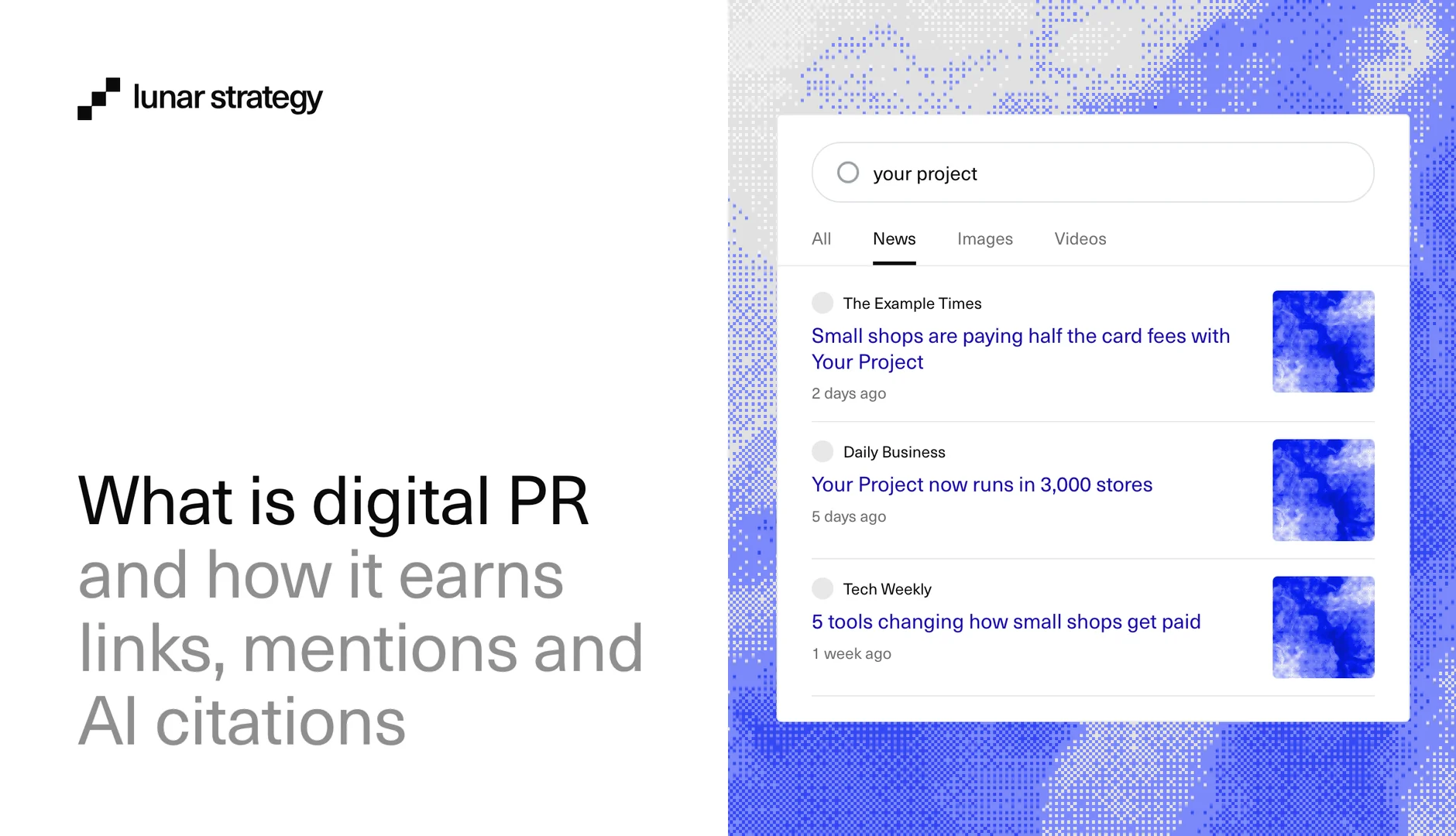
What is digital PR, and how does it earn links, mentions and AI citations?
Digital PR earns links, brand mentions and AI citations from sites you don't own. How it works for crypto projects, what to pitch and how to measure it.
- Written by
- Shann HolmbergManaging Partner
- Published
- Recently updated
- Reading time
- 12 minutes
- Topic
- PR

Contents
- 1Earned coverage, counted in links, mentions and citations
- 2Why it matters more once AI answers come first
- 3In crypto, third parties write the verdict
- 4The tactics that earn coverage for a crypto project
- 5Paid placements look similar and earn far less
- 6How a campaign runs, from story to coverage
- 7How to measure results
- 8Where to start this quarter
- 9How Lunar Strategy approaches digital PR
- 10Frequently Asked Questions
In December 2025, Ahrefs, an SEO software company, studied 75,000 brands to see what the brands that ChatGPT, Google's AI Mode and AI Overviews mention most have in common. One of the clearest patterns: brands that are named often on other websites are also named often in AI answers. The number of pages a brand publishes on its own site showed a much weaker link (Ahrefs).
What other sites say about you now shapes what AI tools say about you, and earning those mentions is the job of digital PR. For crypto projects, whose users and holders start out skeptical, it builds the independent record that Google, ChatGPT and investors check before they trust a name.
This guide is for founders, marketers and growth teams in crypto and Web3. It covers which tactics earn coverage, where paid placements fall short, and how to run and measure a first campaign this quarter.
Earned coverage, counted in links, mentions and citations
Digital PR means getting independent journalists, websites and creators to cover your brand in their own words. One placement can produce a backlink that helps rankings, a mention that builds recognition and a source that AI search tools cite.
Traditional PR counted clippings and audience reach: a newspaper story, a TV segment, a quote in a trade magazine. The online version keeps the craft, a good story pitched to the right reporter, and adds search results to the scorecard. A feature that names your protocol without a link still helps, because Google and AI tools read mentions as evidence of who matters in a category. A feature that links to your docs or data page also passes ranking credit and sends readers who can act on what they read.
Advertising sits on the other side. An ad or a sponsored post is bought, and you control what it says. Earned coverage is chosen by an editor, a host or a creator, which is why readers, search engines and AI tools trust it more.
The three look alike on a "featured in" banner and behave very differently once search engines read them:
| Factor | Traditional PR | Digital PR | Paid placement |
|---|---|---|---|
| Where it runs | Print, TV, radio, news sites | News sites, trade media, blogs, podcasts, YouTube, forums | Sponsored posts, advertorials, press release wires |
| Who decides it runs | An editor | An editor, host or creator | Whoever pays |
| Main outputs | Reach and reputation | Links, brand mentions, AI citations, referral traffic | Guaranteed timing and visibility, labeled as paid |
| Search value | Indirect | Direct: editorial links and mentions | Low: Google expects paid links to be marked as sponsored |
| How it's measured | Clippings, audience size | Referring domains, mentions, referral traffic, AI citations | Impressions and clicks |
Why it matters more once AI answers come first
Many searches now open with an answer that people read without scrolling further. Google's AI Overviews had more than 2 billion monthly users across more than 200 countries and territories and 40 languages by July 2025, according to Sundar Pichai, Google's CEO (Google). The sources named inside that answer collect more of the attention than the links below it.
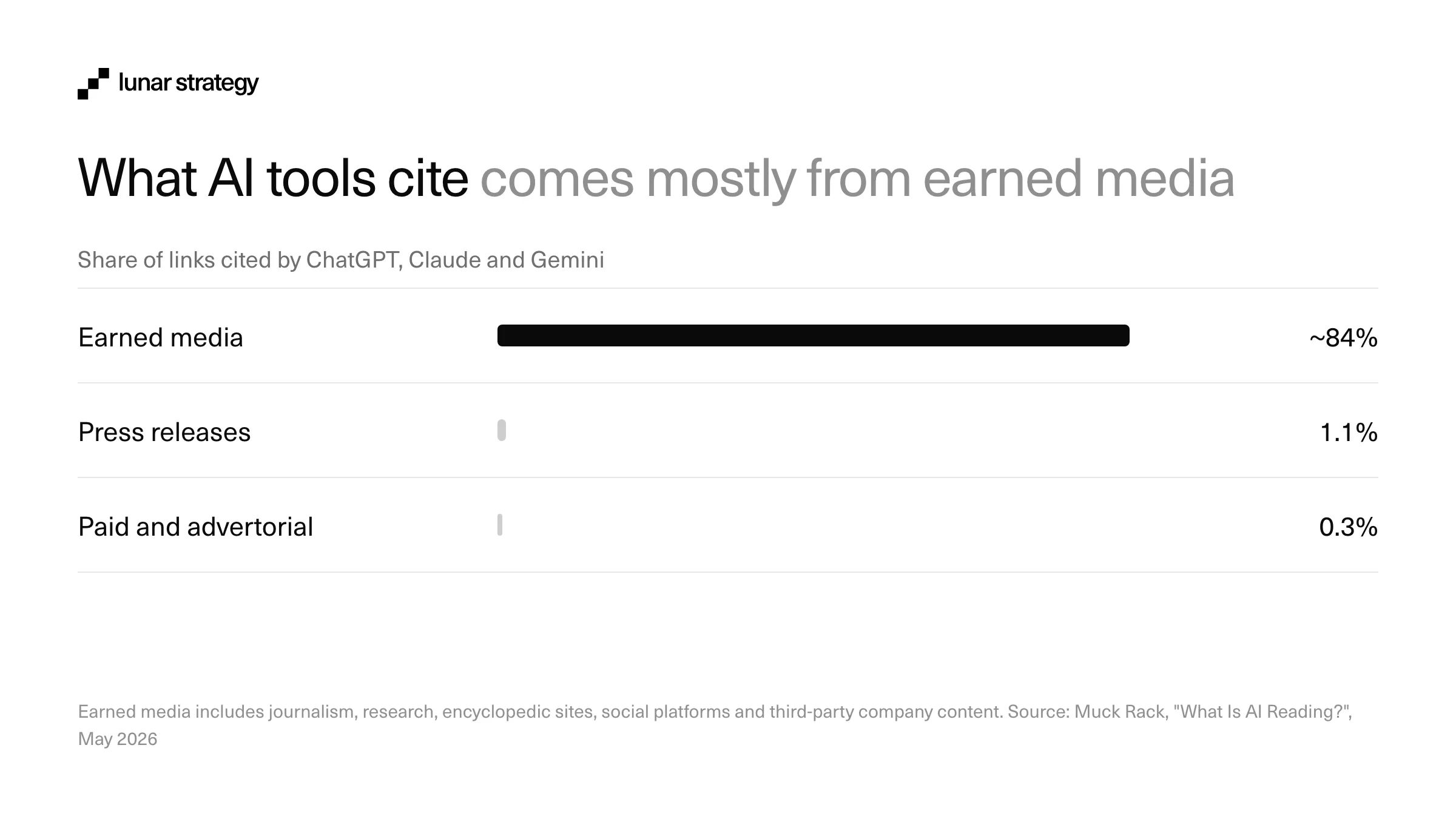
Most of those sources are earned. Muck Rack, a company that sells PR software, analyzed the links cited by ChatGPT, Claude and Gemini and reported in May 2026 that about 84% came from earned media: journalism, research, encyclopedic sites, social platforms and third-party company content. Journalism alone made up about 27%, and owned and paid content together about 16%. Finance questions, the closest category to crypto, cited journalism at 32%, the second-highest rate of the 17 sectors studied (Muck Rack).
One strong placement now pays off in four places:
- Rankings: Google says it uses links as a signal when judging the relevance of pages, and editorial links from sites in your category are the ones that count.
- Referral traffic: readers who click through from a feature arrive with context, often straight to your docs or app.
- AI visibility: brands named more often across the web get named more often in AI answers.
- Trust: an independent reporter describing your product carries weight that your own post on X can't match.
AI tools check a brand the way you would check a restaurant. You call the restaurant to ask about the kids' menu, and you ask someone who has eaten there whether it's any good. Facts come from the brand, judgments from third parties. Wikipedia and similar pages rest on published sources, press articles among them, so one story can reach an AI answer directly and again through the pages that cite it.
Two habits follow for a small team. Give one person ownership of the narrative, because AI tools look for agreement across sources, and the same story told in the press, on podcasts, on your site and on social gives them that agreement. Then find out which outlets AI tools cite in your category (a niche newsletter can matter as much as a national title) and pitch there first. Our guide to generative engine optimization covers the on-site side.
Trust matters most in crypto, because it is the first thing people ask an AI tool about.
In crypto, third parties write the verdict
People ask AI tools whether a project is safe before they connect a wallet, and the project's own site rarely settles that part of the answer. AI tools go to the website and docs for what a project does (features, fees, audits, terms) and to independent sources for whether to trust it. A founder can publish the best FAQ in the category and still have the verdict written by an exchange research page or a review site.
Each engine also reads a different mix. Google's AI Overviews sit on top of Google's own index and can pull in YouTube walkthroughs and Reddit threads, while ChatGPT and Perplexity run their own web searches and lean on the pages their crawlers can read. The sources fall into a few groups, each reached a different way:
| Source type | What AI takes from it | How to reach it |
|---|---|---|
| Exchange academies, blogs and research pages | Definitions, token basics and "what is" answers | Research partnerships, listing coverage, guest explainers |
| Crypto media and review sites | The "is it safe?" and "is it legit?" verdict | Data stories, expert commentary, founder interviews, fast corrections |
| Data aggregators | Numbers such as TVL, volume and supply | Accurate listings, with figures that match your docs |
| YouTube and podcasts | Walkthroughs and founder explanations | Podcast appearances and creator reviews |
| Reddit and forums | What users say after trying the product | Community work and honest replies to criticism |
Where AI answers about a crypto project get their material, and how to reach each source.
Your own site supplies the facts, and coverage supplies the opinions. Because every engine draws on a different mix, one press hit rarely covers them all. A campaign that reaches several source types gives every engine something to quote, which is why we plan crypto SEO and AI search and PR as one piece of work.
The tactics that earn coverage for a crypto project
Journalists are clear about what gets a pitch read. In Muck Rack's 2026 survey of 897 journalists, 70% said a pitch should show clear relevance to their beat, 58% wanted interview access to relevant sources and 40% valued original data or research. Only 14% wanted pre-written quotes (Muck Rack). Each tactic below delivers relevance, access or data.
| Tactic | What it gives a reporter | What you earn | Crypto example |
|---|---|---|---|
| Original data study | A finding nobody else has | Links to your data page, citations in trend stories | A quarterly report on stablecoin flows through your bridge, built from on-chain data |
| Expert commentary on the news | A qualified source, fast | Quotes and mentions in breaking stories | Your security lead explaining an exploit within hours, with the on-chain trail |
| Founder interviews and podcasts | Access to a decision-maker | Mentions, show-note links, YouTube citations | A founder on a DeFi podcast explaining the design choice behind a launch |
| Contributed articles | Ready-made expert analysis | A byline and usually an author link | An op-ed on what a new rule means for builders |
| Press releases | The official record of the news | Discovery by reporters, a source for facts | A funding round, mainnet date or audit result |
| Creator and KOL coverage | An audience that trusts the voice | Mentions on X and YouTube | A KOL walking through the product in a video |
Data studies earn the most durable links, because every later story that repeats the figure links back to its source. Crypto teams have unusually good raw material: on-chain activity is public, timestamped and verifiable, so a reporter can check your numbers in minutes. A study of where liquidity moved after an exploit, which chains users bridge to, or how long airdrop recipients hold their tokens gives a reporter a new angle on a story they already cover.
Commentary runs on speed. When a hack, a listing or a regulatory ruling breaks, reporters on deadline quote whoever answers first with something specific. Keep a short list of named experts on your team, each with a one-line bio and a clear area, and agree in advance on what they can say without a week of approvals.
Press releases put the facts of your news on the record, in one place, where reporters and AI tools can confirm dates and figures. Our guide to writing a crypto press release covers the format. The coverage itself comes from reporters who decide the news deserves a story.
Paid placements look similar and earn far less
Many "PR packages" sold to crypto projects are paid articles on crypto media sites. They buy guaranteed timing, a page you can share and sometimes real readers, and very little search value. Google's spam policies list advertorials with links that pass ranking credit, and links with optimized anchor text in press releases distributed on other sites, as link spam. Paid links are acceptable only when marked with rel="sponsored" or rel="nofollow" (Google Search Central).
AI tools give them little weight too: in the same Muck Rack study, press releases made up 1.1% of AI citations. Wires also carry a reputation risk. In February 2026, Semafor reported that several business news sites quietly took down articles about a study that tied crypto press-release wires to high-risk projects, after at least one executive asked for the takedowns (Semafor).
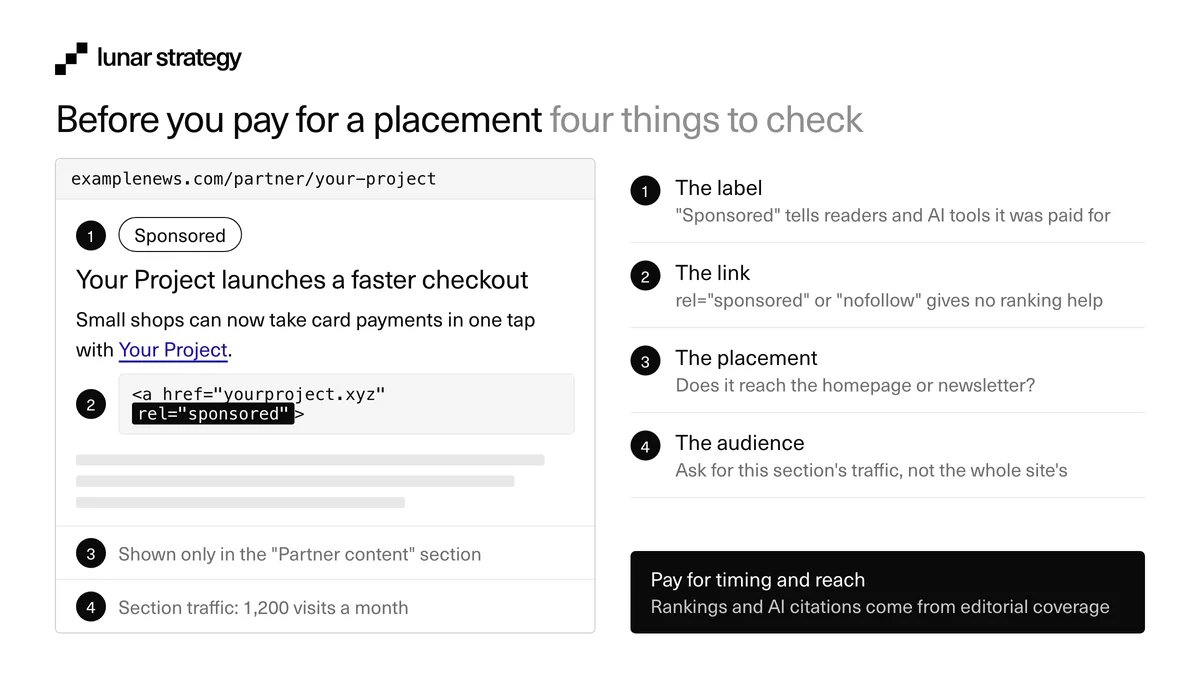
For a launch date you can't miss, paid placements still make sense. Buy them for timing and reach, label them honestly, and keep the earned work running alongside. Before you pay, check four things:
- The label: a "sponsored" or "press release" tag tells readers, and the AI tools that read the page, that it was paid for.
- The link: open the page source. A sponsored or nofollow attribute means the link passes no ranking credit.
- The placement: ask where the article will appear and whether it reaches the homepage or the newsletter.
- The audience: ask for traffic to that section or to similar sponsored pages. The domain's overall traffic tells you little.
How a campaign runs, from story to coverage
Start with a story a reporter would want even if your company weren't in it. Write the headline first, the way a reporter would, then check that data, an expert or access backs it up. If the headline only works with your token's name in it, it belongs on your own channels.
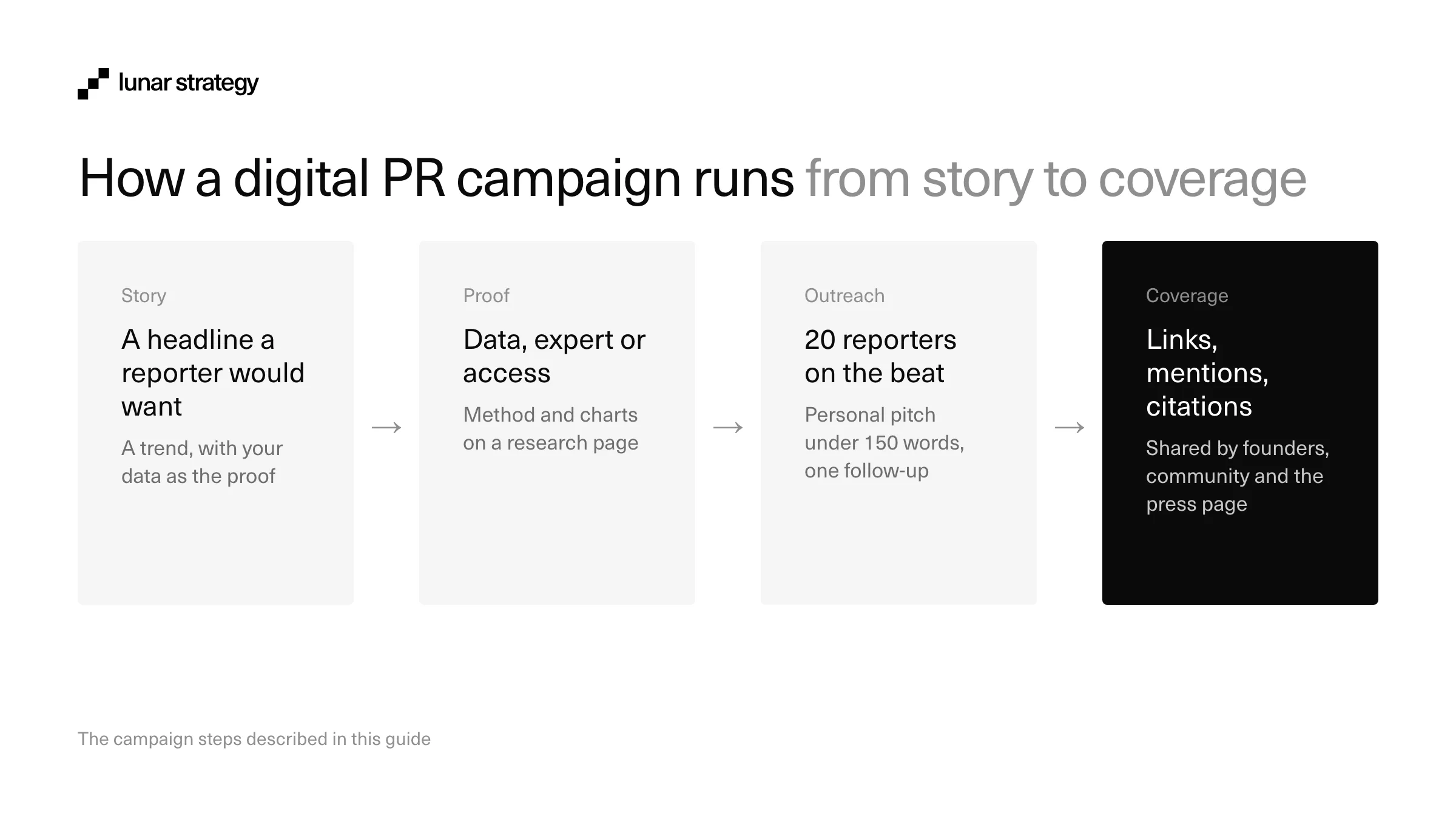
Take a hypothetical lending protocol on an Ethereum layer 2. Its team notices in its own data that liquidations cluster in the first hour after major macro announcements. They pull 12 months of on-chain liquidation data across the five largest lending markets on that chain, publish the method and the charts on a research page, and lead with one number. Then they write three versions of the pitch, for DeFi reporters, markets reporters and podcast hosts, each opening with what that audience cares about.
Outreach goes to a short list. Twenty reporters who covered liquidations or layer 2 lending in the last six months will do more for you than two hundred names from a database, and lists of the best crypto news websites help you find them. Each pitch is a personal email under 150 words, with the finding in the first line, a chart attached and an expert available that week. Send one follow-up a few days later with a new detail, then move on.
Before writing the email, test the story with three questions. Is it news, something that helps the reporter's readers understand what has changed, such as surprising data, a new trend or original research? Why this journalist? Read their recent articles and say up front why you thought of them. And why now? Marketers miss this one most: without a reason to run today, a strong story sits in an inbox until it's forgotten.
In crypto, that reason is usually already in the news or on the calendar: a hack, an ETF decision, a token unlock or a regulatory ruling.
A pitch that gets read covers these parts, in this order:
- Subject line: the finding, with its number, in one line.
- First sentence: the reporter's recent story on the topic, so the relevance is obvious.
- The finding: what you published and the one number that matters.
- Why their readers care: one sentence tied to the reporter's beat.
- What you can offer this week: the dataset and method, an interview with a named expert and charts they can use with credit.
Once coverage lands, share it from founder accounts, add it to your press page, give community moderators the link so they can answer questions with it, and keep the research page current so later stories cite the latest figure. Our guide on getting cited by ChatGPT and Perplexity covers the on-site work that helps AI tools connect the coverage to your project.
How to measure results
Check four levels every month: the coverage itself, its effect on search, its effect on AI answers and its effect on the business. A strong data story keeps earning links and mentions for months as other writers cite it.
| Metric | Why it matters | How to check |
|---|---|---|
| Editorial placements | Coverage an editor chose to run, weighted by how relevant the outlet is | A coverage log with outlet, date, link and link attribute |
| Referring domains from relevant sites | Links Google can count, from sites in your category | Ahrefs, Semrush or the Links report in Google Search Console |
| Brand mentions | Signals Google and AI tools read, with or without a link | Mention alerts in Google Alerts, Ahrefs or Brand24 |
| Referral traffic and actions | Readers who arrived from coverage and did something | GA4 referral sources, plus sign-ups, wallet connections or docs visits |
| AI mentions and citations | Whether ChatGPT, Perplexity and AI Overviews name and cite you | A fixed list of 20-30 prompts run every month (tools for this) |
| Branded search | People searching your name after coverage | Queries containing your brand in Google Search Console |
Placement counts alone say little: ten paid articles with sponsored links can move fewer of these numbers than two editorial features that link to a data page. Run the AI prompt list before a campaign to set a baseline, then again 60 and 90 days after the main coverage lands.
Where to start this quarter
Start with what you already have: the coverage and links you've earned, the questions people ask AI tools about your category, and product data nobody has published yet. Then, in order:
- Pick one story with a number behind it and publish it on a research page on your own site.
- Build a list of 20-30 reporters, podcast hosts and creators who covered that topic in the last six months.
- Name two or three spokespeople, write their one-line bios and agree on what they can comment on.
- Pitch, follow up once, and log every placement with its link and link attribute.
- Compare your AI prompt results from before outreach with the results 60 days later.
One well-run story per quarter, plus fast commentary when news breaks in your sector, builds the record that search engines and AI tools rely on.
How Lunar Strategy approaches digital PR
Lunar's PR service starts with a strategy session and research into your market to define story angles. We then draft articles, design visuals and pitch tailored stories to journalists and editors at crypto and tech publications, coordinate the timing of placements, amplify them through supporting channels and close with a report on placements, traffic and sentiment, with recommendations for the next round.
We've worked with more than 400 crypto teams, and we run PR in the same team as SEO and AI search and KOL campaigns. The story a reporter covers is the one that lands on the research page, on the founder's X account and in the prompts we track in AI answers. For Cardano, we ran a 3-month campaign that paired KOLs amplifying key narratives with PR articles on Cardano's use cases and DeFi initiatives. The Cardano case study reports 12 DeFi and use-case articles and an estimated 120,540 views. If you're weighing your options, our list of the best crypto PR agencies compares the field.
Or book a call and bring the story you want covered: we'll tell you which outlets and angles fit it.
Frequently Asked Questions
Is digital PR the same as link building?
Link building covers any effort to get other sites to link to yours, including guest posts, resource-page outreach and fixing broken links. PR earns links through stories and data that editors choose to cover, and it also produces unlinked mentions and AI citations, which link building doesn't aim for. The two overlap only in part.
Do press releases help SEO?
Distributed press releases pass little ranking value. Google lists links with optimized anchor text in press releases distributed on other sites as link spam. Their value is the record: reporters find the news, and AI tools can confirm dates and figures from it. Editorial links come from the reporters who turn that news into their own story.
How long does digital PR take to show results?
Coverage can land within days of a pitch. The search effects build over weeks, as Google recrawls the linking pages and other writers cite the story. Plan in quarters: one or two strong stories per quarter, measured 60-90 days after each, gives a fair read on links, mentions and AI citations.
What is an unlinked brand mention?
A page that names your project without linking to it. Unlinked mentions still build recognition with readers and give Google and AI tools evidence that your brand belongs in a category. When the mention sits on a site you have a relationship with, a short note asking for a link to the relevant page often converts it.
Can a pre-launch crypto project do digital PR?
Yes, if it has something new to say. Early teams lack a track record, so they lean on founder expertise, technical insight and data from testnets or research. Podcasts, newsletters and niche crypto media are realistic first targets, and each placement makes the next pitch easier because reporters can see someone else has covered you.
Should you hire an agency for digital PR?
It depends on whether your team has reporter relationships and the time to pitch every week. An agency brings media lists, writing capacity and timing; an in-house lead keeps the story close to the product. Our guide on whether you need a crypto PR agency walks through the trade-offs.
Tim, Jack or Luka



Free strategy call
20 min
Whether you need help with GTM or other marketing, we give you a first strategy and advice on a free 20-minute call.
Book a callRated 4.9/5 on Clutch