What is a crypto airdrop, and how does it work?
A crypto airdrop sends free tokens to eligible wallets. Why airdrops exist, how users take part, how projects build one and the famous cases.
- Written by
- Shann HolmbergManaging Partner
- Published
- Reading time
- 15 minutes
- Topic
- Token launch

Contents
Free tokens are one of the oldest ideas in crypto, and the amounts involved keep growing. In December 2025, the trading platform Lighter gave away tokens worth $675 million in a single airdrop, the tenth largest in the industry's history, according to CoinGecko figures reported by Cointelegraph. Money on that scale attracts real users, professional farmers and scammers to the same claim page.
Every airdrop is a trade. The project gives up part of its token supply, and in return it wants something from the people who receive it: real use of the product, feedback while it is still rough, attention or ownership spread across many wallets. Once you know what a project is paying for, the rest makes sense: who qualifies, why the rules are strict and why so many tokens get sold soon after the claim.
This guide is for newcomers checking their first eligibility page and for founders planning a token. It covers what an airdrop is, why projects run them, how users take part, how projects build one, the cases everyone learns from and how we work on airdrops at Lunar, starting with the definition.
What is a crypto airdrop?
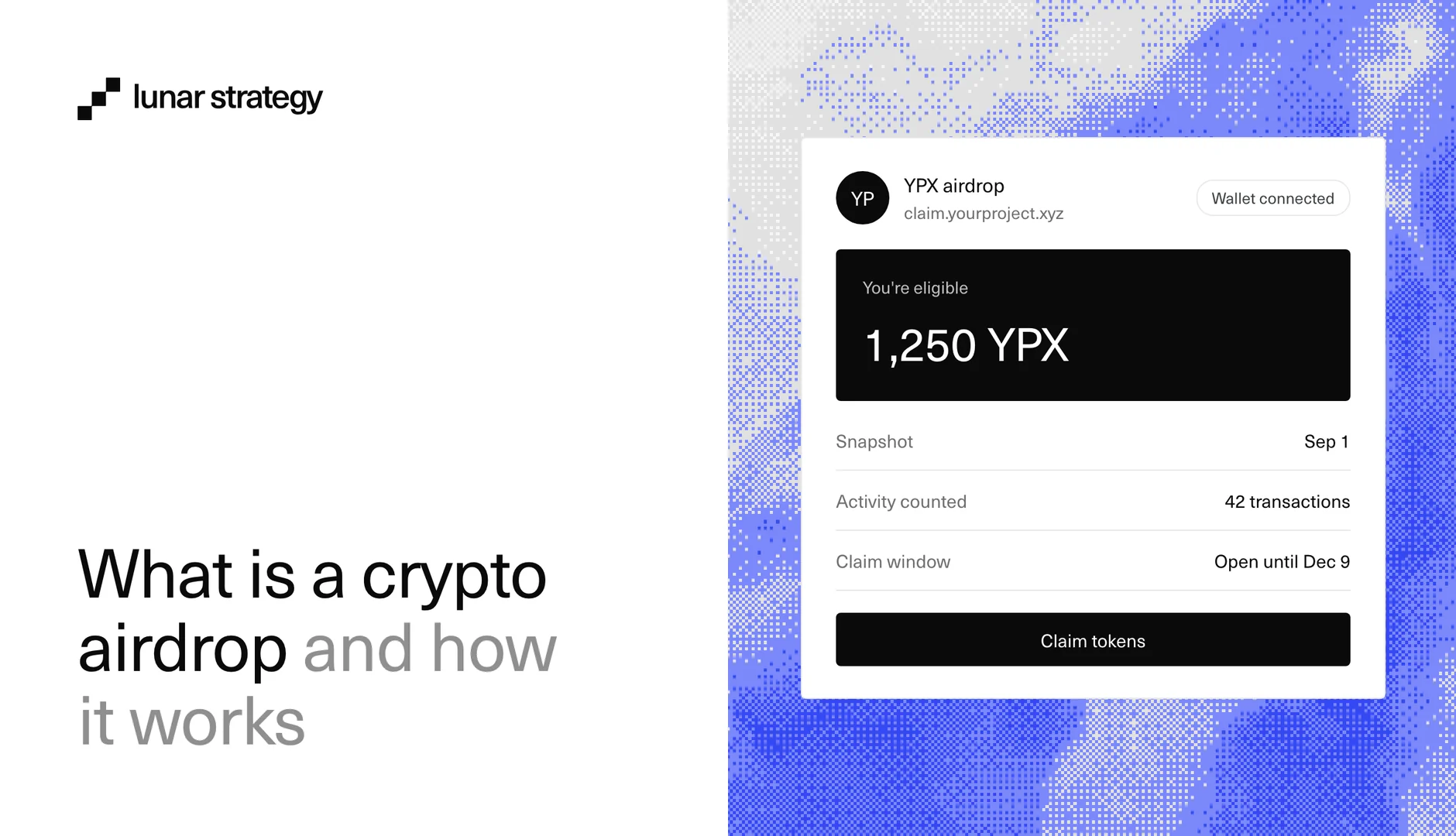
A crypto airdrop is a distribution of free tokens or coins from a blockchain project to many wallet addresses at once. The project decides who qualifies, usually early users of its product or holders of another token, then sends the tokens directly or lets those wallets claim them through its website.
Projects can do this because public blockchains are open records. Every wallet's history is visible, so a team can list the addresses that used its app, held a certain coin or provided liquidity before a given date, and reward exactly those addresses. No sign-up form is needed.
The tokens given away come out of the total supply, so they sit next to the team's and investors' shares in the token plan, which our guide to tokenomics for founders explains. That is also why most airdrops happen at or near a token generation event (TGE), the day a token is created and starts trading.
People usually get a new token in one of three ways, and an airdrop asks the least of them up front:
| Factor | Airdrop | Token sale | Points program |
|---|---|---|---|
| What you give | Nothing, or activity you already did | Money, usually stablecoins or another token | Ongoing activity scored over weeks or months |
| What you get | Tokens, often claimable at the TGE | Tokens at a set price, often locked for a period | Points that may later convert into tokens |
| Who decides the amount | The project, using wallet data | The buyer, within the sale's limits | The project's formula, sometimes published |
| Main risk for you | Fake claim pages and a low price at launch | Losing the money you paid | Time and fees spent for an uncertain reward |
Why do airdrops exist?
A new crypto product has the same problem on the day it goes live: it needs people. It needs users to try the app while it still has bugs, developers to build on it, early fans to talk about it and holders to spread out control of the network. Before it has revenue, a token is the one thing the project can offer all of them, and an airdrop is how it hands that token to the people who showed up first.
Testing is the first reason. Before Linea launched its mainnet in 2023, its testnet campaign, Linea Voyage, saw 5.5 million unique wallets make more than 47 million transactions in three months (Consensys). A testnet is a practice version of a network where tokens have no value, so mistakes cost nothing. No internal team could run a test that size. In September 2025, Linea's airdrop sent 9.36 billion LINEA to 749,662 addresses, rewarding the people who took part in Voyage and a later liquidity campaign (The Block).
Starknet wrote the same idea into its 2024 airdrop rules. It gave tokens to early users who, in its words, "hardened the network by providing feedback on Mainnet prototypes," and to developers with at least three commits to Starknet code on GitHub (Starknet). Early adopters find the bugs, report what is confusing and show the team which features people actually use. The airdrop pays them for that work after the fact, and it tells the next wave of users that helping early is worth it.
The other reasons follow from the same idea: pay the people whose help the product needs.
| Goal | What the airdrop rewards | Example |
|---|---|---|
| Test the product with real users | Using a testnet or an early version, and reporting problems | Linea Voyage testers, rewarded in the 2025 LINEA airdrop |
| Reward early adopters and builders | Past use of the app and code contributions | Starknet's 2024 airdrop to early users and GitHub developers |
| Spread ownership | A share for thousands of wallets, so no small group controls governance votes | Hyperliquid's 2024 airdrop, with no share for private investors |
| Bring in new users and attention | Activity on other networks or in other communities | Monad's 2025 airdrop to users of other crypto communities |
| Start trading and liquidity | Providing liquidity and holding the token | Linea's Surge campaign, which rewarded liquidity providers |
Those goals pull in different directions, and the design of each airdrop shows which one the team picked. When we work on a token launch, our go-to-market team audits the token's utility, points and airdrop mechanics and plans for the selling that follows, because a drop built for awareness attracts a different crowd from one built to reward loyal users. The people an airdrop attracts tend to do what the rules pay for, and little more.
How can users take part in an airdrop?
Users take part in one of two ways. The first is to qualify for something you already did: you used an app, held a coin or provided liquidity before the snapshot, a record of wallet balances or activity at one moment, often a date or block chosen in secret. The second is to earn a place on purpose, by testing a new network, collecting points or completing tasks while the project is still building. The type of airdrop tells you which route is open:
| Type | How you qualify | Example of what counts | What to watch |
|---|---|---|---|
| Retroactive | Past use of a product before anyone knew a token was coming | Trading, lending or bridging on the app | You can't qualify after the snapshot |
| Holder | Hold a specific token at the snapshot | Holding a network's native coin in your own wallet | Coins held on an exchange may not count unless the exchange takes part |
| Testnet | Use the practice version of a network before launch | Sending transactions and trying apps on the testnet | Testnet activity is easy to fake, so filters are strict |
| Points-based | Earn points for chosen actions over a season; points later convert into tokens | Hyperliquid paid out points weekly for about a year before its November 2024 airdrop | The conversion rate is often unknown until the end |
| Task-based (bounty) | Complete promotional tasks such as posting or referring friends | Sharing a post on X or joining the project's community | Low value per person and many fake accounts |
| Contributor | Chosen by hand: builders, ambassadors, active community members | Members of a web3 ambassador program | Small and invite-only |
| Standard (registration) | Sign up with a wallet address before a deadline | Submitting an address on the project's site | The easiest type for scammers to copy |
Retroactive and holder airdrops reward what already happened, so there is nothing left to do except check. Testnet, points and task airdrops reward what people do next, which also makes them the main target of airdrop farmers: people who use a product only to collect tokens, often across hundreds or thousands of wallets. Many of the rules projects set exist because of them, so the safest way to qualify is to use a product the way it is meant to be used, over weeks rather than in one burst.
Once an airdrop is announced, taking part follows the same steps:
- Follow the official channels. The rules, dates and checker link come from the project's website, blog and verified X account.
- Check eligibility. Paste your wallet address into the official checker to see whether you qualify and how many tokens you get.
- Claim inside the window. Connect the wallet that qualified, check the amount and sign the claim transaction, usually paying a small network fee called gas. Some airdrops send tokens straight to wallets with no claim.
- Check how the tokens unlock. Some tokens can be sold right away; others stay locked for a period, so read the terms before you sign.
A wallet that looked eligible can still miss out. Many airdrops require a minimum score or activity spread over weeks, so a single transaction rarely qualifies. Some claim pages block certain countries: in a March 2025 report, the venture firm Dragonfly found that 11 of the 12 large airdrops it studied used geoblocking to restrict US residents (Decrypt). Some projects also add choices at the claim, such as Plume's 33% boost for claiming and coming back to its network, or 66% for deferring the claim (Plume).
How to stay safe from airdrop scams
Fake airdrops are the most common way people lose money around this topic, because the format asks you to connect a wallet and sign something. Scam Sniffer, a firm that tracks wallet-draining phishing, counted $83.85 million stolen from 106,106 victims on Ethereum and similar networks in 2025, as Decrypt reported. Most of these attacks trick people into signing a message that looks harmless but gives the attacker permission to move their tokens.
Attackers also go where the real announcements are. Shortly before Monad's claim portal opened in October 2025, scammers bought Telegram ads that appeared inside Monad's official announcement channel and copied the claim page (Cointelegraph). The co-founder's warning to users fits every airdrop:
"Do not act with urgency, and always triple-verify before doing anything."
Keone Hon, co-founder, Monad, October 2025
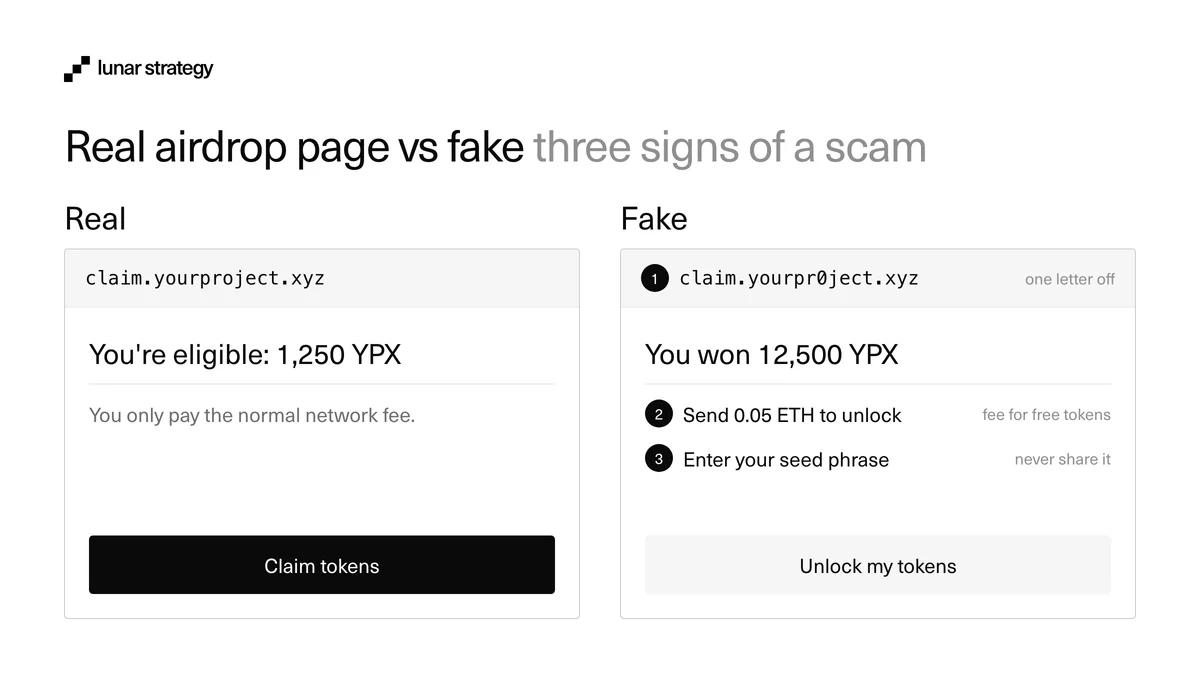
Most airdrop scams show at least one of these signs:
- A fee to unlock free tokens: a real airdrop never asks you to send crypto first. The only cost is the gas fee on a claim transaction you sign yourself.
- A request for your seed phrase: the seed phrase (the 12 or 24 words that back up your wallet) gives full control of it. No project, checker or support agent needs it.
- Unknown tokens in your wallet: some arrive with a link to a "claim" site that leads to a wallet drainer. Leave them alone.
- Urgency and look-alike links: countdown timers, direct messages from "support" and web addresses one letter off from the real one.
- Signatures you can't read: requests for unlimited spending approval or unclear permits are how drainers empty a wallet in one step.
A separate wallet for claims limits the damage if something goes wrong. Long-term holdings can stay in another wallet, such as a hardware wallet, so a fake claim page can reach only the small balance kept for gas.
How can projects implement an airdrop?
For a project, an airdrop is a series of design choices, and each one decides who receives tokens and what they do next. People do what the rules pay for. Reward a single transaction and you get thousands of single transactions; reward months of real use and you get fewer, more loyal holders. Most teams work through the same steps, in this order:
- Set the goal and the budget. Decide what the airdrop should pay for (testing, regular use, wide ownership or liquidity) and what share of the supply it gets.
- Choose what counts. Pick the actions that earn tokens, such as using the app, testing on a testnet, holding a coin or providing liquidity, and decide whether every wallet gets the same amount or rewards grow with activity.
- Take the snapshot. Record wallet activity at a cut-off date, usually kept secret so people can't game the last few days.
- Filter out fake wallets. Remove sybils, which are many wallets run by one person to collect more than one share, and give real users a way to appeal.
- Publish the checker and open the claim. Announce one official link, the claim window and what happens to tokens nobody claims.
- Plan the unlocks and what comes next. Decide whether tokens can be sold on day one or unlock over time, and measure how many recipients keep using the product.
Uniswap's airdrop in September 2020 is the textbook case of the simplest design. The team took a snapshot ending on September 1, 2020, and made 400 UNI claimable by every address that had ever used its v1 or v2 contracts: 251,534 addresses in total, including about 12,000 that had only sent failed transactions (Uniswap Labs). A wallet that had traded once received the same amount as a heavy trader. Most later airdrops scale the reward to how much each wallet did, and they spend far more effort on filtering.
Filtering is now where much of the work goes. Before its airdrop, Linea worked with the analytics firm Nansen and initially flagged 516,960 of 1,297,203 eligible addresses, about 40%, as sybils, then let flagged users appeal (The Block). The claim design matters too. Monad's claim window ran from October 14 to November 3, 2025, and claimed tokens stayed in escrow until its public mainnet launch on November 24. About 70.4% of the tokens were claimed, by 76,021 wallets, and the rest went to future ecosystem programs (Monad).
Our guide to airdrop marketing goes through each decision in depth, from sybil filters to unlock designs and measuring the users who stay. The airdrop also has to fit the launch calendar, explained in what a TGE is in crypto, and the demand-building before it, set out in our 90-day pre-TGE playbook.
Famous airdrop examples
A handful of airdrops shaped how the rest are designed, and their numbers show the gap between claim day and the months after:
| Airdrop | What happened | What it shows |
|---|---|---|
| Hyperliquid (HYPE), November 2024 | Users received 31% of the total supply, with nothing set aside for private investors or market makers (Decrypt) | A large community share is possible when the product already has users and revenue |
| Monad (MON), October 2025 | The airdrop reached nearly 225,000 users of other crypto communities and 5,500 Monad community members, with strict filters against bots (Decrypt) | An airdrop can also target active users of other networks |
| Berachain (BERA) and Linea (LINEA), 2025 | Two of the year's largest airdrops. By mid-December 2025, BERA had fallen about 96% from its peak and LINEA about 85% (Decrypt) | The size of an airdrop says little about the token's price months later |
| Lighter (LIT), December 2025 | A day after the airdrop, about 75% of recipients still held their tokens and 7% had bought more, according to on-chain analyst Arndxt (Cointelegraph) | Holding on day one is a good sign, but it proves little about month three |
The broader pattern is selling. In its June 2026 State of Token Markets report, the research firm Delphi Digital found that across the largest airdrops, between 78% and 94% of recipient wallets had sold most of their allocation within 90 days. Part of it is people cashing a free gain and part is farms that never meant to use the product. Either way, a large share of an airdropped supply usually reaches the market in the first weeks after the claim opens, so the product and the story around it have to give recipients a reason to stay.
How Lunar Strategy approaches airdrops and token launches
We've worked with more than 400 crypto teams since 2019, and in our token launch program the airdrop is planned as part of the launch, next to the narrative, community, creators and PR that bring the right people to the product. The program runs for 90 days, from the plan to the week after the TGE, and starts three to six months before the token goes live.
For Avalon Labs, a CeDeFi lending platform, we ran PR and 15 creators in a 16-day sprint up to its TGE. The Avalon Labs case study reports 913K+ impressions and 6.7K+ engagements in those 16 days, the kind of attention an airdrop needs around it so recipients meet a story worth staying for.
Explore our token launch program →
Or book a call and share your token plan and launch date: we'll tell you which parts of the airdrop we'd look at first.
Frequently Asked Questions
Is a crypto airdrop the same as Apple's AirDrop?
No. Apple's AirDrop is a feature for sending photos and files between nearby iPhones, iPads and Macs. A crypto airdrop is a distribution of tokens to wallet addresses on a blockchain. The two only share a name, which is why a search for "airdrop" often shows iPhone help pages before anything about crypto.
Do you have to pay to receive an airdrop?
A real airdrop never asks you to pay the project. The only cost is the network fee, called gas, for the claim transaction you sign yourself, and some airdrops arrive without any claim at all. Any page that asks you to send crypto first, or to pay a "release" or "verification" fee, is a scam.
What is airdrop farming?
Airdrop farming means using a product only to qualify for future tokens, often with many wallets at once. At scale it is an industry: in November 2025, a single entity claimed about 60% of the aPriori airdrop through 14,000 linked wallets, each funded from Binance with 0.001 BNB (Cointelegraph). Projects respond with sybil filters and minimum activity rules.
Are crypto airdrops taxed?
In many countries they are, and the rules depend on where you live. In the US, the IRS treats tokens from an airdrop after a hard fork as ordinary income once you can move or sell them. In the UK, HMRC charges Income Tax when an airdrop is received in return for a service, and Capital Gains Tax may apply when you sell.
Are crypto airdrops legal?
In most places, giving tokens away is allowed, and regulators have started to address it directly. In March 2026, the US SEC said airdrops of tokens that aren't securities, where recipients give nothing in return, don't need registration. In the EU, MiCA's public-offer rules don't apply to crypto-assets offered for free, unless recipients hand over personal data or the issuer gets something in return.
How do you find upcoming airdrops?
Projects announce airdrops on their official website, blog and X account, often after months of signals such as a points program or a test network. Many people also follow crypto news sites and community discussions. Treat any list of "upcoming airdrops" as a lead to confirm on the project's own channels before you click anything.
Tim, Jack or Luka



Free strategy call
20 min
Whether you need help with GTM or other marketing, we give you a first strategy and advice on a free 20-minute call.
Book a callRated 4.9/5 on Clutch