What is llms.txt, and does a crypto project need one?
llms.txt is a text file that points AI tools to your key pages. What it is, who reads it (Google Search doesn't) and when a crypto project should add one.
- Written by
- Pedro Freitas
- Published
- Recently updated
- Reading time
- 10 minutes
- Topic
- AI search and SEO

Contents
- 1What is llms.txt?
- 2What problem llms.txt tries to solve
- 3How the file is structured
- 4Do Google, ChatGPT and Perplexity read llms.txt?
- 5Does a crypto project need llms.txt?
- 6How to write an llms.txt file for a crypto project
- 7Where to start
- 8How we approach AI search for crypto projects
- 9Frequently Asked Questions
In May 2026, Ahrefs studied the server logs of 137,210 websites and found that about 28% of them published an llms.txt file. Of those files, 97% received zero requests that month, from bots or from people. Thousands of teams added the file because AI search advice said it would help them appear in ChatGPT or in Google's AI answers, and almost nothing came to read it.
The file still has a real job, only a narrower one than most guides promise. It gives AI agents and developer tools a clean map of a site once they are already there, and for crypto projects that map can carry the official facts that scammers copy. This guide is for founders and marketing teams of crypto projects who keep hearing about the file and want a straight answer before they spend time on it.
It covers what the file is, how it is built, who reads it in November 2026, and when it makes sense for a crypto project.
What is llms.txt?
llms.txt is a plain text file, written in Markdown, that sits at the root of a website and gives large language models (LLMs, the AI models behind tools like ChatGPT and Claude) a short summary of the site plus links to its most useful pages. Markdown is a simple text format where "#" marks a heading and "-" marks a list item, so both people and AI models can read it easily.
Jeremy Howard proposed the file on the Answer.AI blog on September 3, 2024. The full specification lives at llmstxt.org, which describes the goal as giving AI tools "concise, expert-level information gathered in a single, accessible location." No standards body has approved it, and no AI company has committed to reading it, so it is best described as a convention some sites follow.
The name copies robots.txt, which is why many people assume the two files work the same way. They do different jobs. The proposal says the file can "complement robots.txt", and that a sitemap, which lists every page for search engines, is no substitute for it, because a sitemap doesn't explain what each page is for.
| File | What it does | Who it is for | Does Google Search use it? |
|---|---|---|---|
| robots.txt | Says which crawlers may visit which parts of the site | Every crawler, including AI crawlers | Yes, it controls crawling |
| sitemap.xml | Lists every page you want indexed | Search engines | Yes, as a discovery hint |
| llms.txt | Summarizes the site and points to a few key pages, in Markdown | AI models and AI agents | No, Google says Search ignores it |
What problem llms.txt tries to solve
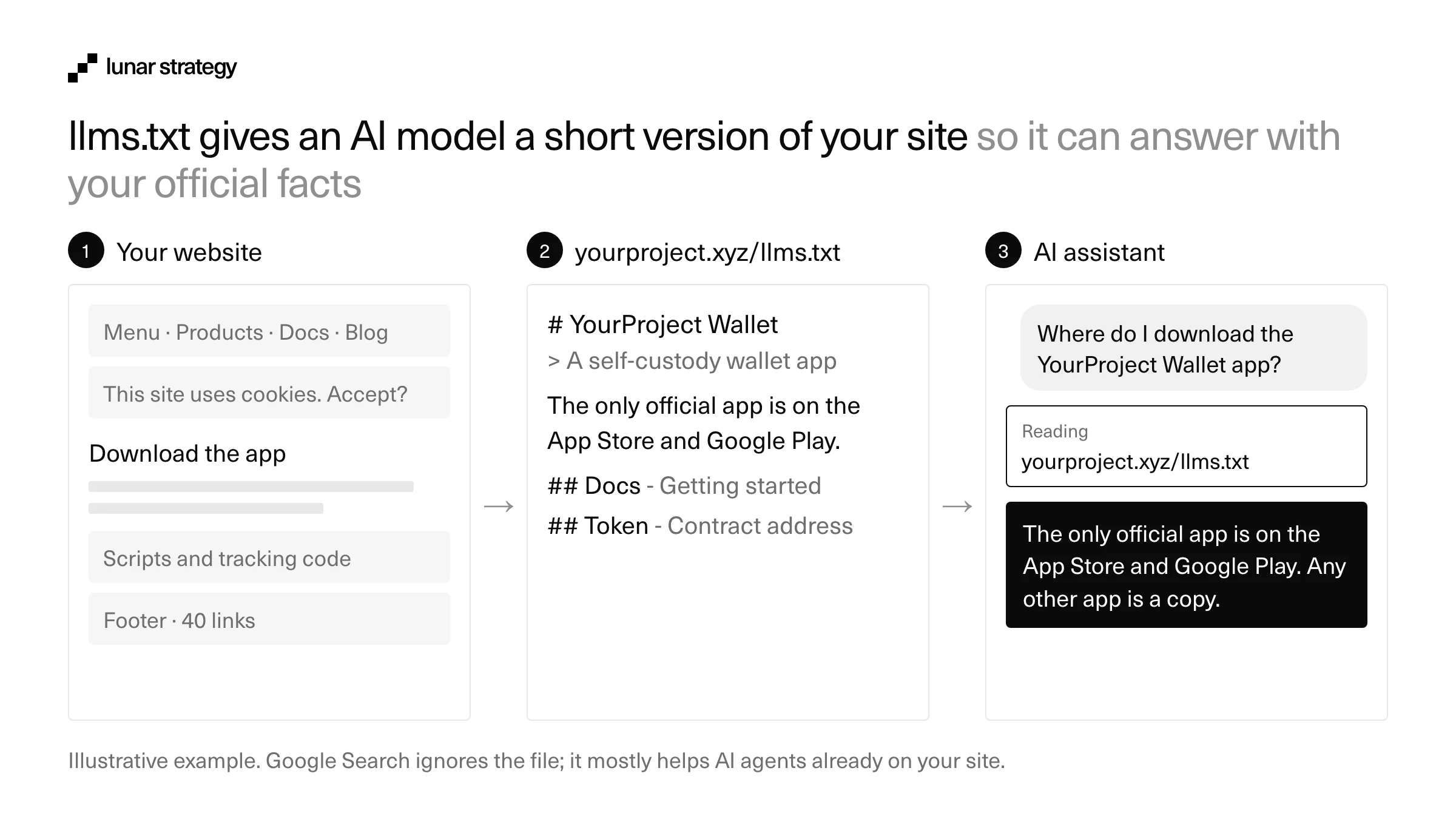
Web pages are built for people. A typical page wraps its text in menus, cookie banners, scripts and ads, and an AI model that reads it has to strip all of that out first. The proposal argues that this cleanup is hard to do well, and that an AI model's context window (the amount of text it can read at once) is still "too small for most websites in their entirety." The file is meant to hand the model a short, clean version instead.
The proposal names three problems that make websites hard for AI tools to use:
- Clutter: the useful text is mixed with navigation, scripts and layout code that the model has to remove.
- Size: a large site does not fit into one AI session, so the model needs to know which pages matter most.
- Choice: without guidance, a tool has to guess whether to read the sitemap, the docs or the blog, and it often picks badly.
Crypto sites tend to have all three problems at once. Many are single-page apps (sites that build each page in the browser with JavaScript), the docs often live on a separate subdomain, and the facts users ask about most, such as which app or contract address is official, sit in a footer, a docs page or a pinned post on X. A short file that lists the official pages in one place is a sensible idea for that kind of site, whatever any AI tool does with it today.
How the file is structured
The proposal defines a fixed order for the file, and only the first part is required. Everything else is optional, but the format works best when it is short and written in plain words: a title, one sentence on what the project is, a few lines of context, then grouped lists of links with a short note after each one.
| Part | Required? | What it holds | Example for a crypto wallet app |
|---|---|---|---|
| Title (an H1, the "#" line) | Yes, the only required part | The project or site name | YourProject Wallet |
| Summary (a quote line, ">") | No | One or two sentences on what the project is | A self-custody wallet for phones and browsers, built by YourProject Labs |
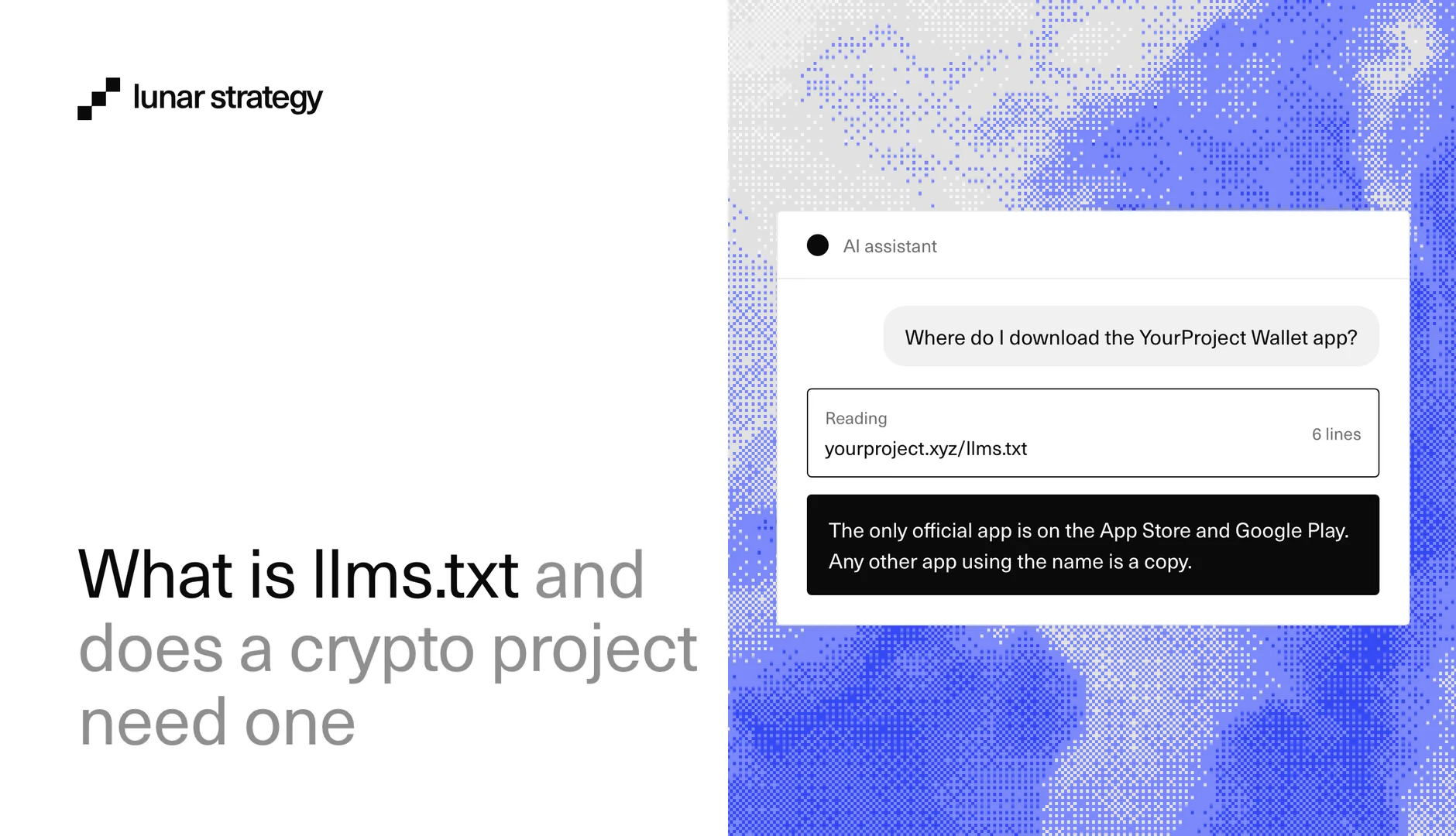
| Context paragraphs | No | Key facts and rules an AI should know, with no headings | The only official app is on the App Store and Google Play; support never asks for a recovery phrase |
| Link sections (H2, "##") | No | Lists of links, each with a short note | Docs, Security, Token, Support |
| "Optional" section | No | Links an AI can skip when it is short on space | Blog, brand kit, press page |
Two related ideas often come up next to the file. The proposal also suggests offering a clean Markdown copy of each important page at the same address with ".md" added at the end. Some platforms add a second file, llms-full.txt, which holds the full text of every docs page in one document, so an AI tool can load it all at once. Mintlify, for example, creates both files automatically for the documentation sites it hosts.
Do Google, ChatGPT and Perplexity read llms.txt?
Google has answered in writing, and the answer is no. Its guide to AI features in Search says you don't need "AI text files" or Markdown to appear in Search, including its AI Overviews and AI Mode, "as Google Search itself doesn't use them." It adds that creating the file for other services is fine, and that doing so "will neither harm nor help" your visibility, "as Google Search ignores them."
John Mueller, a Search Advocate at Google, has been blunter. In April 2025 he wrote on Reddit that no AI service had said it used the file and that server logs showed they didn't even check for it, as reported by Search Engine Journal. He compared it to the keywords meta tag, an old HTML tag where sites described themselves and which search engines learned not to trust:
"To me, it's comparable to the keywords meta tag."
John Mueller, Search Advocate, Google
The AI companies themselves publish the file for their own docs but say nothing about reading it on other sites. OpenAI's crawler documentation explains that sites control access through robots.txt rules for OAI-SearchBot (the crawler behind ChatGPT search) and GPTBot (its training crawler), and Perplexity's crawler page also points site owners to robots.txt. Neither page, nor Anthropic's help article on its crawler, says the bots use llms.txt.
| Company | Publishes a file for its own docs? | Says its search or crawler uses other sites' files? |
|---|---|---|
| Yes, for Google AI Studio | No: Search "ignores them" | |
| OpenAI | Yes | No mention; access is set in robots.txt |
| Anthropic | Yes | No mention |
| Perplexity | Yes | No mention; access is set in robots.txt |
Independent data points the same way. In the Ahrefs study, the AI bots that fetch pages live to answer ChatGPT and Perplexity questions made only about 1.1% of the AI bot requests for these files, and the biggest AI fetchers were GPTBot and Claude Code, Anthropic's coding assistant. A separate SE Ranking study of nearly 300,000 domains found the file on 10.13% of them and "no correlation" between having it and being cited in AI answers.
The clearest sign of where the file is useful comes from Chrome. Lighthouse, Google's free site-audit tool, now checks for the file as part of an experimental group of checks for AI agents that browse websites, and marks a missing file as "not applicable." That fits what Mueller said on Google's Search Off the Record podcast in June 2026: the file can't help AI systems choose between websites, though it may help an automated system that is already on yours, Search Engine Journal reported.
So the file is read by coding agents and audit tools, and almost never by the systems that decide which brands an AI answer names.
Does a crypto project need llms.txt?
No crypto project needs the file to rank on Google or to be cited by ChatGPT and Perplexity, and the evidence above says it won't change either. It is still worth an hour of work in a few situations, all of which involve an AI agent that is already looking at your project and needs the official facts quickly:
- You have developer docs. Builders now use coding assistants that read docs for them, and Ahrefs found coding agents among the most frequent readers of these files. A clean index helps them find your SDK or contract docs instead of guessing.
- Scammers copy your brand. A file that lists the official app, domains, social accounts and token contract addresses (the onchain ID of your token) gives an AI agent one place to check them.
- AI agents act on your product. Wallets, exchanges and payment apps are starting to serve agents that trade or pay for users, and Coinbase already publishes a file written "for AI agents and automated tools".
The file also has a cost when it goes stale. It is self-reported, so AI systems can't trust it for ranking, as Mueller put it, and a file that still lists an old contract address or a retired app is worse than no file at all. Keep only public facts in it, make every fact match your site and docs, and treat it as part of your release checklist.
A small marketing site with ten pages and no docs can skip it and lose nothing. When we audit crypto sites, the file comes near the end of the list. The audit first checks whether each AI crawler can read the key pages, whether those pages load without JavaScript and whether the project's facts match across the site, the docs and its profiles, and the Web3 sites we audit typically have 5-10 critical issues before anyone gets to optional files.
How to write an llms.txt file for a crypto project
Start by checking whether your docs platform already publishes a file, then decide whether the main site needs its own. A docs file usually lists every page automatically, while a main-site file should be written by hand and stay short: one sentence on what the project is, a few lines of rules, and 10-30 links grouped by what a user or agent would look for. Copying the whole sitemap defeats the purpose.
Write the notes after each link in plain words and say exactly what the page answers: "audits and bug bounty" tells an agent far more than "learn more". Save it as a plain text file named llms.txt at the root of the domain, so it opens at yourproject.com/llms.txt, and give each subdomain that has its own audience, such as docs, its own file. Free generators exist, but for 20 links writing it yourself takes less time than cleaning up a generated one.
| What to include | Where it usually lives today | Why an AI agent needs it |
|---|---|---|
| One-sentence summary | Homepage headline | Tells the agent what the project is before anything else |
| Official app and domains | Footer, app store pages | Lets the agent tell the real app from copies |
| Docs and developer quickstart | docs subdomain | Points coding assistants to the right starting page |
| Token facts: ticker and official contract address per network | Docs, token page, block explorer | Prevents agents from repeating a fake address |
| Security: audits, bug bounty, official support channels | Security page, docs | Answers "is this project safe?" with your own sources |
| Optional: blog, brand kit, press | Blog, media page | Extra context an agent can skip when short on space |
Review the file every time one of these facts changes, the same way you would update the website. Some teams also check their server logs once a month to see which bots request the file, which turns a guess into data for your own site.
Where to start
Put the file last on the list, after the work that changes whether AI tools read and quote you. Check that your robots.txt allows the AI crawlers you want, such as OAI-SearchBot, PerplexityBot, Googlebot and Bingbot, and that your key pages show their text without JavaScript. Then make your project's facts match across the site, the docs and exchange listings (our crypto SEO guide covers the technical side), and only after that write or check the file.
- Open docs.yourproject.com/llms.txt and yourproject.com/llms.txt to see what already exists.
- Fix crawler access and server rendering on the pages that explain your product.
- Make the official facts match everywhere, then write the main-site file from the table above.
- Add the file to your release checklist and check your server logs for requests after a month.
The rest of the work is covered in our guides on how to get your crypto project cited by ChatGPT and Perplexity, what AEO is and generative engine optimization.
How we approach AI search for crypto projects
We have worked with more than 400 crypto teams since 2019, and our crypto SEO service covers AI search as well as Google rankings. The work starts with an audit that sets the order of fixes, and optional files like this one come after the issues that keep AI tools from reading a project at all. The audit and monthly work cover these areas:
- Access for each service: checking that Google, ChatGPT search and Perplexity can each read your important pages, and checking again after every release.
- Clear product facts: making the company, foundation, protocol, app and token facts match across your site, docs and profiles.
- Pages that answer: a direct answer near the start of each page, followed by the evidence.
- Outside sources and tracking: checking the publishers and directories AI answers cite instead of you, and re-asking the same questions each month.
For one Web3 security platform, fixing pages that weren't indexed, incomplete metadata and missing internal links brought 26% more clicks and 74% more impressions in three months, as shown on our service page.
We'll review how Google and AI tools read your project and tell you which fixes come first.
Frequently Asked Questions
What is the difference between llms.txt and llms-full.txt?
llms.txt is a short index: a summary of the site and a list of links to the important pages. llms-full.txt puts the full text of every docs page into one large file, so an AI tool can load all of it in a single request. The first is part of the original proposal; the second is a common addition from docs platforms such as Mintlify.
Can llms.txt block AI crawlers from my site?
No. The file only suggests pages to read and has no rules for blocking anything. To control which AI crawlers visit your site, use robots.txt, which OpenAI, Google and Perplexity document for their bots. Blocking OAI-SearchBot, for example, removes your pages from ChatGPT search answers, so check those rules carefully before you change them.
Does llms.txt help SEO?
Not for Google, which says its Search ignores the file and that it will neither help nor harm your rankings. Studies by Ahrefs and SE Ranking also found no measurable effect on AI citations. Its value is for AI agents and coding assistants that are already reading your docs or your site.
Is it safe to put contract addresses in llms.txt?
Yes, as long as the addresses are public and match your website and docs exactly. The file is public, so never add private information, internal links or anything you wouldn't publish on the site. The real risk is a stale file: update it in the same release whenever an address, app or official link changes.
Do I need a developer to create an llms.txt file?
Usually not. The file is plain text, so anyone who can write a short list of links can draft it. Someone with access to the website's hosting or code then uploads it to the root of the domain, and many docs platforms such as GitBook publish one for your docs automatically.
Tim, Jack or Luka



Free strategy call
20 min
Whether you need help with GTM or other marketing, we give you a first strategy and advice on a free 20-minute call.
Book a callRated 4.9/5 on Clutch