What are micro influencers, and which influencer tier works for crypto?
Micro influencers have 10K-50K followers and the best mix of trust and reach. Nano, micro, mid-tier and macro compared, and which tier works for crypto.
- Written by
- Jack HaldorssonCo-Founder
- Published
- Recently updated
- Reading time
- 11 minutes
- Topic
- Creators and KOLs

Contents
- 1What micro influencers are, and where nano and macro start
- 2Why smaller creators get more engagement
- 3How the tiers look on crypto X
- 4Which tier works for crypto, by goal
- 5What each tier costs, and how to compare prices
- 6The risks that grow with size, and the ones that don't
- 7Where to start
- 8How Lunar Strategy works with creator tiers
- 9FAQ
Brands are moving their creator budgets down the follower ladder. In Influencer Marketing Hub's 2026 benchmark survey of more than 600 marketers, 52.83% said they plan to increase or start using micro creators and 51.43% said the same of nano creators, against 20.59% for macro creators (Influencer Marketing Hub, May 2026). For most teams, the question now is which mix of creators reaches the people they need.
Crypto makes that question harder. Audiences are global, the conversation happens mostly on X, fake followers are cheap and paid promotion is regulated in more countries every year. Our view, after working with more than 400 crypto teams since 2019: the tier matters less than the fit, and the best results come from combining tiers on purpose.
This guide is for founders, marketers and growth teams. It explains what each tier means, why smaller creators get more engagement, how the tiers look on crypto X and which mix fits which goal.
What micro influencers are, and where nano and macro start
A micro influencer is a creator with roughly 10,000 to 50,000 followers who posts about one topic for an audience that knows them. The label sits in a scale of five tiers, from nano accounts with a few thousand followers to mega accounts with millions, and each step up trades closeness for reach.
There is no official standard. Platforms don't define the tiers, so analytics companies, agencies and media sites each draw their own lines. Some guides stretch the micro tier to 100,000 followers, and others start it at 1,000. The bands below are the ones HypeAuditor, an influencer analytics company, used in its 2026 report, which analyzed 88.7 million Instagram accounts, 102 million TikTok accounts and 14.5 million YouTube channels. We use them because they come with engagement data for every tier.
| Tier | Followers | What it usually looks like |
|---|---|---|
| Nano | 1,000-10,000 | A user or small creator whose followers often know them personally |
| Micro | 10,000-50,000 | A niche specialist with an engaged, topic-focused audience |
| Mid-tier | 50,000-500,000 | An established voice in one field, often a full-time creator |
| Macro | 500,000-1 million | A broad-reach creator known well beyond one niche |
| Mega | Over 1 million | A celebrity or top creator whose posts reach the mass market |
Most creators sit at the bottom of this scale. On TikTok, 88.7% of creators in HypeAuditor's data have 1,000 to 10,000 followers, while macro and mega accounts together make up 0.2%. Crypto has its own word for the same idea: a KOL (key opinion leader) is a creator whose opinion moves their audience, and our guide to what a KOL is in crypto explains how the term maps onto these tiers.
Why smaller creators get more engagement
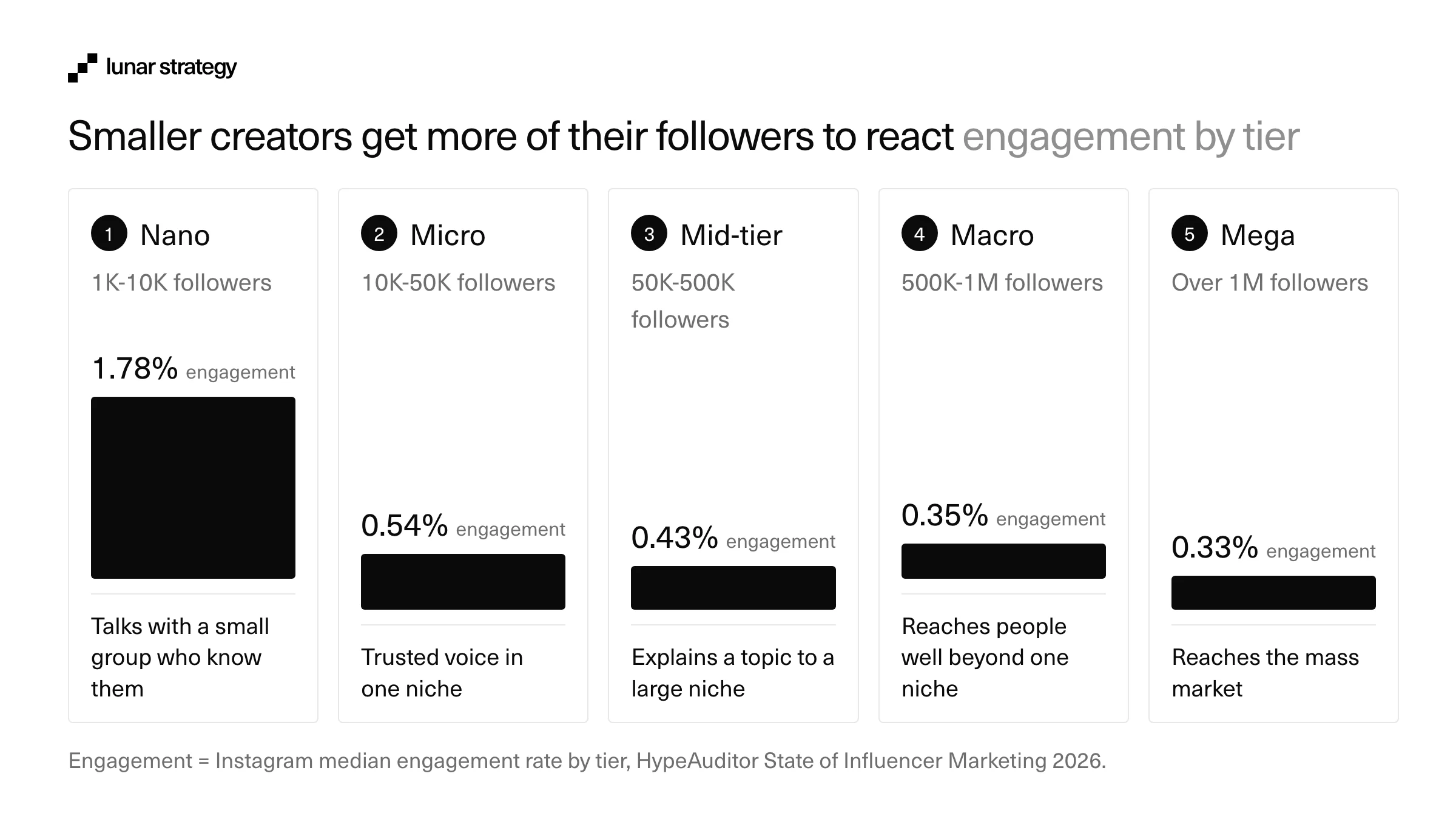
Engagement rate (the share of the audience that likes, comments or shares a post) drops as accounts grow. Smaller creators post for people who chose them for one topic, they answer replies and their followers see more of their posts. A large account reaches far more people in total, but each post means less to each of them.
HypeAuditor's 2026 report puts numbers on that pattern. On Instagram, the median engagement rate falls from about 1.8% for nano creators to 0.54% for micro, 0.43% for mid-tier and 0.35% and 0.33% for macro and mega accounts. TikTok shows the same slope at a higher level, from 11.6% for nano creators to 9.3% for micro, 7.6% for mid-tier and 6.8% for macro and mega (HypeAuditor, 2026). Big accounts still win on totals: a mega creator's post collects thousands of likes, a nano creator's a few dozen.
| Tier | Instagram median engagement | TikTok median engagement |
|---|---|---|
| Nano (1K-10K) | 1.78% | 11.6% |
| Micro (10K-50K) | 0.54% | 9.3% |
| Mid-tier (50K-500K) | 0.43% | 7.6% |
| Macro (500K-1M) | 0.35% | 6.8% |
| Mega (over 1M) | 0.33% | 6.8% |
Brands have noticed. The same report found that 60% of Instagram posts tagged #ad in 2025 came from creators with fewer than 50,000 followers. Higher engagement rates also mean each post starts more conversations for the money, which is why the Influencer Marketing Hub survey shows budgets moving toward the smaller tiers.
These figures don't cover X, where most crypto conversation happens. No recognized data publisher reports engagement by tier for X, so treat the Instagram and TikTok slope as a direction, then check each X account yourself.
How the tiers look on crypto X
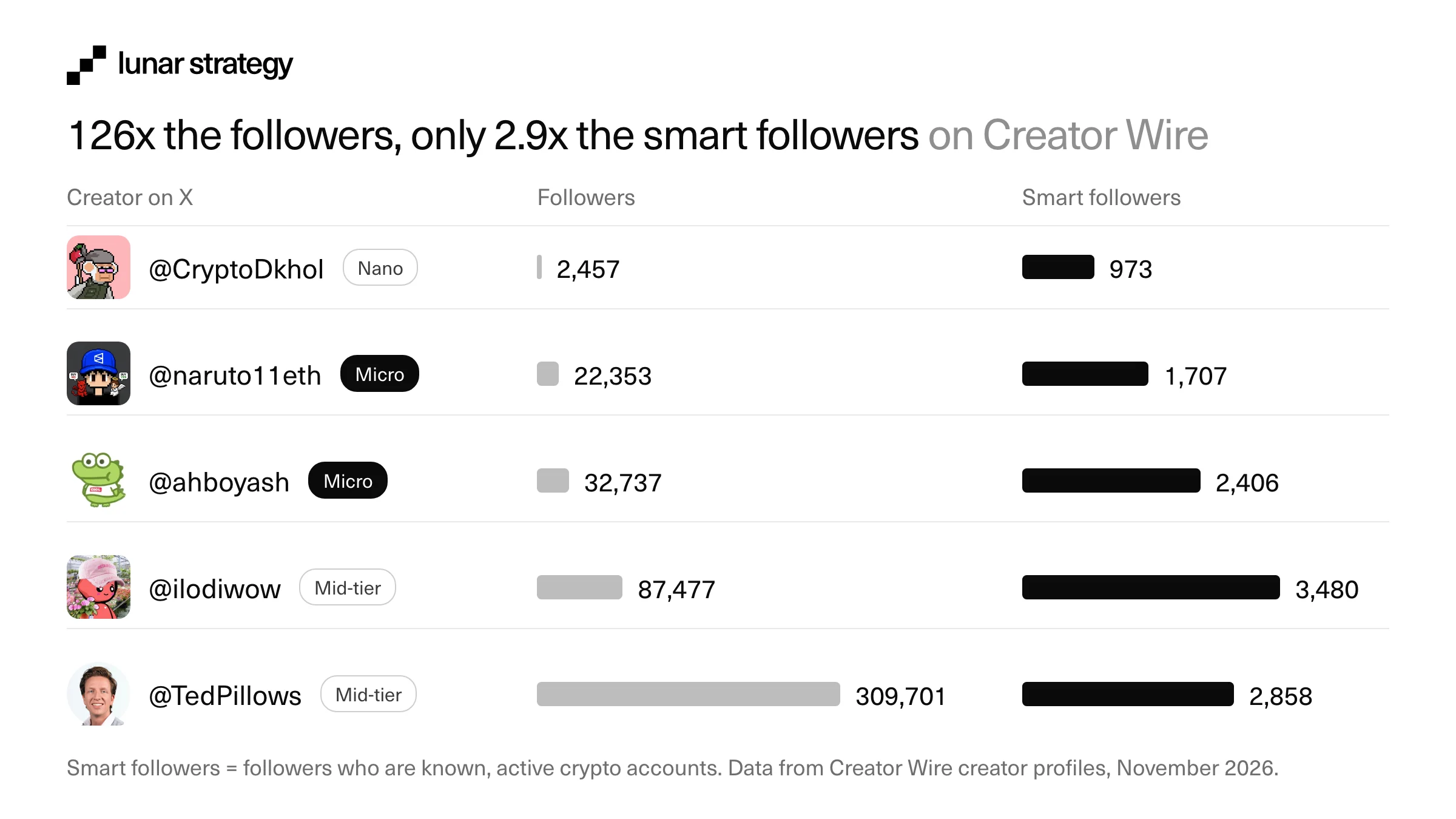
Follower counts on crypto X run lower than on Instagram or TikTok, and they say less about influence. A researcher with 40,000 followers can move more capital than a meme account with 400,000, because the people following the researcher are founders, fund analysts and active traders. Many accounts in crypto also carry bots and bought followers, which inflate the count without adding readers.
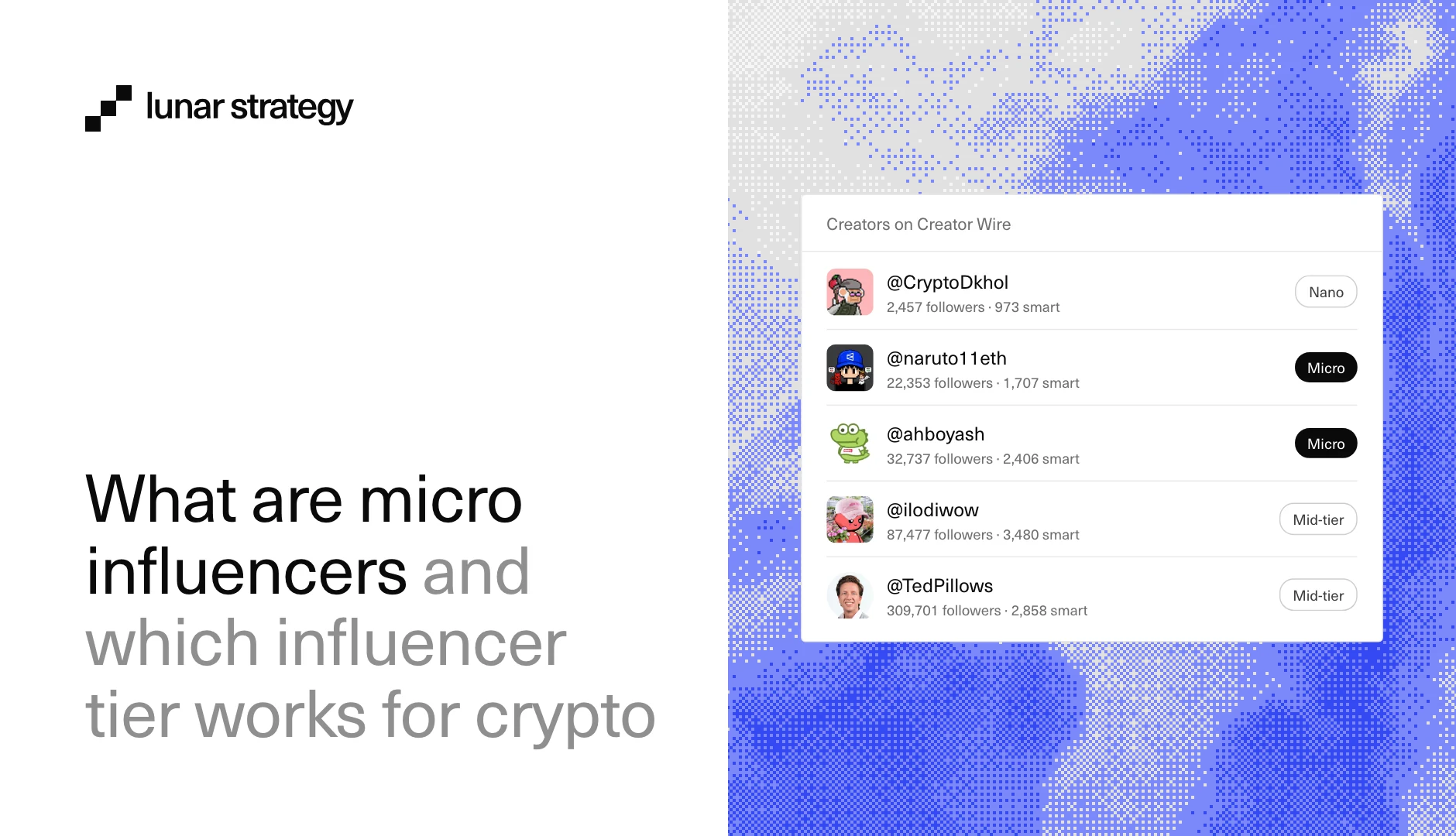
So we sort creators by role and audience first, then by size. When we benchmark a creator, the number we look at hardest is smart followers: how many of their followers are themselves known, active accounts in crypto, such as founders, funds, researchers and builders. A creator with fewer followers and more smart followers usually reaches the people who decide. Replies matter too: real questions under a post show an audience that reads. On Creator Wire, the creator platform we built at Lunar, each creator's smart followers sit next to their follower count, so you can compare the two before you shortlist anyone.
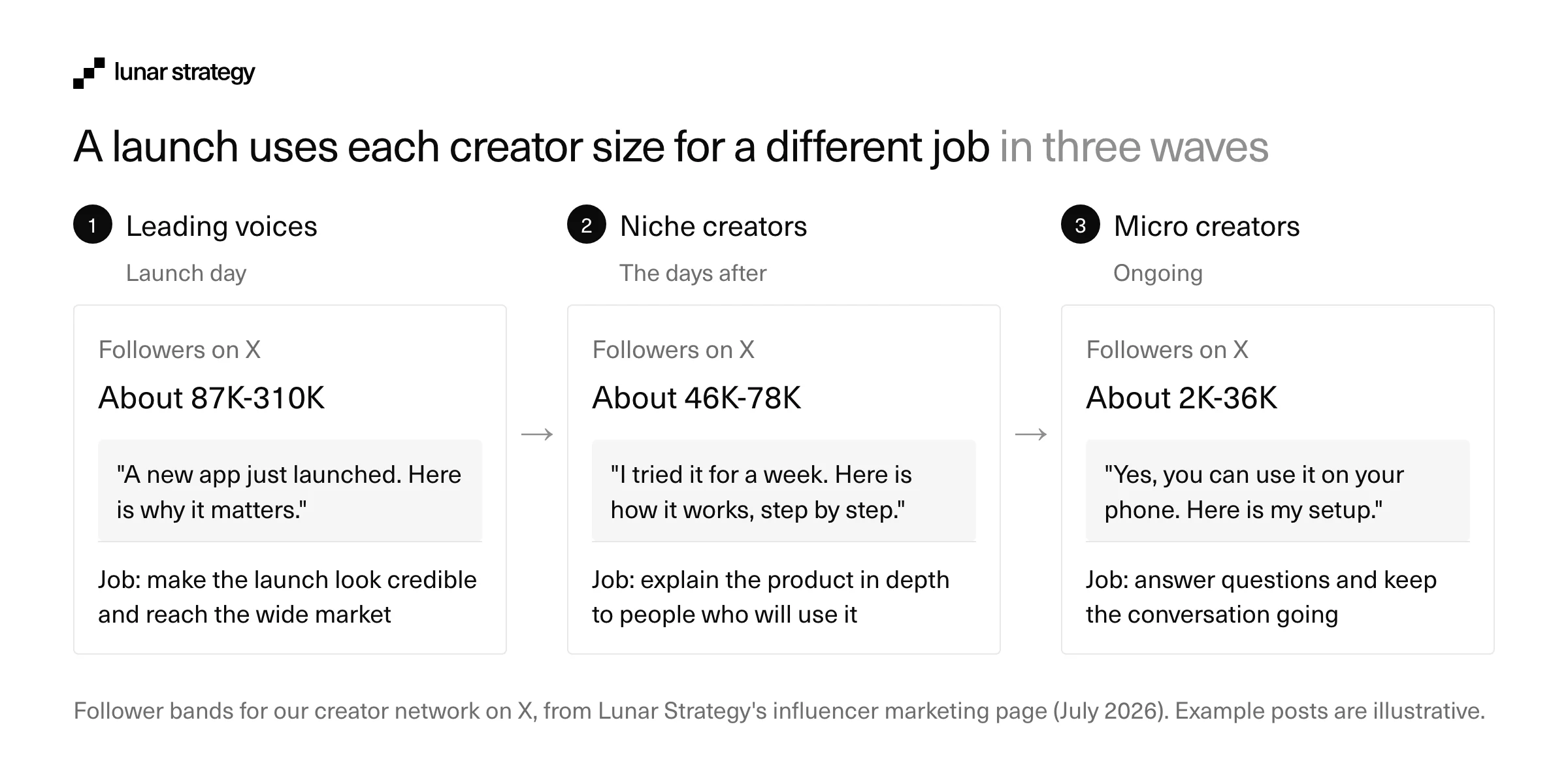
Our own creator network on X uses three tiers with bands that fit crypto, published on our influencer marketing page in July 2026:
| Our tier | Followers on X | Role in a campaign |
|---|---|---|
| Leading voices | About 87K to 310K | Give the project credibility and reach the wider market |
| Niche creators | About 46K to 78K | Explain the product in depth to the audience that uses it |
| Micro creators | About 2K to 36K | Keep the conversation going, answer questions, reach small communities |
That table also shows why the standard bands can mislead in crypto. Our "leading voices" would be mid-tier creators on Instagram, and our micro tier covers both nano and micro accounts. On X, an account above 100,000 followers with a real crypto audience is rare and expensive. Our guide to reach versus influence in crypto marketing goes deeper on why the smaller number often wins.
Which tier works for crypto, by goal
No single tier works best in every case; the right one depends on the goal. A token launch needs visible names on the day, a technical product needs creators who can explain it, and a DeFi app needs people who will try it and talk about it. Most crypto campaigns therefore combine tiers and release posts in waves, so each wave builds on the last.
The table below shows the mix we start from for common goals. It is a starting point, adjusted after the first wave shows which creators moved people:
| Goal | Tier mix to start with | Why |
|---|---|---|
| Awareness at a launch or TGE | A few leading voices, then niche and micro creators in the days after | The big names signal legitimacy; the smaller accounts answer the questions that follow |
| Explaining a technical product | Mostly niche creators, plus micro creators who use the product | Depth beats reach when people need to understand before they act |
| Sign-ups, deposits or TVL | Many micro and niche creators with tracked links | More posts from trusted accounts give more chances to convert, and links show who converts |
| A new region | Local-language niche and micro creators | Small regional accounts often reach markets that English-language X barely touches |
| A long-term community | Micro and nano creators, then an ambassador program | Regular posts from real users keep the project in the conversation between big moments |
Our Polkadot campaign shows what a wide wave can do. In June 2024 we ran a 60-day creator campaign around Hydration, the leading DeFi platform on Polkadot, with boosted yields as the hook. We activated 40 creators, who published 208 posts and reached more than 10.9 million impressions, alongside PR and X Spaces. Over those 60 days, Hydration's TVL (total value locked, the money users deposit in a protocol) went from $27 million to $54 million.
The lesson we take from campaigns like that one: many trusted voices posting over weeks look like a real conversation, while a few big names posting on one morning look like an ad. For long-term work with small creators, a Web3 ambassador program turns the nano tier into a steady channel.
What each tier costs, and how to compare prices
Prices rise with tier, but not in a straight line. Crypto creators set their own rates, rarely publish them and often price by follower count, so two accounts of the same size can quote very different amounts for one post. Agencies and middlemen add a cut, and payment in tokens can hide the real cost.
The fair way to compare is by views. CPM (cost per thousand views) divides the price of a post by how many people saw it, in thousands. In our campaigns, a fair CPM has been about $20, and our breakdown of what a crypto KOL campaign costs shows how that turns into budgets: about $5,000 for a small test, $20,000 for a launch and $100,000 for a major push. Applied to tiers, that leads to a few practical rules:
- Ask for recent view counts, not follower counts, before you agree on a price, and compare every quote by CPM.
- Expect smaller creators to win on cost per view and per reply, and larger ones to win on total reach in one post.
- Test micro creators in batches with their own tracked links, then rebook the ones that brought users.
- Pay for formats that fit the tier: threads and explainers from niche creators, short posts and replies from micro creators, a single headline post from a leading voice.
Views only show who saw a post. To judge the spend, also track the cost of each real user a creator brought in, such as a sign-up, a deposit or a wallet connected.
The risks that grow with size, and the ones that don't
Bigger creators carry a larger legal and reputation risk, because their posts reach more people who don't know the product. The best-known example is from October 2022, when the US Securities and Exchange Commission charged Kim Kardashian for promoting a crypto token on Instagram without disclosing that she was paid $250,000 for the post. She agreed to pay $1.26 million (SEC).
Platform rules now apply at every tier. X's Paid Partnerships Policy requires a "Paid Partnership" label on sponsored organic posts and, as of November 2026, makes crypto and other financial products ineligible for paid partnerships in the European Union, the United Kingdom and Australia. A campaign that pays creators in those regions to promote a token breaks the policy, whatever their size.
Small creators carry risks of their own, mostly around quality. Check these points for every creator, from nano to mega:
- Audience: smart followers, the regions the audience comes from and signs of bought followers, such as sudden jumps in follower count.
- Replies: real questions and discussion, as opposed to emoji, copied phrases and the same accounts replying to everything.
- History: past paid posts, tokens they promoted that later collapsed and whether they disclosed earlier deals.
- Fit: whether they already post about your category in their own words.
Our guide on why influencer marketing fails in crypto covers the failure patterns behind these checks.
Where to start
Start with the goal and the audience you need, then build the mix. Write down the one action you want readers to take, and list the 20 to 40 creators whose followers already include those people, across at least two tiers. Creator Wire lets you filter creators by tier and share the shortlist with your team. Check their smart followers, replies and history, and drop anyone with bought followers or undisclosed past deals. Run a first wave with tracked links, compare every creator by CPM and by cost per real user, then put the next budget behind the ones that worked.
Before the first post goes live, sort out the details that are easy to forget:
- Brief every creator on the facts, and leave the voice to them. Our guide to briefing a KOL has a template.
- Turn on disclosure, and keep paid crypto posts out of the EU, the UK and Australia on X.
- Plan the waves so the big posts come first and the smaller creators answer the questions that follow.
- If the campaign uses video, let creators clip it. Our guide to X Clipping explains how.
How Lunar Strategy works with creator tiers
We run creator campaigns on X, YouTube and TikTok, and we plan every campaign as tiers in waves: leading voices first, then niche creators who explain the product, then micro creators who keep the conversation going. Our team handles the strategy, the briefs, the timing and the reporting, and adjusts each wave from the numbers of the one before.
Finding and checking the creators runs on Creator Wire. It holds a vetted pool of crypto creators sorted into tiers and benchmarked on real engagement and smart followers, with shareable shortlists, budget approvals, live tracking of impressions and CPM, and one payment that covers every creator. Any team can use it, and our Creator Campaign Playbook explains the method in full.
Plan your creator campaign with us →
We'll look at your goal and suggest the tier mix and first wave for your project.
FAQ
What is a nano influencer?
A nano influencer is a creator with roughly 1,000 to 10,000 followers. Their audience is small and often personal: friends, colleagues and people who share one interest. Nano creators usually have the highest engagement rates and the lowest prices, which makes them useful for community programs, product testing and local markets, though each post reaches few people.
How many followers do you need to be a micro influencer?
Most definitions start at 10,000 followers and end at 50,000, though some guides stretch the band to 100,000. The count matters less than the audience. A creator with 15,000 followers who posts about one topic and gets real replies fits the label well. An account of the same size built on giveaways rarely gets the same attention from its followers.
Is a micro influencer the same as a micro KOL?
Mostly, yes. In crypto, KOL (key opinion leader) is the common word for a creator whose opinion moves their audience, and a micro KOL is a small-audience creator in that sense. The difference is emphasis: "KOL" stresses expertise and trust, while "influencer" is the broader marketing term used across every industry.
What is a mega influencer?
A mega influencer has more than 1 million followers, usually a celebrity or one of the biggest creators on a platform. Their posts reach the mass market, but engagement rates are the lowest of any tier and prices the highest. In crypto, mega accounts also bring the most regulatory attention when a paid post goes wrong.
What are smart followers?
Smart followers are the followers of an account who are themselves known, active accounts in the same field, such as founders, investors, researchers and builders in crypto. Counting them shows whether a creator reaches people who make decisions. Two creators with the same follower count can have very different smart follower numbers, and the higher one usually drives better results.
Do micro influencers need to disclose paid posts?
Yes. Disclosure rules apply to paid posts at every size. On X, sponsored posts need the "Paid Partnership" label, and X's policy points US creators to the Federal Trade Commission's endorsement guides, which require the payment to be clear. Some regions go further: on X, paid promotion of crypto is not allowed at all in the EU, the UK and Australia.
Tim, Jack or Luka


Free strategy call
20 min
Whether you need help with GTM or other marketing, we give you a first strategy and advice on a free 20-minute call.
Book a callRated 4.9/5 on Clutch