How a crypto GTM turns attention into onchain revenue
A crypto go-to-market strategy turns launch attention into users, holders and TVL. What goes into the plan, how to roll it out and how to measure it.
- Written by
- Shann HolmbergManaging Partner
- Published
- Reading time
- 12 minutes
- Topic
- Strategy and growth

Contents
- 1What is a crypto go-to-market strategy?
- 2Crypto GTM works on a shorter clock than traditional GTM
- 3A crypto GTM plan fits on one board
- 4Growth without a strategy is guesswork
- 5Every stage of the funnel needs its own plan, from first impression to retention
- 6How to turn attention into users and holders
- 7How Lunar Strategy builds a crypto GTM plan
- 8Measure each stage against KPIs set in the strategy
- 9Three launches we planned, and what they returned
- 10Start the GTM 3 to 6 months before a big launch
- 11Frequently Asked Questions
A token launch, a presale or a mainnet release gets a few weeks when the market is paying attention to you. If that window is spent on a scattered campaign, the attention fades before it turns into users, holders or TVL (total value locked, the money deposited in a protocol). The project then has to buy attention again, at a higher cost, with less to say.
A crypto go-to-market strategy turns that window into a plan, so the positioning, the message and the rollout are decided before any money goes into reach. We build these plans with founders every week at Lunar Strategy, and this guide follows the same order we use with them.
It's written for founders, marketers and growth teams launching a token, a protocol or a crypto product. It covers what a crypto GTM is, how it differs from a traditional one, what goes into the plan, how the funnel works, the moves that turn attention into holders, how we build it, how to measure it, and when to start.
What is a crypto go-to-market strategy?
A crypto go-to-market strategy is the plan for how a project reaches its users and holders. It covers the positioning, the audiences, the narrative and the order of the rollout, and every channel follows it, before or after a TGE (token generation event, the day a token goes live). When the launch comes, the right people already know what you are, why it matters to them, and what to do next.
Take a DEX token. The plan decides who hears about it first (traders, liquidity providers or funds), what each of those groups is told, and which channel goes live first. A trader cares about fees and liquidity, a fund cares about volume and the team, and a liquidity provider cares about yield. One message can't serve all three, so the plan gives each one its own.
The plan covers more than marketing. It ties together the product, the brand, the token and the growth plan, so that every post, creator campaign, press story and community event pushes in the same direction. That's why we treat it as the first step of any launch, and the channels as the last.
Crypto GTM works on a shorter clock than traditional GTM
A traditional GTM plan assumes slower sales cycles and a few central channels, like ads, a sales team and the press. A crypto launch runs on a short timeline, around a TGE or a sale, in front of global communities that are online all day. The plan has less time to work and a louder room to work in.
The reach also comes from different places. Creators and KOLs (key opinion leaders, the accounts people follow for crypto news and opinions) carry most of it, token incentives shape what users do, and your first users are often also your investors and your loudest promoters. A holder who bought early has a reason to talk about you, which a SaaS customer rarely does.
| Traditional GTM | Crypto GTM | |
|---|---|---|
| Timeline | Slower sales cycles | Short timelines around a launch or TGE |
| Audience | Buyers in target markets | Global communities, online all day |
| Reach | Ads, sales teams, press | Creators, KOLs, X and community |
| What drives action | The product and the price | The product, the narrative and token incentives |
| First users | Customers | Users, holders, investors and promoters at once |
A crypto GTM plan fits on one board
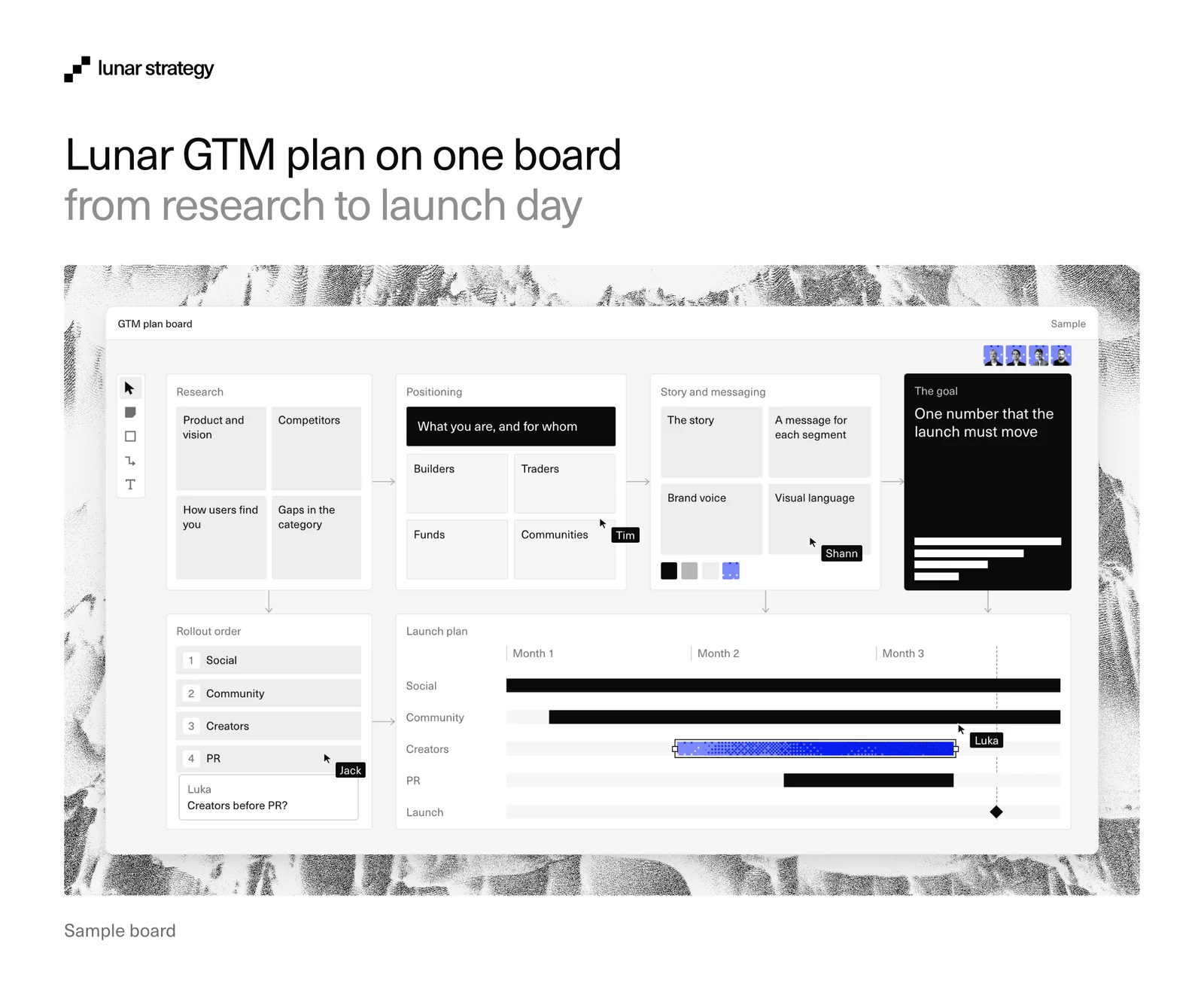
The full plan fits on one board, from research on one side to a three-month launch plan on the other. Each part is decided by the one before it, so nothing in the launch plan is a guess.
- Research: your product and vision, your competitors, how users find you and start to use your product, and the gaps in your category.
- Positioning: what you are, and for whom. Builders, traders, funds and communities each need their own reason to care.
- Story and messaging: the core story, one message for each audience segment, the brand voice and the visual language.
- The goal: one number the launch must move, such as holders, TVL, a raise or active users.
- Rollout order: which channel starts first and how the rest follow, from social and community to creators and PR, all leading to the launch date.
The goal is the part teams most often skip. With one number to move, every channel can be judged against it. Without it, a campaign can look busy for weeks and still leave nobody able to say whether it worked.
Growth without a strategy is guesswork
Without a plan, every team writes its own version of the story. The social team posts one message, the creators get a different brief, and the press release tells a third story. Each piece can be good on its own, and the launch still feels scattered, because the audience hears three projects instead of one.
The cost shows up in the budget. Campaigns lose focus, teams pull in different directions, and nobody can say which spend worked, because there was never one goal to measure against. The money goes out, and the project is left hoping something sticks.
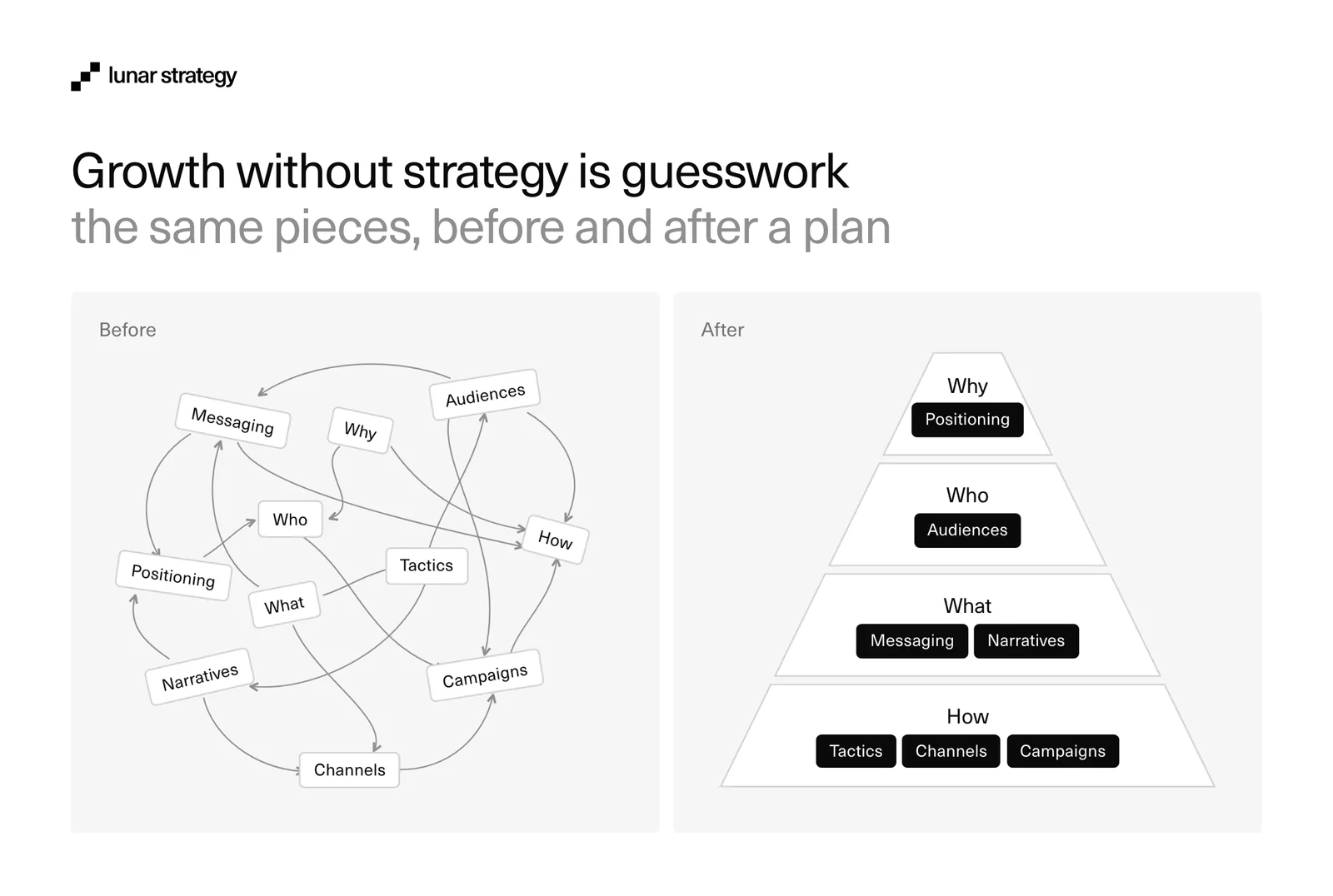
A plan puts the same pieces in order. Positioning comes first (why you exist), then the audiences (who), then the messaging and narratives (what), and only then the tactics, channels and campaigns (how). Product, brand and token strategy become one growth system, and every channel knows what it is there to do.
Every stage of the funnel needs its own plan, from first impression to retention
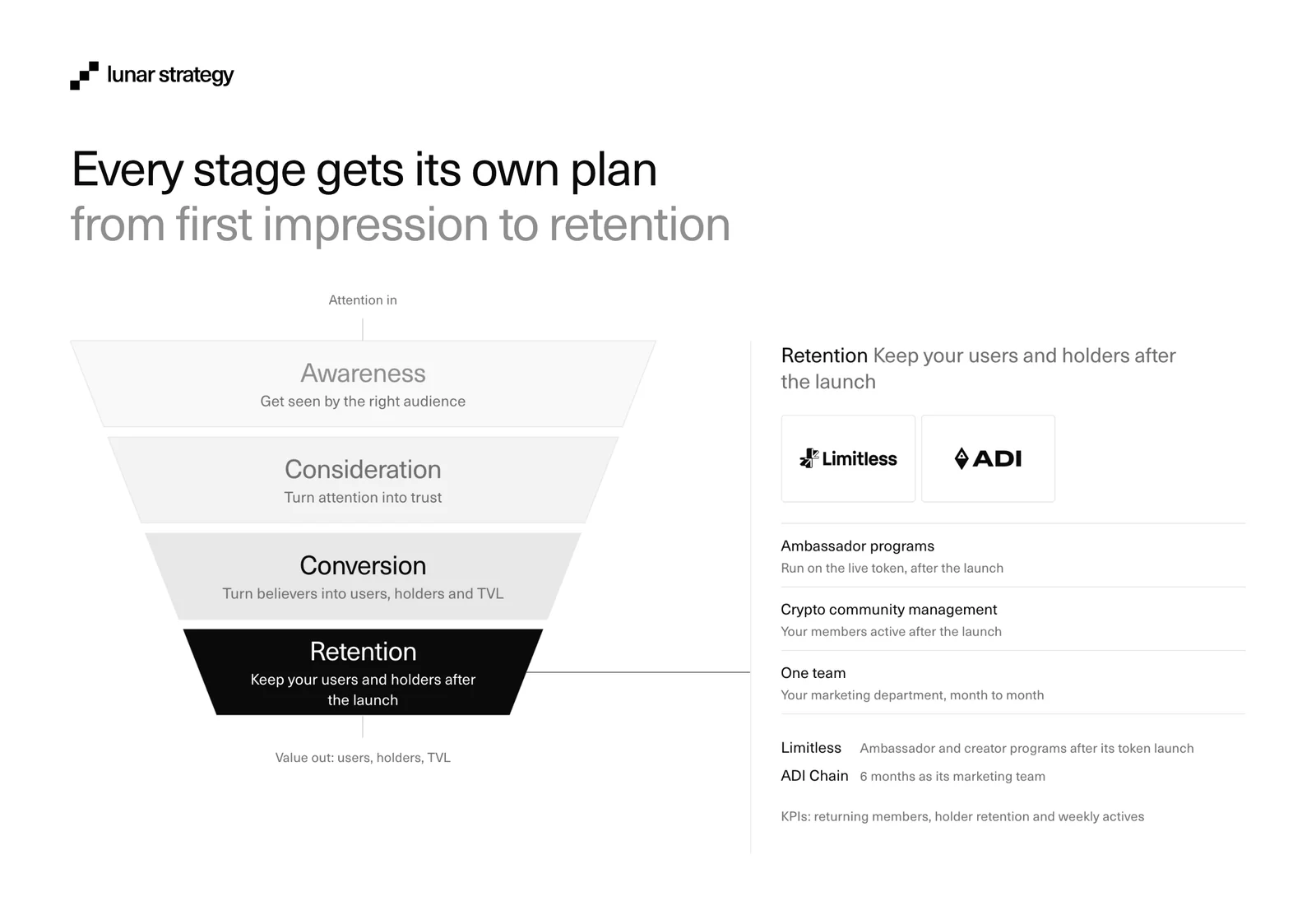
A crypto GTM plans the whole funnel, and each stage has its own job and its own KPIs. Awareness gets you seen by the right audience, consideration turns that attention into trust, conversion turns believers into users, holders and TVL, and retention keeps them after the launch.
More impressions bring more users only up to a point. One creator post is one touchpoint, and in our creator campaigns people usually need to see a project 5 to 6 times, from voices they already trust, before they sign up or deposit. On X, the path often runs from a creator post to your profile, then to your landing page, then to the conversion. If one step is weak, the people you paid to reach drop off right there.
Attention only turns into users when every stage after the first impression is planned too.
How to turn attention into users and holders
The work that converts attention happens before you pay for reach, and each move makes the next one work.
Pick one audience and sell the outcome. A post that tries to speak to traders, developers and institutions at once means little to any of them. Pick one audience for this push and tell them what they get: fill in "[project] helps [who] get [outcome]", lead with the outcome (the yield, the access, the reward) before the tech, and add a real reason to act now, such as early access, a points campaign, a presale allocation or a deposit campaign.
Build the funnel before you buy attention. Creators can only send people somewhere, and if the landing page doesn't sell one clear offer to those exact people, they leave before they convert. Give each page one action (a sign-up or a deposit), a headline that sells the outcome with one main button repeated down the page, and trust signals people can check: audits, backers, partners and real numbers.
Treat your X profile as a landing page. Most creator posts send people to your profile first, so the banner and bio should say what you do in one line, and the pinned post should be your best proof or your offer. The founder should post too, because people trust the team behind a token. For the mechanics of reach on the platform, see how the X algorithm ranks posts.
Distribute in waves. One wave of creators gives people one reason to look. Several waves from trusted voices in a short window give them the touchpoints they need. We run creator campaigns through Creator Wire, with more than 5,000 creators, in tiers:
- Wave 1: the most trusted voices in your niche
- Wave 2: bigger accounts, once the narrative is set
- Wave 3: the broad push around your launch moment
Partners and PR (your story in crypto and tech media, your team on podcasts) add independent voices around each wave. Short-form clips can extend each wave too, which is how an X clipping campaign fits into the rollout.
Stack smaller launches. One big launch day gives one spike. A run of smaller launches, such as a brand reveal, a new partner, a feature, a points season or a creator wave around a milestone, gives people a new reason to talk about you every couple of weeks and gives creators something new to post. Jack Haldorsson from our team wrote the full 90-day version, with the cases and numbers behind each step:
How to run a 90-day crypto go-to-market
Jack Haldorsson (@Jackhaldorsson), View on X
How Lunar Strategy builds a crypto GTM plan
Every engagement starts with discovery. We run workshops with your team on the product, the vision and the milestones, study your competitors, map how users find and start to use your product, and look for the gaps in your category. This research shapes the messaging, the positioning and the narrative.
Next comes the strategy: your positioning, audience segments, narrative, messaging, brand voice and visual language. We present it with campaign angles and channel tactics, and a timeline ties the big ideas to your launches. On the token side, we review your utility, points and airdrop mechanics, and plan for sell pressure.
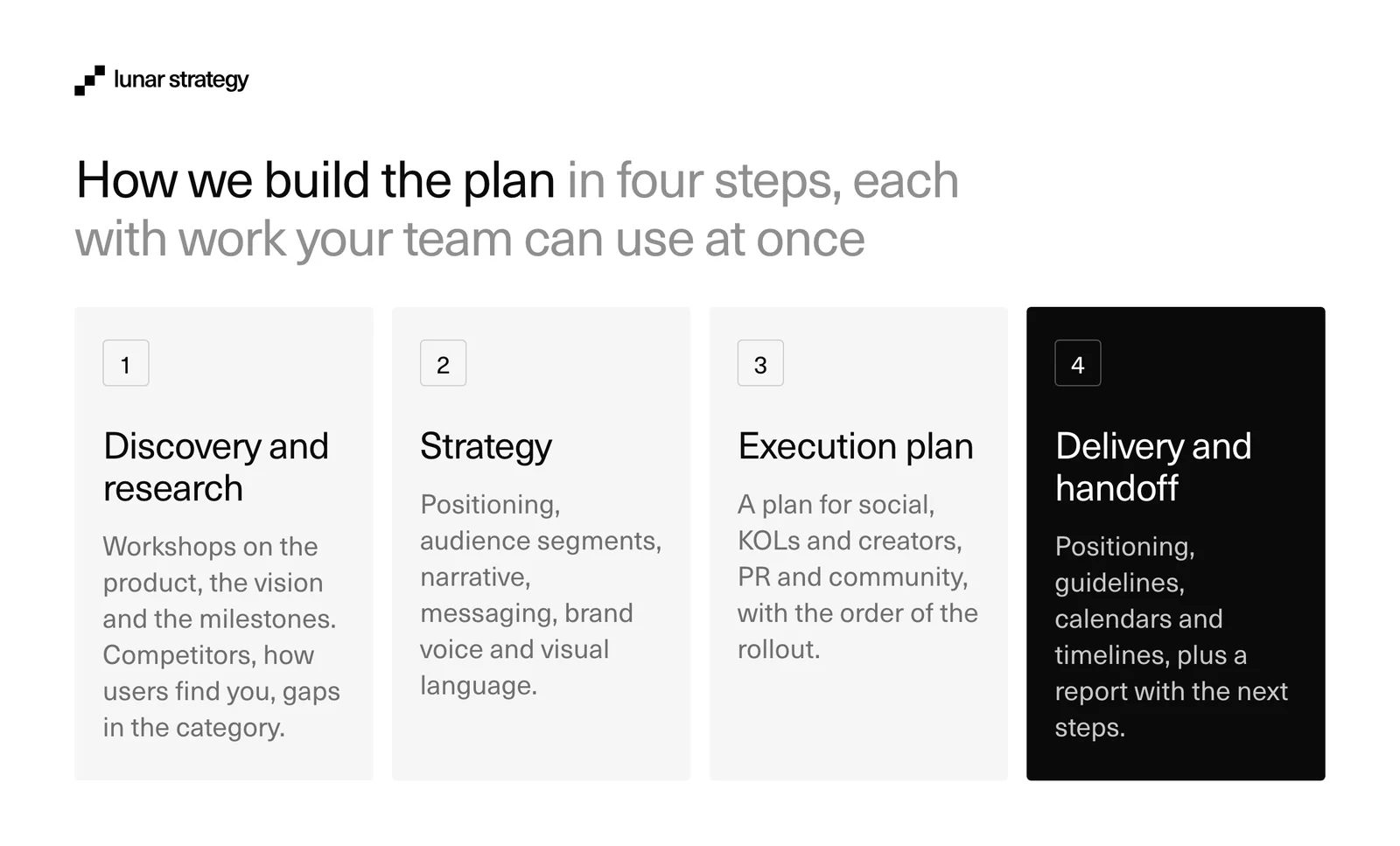
Then the execution plan: a plan for every channel the launch needs (social, KOLs and creators, PR and community), the order of the rollout, and a way to track each channel against the plan. When the campaign goes live, we coordinate the delivery across platforms.
Finally, delivery and handoff. Your team gets every document in a form it can use at once: the competitor analysis, brand audit and audience segments; the positioning, guidelines and a content calendar; and a rollout plan with plans for KOLs, paid ads and PR, plus a report with the next steps.
Measure each stage against KPIs set in the strategy
We set the KPIs with each team in the strategy phase, and they follow the project's goals and the phase it's in. A pre-TGE project measures demand, a live protocol measures deposits and retention. The metrics that matter, stage by stage, with a result from our own launches:
| Stage | KPIs | From our launches |
|---|---|---|
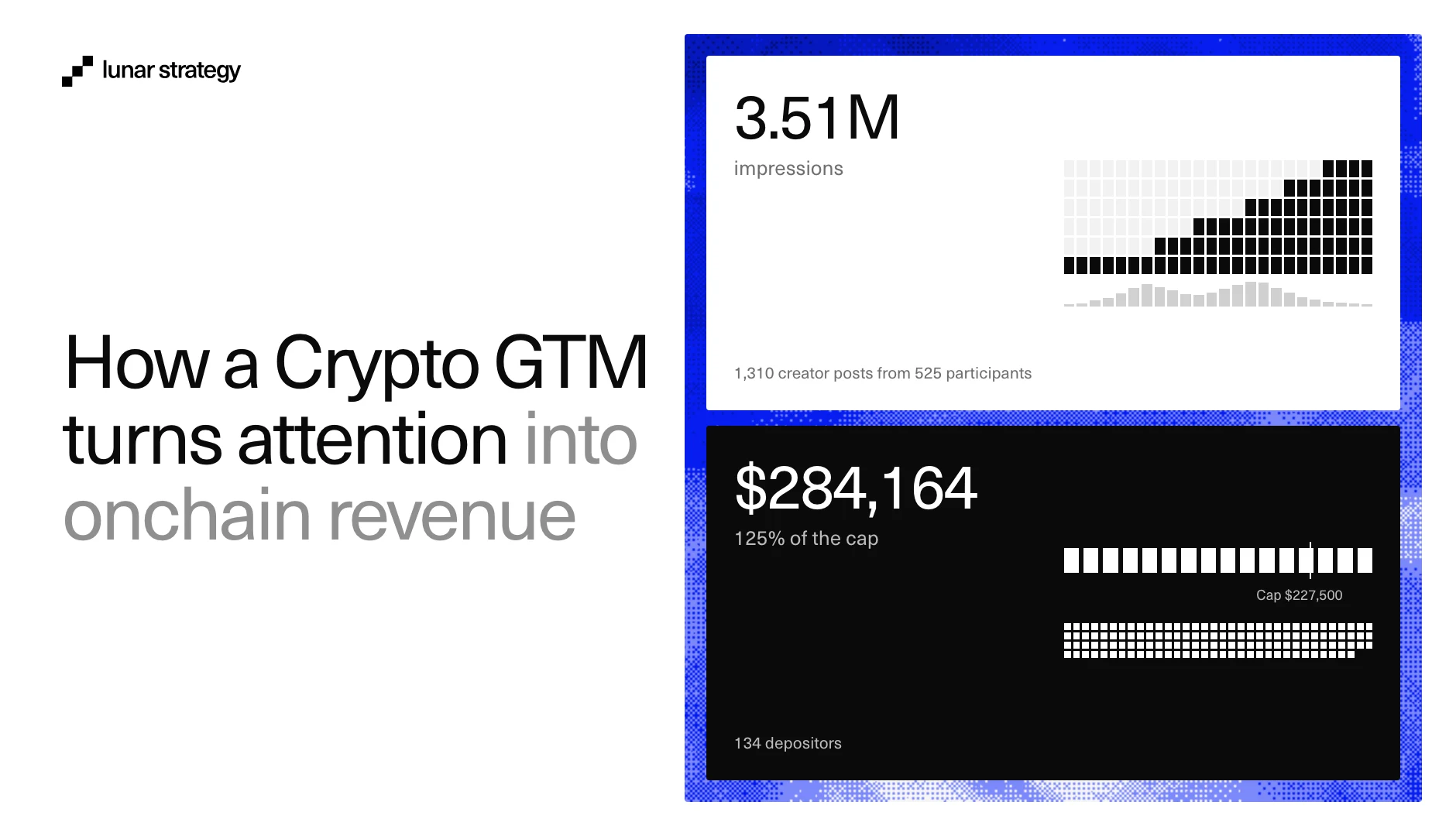
| Awareness | Impressions, reach, follower growth, share of voice | DualMint: 3.51M impressions |
| Consideration | Replies, bookmarks, smart followers (accounts that other respected accounts follow) | GMTrade: replies +190% |
| Conversion | Users, holders, TVL, a raise against its cap | DualMint: 125% of the cap |
| Retention | Returning members, holder retention, weekly active users | Limitless: programs after its token launch |
Markets move and products change. When the data shows a better direction, the plan changes with it.
Three launches we planned, and what they returned
DualMint, a presale. We refreshed the brand identity, made the visual creatives and wrote the messaging. Then creators and socials carried the $PLAY presale in a set order: GTM plan, brand, creators, socials, precommits, and the raise from 1 to 8 October. The campaign reached 3.51M impressions, with 1,310 creator posts from 525 participants, and the presale raised $284,164 from 134 depositors, 125% of its $227,500 cap. The creator side ran through Creator Wire, with 0.5% of the DualMint token supply set aside for creators.
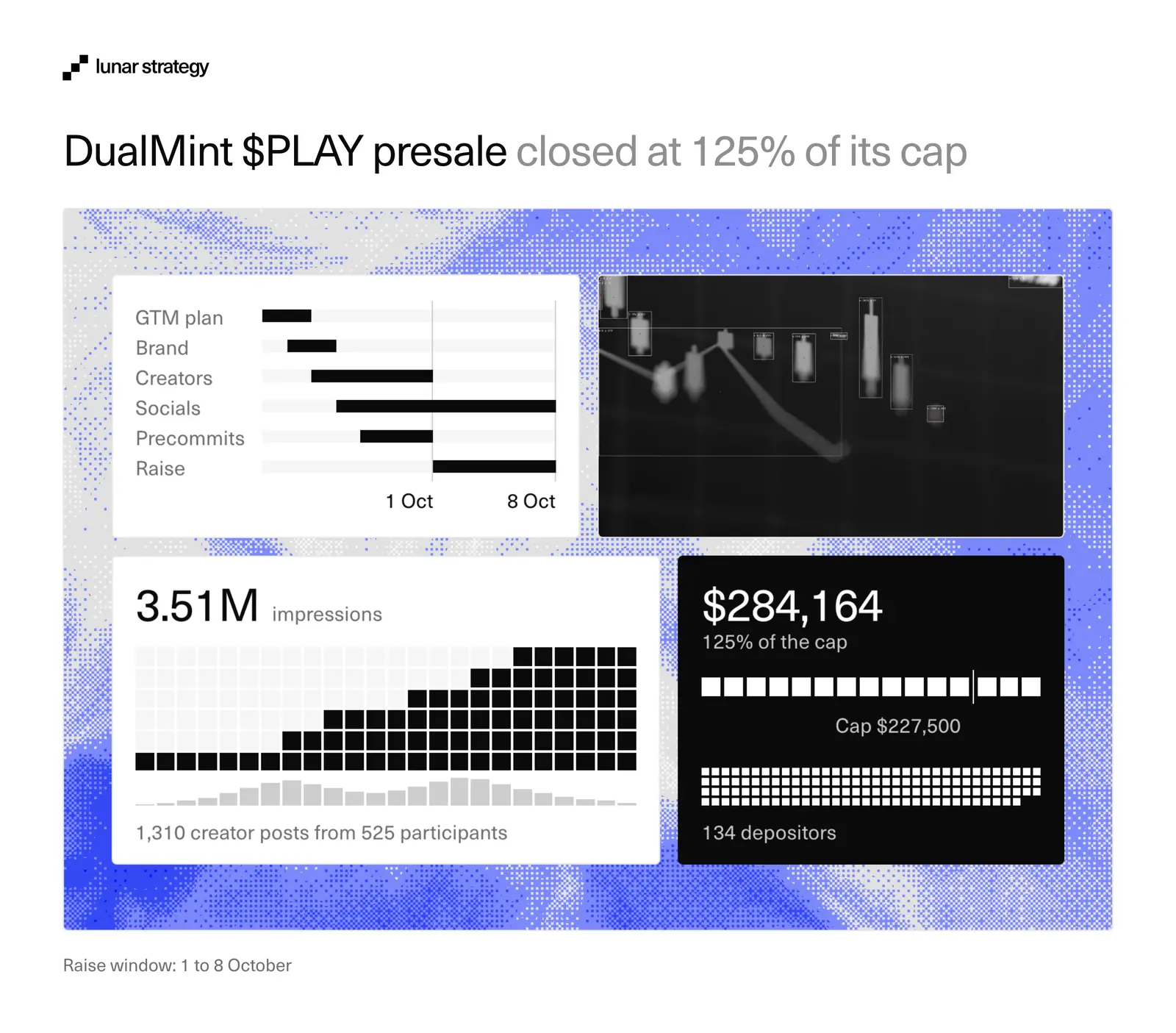
DualMint $PLAY presale results
Lunar Strategy (@LunarStrategy), View on X
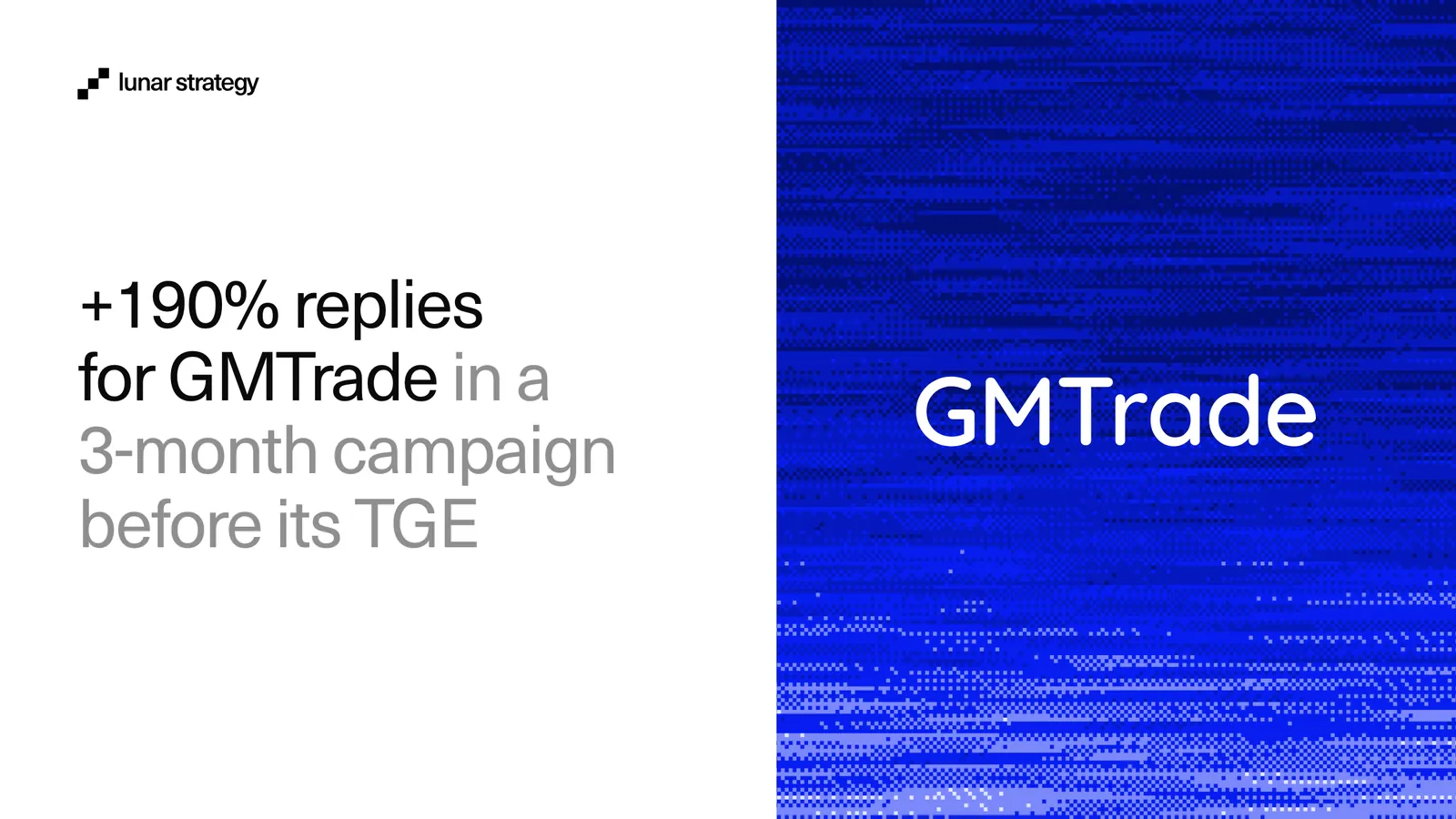
GMTrade, before its TGE. GMTrade, formerly GMXSOL, needed a clear direction before launch: positioning, a brand identity and a plan that showed the market it was a real business with a committed team. We built the go-to-market strategy, wrote the final positioning and the big ideas, created the visual language and brand guidelines, and aligned all messaging and content with the new identity, with a rollout focused on the community.
In a 3-month campaign, replies grew 190% and bookmarks grew 154%, so people were joining the conversation and saving the content. Smart followers grew 33.6%, from 125 to 167 accounts that include projects, VCs, developers and KOLs. The account also gained 1.2K verified followers and 1.5K profile visits.
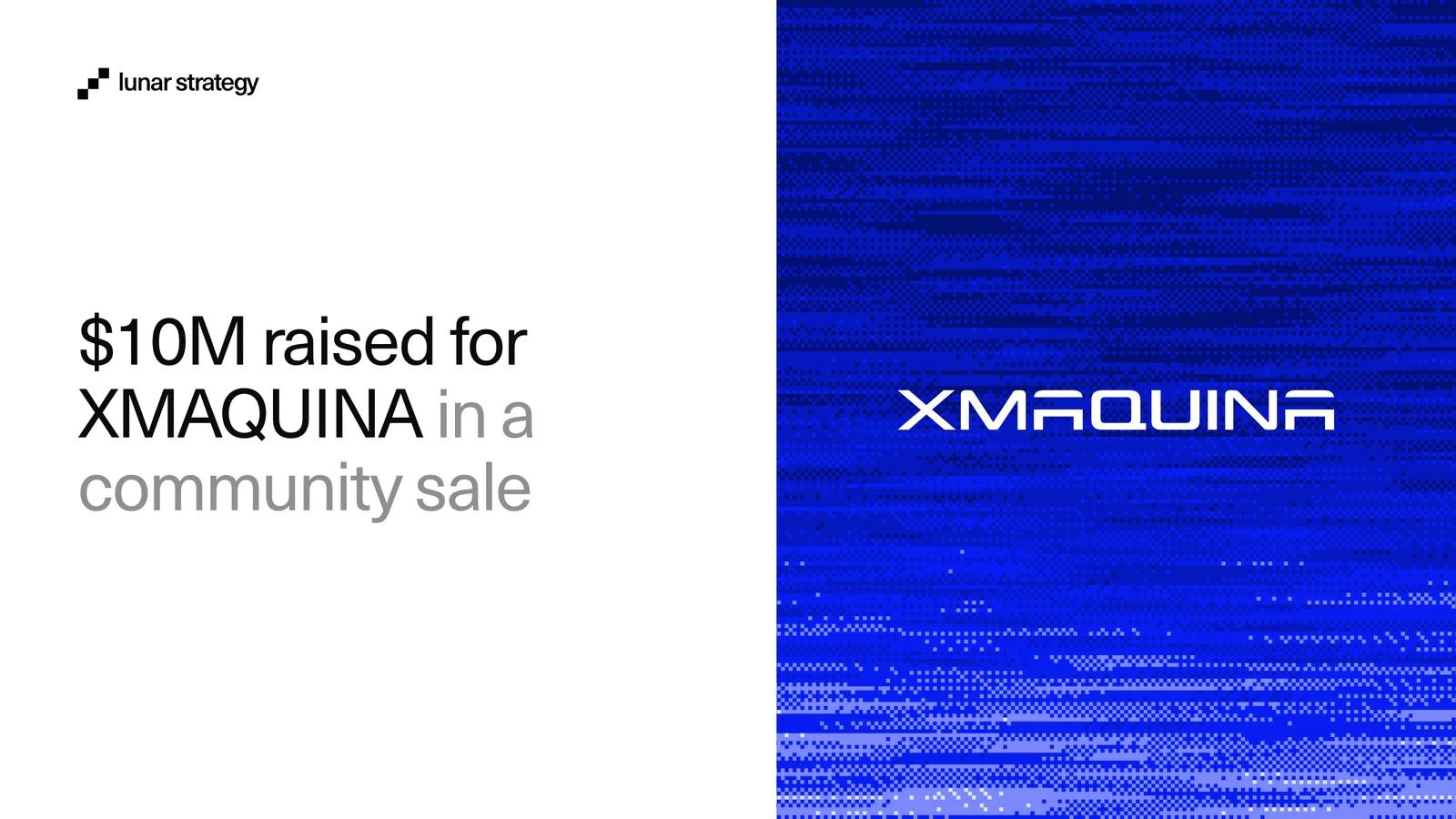
XMAQUINA, a community sale. XMAQUINA needed to stand out in a crowded market and drive its community sales. The work covered the narrative, the game mechanics and the brand: a humanoid narrative around the project, leaderboard mechanics, and a mascot that made the brand recognizable at a glance. We also added staking on top of the existing features, so holders had one more reason to stay engaged. The community sale raised $10M.
Start the GTM 3 to 6 months before a big launch
The best time to build a crypto GTM is 3 to 6 months before a big launch. That leaves time for the research, the strategy, the content and an ordered rollout, so the project goes live with a message people already recognize. Start by writing the one-line positioning and the one number the launch must move, then decide which audience hears about you first.
A plan also fits later: after a launch, when the first attention has faded; during a rebrand; or when you spend on marketing but can't see what works. If your token is already live, our token launch strategy guide covers the post-TGE side.
Since 2019, we've worked only in crypto, with more than 400 crypto teams. Your own team can run the plan, or we run it with you through three programs that start with the plan as their first part:
| Program | Length | What it does |
|---|---|---|
| Crypto marketing department | Ongoing, month to month | We plan your marketing and run every channel of it |
| Token launch marketing | 90 days | Demand before your TGE, and activity after it |
| Token sale and presale marketing | 6 to 8 weeks | Demand for your raise, presale or community sale |
A free 20-minute call with a partner. You leave with a first plan, whether you hire us or not. See the full service on our crypto go-to-market strategy page.
Frequently Asked Questions
What does GTM mean in crypto?
GTM stands for go-to-market. In crypto it means the plan for how a project reaches its first users, holders and partners: who it targets, what it tells each audience, and in which order the channels go live. It usually runs around a launch moment, such as a TGE, a presale or a mainnet release, and continues after it.
Is a GTM strategy the same as a marketing plan?
No. The marketing plan is one part of the GTM. The GTM decides the positioning, the audiences, the goal and the rollout order, and it also covers the product, the brand and the token. The marketing plan then sets the channels, the content and the budget that carry that strategy to the market.
Does a project need a token to have a crypto GTM strategy?
No. A GTM works for any crypto product going to market, with or without a token: a wallet, an exchange, infrastructure or an app. A token adds its own pieces to the plan, such as the TGE, points, airdrops and sell pressure, but the order of positioning, audience, message and channel stays the same.
Can a small team run a crypto GTM without an agency?
Yes, if the team keeps the order. Write the positioning and the one goal first, pick one audience, fix the landing page and the X profile, then add creators and PR in waves. What an agency adds is research capacity, creator and media relationships, and the hours to run every channel while the team keeps shipping product.
Tim, Jack or Luka



Free strategy call
20 min
Whether you need help with GTM or other marketing, we give you a first strategy and advice on a free 20-minute call.
Book a callRated 4.9/5 on Clutch